




Abstract
Background: Female infertility is often of unknown etiology and is a significant medical problem. It occurs when implantation does not occur; a fertilized embryo fails to survive after implantation; or when the egg cannot move from the ovary to the uterus. The aim of this study was to analyze the role of estrogen receptor 1 (ESR1) genotypes in female infertility. Methods: Blood samples were collected from 114 women with infertility undergoing infertility treatment. Samples were also collected from 115 age-matched control women with at least one live child and with no history of infertility or abortions. Genomic DNA was isolated from the blood samples, and genotyping of the ESR1 gene was performed using polymerase chain reaction-restriction fragment length polymorphism. Results: The study revealed the presence of two single nucleotide polymorphisms (SNPs) in the ESR1 gene, PvuII and XbaI. Individual analyses of these two polymorphisms showed that the XbaI heterozygote was significantly increased in controls compared to cases (odds ratio—0.39, confidence interval—0.21 to 0.74, p—0.005). The combined analysis of the PvuII and XbaI genotypes showed no significant difference between the case and control samples. Conclusion: Analysis of the Pvull and Xba1 polymorphisms of the ESR1 gene, demonstrated that the XbaI heterozygote was significantly increased in controls indicating a protective effect.
Introduction
T
In infertile couples, while 37% of the cases are due to unexplained causes, male factors are responsible in 30.2% of the cases and female factors in 19.5% of the cases (Mital et al., 2012). Of the known causes, a majority have been found to have a genetic origin (Hamada et al., 2013), which could be chromosomal abnormalities or single gene mutations. Also implicated in the treatment and management of infertility are single nucleotide polymorphisms (SNPs), which are common genetic variations found in the human genome and could sometimes lead to the improper functioning of the gene. Of particular importance in female infertility are SNPs in the estrogen receptor (ESR) gene, which play an important role in mediating estrogen action on target tissues.
Estrogen is an endocrine hormone and is responsible for ovulation, implantation, pregnancy maintenance, childbirth, and lactation (Saunders, 2005). Estrogen signaling is mediated by means of binding to ligand-dependent transcription factors, estrogen receptors (ERs). There are two subtypes of ERs: ERα and ERβ, coded by ESR1 and ESR2 genes, respectively. The 140 kb ESR1, located on chromosome 6q25.1, consists of eight exons with its intron one containing two SNPs named the PvuII (T/C) and XbaI (A/G). These intronic variations have been reported in relation with spontaneous abortions (Filicori et al., 1999), infertility (Edwards et al., 1984), the success of in vitro fertilization (IVF) (Tesarik and Mendoza, 1995; Albagha et al., 2005), and preeclampsia (Kos et al., 2001). While these previous studies indicate that ESR1 polymorphisms may provide an explanation for unexplained female infertility, there is a paucity of studies from the Indian subcontinent. Therefore, the aim of this study was to evaluate the association of ESR1 gene PvuII and XbaI polymorphisms with infertile Indian women.
Materials and Methods
Subjects
The study included 114 infertile women as the cases. These women were undergoing IVF and were in the age group of 25-40 years. The control group consisted of 115 randomly selected, normally menstruating women, in the age group 20-40 years, having had at least one normal pregnancy. All the study participants completed a detailed questionnaire regarding their medical history, family history, lifestyle habits, and exposure to drugs or toxins. The participants with any of the above mentioned causes were excluded from the study.
Genotyping
High-molecular weight genomic DNA was extracted from whole blood by salting out method. The ESR1 gene was amplified using the following primers: Forward primer: 5′ CTGCCACCCTATCTGTATCTTTTCCTATTCTCC 3′ and reverse primer: 5′ TCAGATAATCGACGCCAGGGTGGCAGAGAAAGA 3′ (Kitawaki et al., 2001). The polymerase chain reaction amplicon of 1300 bp was subjected to restriction fragment length polymorphism to identify the sequence variations using two restriction enzymes, PvuII and XbaI. The PvuII cleaved the gene at restriction site 5′ CCCAG|CCGTT 3′, giving two fragments of 450 and 850 bp, whereas the variation in the restriction sequence resulted in an unrestricted fragment yielding a complete 1300 bp product (Fig. 1). Heterozygous condition showed three fragments of 450, 850, and 1300 bp. XbaI restriction enzyme cleaved the gene at the restriction site 5′ T|CTAGA 3′. This cleavage resulted in two amplicons: 400 and 900 bp. Variations in this restriction sequence resulted in an unrestricted product of 1300 bp and the heterozygous condition yielded three products of 1300, 900, and 400 bp (Fig. 2). The observed PvuII and XbaI polymorphisms were confirmed by Sanger sequencing.

Restriction fragment length polymorphism for PvuII. Lane 2: TT homozygote wild-type genotype; lane 1, 3, 4, 6: CT heterozygote genotype; lane 5: CC homozygote mutant genotype.

Restriction fragment length polymorphism for XbaI. Lane 2, 5: AA homozygote wild-type genotype; lane 4, 6: AG heterozygote genotype; lane 3: GG homozygote mutant genotype.
Statistical analysis
The expected genotype and allele frequencies were calculated for the cases and controls. These frequencies were used to test if the population followed Hardy-Weinberg equilibrium. The odds ratio (OR), confidence interval (CI), and p-value were calculated to determine the significance level between the cases and controls. A difference was considered to be statistically significant when p-values were <0.05. The Hardy-Weinberg equilibrium was estimated using HW-calculator and the estimation of significance was done using Epi Info 7 software.
Results
The allele and genotype frequencies of PvuII and XbaI genotypes observed in the case and control are presented in Figure 3. The expected genotype frequencies were calculated, and distributions of all the genotypes were found to follow Hardy-Weinberg equilibrium among patients and controls of ESR1 PvuII and patient samples of XbaI. However, the controls of XbaI did not follow Hardy-Weinberg equilibrium.
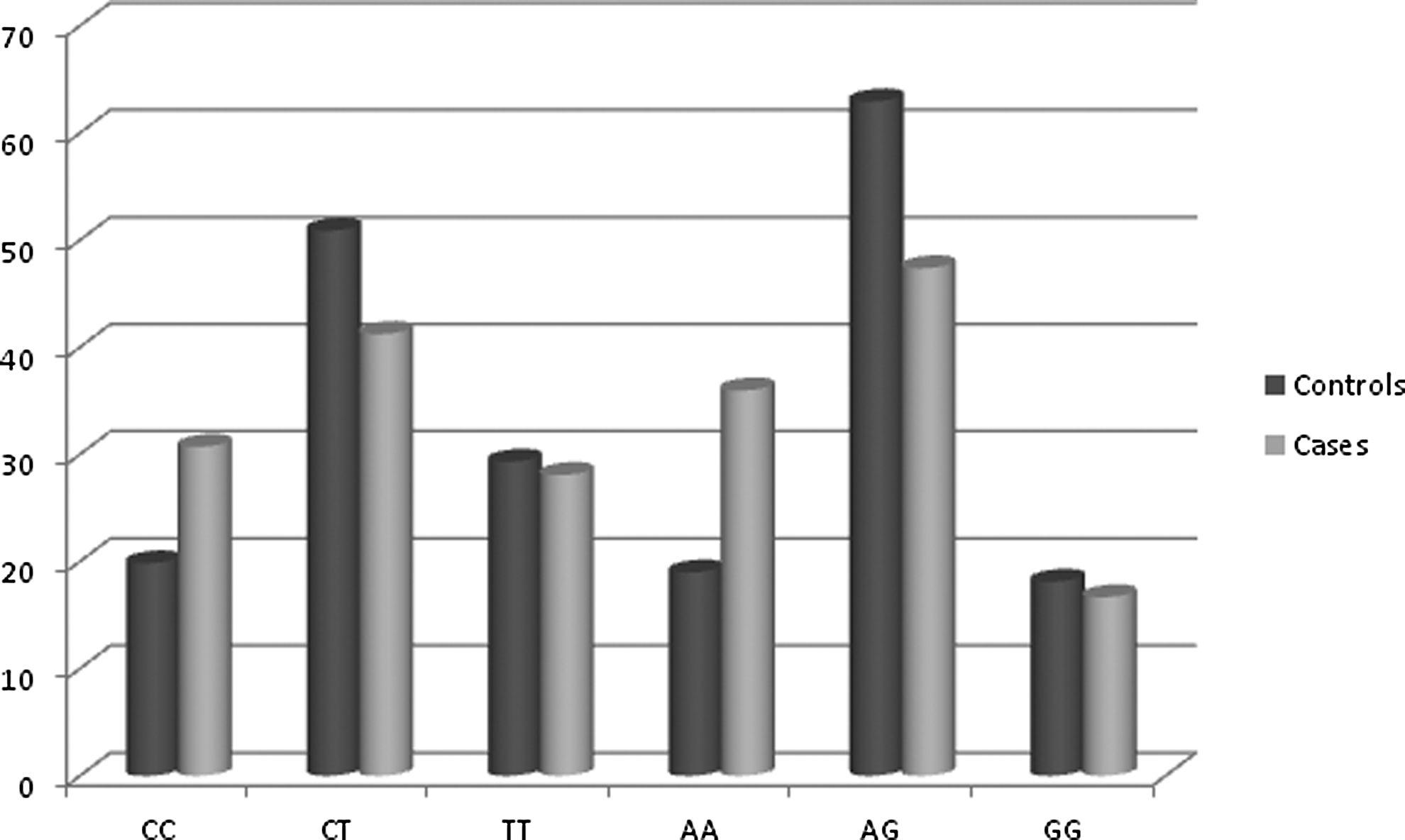
Distribution of PvuII and XbaI genotypes in cases and controls.
With C/C as the reference genotype, the OR for the heterozygotes and homozygotes of T allele for PvuII was determined at 95% CI. The results revealed no significant difference in the frequency between the cases and controls (Table 1). However, for XbaI, the heterozygote genotype frequency was higher in the controls compared to the cases and was statistically significant (OR—0.39, CI 0.21-0.74, p—0.005) (Table 1).
SNP, single nucleotide polymorphism; OR, odds ratio; CI, confidence interval; NS, nonsignificant.
The combined analysis of the two SNPs (PvuII and XbaI) showed nine different combinations, and all the nine combinations were observed in both the case and control samples. The wild-type genotypes in both SNPs were kept as a reference, and the OR and 95% CI were calculated for the other combinations. The results revealed no significant difference between the cases and controls (Table 2).
Discussion
The increasing prevalence of infertility, which affects ∼15% of couples of reproductive age, has significant medical, social, and financial implications. The development of IVF has led to successfully overcoming the many diverse causes of infertility. An estimated 2-3% of all births in developed countries are a result of IVF procedures, where although there is a steady increase in the pregnancy rate, the outcomes are only successful in 30% of the cases. The success of IVF treatment depends mainly on the effectiveness of controlled ovarian hyperstimulation (COH), which is a routine procedure preceding IVF, where the growth and development of multiple follicles are induced using exogenous gonadotropins. Age, ovarian reserve, and hormonal status have been proposed as predictive markers of COH outcome. In addition to these parameters, genetic variability seems to be a significant aspect in determining the ovarian response in COH and IVF. Due to these suggestive findings, we investigated ESR1 gene polymorphisms in females with infertility to determine whether potential allelic variants may contribute to infertility.
Estrogen is the most important hormone in the female reproductive system. It controls the secretion of the gonadotropins of the pituitary and is responsible for ovulation, implantation, pregnancy maintenance, childbirth, and lactation (Saunders, 2005). Active estrogen is found only in cells expressing ERs, and estrogen response occurs only when these receptors bind to the corresponding proteins in several processes. ERα and ERβ (6q25.1 and 14q23.2), the two receptors that bind to estrogen, determine the estrogen response. Therefore the proper functioning of the ESR is necessary for the activation of estrogen hormone.
In the present study, we have analyzed two SNPs of the ESR1 gene in cases of female infertility undergoing in vitro fertilization. The rationale for selecting these two SNPs was based on the evidence of previous studies that reported the association of PvuII and XbaI polymorphisms with both male and female infertility (Georgiou et al., 1997; Kmieć et al., 2002; Boivin et al., 2007; Corbo et al., 2007). In addition, PvuII and XbaI polymorphisms are located in intron 1 and are ∼50 bp apart from each other. Although their intronic location makes it uncertain that the polymorphisms may affect ESR expression, they may be in linkage disequilibrium with other ESR1 mutations, which may affect both the ER gene expression and function.
For the PvuII SNP, no significant association between the cases and controls was observed, which contradicts the results obtained in the studies of Patel (2014), Kitawaki et al. (2001), and Sundarrajan et al. (1999), all of whom showed a significant association between the cases and controls in their studied population. In contrast, our results correlate with the data obtained by Georgiou et al. (1997), where there was no significant difference between the cases and controls for the PvuII genotypes. These conflicting data point to ethnic-based differences making it imperative to study the frequencies of these SNPs in different populations.
In contrast, the XbaI heterozygote genotype showed a significantly increased frequency in the controls compared to the cases thus indicating a possible protective effect. This deviates from the study conducted by Patel (2014), which showed no difference between the case and control samples, but agrees with the study by Ayvaz et al. (2009) in Turkish population, which described a significant correlation in XbaI polymorphism and chances of infertility. The homozygote common allele of XbaI was reported to be related to increased bone mineral density, reduced risk of osteoporosis, and cardiovascular diseases, which are all signs suggestive of higher levels of estrogen. So, possibly the SNP results in a lowered activity of the gene encoding protein, which leads to the low activity of ERs and the consequent weak estrogenic action in the tissue. The continuous weak estrogenic effect in the reproductive tissue, especially the ovaries, may have a negative feedback on the pituitary gland, especially follicle stimulating hormone secretion which in turn can accelerate the rapid depletion of the ovarian follicles, leading to ovarian dysfunction. However, this is only a hypothesis and the exact mechanism of the protective effect of the XbaI polymorphism would require more detailed functional studies.
The genomic organization of ESR1 gene promoter is very intricate and alternative splice sites are present in multiple promoter regions. This could result in the formation of different estrogen protein transcripts, which in turn could affect the function and production of ESR protein. Hence the possibility of these polymorphisms affecting the correct splicing of RNA cannot be excluded.
Conclusion
In conclusion, our preliminary data present some evidence that ESR1 gene variability may be associated with infertility. The regulation of ESR1 expression is possibly dependant on the ESR1 genotypes, serving as markers in predicting the risk for infertility and success of IVF treatment. Nonetheless, additional studies are necessary to determine its application in predicting genetic predisposition in an individual during their precycle evaluation.
Footnotes
Author Disclosure Statement
No competing financial interests exist.