




Abstract
Aim: Increased DNA methylation within the promoter regions of tumor suppressor genes has been associated with gene silencing in various cancers. CDX2, a caudal-related homeobox transcription factor, represents a key tumor suppressor in colorectal cancer. However, the pathological role of its promoter methylation has not yet been well defined in colorectal cancer. Methods: We measured CDX2 promoter methylation by methylation-specific PCR (MSP) and CDX2 mRNA levels by real-time quantitative reverse transcription-PCR in both tumor and normal control tissues collected from 108 colorectal cancer patients and then performed correlation analyses. We also determined whether CDX2 promoter methylation status was associated with any clinicopathological features and prognosis in these patients. Results: CDX2 was expressed in all normal mucosa, but only in 38 (35.2%) tumor tissues. CDX2 promoter methylation was detected in 43 (39.8%) tumor samples, but in none of the normal tissue specimens. DNA methylation correlated with decreased mRNA level in these tumors (p < 0.05). The methylation of the CDX2 promoter was associated with enhanced lymph node metastases and shorter survival time (p = 0.0273), but was independent of tumor stage, tumor differentiation, gender, and age. Conclusion: Enhanced CDX2 promoter methylation is associated with gene silencing in a subgroup of colorectal cancer patients with lymph node metastasis and shorter survival times.
Introduction
C
CDX-2 is the product of the Cdx-2 homeobox gene corresponding to the Drosophila melanogaster gene caudal, which determines the fly's most posterior body segment (Moreno and Morata, 1999). There were two Cdx homeobox genes that have been found so far in humans CDX1 (Bonner et al., 1995) and CDX2 (Drummond et al., 1997). CDX2 is essential for proliferation and differentiation of intestinal epithelial cells (Walters et al., 1997) and regulates the homeostasis of the colon (Hryniuk et al., 2012). Recent studies have demonstrated that CDX2 was a key tumor suppressor involved in colon carcinogenesis (Bakaris et al., 2008; Hong et al., 2013). However, the various molecular and clinicopathological associations with CDX2 reduction or loss have been inconsistent between studies in different colorectal cancer populations (Barbareschi et al., 2003; Moskaluk et al., 2003; Werling et al., 2003; Li et al., 2015; Zhang et al., 2015).
In the present study, we investigated the association between CDX2 methylation and mRNA expression utilizing 108 colorectal cancers and the correlation with clinicopathologic features or the prognosis of patients. Furthermore, this study explored it as a prognostic factor and a therapeutic target for human colorectal cancer.
Materials and Methods
Tissue samples and nucleic acid extraction
Primary sporadic adenocarcinomas were collected from a total of 108 consecutive patients between 2000 and 2001 from the First Affiliated Hospital of Zhengzhou University, China. Among these samples that we collected, only 58 of them were collected with surgical resection and met our criteria with paired normal tissues. The remaining 50 samples were collected with colonoscopy biopsies without normal control tissue. All the specimens were obtained with ethical approval from the hospital. The mean age was 58.3 years (range, 28-67 years). None of the patients in this study had undergone therapies, including preoperative chemotherapy and radiotherapy. An overview of patient clinicopathological characteristics is shown in Table 1. Genomic DNA and total RNA were isolated from both tumor and normal tissues using QIAamp DNA or RNeasy Purification Kit (Qiagen), respectively, according to manufacturers' protocols and then were stored at −80°C for further use.
χ2 test.
p < 0.05.
Real-time quantitative reverse transcription-PCR
Real-time quantitative reverse transcription-PCR (qRT-PCR) was performed using the One Step SYBR® PrimeScript™ RT-PCR Kit (TAKARA) with GAPDH as a control. In brief, 2 μg of total RNA was reverse transcribed according to the manufacturer's instruction. The primers of CDX2 used were 5′-CAGACTACCATCCGCACCA-3′ (forward) and 5′-CATCCACTCGCACAGGTTC-3′ (reverse). The PCR program was: initial denaturation at 95°C for 5 min, and 30 cycles at 95°C for 10 s, 57°C for 20 s, and 72°C for 30 s. The relative CDX2 mRNA levels were normalized to the mRNA level of GAPDH gene.
Bisulfite treatment and methylation analysis
Bisulfite modification of DNA was done using a BisulFlash DNA Modification Kit (EpiGentek) according to the manufacturer's protocol. The methylation of CDX2 gene was accessed by methylation-specific PCR (MSP), and the sets of primer used for targeting the promoter region of human CDX2 genomic sequence were as follows: methylated forward 5′-GGAGTTGTTTCGATAGGAGCGC-3′, methylated reverse 5′-TTACTAAAACCGAACTAAACGCG-3′, unmethylated forward 5′-GGAGTTGTTTTGATAGGAGTGT-3′, and unmethylated reverse 5′-TTACTAAAACCAAACTAAACACA-3′. MSP was performed at 95°C for 5 min, followed by 40 cycles at 95°C for 10 s, 60°C for 20 s, and 72°C for 30 s, and ended at 72°C for 5 min.
Statistics
All data were investigated by the SPSS 16.0 statistical software (SPSS, Inc., Chicago, IL) using χ2 test, Kaplan-Meier survival analysis, log-rank test, or Cox regression analysis. A p < 0.05 was considered statistically significant.
Results
The methylation of CDX2 promoter is inversely correlated with mRNA expression level
In an attempt to investigate the expression of CDX2 mRNA in colorectal cancer (CRC) tissues, we carried out qRT-PCR analysis in 108 available tumor specimens and 58 paracancerous benign mucosas using GPDH as the internal control (Fig. 1). In 58 matched samples, the CDX2 expression was only observed in 18 tumors (31%, 18/58). In contrast, the high level expression of CDX2 was found in all of the paracancerous mucosas (100%, 58/58), indicating that CDX2 expression was significantly reduced than in matched paracancerous mucosas (p < 0.05) (data not shown). Next, we further determined whether expression levels of CDX2 genes were regulated by promoter region methylation using MSP assay. Aberrant methylation of CDX2 was detected in 43 of 108 (39.8%) tumors, and further analysis showed a significant correlation between the MSP and RT-PCR (p < 0.05) (Table 2). Methylation of CDX2 in tumors was associated with decreased expression of its mRNA, suggesting that the expression levels of CDX2 might be regulated by promoter region methylation in human colorectal cancer.
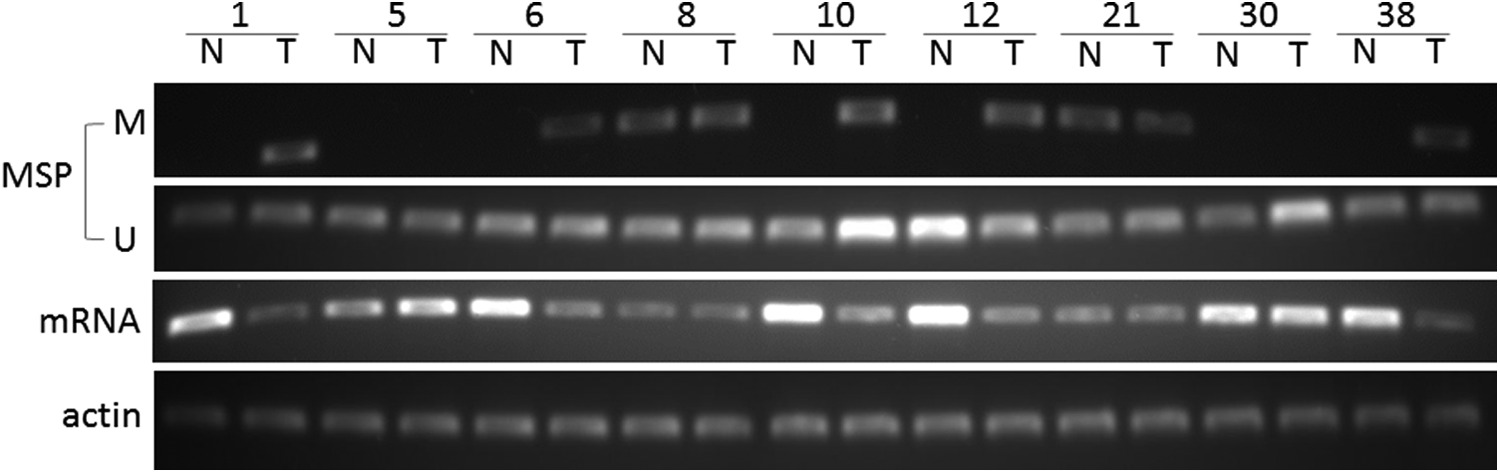
Representative results of RT-PCR and MSP for CDX2 in CRC. 1, 10, 12, and 38 tumor samples with methylation pattern and absence of CDX2 mRNA. In contrast, 5 and 30 tumor samples with unmethylated pattern and presence of CDX2 mRNA. Lanes M and U correspond to methylated and unmethylated DNAs, respectively. Actin was used as an endogenous control for RT-PCR. CRC, colorectal cancer; MSP, methylation-specific PCR; RT-PCR, reverse transcription-PCR.
CRC, colorectal cancer.
The methylation of CDX2 promoter was correlated with lymph node invasion
Correlation analysis between methylation status and clinicopathologic parameters revealed that CDX2 methylation was significantly associated with node metastasis (p < 0.0198), while no significant correlation was observed between CDX2 methylation and tumor stage, tumor differentiation, gender, and age (Table 1).
The methylation of CDX2 promoter was associated with shortened survival
Due to various reasons (including wrongly recorded or unrecognized phone numbers, stopped responding in the middle of follow-up, etc.), follow-up data were only completed in 72 cases, which were used for survival analysis. We did similar clinicopathological analysis toward these 72 patients and found that the associations between CDX2 methylation and clinicopathological characteristics, including age, sex, TMN staging, differentiation, and lymph node metastasis, were similar to those analyzed with 108 patients (Table 1). Therefore, a systematic bias due to the loss of 36 samples in this analysis is less likely. The survival times for 72 of the 108 cancer patients were available and were found to be inversely correlated to CDX2 methylation (Fig. 2). The median survival time of colorectal cancer patients with CDX2 methylation (26 months) was significantly shorter than the patients without CDX2 methylation (36 months) (p = 0.0273) (Fig. 2). In an attempt to clarify the significance of CDX2 methylation correlated to the prognosis of CRC, multivariate analysis was performed. As shown in Table 3, multivariate Cox regression analysis showed that CDX2 methylation in primary colorectal tumors and lymph node metastases were two factors significantly associated with shorter patient survival. These results support our findings that CDX2 methylation promotes metastasis of CRC. The detection of CDX2 methylation may be a useful assay to predict the prognosis of human CRC.
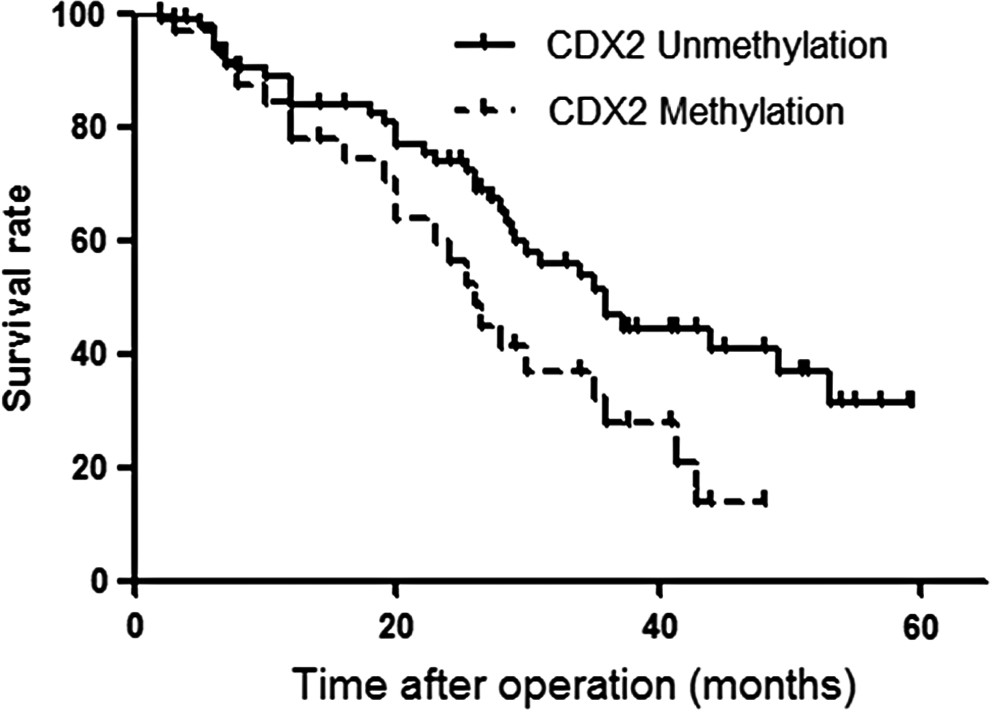
CDX2 methylation and survival of patients with colorectal cancer. Survival analysis of colorectal cancer patients (n = 72) with or without methylation of CDX2 in tumor tissues was performed by Kaplan-Meier survival analysis. Long-rank (Mantel-Cox) test showed p < 0.05 (p = 0.0273).
Multivariate analysis of the factors correlated with survival by Cox regression using SPSS 16.0.
p < 0.05.
p < 0.01.
Discussion
In the present study, we found that the loss of CDX2 expression in colorectal cancer is inversely related with the methylation of CDX2 promoter. We also have shown that CDX2 loss is not correlated with tumor stage, tumor differentiation, gender, and age. However, our study shows that CDX2 loss is associated with lymph node metastasis and dismal survival. These results provide useful information on CDX2 expression patterns in colorectal cancer and clinician may consider the role of CDX2 methylation test in clinical and pathology practice. Some reports found that colonic adenocarcinomas showed strong extensive staining of CDX2 in 90% of colorectal cancer and also CDX2 was expressed in almost all primary and metastatic CRC (88 of 90) in lung and was never observed in primary lung tumors (Barbareschi et al., 2003; Moskaluk et al., 2003; Werling et al., 2003). Other reports showed that the positive rate of CDX2 was 69.4% in colorectal cancer in comparison with 95.0% in normal colorectal tissues (Zhang et al., 2015) and CDX2 cooperated with Nkx2-1 to inhibit lung adenocarcinoma metastasis (Li et al., 2015), which is in agreement with our present study. The conflicting results may be due to the antibody sensitivity and specificity or inconsistent criterion of evaluating CDX2 expression using immunohistochemistry.
In the present study, we showed that there was a strong association between CDX2 methylation and overall survival in colorectal cancer. The group of tumors with CDX2 methylation showed the worst overall survival in comparison with that of nonmethylation. To our knowledge, this is the first report that provided a relationship between CDX2 methylation and overall survival. Previous studies reported that CDX2 loss has been associated with poor prognosis in malignancies, including colorectal cancer (Fan et al., 2005; Hansel et al., 2005; Baba et al., 2009), in which immunohistochemistry method was used. Nonetheless, most immunohistochemical studies recorded a CDX2 expression only as an intensity score and investigated the relationship of CDX2 expression with prognosis simply by dividing negative staining and positive staining (Barbareschi et al., 2003; Werling et al., 2003; Fan et al., 2005; Dawson et al., 2013; Hong et al., 2013), leading to limited usage of this assessment method due to its low sensitivity and specificity. Therefore, methylation assay may be superior over immunohistochemistry in predicting poor clinical outcome in terms of overall survival (OS), such as recurrent malignant gliomas defined by a given O(6)-methylguanine-DNA methyltransferase (MGMT) activity level (Christmann et al., 2010).
The precise mechanisms for loss of CDX2 expression in colorectal cancer remain to be fully elucidated. Promoter CpG island methylation is an important mechanism for silencing tumor suppressor genes in the carcinogenic process (Toyota et al., 1999). CDX2 mutations of both alleles occur infrequently in sporadic colorectal cancers with extensive microsatellite instability (RER+ phenotype) (Wicking et al., 1998; Woodford-Richens et al., 2001).Although CDX2 polymorphism led to reduced CDX2 expression in a population-based case study (Sullivan et al., 2008), genetic alterations in the CDX2 gene may play only a minor role in sporadic and hereditary nonpolyposis colorectal cancer (HNPCC) colorectal carcinogenesis (Yagi et al., 1999; Sivagnanasundaram et al., 2001),which is ∼10% of CRC tumor progression involving the loss of CDX2. Our study has suggested a correlation between methylation and gene expression that might account for the gene of CDX2 silencing in colorectal cancer. Therefore, epigenetic inactivation of tumor suppressor through aberrant methylation of the CpG island promoter might be a frequent occurrence in sporadic colorectal cancer (Jones and Baylin, 2007).
Taken together, low level of CDX2 mRNA is correlated with the promoter methylation and may increase the likelihood of metastatic disease, which may therefore serve as a marker to warrant more intensive surveillance in colorectal cancer patients.
Footnotes
Acknowledgment
This work was supported by grant (NSFC No. 81272371) from the Fund by National Nature Science Foundation of China.
Author Disclosure Statement
No competing financial interests exist.