




Abstract
Genetic Testing and Molecular Biomarkers
officially retracts the article entitled, “Single Nucleotide Polymorphisms in the PTPN1 Gene Are Associated with Susceptibility to Esophageal Squamous Cell Carcinoma: A Case-Control Study in Inner Mongolia, China,” by Hong-Bo Ji, Le-Le Wang, Xiao-Ying Wang, Sheng-Jie Yin, Di Shang, Li-Li Sun, and Lei Wang (Genet Test Mol Biomarkers, 21(5):305-311; DOI: 10.1089/gtmb.2016.0194) at the request of the corresponding author, Dr. Lei Wang, who explained that, “my subsequent research has overturned my original research” and asked to “remove this inaccurate result...so as to avoid bringing troubles to other researchers.”
Though Dr. Wang nor any of his coauthors have not responded to numerous requests for more detailed information, the Editor of Genetic Testing and Molecular Biomarkers determined that the article should not remain in the literature due to the potential problems surrounding the results.
The Editor and Publisher of Genetic Testing and Molecular Biomarkers are committed to preserving the scientific literature and the community it serves.
Introduction
E
Tyrosine phosphorylation is an important mechanism that regulates a variety of processes, including cell growth, proliferation, survival, and metastasis (Motiwala and Jacob, 2006). The human non-receptor type 1 (PTPN1) gene encodes protein tyrosine phosphatase 1B (PTP1B) and maps to 20q13.1-q13.2 (Olivier et al., 2004; Zhou et al., 2011). PTPN1 was also known as PTP1B, which was originally extracted from human placentas and is a member of the protein tyrosine phosphatase family (Wang et al., 2012; St-Germain et al., 2015). PTP1B is an important regulator of signaling pathways involved in human diseases such as diabetes, obesity, and cancer (Lessard et al., 2010). Moreover, high expression levels of PTPN1 occur in several cancers such as breast cancer, ovarian cancer, colorectal cancer, some tumors of epithelial origin, and in a variety of tumor tissues or cells where it promotes the growth, proliferation, differentiation, and metastasis of tumor cells (Zhu et al., 2007; Balavenkatraman et al., 2011; Fan et al., 2013; Soysal et al., 2013). Polymorphisms in the PTPN1 gene are associated with certain diseases in humans, including dyslipidemia, diabetes mellitus, cardiovascular complications, and obesity (Olivier et al., 2004). In addition, some single nucleotide polymorphisms (SNPs) in the PTPN1 gene, such as 981C>T and IVS6+G82A, are associated with insulin resistance, dyslipidemia, diabetes mellitus, and obesity (Zhou et al., 2011). Based on these findings, we predicted that SNPs in the PTPN1 gene may be correlated with ESCC. In this study, we compared PTPN1 gene polymorphisms in ESCC patients and healthy controls from the Inner Mongolia area of China. This exploration of whether PTPN1 gene SNPs is associated with susceptibility to ESCC could provide a theoretical basis for the diagnosis and prevention of ESCC.
Materials and Methods
This study was approved by the Institutional Ethics Committees of the Chifeng Municipal Hospital, and all participants in this study or their family members provided written informed consent.
Study subjects
A total of 302 patients diagnosed with primary ESCC who underwent surgical treatment in Chifeng Municipal Hospital and other hospitals between April 2012 and September 2016 were enrolled. The average patient age was 48.35 ± 5.62 years, and there were 87 females and 215 males enrolled. Diagnoses were based on the 7th edition of the Union for International Cancer Control-American Joint Committee on Cancer (UICC-AJCC) tumor node metastasis staging system (Talsma et al., 2012). White light endoscopy and iodine staining were used to observe color changes in lesions located in the esophageal mucosa. Esophageal lesions were defined as esophageal mucosa having a light color with clear boundaries or that were yellow with raised and depressed portions. The inclusion criteria were as follows: (1) lack of autoimmune disease and (2) no history of blood transfusions, radiotherapy, or chemotherapy. The families of the enrolled subjects must have lived in the Inner Mongolia area for two or more generations. Patients who were excluded met at least one of the following criteria: (1) previous or present history of malignant diseases; (2) previous surgical treatment of the esophagus or related organs; (3) previous history of adjuvant radiotherapy or chemotherapy; (4) advanced ESCC or related lymphatic metastasis; or (5) pulmonary function defects or eating disorders. This study also included as controls 373 healthy people who underwent physical examination in Chifeng Municipal Hospital. The ESCC group and the control group had similar baseline characteristics, and all were from the Inner Mongolia area. The distribution frequencies of gender and age between the two groups were similar. All participants were unrelated.
Sample collection
The investigation was conducted based on relevant literature local environment and population. The baseline characteristics of patients in both the ESCC and control group were collected using a questionnaire that asked for name, gender, age, place of birth, body mass index (BMI), and hypertension. The questionnaire also asked respondents to describe their eating, smoking, and drinking habits, as well as whether they had experienced psychological trauma.
Peripheral venous blood samples (5 mL/individual) were collected from all individuals in the morning and were stored in sterilized ethylene diamine tetraacetic acid (EDTA) tubes at −80°C.
SNP genotyping
Genomic DNA was extracted from peripheral venous blood samples (1 mL anticoagulated blood of each sample) with a DNA Extraction Kit (Beijing Solarbio Science & Technology Co., Ltd., Beijing, China) and stored at −20°C. Genomic DNA purity was assessed by measuring the optical density (OD) values at 260 and 280 nm, and purity was defined as an OD260/OD280 ratio between 1.8 and 2.0. Based on information listed in GenBank (National Center for Biotechnology Information [NCBI, Bethesda, MD]), polymerase chain reaction (PCR) primers for amplification of rs2904268 C>G, rs2230605 A>G, and rs16995309 C>T were designed with Primer Premier 6.0 software (Table 1). Primer specificity was detected by the Basic Local Alignment Search Tool (BLAST) version 2.0 (NCBI). Three primers specific for each SNP were synthesized by Shanghai Sangon Biological Engineering Technology & Services Co., Ltd. (Shanghai, China). The genotypes of these three SNPs were detected by bidirectional PCR amplification of specific alleles (Bi-PASA). The PCRs included 50 ng genomic DNA, 1.1 μL of P and 1.1 μL of Q (6.25 μM primers), 1.6 μL of A and μL of B (6.25 μM primers), 2.0 μL dNTPs (62.5 μM), 0.1 μL 25 mM MgCl2, 2.5 μL 10 × PCR buffer (including 15 mM MgCl2), 0.2 U Taq polymerase, and ddH2O to a final volume of 25 μL. The amplification conditions were predenaturation at 95°C for 3 min, denaturation at 94°C for 30 s, annealing at 51°C for 45 s, and 34 cycles of extension at 72°C for 45 s. The PCR products in the reaction tube were validated by agarose gel electrophoresis. Genotypes were then analyzed using a gel imaging system (ProteinSimple, Santa Clara, CA). Verified samples were sequenced by Shanghai Sangon Biological Engineering Technology & Services Co., Ltd. (Shanghai, China) (Figs. 1-3).
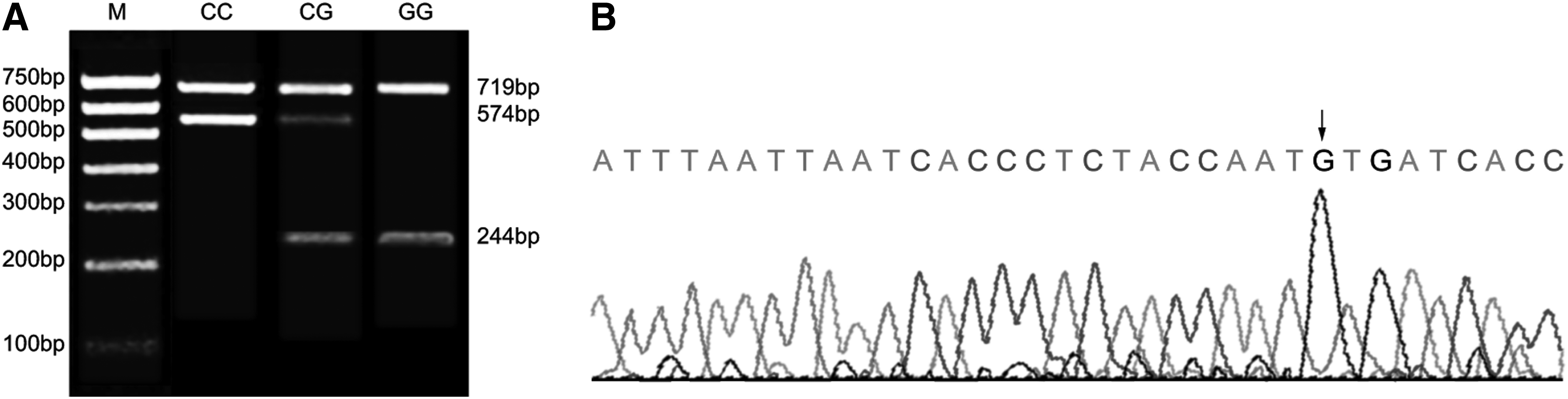
Genotypes and fragment sizes of rs2904268 C>G in the PTPN1 gene detected by Bi-PASA and the sequencing map.
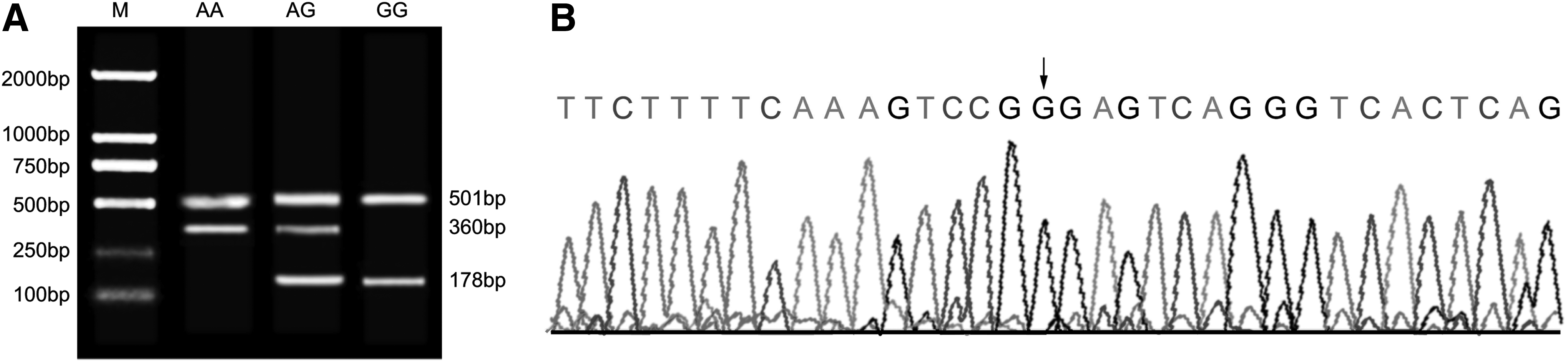
Genotypes and fragment sizes of rs2230605 A>G in the PTPN1 gene detected by Bi-PASA and their sequencing map.
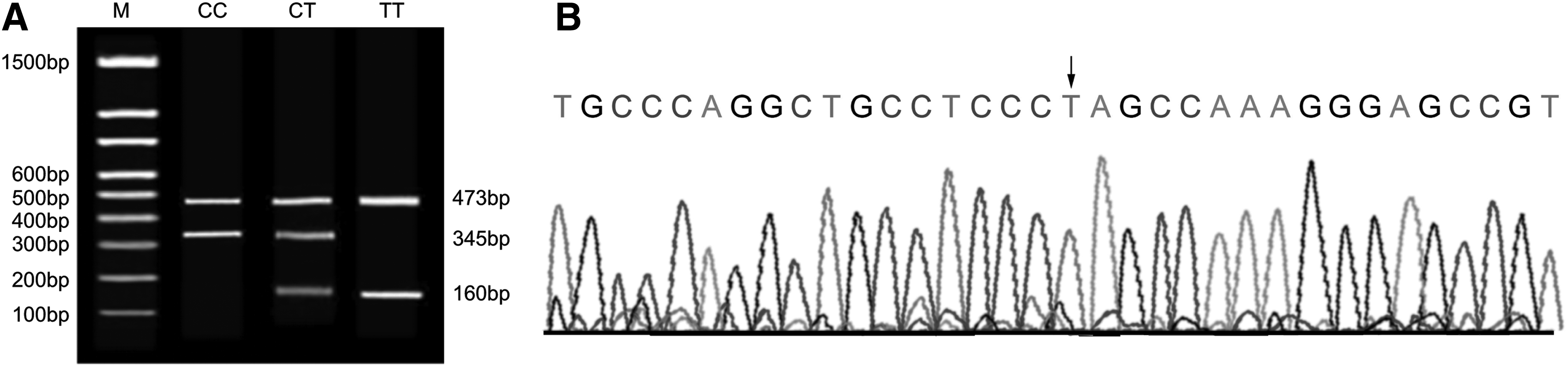
Genotypes and fragment sizes of rs16995309 C>T in the PTPN1 gene detected by Bi-PASA and their sequencing map.
SNP, single nucleotide polymorphism.
Statistical analysis
Data were processed using SPSS 21.0 statistical software (SPSS, Inc., Chicago, IL). Enumeration data were presented as a proportion or percentage. Measurement data were expressed as mean ± standard deviation (SD). Differences in genotype and allele frequencies of the PTPN1 gene between the ESCC and control groups were tested by chi-square test, and population-representative samples were detected by Hardy-Weinberg Equilibrium. Differences in haplotype frequencies between the ESCC group and control group were analyzed by SHEsis software. Logistic regression analysis was applied to analyze risk factors associated with ESCC. Risk was indicated by an odds ratio (OR) and 95% confidence interval (95% CI). A two-sided p value <0.05 was regarded as statistically significant.
Results
Comparison of baseline characteristics between ESCC patients and healthy controls
Baseline characteristics of individuals in the ESCC and control groups were collected for a comparative analysis. There was no statistical difference in age, gender, BMI, hypertension, psychological trauma, or long-term depression between the ESCC group and the control group (all p > 0.05). However, there were differences in history of smoking, drinking, and eating habits between the two groups (p < 0.05) (Table 2).
BMI, body mass index; ESCC, esophageal squamous cell carcinoma.
Comparison of rs2904268 C>G, rs2230605A>G, and rs16995309 C>T genotype frequencies between ESCC patients and healthy controls
Genotype frequencies of rs2904268 C>G, rs2230605A>G, and rs16995309 C>T in both the ESCC and control groups were consistent with Hardy-Weinberg Equilibrium (all p > 0.05), indicating that the genotype frequencies of the three sites were representative. There were significantly higher frequencies of the rs2904268 C>G CG and GG genotypes in the ESCC group than in the control group (Table 3, both p < 0.05). A markedly increased risk of ESCC was observed for individuals with the GC (OR = 2.630, 95% CI = 1.568-4.411) and GG (OR = 2.338, 95% CI = 1.384-3.952) genotypes relative to individuals with the CC genotype. Meanwhile, no statistical difference was observed between the ESCC group and the control group in genotype frequencies of rs2230605A>G and rs16995309 C>T (all p > 0.05).
OR, odds ratio; 95% CI, 95% confidence interval.
Comparison of rs2904268 C>G, rs2230605A>G, and rs16995309 C>T haplotype frequencies between ESCC patients and healthy controls
In this study, eight haplotypes (GAC, GAT, CGC, CGT, GAC, GAT, GGC, and GGT) for rs2904268 C>G, rs2230605 A>G, and rs16995309 C>T were seen in the PTPN1 gene (Table 4). Relative to the control group, individuals in the ESCC group had notably elevated GGC and GAT haplotype frequencies and significantly reduced frequencies of the CGC and GGT haplotypes (all p < 0.05).
ESCC group (n = 302); control group, healthy controls (n = 373).
Binary logistic regression analysis
Binary logistic regression analysis was next conducted with the risk of ESCC as the dependent variable and history of smoking, drinking, poor eating habits, rs2904268 CG+GG genotype, GAT haplotype, and GGC haplotype as the independent variables. Smoking, drinking, poor eating habits, the CG+GG genotype, and the GAT haplotype of rs2904268 were all identified as risk factors for ESCC (all p < 0.05), whereas the GGC haplotype was not an ESCC risk factor (both p > 0.05) (Table 5).
SE, standard deviation; df, degrees of freedom; Sig, p value; Exp(B), adjusted odds.
Discussion
PTPN1 is considered to play an important role in ESCC and can be a potential target for developing ESCC therapies (Wang et al., 2013). This study examined whether the rs2904268 C>G, rs2230605A>G, and rs16995309 C>T polymorphisms in the PTPN1 gene were associated with susceptibility to ESCC in residents of Inner Mongolia. A comparison of ESCC patients with control individuals showed that the rs2904268 C>G polymorphism in the PTPN1 gene was associated with susceptibility to ESCC in patients living in Inner Mongolia, China. PTPN1 negatively modulates leptin signaling in hypertension by inhibiting Janus tyrosine kinase 2 (JAK2) activity (Gu et al., 2010). Indeed, Beales et al. showed that modulation of PTPN1 activity in EADC can be a useful treatment approach and that PTPN1 downregulation can diminish JAK2 activation, which is induced by leptin (Beales et al., 2014).
Our study also revealed that genetic sequence variants in PTPN1 can be associated with human diseases, including diabetes, obesity, cardiovascular complications, and dyslipidemia (Olivier et al., 2004). PTPN1 plays a role in the polygenic basis of obesity by regulating leptin sensitivity and insulin, as well as energy metabolism (Mo et al., 2010). Therefore, leptin signaling-dependent regulation of PTPN1 function was predicted to be involved in the development of ESCC. An increasing number of gene variants at different regions have been studied in the context of susceptibility to ESCC, including the PSCA locus at 8q24 and the CASP8 locus at 2q33 (Abnet et al., 2012; Dai et al., 2014). Our study further showed that both the CG and GG genotype frequencies of rs2904268 C>G in the PTPN1 gene were markedly higher in the ESCC group than the control group. Compared with the control group, the ESCC group had markedly elevated GGC and GAT haplotype frequencies and significantly reduced frequencies of the CGC and GGT haplotypes. As such, the CG and GG genotypes, GGC, GAT, CGC, and GGT haplotypes of rs2904268 C>G can be associated with a susceptibility to ESCC.
The results also showed that a history of smoking, drinking, poor eating habits, CG+GG genotype, and rs2904268 C>G GAT haplotype were risk factors for ESCC. This finding is consistent with a previous study confirming that a history of smoking and drinking is correlated with an increased risk of EC (Chung et al., 2010). Indeed, smoking and drinking were previously proposed to be high-risk factors for ESCC. Alcohol and tobacco smoke are both associated with tissue injury and inflammation induced by toxic and mutagenic metabolic products (Radojicic et al., 2012). Moreover, a poor diet and eating late at night, as well as some vegetables and spicy foods, can increase the risk of EC (Sun et al., 2010). As one of the most common polymorphisms in the human genome, SNPs are considered to be the major cause of genetic variations that can influence protein sequences and activities to promote disease in individuals carrying these polymorphisms (Chaudhary et al., 2015). Yao et al. (2015) reported that the rs6029959 polymorphism in the PTPRT gene can act as a risk factor for ESCC in Chinese populations. In this study, a binary logistic regression analysis revealed that individuals with the rs2904268 CG+GG genotype and GAT haplotype had a higher risk of ESCC. Taken together, the results show that smoking, drinking, poor eating habits, rs2904268 C>G GG genotype, rs2904268 C>G CG+GG genotype, and GAT haplotype are all possible risk factors for ESCC.
In conclusion, our study provides evidence that the rs2904268 C>G polymorphism in the PTPN1 gene can be associated with susceptibility to ESCC in Inner Mongolia. Thus, the rs2904268 C>G polymorphism in the PTPN1 gene can have predictive value for ESCC diagnosis and treatment and offers a theoretical basis for treatment and contributes to polygenic joint detection. However, there are limitations to this study, in particular its small sample size and focus on one geographical region. As such, further studies on the association of SNPs in the PTPN1 gene and PTPN1 mechanisms with susceptibility to ESCC are required.
Footnotes
Acknowledgment
The authors thank all the researchers who contributed valuable work to this article.
Author Disclosure Statement
No competing financial interests exist.