




Abstract
Background:
Periodontitis is an inflammatory disease caused by bacterial triggering of the host immune-inflammatory response, which in turn is regulated by microRNAs (miRNA). Polymorphisms in the miRNA pathways affect the expression of several target genes such as tumor necrosis factor-α and interleukins, which are associated with progression of disease.
Objective:
The objective of this study was to identify the association between the MiR-146a single nucleotide polymorphisms (SNPs) (rs2910164, rs57095329, and rs73318382), the MiR-196a2 (rs11614913) SNP and chronic periodontitis.
Methods:
Genotyping was performed for the MiR-146a (rs2910164, rs57095329, and rs73318382) and the MiR-196a2 (rs11614913) polymorphisms in 180 healthy controls and 190 cases of chronic periodontitis by the direct Sanger sequencing technique. The strength of the association between the polymorphisms and chronic periodontitis was evaluated using logistic regression analysis. Haplotype and linkage analyses among the polymorphisms was performed. Multifactorial dimensionality reduction was performed to determine epistatic interaction among the polymorphisms.
Results:
The MiR-196a2 polymorphism revealed a significant inverse association with chronic periodontitis. Haplotype analysis of MiR-146a and MiR-196a2 polymorphisms revealed 13 different combinations, of which 5 were found to have an inverse association with chronic periodontitis.
Conclusion:
The present study has demonstrated a significant inverse association of MiR-196a2 polymorphism with chronic periodontitis.
Introduction
P
Interactions of oral bacteria and host immune cells lead to the production of proinflammatory cytokines and chemokines such as interleukin-1α (IL-1α), interleukin-1β (IL-1β), tumor necrosis factor-α (TNF-α), interleukin-6 (IL-6), interleukin-8 (IL-8), interleukin-10, and matrix metalloproteinases. Evidence suggests that the inflammatory response in periodontitis is strictly controlled by various innate immune regulators, including MiRNAs (Nahid et al., 2011).
MiRNAs are short noncoding RNA molecules of about 21-25 nucleotides in length and are considered as post-transcriptional regulators or modifiers (Pillai, 2005). MiRNAs negatively regulate proinflammatory gene expression especially in the regulation of Toll-like receptor-4 (TLR4) signaling (Pillai, 2005). The expression of TLR2 and TLR4 has been found to be induced by gram-negative periodontal bacteria such as Porphyromonas gingivalis, Prevotella intermedia, and Aggregatibacter actinomycetemcomitans (Sun et al., 2008, 2010). The MiRNAs that regulate these pathogen detection receptors play a pivotal role in the host response to the disease (Kebschull and Papapanou, 2015).
MiRNAs have been studied for over a decade, but there are only few studies (Lee et al., 2011; Nahid et al., 2011; Xie et al., 2011, 2013; Perri et al., 2012; Stoecklin-Wasmer et al., 2012; Kadkhodazadeh et al., 2013) on the relationship between MiRNAs and the pathogenesis of periodontitis. The profiling of MiRNA by microarray and quantitative PCR array has reported expression of various MiRNAs in a pair of pooled gingival tissues, and the differential expression of MiRNAs has been observed in periodontitis-affected gingival tissues when compared to healthy gingiva (Lee et al., 2011; Xie et al., 2011; Perri et al., 2012; Stoecklin-Wasmer et al., 2012; Kadkhodazadeh et al., 2013).
Furthermore, MiR-146a downregulates key adaptor molecules in innate immune response (Xie et al., 2013). Elevated MiR-146a levels are reported to suppress the activity of nuclear factor-κB (NF-κB) pathway by downregulating interleukin-1 receptor-associated kinase-1 and TNF receptor-associated factor-6. It is expressed at low levels in naive human T cells and overexpressed in memory T cells (Taganov et al., 2006). It is produced on stimulation of both T cell receptor and NF-κB induction, suggesting that silencing of MiR-146a gene expression may contribute to inflammatory diseases (Taganov et al., 2006). The MiR-196 family has been reported to be involved in normal cell differentiation, proliferation, and tumorigenesis of various cancer types (Ge et al., 2014). MiR-196a2 has biological functions involving immunity, inflammation, and defense against viruses (Chen et al., 2011). However, expression of MiR-196a2 in chronic periodontitis has not been explored.
Studies have suggested that single-nucleotide polymorphisms (SNPs) or genetic variants in miRNA can modulate miRNA biogenesis, expression, binding affinity, and specificity of the target mRNA and disease risk (Muiños-Gimeno et al., 2010; Wang et al., 2012a; Ge et al., 2014). The MiR-146a polymorphisms are located at the 60th nucleotide position in the seed region of pre-MiR-146a (rs2910164), at the −386 nucleotide position in the promoter region (rs57095329) and at −690 nucleotide position in the promoter region (rs73318382) (Luo et al., 2011). MiR-196a2 consists of two types of mature MiRNAs namely—MiR-196a-5p and MiR-196a-3p, both processed from the same stem loop. The MiR-196a2 polymorphism rs11614913 is located in the mature sequence of MiR-196a-3p (passenger strand), which affects the processing of pre-miRNA to its mature form and also the capacity to regulate target genes (Wang et al., 2012a). MiR-146a and MiR-196a2 gene polymorphisms with increased expression levels of MiR-146a and miR-196a, respectively, have been reported (Shen et al., 2008; Liu et al., 2013). Till date, only one study on MiR-146a polymorphism (rs2910164) and chronic periodontitis susceptibility has been reported (Kadkhodazadeh et al., 2013). MiR-196a has been reported to be involved in several autoimmune diseases, inflammatory diseases, and cancer. Proinflammatory cytokines such as IL-1α, IL-1β, and IL-8 are predominantly reported as target molecules for MiR-196a, which are established as candidate genes involved in the pathogenesis of chronic periodontitis (Wang et al., 2012a). A study on miRNA expression profiling of gingival tissue biopsies collected from normal weight and obese individuals with periodontitis has reported differential expression of MiRNAs, including MiR-196a, which was found to be downregulated in obese individuals with periodontitis (Kalea et al., 2015). However, no reports exist on the role of MiR-196a2 polymorphism in chronic periodontitis.
Therefore, the objective of the present study was to determine the association of MiR-146a variants rs2910164 (C/G), rs57095329 (A/G), and rs73318382 (A/C) and MiR-196a2 variant rs11614913 (C/T) with chronic periodontitis.
Materials and Methods
Setting
The study participants were examined at the outpatient Department of Periodontics, Sri Ramachandra University, Chennai. The study was approved by the Institutional Ethics Committee [IEC-NI/13/OCT/36/82] of Sri Ramachandra University, Chennai. Informed consent was obtained from all the study participants.
Participants
Subjects only older than 18 years were included in the study. The study consists of both male and female participants who belong to the same geographical location (in and around Chennai, India). The study size comprises a total of 370 subjects, of which, 180 were controls (individuals with healthy gingiva) and 190 were patients with chronic periodontitis. Sample size calculation was performed with 95% confidence interval (95% CI) and 80% power using the allele frequencies reported by Shao et al. (2014). A total of 2300 individuals were screened between the period of January 2015 and October 2015, of which 568 individuals met the inclusion and exclusion criteria of the study. Of the 568 individuals, 370 individuals (180 healthy controls and 190 chronic periodontitis patients) expressed willingness to participate in the study. American Dental Association/American Academy of Periodontology (AAP) 1999 system of periodontal disease classification is the gold standard method, which classifies the two types of periodontitis (chronic and aggressive) based on the destructive forms of the disease. The study participants were selected based on the following inclusion and exclusion criteria, according to the AAP (1999) guidelines. The inclusion criteria for cases (patients with chronic periodontitis) include individuals with attachment loss of >1 mm in more than 30% of the sites examined (Armitage, 1999) with a radiographic evidence of bone loss, presence of abundant local factors such as plaque/calculus, and presence of at least 10 (natural) teeth. Inclusion criteria for controls (individuals with healthy gingiva) include individuals with a ≤3 mm probing pocket depth (PPD), no gingival bleeding on probing, absence of clinical attachment loss and any clinical signs of gingival inflammation, and no history of periodontitis. Current and former smokers, individuals with any systemic diseases such as diabetes and hypertension, individuals under any antibiotic or anti-inflammatory medications for the last 6 months, and pregnant women were excluded from the study (applicable for both controls and cases).
Clinical examination
Full mouth clinical periodontal examination was performed for all the participants. Clinical examination included the following periodontal indices: gingival index (Silness and Loe, 1964), plaque index (Loe, 1967), oral hygiene index (Greene and Vermillion, 1964), clinical attachment level (CAL), and PPD. A manual periodontal probe (UNC 15 periodontal probe) was used to evaluate all of these parameters by the same examiner (V.L.). A two-way random-effects model was used to calibrate intraexaminer variability and reliability by calculating intraclass correlation coefficients, which was found to be >0.85.
Sample collection and processing
About 3 mL of peripheral blood was collected under aseptic conditions from the antecubital vein in EDTA vacutainers (Beckton-Dickinson, Franklin Lanes, NJ). DNA was isolated from all the blood samples using the QIAamp DNA Mini Kit (Qiagen, Germany), according to the manufacturer's protocol. The quality of extracted DNA was checked using the NanoDropND-1000 (Thermo Fisher Scientific).
SNP genotyping
PCR was performed for both MiR-146a polymorphisms rs2910164, rs57095329, and rs73318382 and MiR-196a2 polymorphism rs11614913 using specific primers described earlier (Hu et al., 2008; Luo et al., 2011). The PCR mixture contained 100 ng genomic DNA, 1 × Taq Buffer, 200 μM of dNTP, 1.5 units of Taq polymerase (Bangalore Genei, India), and 30 pM each of forward and reverse primers. Genotyping was performed by direct dye terminator sequencing using ABI 3730 Genetic Analyzer (Applied Biosystems) and the results were analyzed using SeqScape v2.7 software (Applied Biosystems).
Statistical analysis
Genotype and allele frequencies for the selected polymorphisms were calculated for both cases and controls. The frequencies were tested for Hardy-Weinberg equilibrium by the chi square test. The strength of association was determined by odds ratio with 95% CI, and Bonferroni corrected p-value was estimated by logistic regression analysis (as it uses maximum likelihood method, which is the most preferable statistical method for unmatched case-control studies, when compared to the chi square method) using Epi info v7 software. p-Values of <0.05 were considered to be statistically significant. To identify the association of the genotypes with clinical parameters and indices of chronic periodontitis patients, a one-way analysis of variance (ANOVA) test was performed. Haplotype analysis and pairwise linkage disequilibrium were done using SNP stats online tool (Solé et al., 2006), which uses the Markov Chain Monte Carlo method to estimate haplotype frequencies and the standardized disequilibrium coefficient (D′) and squared correlation coefficient (r2 or Δ2) to assess linkage disequilibrium between the SNPs. Multifactorial dimensionality reduction (MDR) analysis to assess the epistatic interaction between the SNPs of the two MiRNAs was performed using MDR software v3.2.
Results
The distribution of males and females of the 180 control subjects was as follows: 85 males and 95 females, meanwhile, for the 190 subjects with chronic periodontitis, 107 were males and 83 were females. The details of all the demographic features of the sample are listed in Table 1. The controls and case (periodontitis) groups for all the three polymorphisms of MiR-146a and case group of MiR-196a2 followed the Hardy-Weinberg equilibrium. Meanwhile, the control group of MiR-196a2 showed a deviation in Hardy-Weinberg equilibrium.
p-Value <0.05 is significant.
CAL, clinical attachment level; OHI, oral hygiene index; SD, standard deviation.
The sequences obtained by genotyping using Sanger's dideoxy method were submitted to GenBank (GenBank: KR606819-23, KT003585-96). The distribution of genotype and allele frequencies (following age adjustment by multivariate logistic regression analysis) among the cases and controls for the polymorphisms in MiR-146a and MiR-196a2 is summarized in Table 2. The genotype frequency was similar among cases and controls for the polymorphisms in MiR-146a (rs2910164, rs57095329, and rs73318382) and no significant association with chronic periodontitis could be determined. However, for the polymorphism in MiR-196a2 (rs11614913), the variant genotype (TT) was found to be significantly higher in controls compared to cases [OR = 0.23 and 95% CI = 0.13-0.42], similar distribution observed in dominant and recessive models, with an OR of 0.48 (95% CI = 0.31-0.73) and 0.28 (95% CI = 0.16-0.49), respectively.
Ref indicates the reference genotype (wild type).
p-Value <0.05 is significant.
CI, 95% confidence interval; NS, not significant.
Haplotype analysis of the MiR-146a and MiR-196a2 polymorphisms revealed 13 different haplotypes, out of which 5 combinations were found to be higher in controls than in periodontitis patients, as given in Table 3. The pairwise linkage disequilibrium analysis showed strong linkage between rs57095329 and rs73318382 (r2 = 0.960227) of MiR-146a gene. The major and minor allele frequencies for the polymorphisms of MiR-146a and MiR-196a2 observed in the present study were compared with HapMap data from other reported populations, as illustrated in Figure 1.
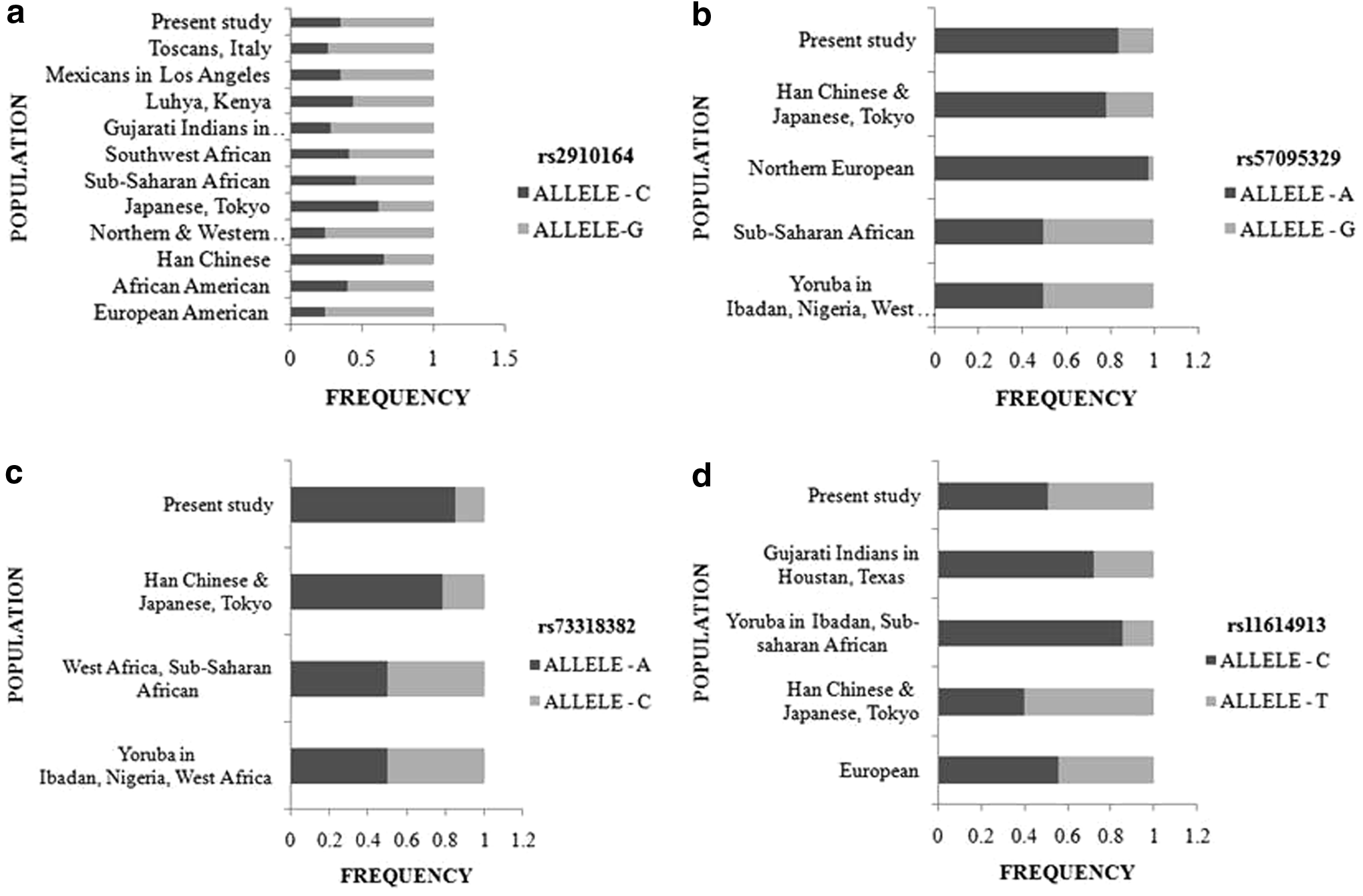
Representation of the comparison of allele frequencies for the polymorphisms
p-Value <0.05 is significant.
MDR analysis for the gene-gene interactions showed a significant model with all the four polymorphisms having a cross-validation (CV) consistency of 10/10 and testing accuracy (TA) more than 0.5 (Table 4). One-way ANOVA did not reveal any significant association between any of the clinical parameters and the genotypes of MiR-146a and MiR-196a2 among chronic periodontitis patients (Table 5).
CV, cross-validation.
mean ± SD.
PPD, probing pocket depth.
Discussion
MiR-146a belongs to the MiR-146 family, which consists of two members, MiR-146a and MiR-146b. It is located on chromosome 5. MiR-146a has been considered as a mediator of inflammation. Innate immune response is the first line of defense mechanism against pathogens/pathogenic diseases (Motedayyen et al., 2015).
Expression levels of MiR-146a have been reported to be higher in chronic periodontitis patients (p < 0.001) with a positive correlation between the levels of MiR-146a and the clinical parameters of probing depth and CAL. The study suggested that chronic periodontitis patients had higher levels of MiR-146a compared to the healthy individuals, along with reduced levels of proinflammatory cytokines, TNF-α, and IL-6 (Motedayyen et al., 2015). However, the present study is focused only on the role of polymorphisms in periodontitis and did not show any significant association between the genotypes and chronic periodontitis. Further analysis on the clinical parameters and SNPs also did not show any significant difference.
MiR-146a polymorphisms have been evaluated for their role in varied disease states such as breast and ovarian cancer, hepatocellular carcinoma, and rheumatoid arthritis (Shen et al., 2008; Yang et al., 2011; Wang et al., 2012b). In systemic lupus erythematosus and oral squamous cell carcinoma (OSCC) tissues, the G allele of the variant, rs57095329, showed significant association with the disease and was linked to the reduced expression of MiR-146a in controls. Combined functional assays showed that G-allele decreased protein-binding affinity and activity of the promoter compared to the promoter containing the protective A-allele (Luo et al., 2011; Hung et al., 2012).
Studies are scarce regarding the role of SNPs in miRNA and periodontitis susceptibility in populations across the world. In an Iranian population, significant association between MiR-146a (rs2910164) and MiR-499 (rs3746444) polymorphisms and susceptibility to chronic periodontitis and peri-implantitis have been reported (Kadkhodazadeh et al., 2013). However, no studies in the Indian population have reported any possible association of MiR-146a gene polymorphism with periodontitis. The present study is aimed at determining the relationship of three SNPs [rs2910164 (C>G), rs57095329 (A>G), and rs73318382 (A>C)] in MiR-146a and MiR-196a2 polymorphism rs11614913 (C>T) with risk for development of chronic periodontitis. The results showed no significant difference between the genotypes of cases and controls for all the three polymorphisms of MiR-146a. The difference in the significance between our study and the study in the Iranian population may be due to environmental factors and lifestyle. Pairwise linkage analysis of the selected SNPs in MiR-146a provided evidence for a strong linkage between rs57095329 and rs73318382. Similar findings on linkage analysis were reported in the Chinese population (r2 = 0.81) between rs57095329 and rs73318382 alleles (Luo et al., 2011; Hung et al., 2012).
The MiR-196 family consists of three genes, MiR-196a-1 located on chromosome 17, MiR-196a-2 located on chromosome 12, and MiR-196b located on chromosome 7. MiR-196a and MiR-196b differ only by one nucleotide. The MiR-196 family is located in the HOX (homeobox) gene regions and has been reported to be involved in regulation of cellular functions such as proliferation and differentiation, and various biological functions such as inflammation and immune response (Chen et al., 2011).
The possible association of MiR-196a2 gene polymorphism (rs11614913) has been reported in several cancer studies. Increased expression levels of MiR-196a with the variant “TT” genotype of MiR-196a2 polymorphism were reported in OSCC patients (Liu et al., 2013). Similar findings were reported in breast cancer, lung cancer, and colorectal cancer (Muiños-Gimeno et al., 2010). On the contrary, the present study revealed that the variant “TT” genotype was found to be higher in controls when compared to cases, indicating an inverse association with chronic periodontitis.
In addition, we obtained a highly significant Hardy-Weinberg deviation in the control group, suggesting a possibility of population stratification in the source population, which results in the deficit of heterozygotes. Inbreeding could also play a role in this; nonetheless, the samples were collected at random from patients attending the hospital for routine follow-up. Therefore, population stratification is more likely to play a role in the present study. Genotyping error is also suggested to be a reason for Hardy-Weinberg deviation, although this does not seem to be a probable cause for this observation as the genotypic distribution for the cases follows the Hardy-Weinberg equilibrium, which is not mandatory for case groups.
The study reveals a statistically significant difference in mean age between the controls and cases. However, after adjusting for age, the interpretation of the results remained unaltered.
Although there was no statistically significant association of MiR-146a with chronic periodontitis in the present study, haplotype distribution of the three SNPs of MiR-146a with MiR-196a2 polymorphism rs11614913 revealed 13 haplotypes, of which 5 combinations (GAAT, CAAT, GGAT, GACT, and CACC) were significantly higher in controls compared to cases, thereby exhibiting an inverse association with chronic periodontitis. Although it has been suggested that only haplotypes with a population frequency of more than 5% should be evaluated in case-control comparisons, the associations between rare alleles and disease may be ignored if this rule is applied in a small data set. Moreover, this is the first study to have reported an association of MiR-146a and MiR-196a2 haplotypes with chronic periodontitis. However, more functional studies are required to assess the significance of these haplotypes in a larger sample size.
MDR is a statistical software developed by Hahn et al. (2003). It is a powerful tool that reduces the dimensionality of multilocus data to improve the ability to detect genetic combinations that confer disease risk. The software was designed to detect gene-gene or gene-environment interactions in data sets with categorical independent variables such as SNPs/mutations and environmental factors that can be represented as categorical variables. MDR analysis involves a hypothetical mathematical modeling, in which permutations and combinations of the available data are performed to identify a model that gives information on genotype combinations and disease risk. Hence, multilocus genotypes are pooled into a single category—high-risk (if the ratio of affected vs. unaffected individuals exceeds a threshold of 1.00) and low-risk (if the ratio of affected vs. unaffected individuals does not exceed the threshold) genotypes. CV and permutation testing are used to classify the status of the disease based on high- and low-risk genotype combinations. For a 10-fold CV interval, at least 9 out of 10 CV and the expected TA of 0.50 (for a case-control study) are considered as the best interaction model. If the CV is maximum and prediction error is minimum, statistical parsimony is used to choose the best model. Therefore, in the present study, the model with all the SNPs (rs2910164, rs57095329, rs73318382, and rs11614913) interacting is chosen as the best model. The major and minor allele frequencies for the polymorphisms of MiR-146a and MiR-196a2 were compared with frequencies obtained from HapMap project (The International HapMap Consortium, 2003). The frequencies were found to be similar to those observed in the Han Chinese and Tokyo Japanese populations for polymorphisms rs57095329 and rs73318382 (The International HapMap Consortium, 2003). Meanwhile, our findings of allele frequencies for rs2910164 were analogous with that of Toscans (Italy), Gujarati Indians in Texas, Europeans in Utah, and European American populations. In case of rs11614913, the allele frequencies observed in the present study were similar to that in the European population (The International HapMap Consortium, 2003).
Conclusion
The study revealed that MiR-196a2 polymorphism (C>T) had an inverse association with chronic periodontitis. The polymorphisms rs2910164 (G>C), rs57095329 (A>G), and rs73318382 (A>C) of MiR-146a did not show any association with susceptibility to chronic periodontitis in this study population. Haplotype analysis revealed five haplotypes to be exhibiting an inverse association.
Footnotes
Acknowledgment
We acknowledge the Central Research Facility of Sri Ramachandra University for the technical support provided.
Author Contributions
P.V. conceived the study, performed the sample collection, processing, experimentation, and wrote the initial draft of the manuscript. V.L. contributed in subject selection based on clinical parameters and helped in sample collection. S.R.R. supervised the clinical aspect of the experimentation and edited the manuscript. V.V. supervised the genetic component of experimentation, edited, and finalized the manuscript.
Author Disclosure Statement
No competing financial interests exist.