




Abstract
Aims:
This study was designed to develop a high-resolution melting (HRM) analysis-based cardiovascular (CV) pharmacogenetics (PGx) genotyping panel for the Canon DNA Genetic Analyzer multiplex genotyping platform and cross-validate its performance with the TaqMan®-based OpenArray® method.
Methods:
The CV PGx genotyping panel containing 17 single nucleotide polymorphisms (SNPs) selected from 5 genes (CYP2C9, CYP2C19, CYP4F2, SLCO1B1, and VKORC1) and the CYP2C cluster was used to compare genotyping results between analysis methods. Genomic DNA from 223 clinical samples was used to genotype the 17 SNPs on the Canon DNA Genetic Analyzer and TaqMan OpenArray Quant Studio Real-Time PCR (polymerase chain reaction) System.
Results:
The concordance between the Canon DNA analyzer and TaqMan-based OpenArray genotyping results for the 17 SNPs ranged from 99.10% to 100% where SNPs (rs4244285, rs12248560, rs4986893, rs72552267, rs28399504, rs4149056, rs28371686, rs9332131, rs72558189, rs9923231, rs12777823), (rs41291556, rs1799853, rs7900194, rs28371685, rs2108622), and (rs1057910) showed 100%, 99.60%, and 99.10% concordance, respectively.
Conclusion:
These results show that the HRM analysis-based CV PGx genotyping panel performed well when compared with TaqMan-based OpenArray. The multiple genetic variant testing capability, efficient turnaround time and reproducibility of both assays formats suggest that the PGx panel with the DNA analyzer or other real-time PCR instruments with HRM assay analysis capability can be used for PGx testing in both research and clinical practice settings.
Introduction
As a result of advances in pharmacogenetics (PGx) research, genotyping has entered clinical practice to help inform drug-prescribing decisions. This is particularly evident in cardiology, with examples of genotyping to inform antiplatelet, anticoagulant, and statin therapy (Cavallari et al., 2016, 2017; Empey et al., 2017). In fact, CYP2C19 testing to guide antiplatelet therapy after percutaneous coronary intervention is one of the most common PGx applications in clinical practice (Cavallari et al., 2017). As the field grows so does the demand for efficient, multiplexed, automated, and economical genotyping methods.
Patients undergoing coronary intervention are commonly treated with statin therapy and often additionally require oral anticoagulation for treatment or prevention of thromboembolic disorders (Cavallari et al., 2018). As such, genotyping for variants predictive of response to multiple cardiovascular (CV) drugs may not only have immediate use to guide antiplatelet therapy, but could also inform current or future statin and anticoagulant therapy. Developing a custom-designed PGx genotyping panel would facilitate such genotyping. The importance of having a panel-based PGx testing was further highlighted in a recent publication (Weitzel et al., 2017).
Genetic variations affect the metabolism, transport, and sensitivity to numerous drugs, including drugs used in treating or controlling CV disease. The important role of the CYP2C9, CYP2C19, CYP2C cluster, CYP4F2, SLCO1B1, and VKORC1 genes in CV PGx have been previously shown (Lee et al., 2014; Ramsey et al., 2014; Cavallari and Weitzel, 2015; Cavallari and Mason, 2016; Roden, 2016; Tuteja and Limidi, 2016; Kaye et al., 2017). A custom-designed PGx panel, including variations within these genes, would offer flexibility in terms of adding any single nucleotide polymorphism (SNP) based on its frequency in a population of interest or adding SNPs based on new evidence.
In this study, we sought to develop a high-resolution melting (HRM) analysis-based CV PGx genotyping panel for Canon DNA genetic analyzer multiplex genotyping platform and cross-validate its performance with the Applied Biosystems TaqMan®-based OpenArray®. Seventeen SNPs from CYP2C19 (CYP2C19*2 c.681G>A rs4244285; CYP2C19*3 c.636G>A rs4986893; CYP2C19*4 c.1A>G rs28399504; CYP2C19*6 c.395G>A rs72552267; CYP2C19*8 c.358T>C rs41291556; CYP2C19*17 c.-806C>T rs12248560), CYP2C9 (CYP2C9*2 c.430C>T rs1799853; CYP2C9*3 c.1075A>C rs1057910; CYP2C9*5 c.1080C>G rs28371686; CYP2C9*6 c.818delA rs9332131; CYP2C9*8 c.449G>A rs7900194; CYP2C9*11 c.1003C>T rs28371685; CYP2C9*14 c.374G>A rs72558189), CYP4F2 (CYP4F2 c.1297G>A rs2108622], CYP2C cluster (CYP2C rs12777823), VKORC1 (VKORC1-1639G>A rs9923231), and SLCO1B1 (SLCO1B1 c.521T>C rs4149056) were included in this panel and used for genotyping (Table 1). These SNPs were chosen based on the high level of evidence supporting their association with clopidogrel, warfarin, and simvastatin response and inclusion in guidelines by the Clinical Pharmacogenetics Implementation Consortium (CPIC) (Scott et al., 2013; Ramsey et al., 2014; Johnson et al., 2017). Importantly, variants occurring predominantly in underrepresented populations, such as the CYP2C9*5, *6, *8, and *11 alleles and rs12777823 variant in the CYP2C cluster, were included, given their importance for warfarin dosing in African Americans (Cavallari et al., 2010; Perera et al., 2013).
Variants Genotyped on Canon DNA Analyzer and TaqMan OpenArray Quant Studio Real-Time Polymerase Chain Reaction Platforms
SNP, single nucleotide polymorphism.
Materials and Methods
DNA isolation and genotyping
A total of 223 whole blood samples collected from subjects (Supplementary Table S1) enrolled in a previous study that had been approved by the University of Florida (UF) Institutional Review Board (IRB) were used for this research. All subjects provided informed written consent for use of their samples for future research, and this project was approved by the UF IRB. Genomic DNA was extracted from blood samples using the FlexiGene DNA Kit (Qiagen, Valencia, CA).
Genomic DNA was used to genotype 17 SNPs included in the CV PGx genotyping panel (Table 1) on the Canon DNA analyzer genotyping platform (Cao, et al., 2014; Sundberg, et al., 2014; Langaee et al., 2017). Samples with DNA concentration of ≥30 ng/μL and purity of ≥1.7 were used for this study. The DNA was diluted to the final stock concentration of 30 ng/μL using DNase-free water. The race/ethnicity distribution for individuals is shown in Supplementary Table S1.
DNA controls and oligonucleotides
Polymerase chain reaction (PCR) primers were designed for 15 HRM genotyping assays to detect 17 single nucleotide variants in CYP2C9, CYP2C19, CYP2C cluster, CYP4F2, SLCO1B1, and VKORC1 genes (Table 1). The CYP2C9*2, CYP2C9*8 and CYP2C9*3, CYP2C9*5 SNPs were included in two single HRM genotyping assays (Supplementary Table S2). An internal temperature control oligonucleotide was included in a small amplicon for better temperature precision (Langaee et al., 2017). An ultraconserved element on chromosome 17 was also used for additional control during instrument development but is not required for future system use (Bejerano et al., 2004; Langaee et al., 2017). Control DNA was extracted from the GM11254 cell line (Coriell Institute, Camden, NJ) by column absorption (Blood and Cell Culture DNA Kit; Qiagen). The actual primer, probe, and control sequences are shown in Supplementary Table S2. The PCR and HRM parameters for all assays are presented in Supplementary Table S3.
Rapid-cycle PCR and HRM analysis
PCR reactions were performed in a microfluidic-based DNA analyzer as described before (Cao et al., 2014; Langaee et al., 2017), and detailed PCR and HRM protocols for all the tests are shown in Supplementary Table S3. The melting curves were interpreted using a custom-made HRM software in the Canon DNA analyzer instrument, and genotyping calls were made from the first derivative plots of the melting curves (Fig. 1, Supplementary Fig. S1 and S2). A known wild-type sample was used in all the runs as a reference for the Tm and the shape of the curve (Langaee et al., 2017).
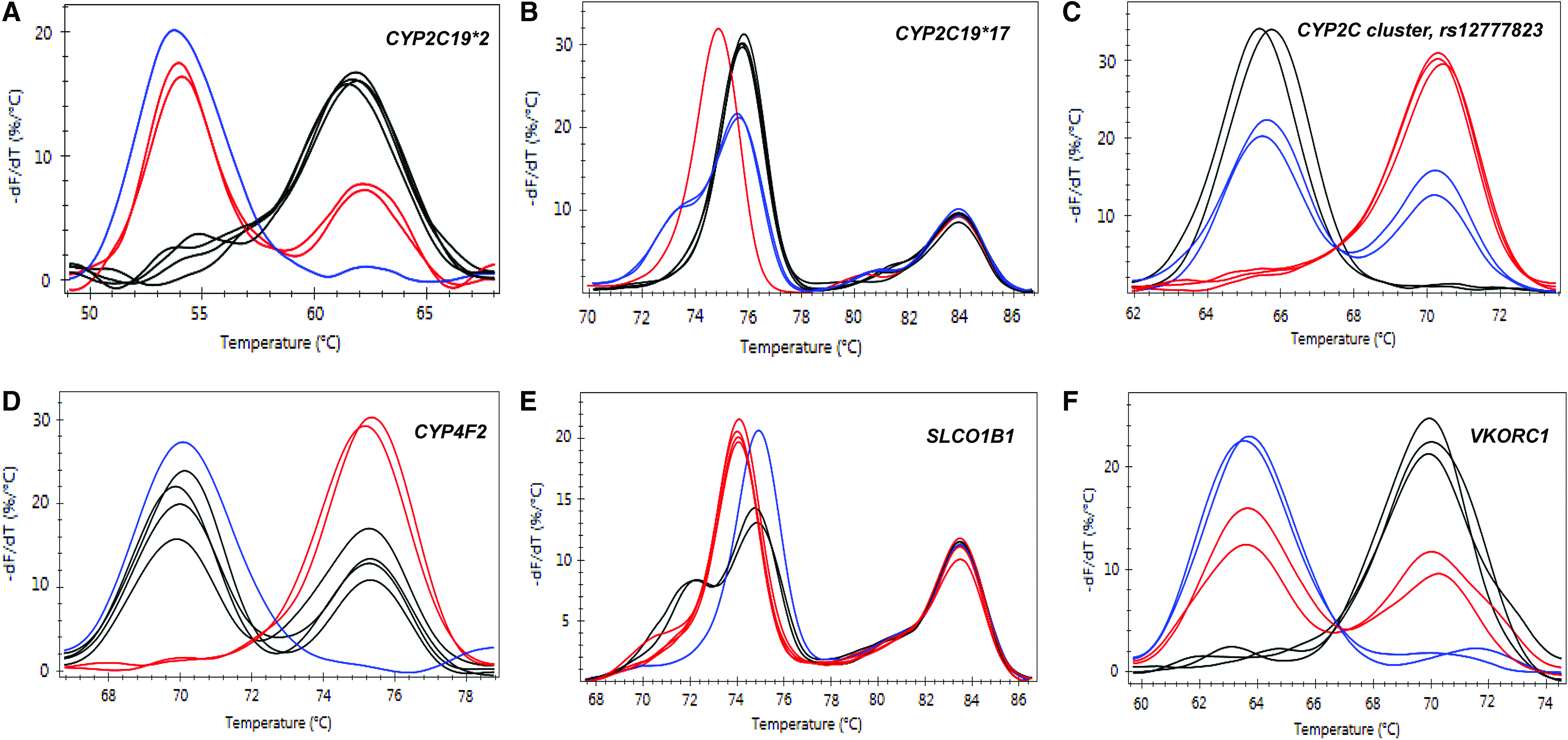
Examples of melting curves for six DNA samples at six different loci [CYP2C19*2 c.681G>A, rs4244285
Cross-validation of genotyping
The cross-validation of genotyping calls resulted from the Canon DNA analyzer was carried out on TaqMan-based OpenArray Quant Studio Real-Time PCR System genotyping platform and samples with mismatch genotypes between the two genotyping systems were validated by Sanger sequencing method. The departure from Hardy-Weinberg equilibrium (HWE) for all 17 SNPs was tested by chi-squared test with one degree of freedom.
Results
Genotyping results and cross-validation for DNA samples
All 223 DNA samples isolated from whole blood were successfully genotyped on the two genotyping platforms for 17 SNPs shown in Table 1. The genotype distribution for all 17 polymorphisms on both genotyping platforms were in HWE by chi-squared analysis.
The concordance between the Canon DNA analyzer and TaqMan-based OpenArray genotyping results for the 17 SNPs ranged from 99.10% to 100% where SNPs (rs4244285, rs12248560, rs4986893, rs72552267, rs28399504, rs4149056, rs28371686, rs9332131, rs72558189, rs9923231, rs12777823), (rs41291556, rs1799853, rs7900194, rs28371685, rs2108622), and (rs1057910) showed 100%, 99.60%, and 99.10% concordance, respectively.
The results from the Canon DNA analyzer and TaqMan-based OpenArray showed mismatch and undetermined (failed to assign genotypes) genotyping for CYP2C9*2, CYP2C9*3, CYP2C9*8, CYP2C9*11, CYP2C19*8 and CYP4F2 rs2108622 SNPs in seven samples. When these samples were analyzed by Sanger sequencing, three genotype calls from the Canon DNA analyzer and three from TaqMan-based OpenArray matched with Sanger sequencing and the genotype results from one sample from both platforms were inconsistent with the sequencing results (Tables 2 and 3).
Genotype Concordance in CYP2C19 and SLCO1B1
Genotypes are presented as numbers and percentages. Total number of genotype calls for each SNP on both genotyping platforms is shown in bold.
Genotype Concordance in CYP2C9, VKORC1, CYP4F2, and rs12777823 in CYP2C Cluster
Genotypes are presented as numbers and percentages. Total number of genotype calls for each SNP on both genotyping platforms is shown in bold.
One homozygous major allele sample was undetermined on Canon and called on QuantStudio OpenArray.
Two samples were undetermined on QuantStudio OpenArray and called heterozygous on Canon DNA analyzer.
Overall, the HRM analysis-based CV PGx genotyping panel performed well when compared with TaqMan-based OpenArray and showed good variant testing capability, efficient turnaround time (5 h), and reproducibility.
Discussion
As a result of international genomic medicine initiatives, genotyping is increasingly used in clinical practice to guide drug prescribing (Cecchin et al., 2017; Weitzel et al., 2016). This creates a need for efficient, economical, and customizable genotyping platforms that allow for incorporation of additional variants as the evidence evolves. Data currently support genotyping to inform prescribing for three major CV medications: clopidogrel, simvastatin, and warfarin. Specifically, CYP2C19 genotype is predictive of clopidogrel effectiveness, and there are recent data that genotype-guided antiplatelet prescribing after coronary intervention leads to a reduction in major adverse CV events (Cavallari et al., 2017). In the case of simvastatin, SLCO1B1 genotype is predictive of risk for drug-induced myopathy, with symptoms ranging from mild myalgias that may threaten medication adherence to life-threatening rhabdomyolysis (Link et al., 2008; Voora et al., 2009). The CYP2C9, VKORC1, and CYP4F2 genotypes jointly influence the dose of warfarin required for optimal anticoagulation, and there is recent evidence of improved outcomes with a genotype-guided approach to warfarin dosing (Gage et al., 2017; Johnson et al., 2017). Guidelines by the CPIC are available for each of these drugs to assist clinicians with the interpretation and translation of genotype results into prescribing decisions (Scott et al., 2013; Ramsey et al., 2014; Johnson et al., 2017). The CPIC warfarin guidelines specifically recommend genotyping for variants important in African ancestry populations (Johnson et al., 2017), which we included on our panel.
HRM analysis-based assays are being developed at a higher rate and used in different research areas such as genotyping, mutation discovery, typing of disease and cancer loci, pathogen detection, and others (Montgomery et al., 2010; Cousins et al., 2012; James et al., 2012; Chen et al., 2014; Langaee et al., 2017). The most commonly used real-time PCR instruments in research and clinical laboratories usually have the HRM application option that facilitates and promotes the application of HRM assays. The main objective of this study was to develop a five gene (CYP2C9, CYP2C19, CYP2C cluster, CYP4F2, SLCO1B1, and VKORC1) CV PGx genotyping panel to run on the Canon DNA analyzer genotyping platform and cross-validate it with the TaqMan-based OpenArray, a commonly used genotyping platform.
Among the 223 DNA samples from whole blood that were genotyped for the 17 SNPs of interest, there were a low number of mismatches and undetermined genotype calls, ranging from 1 to 2 for six SNPs in both genotyping platforms. Three of these mismatches occurred in the rare SNPs (CYP2C19*8 rs41291556, CYP2C9*8 rs7900194, and CYP2C9*11 rs28371685). Rare genetic variants are gene and drug-specific and can account for some of the unexplained genetic interindividual variability in drug response. Although great improvements have been made in genotyping technologies, genotyping errors can happen due to different factors such as assay design and efficiency, instrument performance, DNA quality, PCR inhibitors, and in many cases cannot be prevented. When genotyping for rare polymorphisms, the inclusion of positive control samples may help prevent some incorrect genotyping calls.
Our results show that the HRM analysis-based CV PGx genotyping panel performed well when compared with TaqMan-based OpenArray. The multiplex genetic variant testing capability and reproducibility suggest that the CV PGx genotyping panel and DNA analyzer are feasible for either research or clinical genotyping applications.
Conclusions
These results show that the HRM analysis-based CV PGx genotyping panel performed well when compared with the TaqMan-based OpenArray. The multiple genetic variant testing capability, short turnaround time, and reproducibility suggest that, the CV PGx genotyping panel and DNA analyzer or other real-time PCR instruments with HRM assay analysis capability can be used for genetic testing in the research setting and also in clinical practice where fast turnaround time of genotyping results plays an important role in personalized medicine-based drug therapy.
Footnotes

References
Supplementary Material
Please find the following supplemental material available below.
For Open Access articles published under a Creative Commons License, all supplemental material carries the same license as the article it is associated with.
For non-Open Access articles published, all supplemental material carries a non-exclusive license, and permission requests for re-use of supplemental material or any part of supplemental material shall be sent directly to the copyright owner as specified in the copyright notice associated with the article.
