




Abstract
Purpose:
The methylene tetrahydrofolate reductase (MTHFR) C677T, MTHFR A1298C, and the methionine synthase reductase (MTRR) A66G polymorphisms are the three most common folate metabolism-related loci in the Chinese population. They are associated with numerous birth defects or congenital diseases. To facilitate screening and genetic counseling, we established a method for the simultaneous detection of these three polymorphisms using the Luminex liquid suspension chip and multiple asymmetric polymerase chain reactions (PCRs).
Materials and Methods:
The three polymorphisms were amplified by multiplex PCR with biotinylated primers, followed by hybridization with six probe-linked magnetic microspheres. The mean fluorescent intensity value in each microsphere was detected by Luminex Magpix for polymorphism detection in 150 samples and confirmed by sequencing.
Results:
The consistency between the Luminex liquid suspension chip method and sequencing was 100%. Among the 150 randomized samples, the minor allele frequency (MAF) of MTHFR C677T was 0.41, which was the most common variant allele, followed by MTRR A66G (MAF = 0.24), and finally MTHFR A1298C (MAF = 0.19).
Conclusion:
The Luminex liquid suspension chip method can replace sequencing to analyze the MTHFR C677T, MTRR A1298C, and MTRR A66G loci simultaneously as a rapid, convenient, accurate, and stable method for large-scale testing.
Introduction
Folic acid is a water-soluble form of vitamin B that is obtained from the diet and once ingested, transforms into the biologically active form tetrahydrofolate in the body, which participates in almost all biochemical metabolic processes, including the synthesis of proteins, nucleotides, and hemoglobin that are important for the growth and division of cells. Methylene tetrahydrofolate reductase (MTHFR) and methionine synthase reductase (MTRR) are the key enzymes in the folate metabolism pathway, which maintain normal folate metabolism and homocysteine levels in the body (Li et al., 2015). Mutations of the MTHFR and MTRR genes, including MTHFR C677T (rs1801133), MTHFR A1298C (rs1801131), and MTRR A66G (rs1801394), can lead to decreased activity of the encoded folate metabolic enzymes, which obstructs the conversion of homocysteine to methionine, consequently reducing the folate level and increasing the homocysteine concentration (Tetik Vardarli et al., 2015; Holmes et al., 2011). As such, the risks of premature delivery, recurrent miscarriage, anemia, and neonatal malformations such as neural tube defects, congenital heart disease, Down syndrome, cleft lip, and cleft palate increase significantly (Yang et al., 2013b; Bezerra et al., 2015; Coppedè, 2015; Greenop et al., 2015; Wang et al., 2015a).
Current methods for detecting folate-related polymorphisms include the use of polymerase chain reaction (PCR)-fluorescent probes, amplification refractory mutation system-PCR with fluorescence, and gene sequencing (Wang et al., 2012). However, these fluorescence methods are prone to generating false positives. Moreover, since the quality of the templates is not stable, nonspecific staining will be prominent. Although sequencing is more accurate, it requires a relatively long time to obtain results. Therefore, the current methods are generally low throughput and highly time consuming, which are not suitable for large-scale screening.
The Luminex xMAP system (Yan et al., 2017; Yu et al., 2018) has been widely used in clinical practice in recent years with good performance in detecting multiple indicators simultaneously, along with advantages of high sensitivity, stability, and ease of use. In this study, exfoliated oral cells were selected as test samples to establish a method for the rapid detection of MTHFR C677T, MTHFR A1298C, and MTRR A66G polymorphisms, which can provide an important reference for the individualized supplementation of folic acid and lay the foundation for further studies on the polymorphisms at these three sites and associated risks of diseases.
Materials and Methods
Samples
This study was done with exfoliated oral cells from 150 healthy person range in age from 18 to 40 years old (male/female ratio: 0.705:1) undergoing physical examination. All specimens were collected with the approval of the Ethics Committee at the Third Affiliated Hospital of Sun Yat-sen University. The DNA was extracted from the oral cells using the automatic nucleic acid extraction and purification instrument SMART32 (DAAN Gene Co., Ltd.) according to the manufacturer's instructions. The extracted DNA was stored at −20°C until use.
Preparation of probes, primers, and plasmid templates
According to the sequences of MTHFR C677T, MTHFR A1298C, and MTRR A66 in GenBank, primers and probes were designed with PrimerPlex 2, which was amplified and hybridized. The 5′ end of the forward primer was labeled with biotin, and the 5′ end of the probe was labeled with amination. The primers and probes were synthesized by DAAN Gene (Tables 1 and 2).
Primers Related to MTHFR and MTRR
Probes Related to MTHFR and MTRR
Using the amplified fragments of the mutation sites as templates, six different plasmid templates (STANDARD1-6) were designed. The synthesis and sequencing were performed by GENEWIZ Co. (Suzhou, China) (Table 3).
Genotypes of the Plasmid Standards
Establishment of the PCR system
PCR was performed on the ABI 9700 system (Applied Biosystems) in a 25-μL reaction containing 8 pmol of each biotinylated primer, 2 pmol of each general primer, 9 U of hot-start Taq polymerase (DAAN Gene, Guangzhou), 100 nmol of Mg2+, 1.625 μmol of Tris-HCl (pH 8.8), 0.83 μmol of NH4+, 1.25 μL of 20% Tween-20, 15 nmol of dNTPS (A:C:G:T:U = 1:1:1:1:2), 0.5 U of UDG enzyme, 5 μL of templates, and water. The reaction program was set to 50°C for 3 min, 95°C for 15 min, 94°C for 30 s, 55°C for 30 s, and 72°C for 30 s, repeated for 45 cycles, followed by 72°C for 7 min, and the reaction was terminated at 4°C.
Coupling the probes to the magnetic microspheres
The probe powder was dissolved with sterile purified water to 100 μM; five million of each of the six types of magnetic fluorescent-labeled microspheres (MagPlex, Luminex) were added to a 1.5-mL low-binding centrifuge tube and centrifuged at 9000 rpm for 30 s. The supernatant solution was discarded, and the magnetic beads were collected; 50 μL of 0.1 mol/L 2-(N-Morpholino)ethanesulfonic acid hydrate (pH 4.5; Sigma) was added. After ultrasonic resuspension, 3 μL of probes and 10 μL of freshly prepared N-(3-Dimethylaminopropyl)-N′-ethylcarbodiimide hydrochloride (10 mg/mL; Sigma) were added, mixed, and incubated in the dark for 30 min. Next, 1 mL of 0.02% Tween-20 (Sigma) was added; the magnetic beads were resuspended and then collected through 30 s of centrifugation at 9000 rpm. The supernatant was discarded, and then 1 mL of 0.1% sodium dodecyl sulfate was added, and the magnetic beads were resuspended and collected through 30 s of centrifugation at 9000 rpm, and the solution was discarded. Finally, the magnetic beads were stored in 500 μL of Tris-ethylenedinitrilotetraacetic acid buffer (Sigma). The efficacy of the coupled magnetic microspheres was confirmed according to the gradient-diluted biotinylated complementary sequences of the probes, as described below.
Hybridization of PCR products, fluorescence-labeled microspheres, and streptomycin-R-phycoerythrin conjugates
The fluorescence-labeled microspheres were diluted to 300 beads/μL using tetramethylammonium chloride hybridization buffer. Forty-five microliters of the fluorescence-labeled microsphere solution was mixed with 5 μL of the PCR products and 25 μL of 20 ng/μL streptomycin-R-phycoerythrin conjugates. The mixture was allowed to hybridize at 55°C, and the mean fluorescence intensity (MFI) value was measured on a Luminex MAGPIX instrument.
Criteria for interpretation of results
The gradient-diluted plasmid templates were tested four times simultaneously, and the receiver operating characteristic (ROC) curve was used to calculate the range of the wild-type (N)/mutation (M) values of the wild type, heterozygous, and homozygous mutants. When a sample falls within the corresponding range, the specific genotype of the sample can be determined. If the sample is not within the range of any genotype, it will need to be re-amplified.
Identification of the exfoliated oral cell samples
The 150 DNA samples extracted by SMART 32 from oral exfoliated cells were added as templates, amplified, and hybridized as described above and tested for the three polymorphisms using Luminex MAGPIX.
Sequencing verification of the results
To verify the results from the Luminex MAGPIX method, PCR-based sequencing protocol (25 μL) was conducted by amplifying each mutation site in all 150 DNA samples except that 8 pmol of general primers were used.
Results
Complementary sequences confirmed the sensitivity of the six types of magnetic beads
Complementary sequences in gradients of 0.1 fmol to 10 pmol were each hybridized with the target magnetic beads, and the MFI value measured by MAGPIX increased with the increasing concentration of complementary sequences (Fig. 1). When the concentration was higher than 10 pmol, the MFI value began to plateau and then subsequently declined. Thus, in this concentration range, there was a positive linear correlation with the MFI value measured by the instrument, demonstrating that this set of probes could detect the presence of target nucleic acids at a concentration as low as 1 fmol.
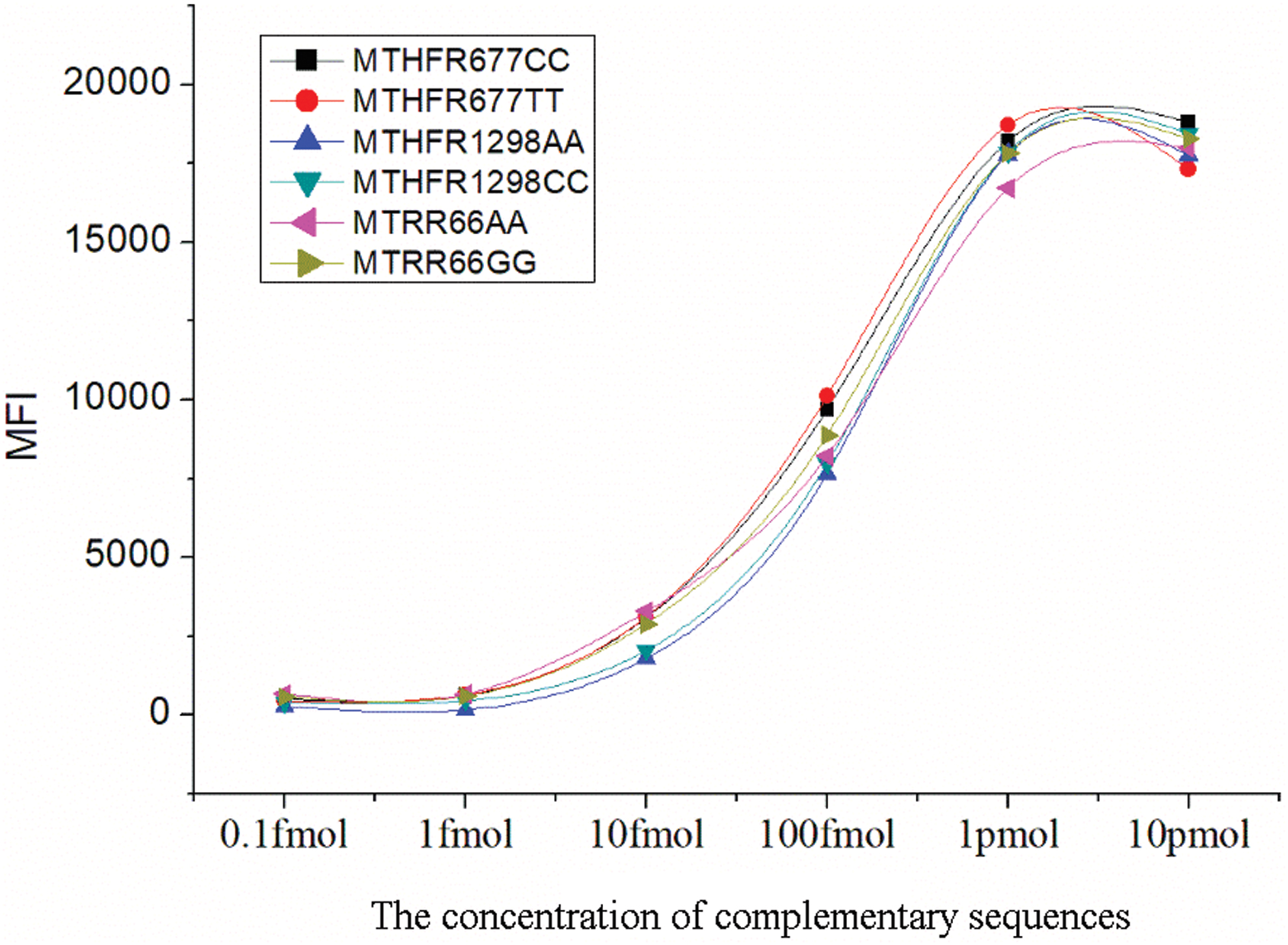
Sensitivity analysis of six Luminex magnetic beads-probes. Color images are available online.
Criteria for the interpretation of results
The experiment was repeated using the known templates STANDARD1-6, and the N/M probes ratio at each mutation site was calculated. The interpretation criterion was obtained from the calculation of the ROC curve. The value of each of the three sites should be greater than at least one of the cutoff values of the wild-type or 677M mutant to be considered as a successful PCR amplification of samples (Table 4).
Cutoff Value of Probes
After confirming the success of the amplification, the genotype of each site of every sample was determined according to the range of the N/M ratio of each probe (Table 5).
Relationship Between (Wild-Type)/M (Mutant Type) Values and Genotypes
MFI, mean fluorescence intensity.
Polymorphism detection in exfoliated oral cells
The concentration of the extracted nucleic acid was measured by NanoDrop spectrophotometer (Thermo Fisher). The results showed that the concentration range of the extracted cells was 0.5-5 ng/μL.
Three target alleles: MTHFR C677T, MTHFR A1298C, and MTRR A66 were tested using the Luminex xMAP system. The results of the 150 exfoliated oral cell samples subjected to the established method and interpretation criterion were well matched with the sequencing results (Fig. 2), and the consistency between the two methods is 100%. Based on Kappa test result (Kappa = 1.000, p < 0.001), the Luminex xMAP system was in good agreement with sequencing.

Sequencing results of three different polymorphism sites. The arrows indicate SNP mutation sites. Color images are available online.
The observed genotypic frequency showed no deviation from Hardy-Weinberg equilibrium (p > 0.05). The minor allele frequency (MAF) was calculated according to the definition of NCBI. MAF of MTHFR C677T reached up to 0.41, which was the most common gene mutation site, followed by MTRR A66G (MAF = 0.24), and finally MTHFR A1298C (MAF = 0.19). The result showed was similar to previous literature (Yang et al., 2013a) (Fig. 3).
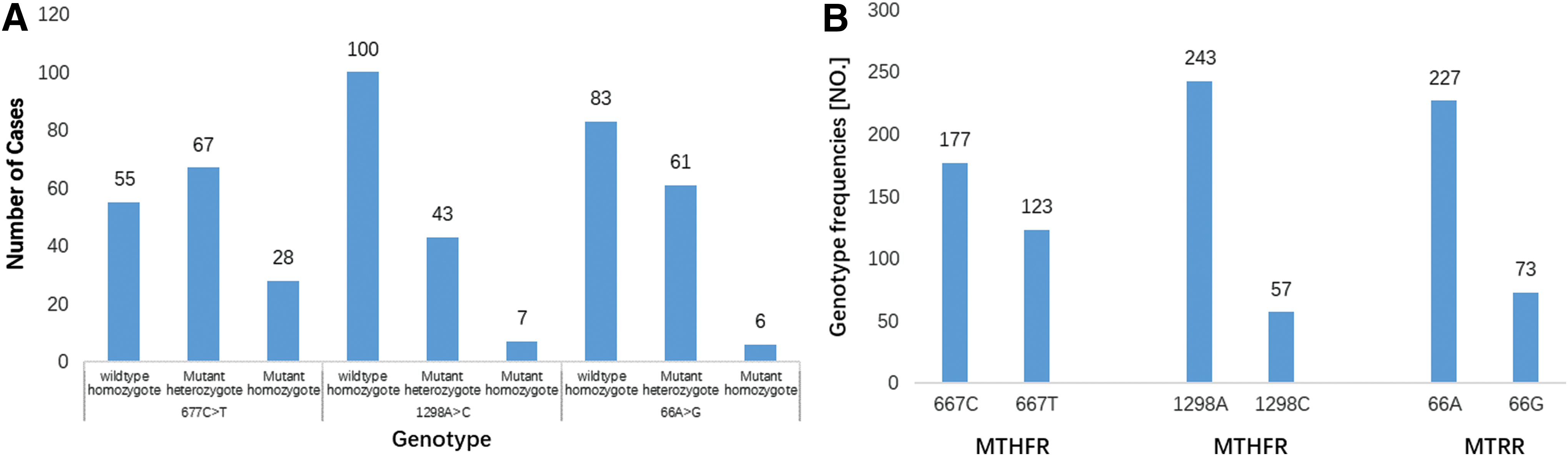
Genotype and allelic frequencies in total 150 samples.
Mutations in MTHFR or MTRR alleles were detected in all 150 samples tested; 16 different genotypes were detected. Patients carrying at least one mutant gene were present in 95.33% (143/150). As such, most Chinese had low metabolic capacity of folate based on genetic pharmacology.
Discussion
Folate deficiency is associated with congenital heart disease, breast cancer, congenital hypoplasia, and miscarriage in pregnant women (Moazzen et al., 2017), and therefore, routine screening is important. In this study, we established a method based on the Luminex LiquiChip system for the simultaneous detection of polymorphisms at three sites, MTHFR C677T, MTHFR A1298C, and MTRR A66. We optimized the processing of the Luminex results and determined the interpretation criteria, and this method was successfully used to analyze 150 random samples of exfoliated oral cells collected from healthy people, demonstrating 100% accuracy with first-generation (PCR-based) sequencing.
In contrast to the traditional methods of detection with limited sensitivity and requirement of invasive collection of venous blood from the patient, we were able to extract the DNA from the patient's exfoliated oral cells (0.5-5.9 ng/μL) for sensitive detection. Thus, this is a completely noninvasive procedure, which will alleviate the psychological burden for the subjects, making it easier to carry out large-scale screening. These results indicate that the Chinese population would benefit from supplementation of different levels of folic acid to reduce the incidence rate of various diseases related to folic acid deficiency. Considering the high prevalence of these mutations, large-scale screening of MTHFR C677T, MTHFR A1298C, and MTRR A66 polymorphisms is urgently needed. In particular, large clinical trials to investigate the relationship between polymorphisms of the related gene mutation sites and the dose of folic acid supplementation are warranted.
Although several studies have found associations of MTHFR and MTRR with a variety of diseases, there is still some controversy on these relationships. For example, the MTHFR 677C>T and 1298 A>C polymorphisms have been widely reported to be significantly correlated with a risk of breast cancer (He and Shen, 2017; Li et al., 2014). Wang et al. (2015b) showed that MTHFR A1298C heterozygous and homozygous mutants were correlated with an increased risk of breast cancer in the Chinese population. However, some studies have shown that the MTHFR A1298C mutation is not directly related to breast cancer. For example, Li et al. (2014) conducted a meta-analysis of a total of 57 studies and found that the 677C>T mutation is directly related to the development of breast cancer, whereas the 1298A>C mutation is not. Therefore, the potential relationship between A1298C mutation and various disease risks remains a popular topic of research.
When searching the keywords “C677T, A1298C, and A66G” in PubMed, numerous studies related to the C677T site were retrieved along with those related to A1298C despite its controversy. However, there has been relatively less research on the A66G polymorphism. Nevertheless, more studies related to MTRR have emerged in recent years, and A66G is a critical polymorphic site on this gene. Recent studies have shown that the A66G and C677T mutations have some impacts on the development of tetralogy of Fallot (Noori et al., 2017). The A66G polymorphism has also been associated with ventricular septal defect (Guo et al., 2017). Therefore, a joint screening of the three loci is crucial.
The method established in this study can rapidly screen the three mutation sites MTHFR C677T, MTHFR A1298C, and MTRR A66 in specific populations and thereby promote the assessment of disease risks related to these genes. The next step is to conduct large-scale clinical trials to further investigate the relationship between the three polymorphisms and the appropriate dose of individualized folic acid supplementation.
Footnotes
Acknowledgment
The authors thank the Third Affiliated Hospital of Sun Yat-sen University for its support.
Author Disclosure Statement
No competing financial interests exist.
Funding Information
This study was supported by National and Regional Joint Engineering Laboratory for Clinical Medical Molecular Diagnostics, Guangdong (No. 2014G-P048).