







Abstract
Background:
As the demand in genetic testing increases, various fields look toward collection methods that are noninvasive and efficient in recovering deoxyribonucleic acid (DNA) for testing that will allow for high first-pass success rates.
Objective:
Two extraction methods (PrepFiler™ Express Forensic Extraction and the Maxwell® RSC Buccal Swab DNA Kits) were optimized to increase DNA yield from a buccal cell collection device (Gentueri's CollectEject™ Swab).
Materials and Methods:
Buccal swabs were processed under varying incubation parameters using a forensic workflow. The PrepFiler method was adjusted to test longer incubation times and more aggressive agitation. The Maxwell method was adjusted to test incubation temperatures and duration.
Results:
Quantitative results showed that increased agitation can yield more DNA through the PrepFiler extraction, but longer incubation times did not increase DNA recovery. The results from the Maxwell study showed no significant difference between incubation temperatures or times.
Conclusions:
The results indicate that various applied genetic fields can utilize a noninvasive, simple collection method using the CollectEject device in conjunction with extraction methods already implemented in laboratories to collect 5000 ng of DNA or greater from a buccal cell collection.
Introduction
Every nucleated cell contains deoxyribonucleic acid (DNA) and analysis of this genome gives insight to the individuals' unique genetic identity and potential risk status for falling ill with genetic diseases (Sugata et al., 2002; Chaudhary et al., 2015; Fiorani and Cinotti, 2020). In the clinical sector, predictive screening, diagnostic testing for certain genotypes, possible somatic or germline mutations, biomarkers, and epigenetic anomalies can provide insight about a patient's predisposition for a certain disease or individual tolerance of drugs and treatments in the field of personalized medicine (Marteau and Croyle, 1998; Rahner and Steinke, 2008; Jostins and Barrett, 2011; Roberts et al. 2012; Whirl-Carrillo et al., 2012; Cascella et al., 2015). Risk assessment of hereditary diseases has been of growing demand in personal or reproductive health for individuals with or without prior knowledge of their status (Quarrell et al., 1987; Evers-Kiebooms et al., 2002). Comparison of distinct mutations in the Y-chromosomal or mitochondrial DNA can demonstrate kinship for paternity testing or disaster victim identification (Kayser and Sajantila, 2001; Leclair et al., 2001). In forensic science, genetic profiles help identify victims or perpetrators using biological evidence collected from a crime scene (Butler, 2011).
Contrary to performing tissue biopsies or drawing blood for these analyses, swabbing of mucosal surfaces or skin is a simple, noninvasive technique (Beckett et al., 2008; McMichael et al., 2009; Woo and Lu, 2019). Previous studies have evaluated DNA yield from less invasive techniques such as saliva collection, buccal cells, and oral rinses (King et al., 2002; Rogers et al., 2007). Collection utilizing these techniques does not require a clinical environment or complex storage conditions and can be performed by a nonprofessional at home (Cascella et al., 2015). Sufficient biological material collection and stabilizing storage conditions are just as important as efficient release of sample from the swab (Adamowicz et al., 2014; Comte et al., 2019).
The goal of this study was to maximize the amount of DNA that can be recovered from a buccal collection utilizing the Gentueri CollectEject™ Swab in combination with the Gentueri SwabSaver® tube. Gentueri™ has recently released a product line of swabs, CollectEject, that allow for a quick and efficient collection process. The swab is attached to an applicator that ejects the tip of the swab directly into a tube without need for cutting. The swab design also allows for increased surface area for improved DNA collection and retention. Two standard DNA extraction procedures applied in various DNA testing fields for high-throughput testing of buccal swab samples were evaluated (Lui et al., 2012; Montgomery et al., 2017). Extraction methodologies are created by manufacturers to handle a variety of sample types or matrices and are not always tailored for one specific swab brand or type. Incubation settings were adjusted and compared to the standard protocol to optimize the yield of DNA in one pass of testing.
Materials and Methods
Sample preparation
Eighty buccal swabs were collected from consenting adult volunteers. All personal information was de-identified by Gentueri and not known to the authors. Buccal swabs were collected for 15 s while rubbing the inside of both cheeks using Gentueri's CollectEject Oral Swabs. Samples were stored at room temperature in either a Gentueri SwabSaver, a tube designed for sample storage with a built-in spin basket and a removable desiccant chamber that seals off the tube and can be replaced by a LabCap, or a foiled Gentueri Oral Collection Kit, a zip bag containing desiccant.
PrepFiler™ express forensic DNA extraction and quantitation
Extraction was performed using the PrepFiler Express™ Forensic DNA Extraction Kit on the Automate Express™ Forensic DNA Extraction System (Applied Biosystems) following manufacturer's guidelines (Thermo Fisher Scientific, Inc., 2009). The incubation step occurred directly in the SwabSaver, after 330 μL of the manufacturer-recommended master mix was added to the SwabSaver™ spin basket, which was sealed by replacing the desiccant cap with a LabCap. SwabSaver tubes containing samples were incubated in a thermomixer. Five incubation parameters were evaluated as follows: Groups I and II—40 min at 70°C at 750 revolutions per minute (RPM) (n = 12 physical samples for both Groups I and II), Group III—overnight (∼16 h) at 70°C at 750 RPM (n = 12), Group IV—2 h at 70°C at 850 RPM (n = 6), and Group V—80 min at 70°C at 850 RPM (n = 6). Group I and II follow manufacturer's guidelines. Six of the physical samples from Group III were extracted a second time following the same procedure as aforementioned for Group III to see if DNA remained on the swab after initial incubation. Samples were eluted in 250 μL of storage buffer (proprietary) and stored at −15°C.
Quantitation of human DNA was performed in triplicate for all samples using real-time polymerase chain reaction (PCR) utilizing the Quantifiler™ Trio DNA Quantification kit (Applied Biosystems) on the Applied Biosystems™ 7500 Real-Time PCR System. Half-reactions using half of the reagent volume suggested by the manufacturer (4 μL of Quantifiler™ THP PCR Reaction Mix, 5 μL of Quantifiler™ Trio Primer Mix, and 1 μL of DNA extract) were prepared based on the manufacturer's guidelines. Except for the reaction volume, all recommended PCR parameters were followed (Thermo Fisher Scientific, Inc., 2017).
Maxwell® RSC buccal swab DNA Kit extraction and quantitation
Extraction was performed using the Maxwell RSC Buccal Swab DNA Kit (Promega, 2019). The incubation step occurred directly in the SwabSaver basket using the manufacturer-recommended buffer. Incubation temperatures of 56, 60, 65, and 70°C (n = 4 samples per temperature) were tested. Once the optimal incubation temperature (65°C) was determined, incubation times were tested at 30 min, 60 min, 120 min, and 12 h (n = 4 samples per incubation time). Manufacturer's incubation recommendations are 56°C for 20 min, which were not tested in this study. The remainder of the extraction followed manufacturer's guidelines for the Maxprep™ Liquid Handler (Promega, 2019). Samples were eluted in 50 μL of the kit supplied elution buffer and stored at −20°C. DNA concentration (ng/μL) and DNA purity (A260/A230, A260/A280) were determined by sampling each elution with the DenoVix DS-IIFX Nanodrop system (not specific for human DNA).
Statistical analysis
Using Excel's Data Analysis tool, means and standard deviations (SDs) were calculated, and significance in data sets was determined via analysis of variance (ANOVA): single factor analysis (α = 0.05). If the F-value was found to be greater than F-critical, the null hypothesis (means of all data sets are equal) was rejected and a post hoc Tukey's HSD (honestly significant difference) test was performed utilizing a Studentized Range q Table.
Results
Automated PrepFiler express extraction
The average DNA yields of all samples per group are visualized groupwise in Figure 1. Groups I-V yields show variance between and within groups, resulting in wide SDs. Groups I and II, processed under the same conditions, show variance between the average quantitation values. Samples of Group III were incubated the longest, but do not show increased recovery. Incubation conditions in Group IV led to a higher average recovery than in Groups I through III, but did not show a statistically significant increase. The treatment of the samples of Group V led to a significant increase of DNA yield with an average of 7261 ng (p < 0.05), as determined via ANOVA analysis and Tukey's HSD, with over three times as much total DNA recovery. No statistically significant differences were seen between average DNA yield among Groups I through IV.
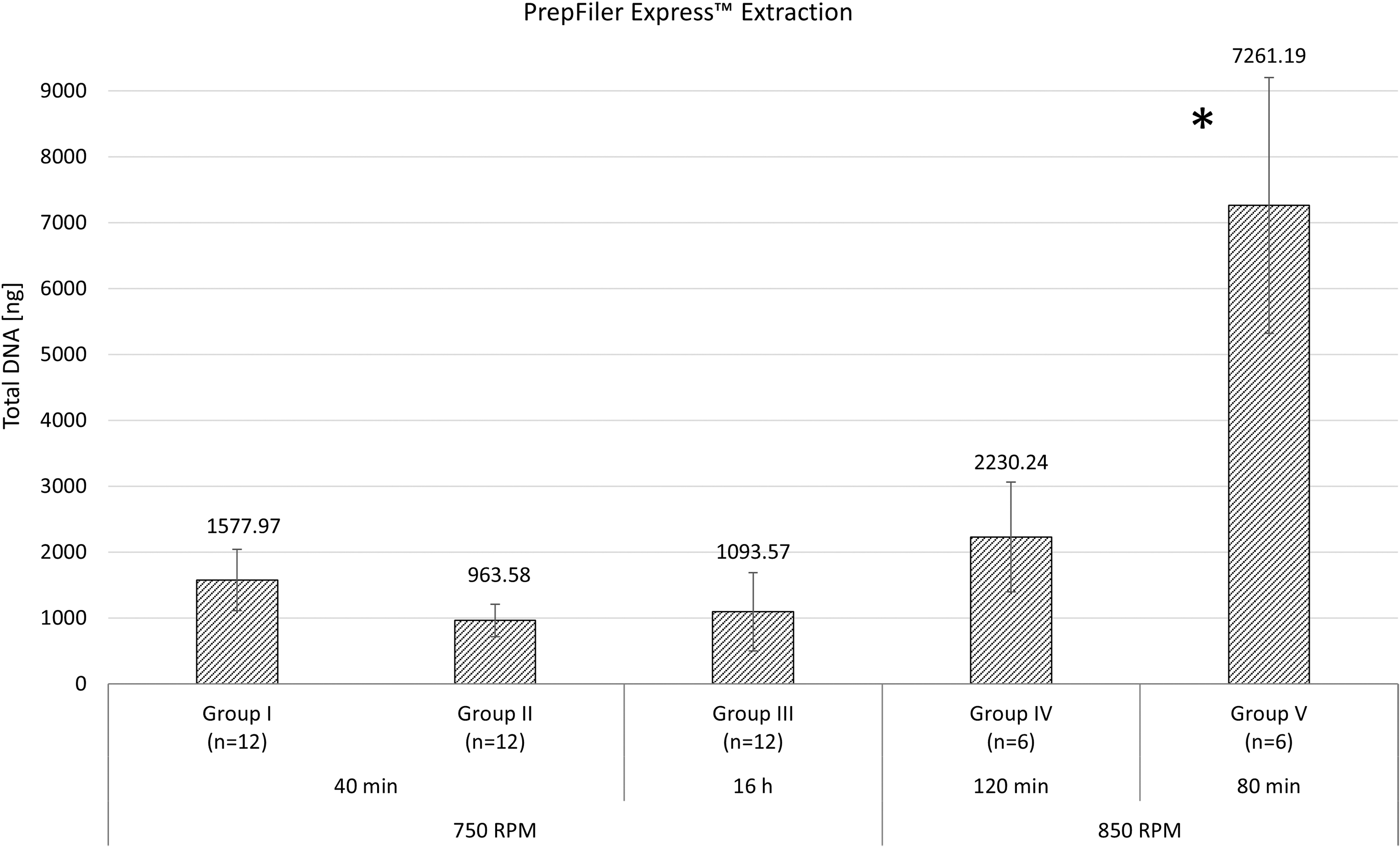
Average total DNA quantification data per group extracted using PrepFiler™ Express. All samples were incubated at 70°C, agitation during incubation was either 750 or 850 RPM, and incubation duration varied between 40 min and 16 h. The average DNA yield per group is shown in ng, and the average SD was calculated using the DNA yield of the individual sample. Error bars show the SD, and significant differences are marked with *. DNA, deoxyribonucleic acid; RPM, revolutions per minute; SD, standard deviation.
Reextraction of six samples of Group III shows very low DNA recovery, suggesting most DNA was recovered during the first extraction (Fig. 2). Furthermore, there was little degradation observed in all groups. Degradation is calculated by dividing the small quantitation target value by the large target value. If the quantity of the smaller amplicon (T.small) is found to be greater than the quantity of larger amplicon (T.large) of the same PCR reaction, degradation is assumed since the ratio of T.small to T.large is supposed to be 1:1 for a pristine sample (Thermo Fisher Scientific, Inc., 2017). The degradation ratio was 1.03 for Group I and increased to 1.50 for Group V.

Average DNA quantification data from reextracted samples. Samples for the first and second extraction of six selected samples. The average DNA yield per group is shown in ng. Error bars show the SD. Error bars for Extraction 2 data may not be clearly visible due to the low SD of these data.
Maxwell RSC buccal swab extraction
Processing samples with the Maxwell RSC Buccal Swab DNA Kit at various incubation durations and temperatures did not result in any statistically significant differences in DNA yield, but wide SDs were observed (Fig. 3). Since the 65°C generated the highest yield of DNA on average, this temperature was chosen for the incubation time study. All combinations of temperature and time yielded milligram quantities of DNA, sufficient for most molecular applications.

Average total DNA quantification data per group extracted using Maxwell® RSC Buccal Swab DNA Kit. Groups were either incubated for 30 min at varying temperatures, or at 65°C for different durations (n = 4 for each incubation time and temperature examined). The average DNA yield per group is shown in ng, and the average SD was calculated using the DNA yield of the individual sample. No statistical significance was observed between data sets. Error bars show the SD.
Discussion
When extracting the Gentueri CollectEject Oral Swabs, the PrepFiler method yielded consistent results under varying incubation times at 750 RPM agitation settings. Increasing agitation promoted increased sample release for both incubation times evaluated at 850 RPM (80 and 120 min). The suggested incubation parameters for yielding maximum DNA from the PrepFiler method using the Gentueri CollectEject Swabs are 850 RPM and incubating samples for 80 min at 70°C. The Maxwell RSC Buccal Swab incubation temperature experiment indicated that the entire temperature range tested is suitable for this procedure. The data of the PrepFiler study correlates with the results of the Maxwell study, indicating that prolonged incubation does not enhance DNA yield. Therefore, the shortest incubation time, 30 min, and 65°C would be the recommended incubation parameters for the Maxwell procedure.
In all sample groups, a high amount of variance between samples was observed. The authors chose to utilize true buccal swabs in this study to remain consistent with how the CollectEject swabs would be utilized in various fields. This variability suggests that there may be many factors that affect overall DNA recovery during the swabbing process. This could also explain the significant increase between Groups IV and V, which show that a shorter incubation time yields more DNA.
An additional extraction was performed on samples from Group III of the PrepFiler study to investigate efficiency of sample release from the swab and to determine if multiple rounds of extraction should be performed. Results were consistent across the samples and indicate that one round of incubation should be sufficient for processing. Authors also performed a preliminary look into the effect of the incubation settings on DNA degradation in samples collected with the CollectEject Oral Swabs. All PrepFiler groups exhibited no degradation (range between 1.02 and 1.50). Studies performed on the degradation index suggest that truly degraded samples have an index greater than 4 (Vernarecci et al., 2015). Further studies utilizing methods that can observe degradation of larger base pair sizes would be useful to evaluate the effect of more aggressive incubation parameters.
No direct comparison of the two extraction methods was performed. The collaborating laboratories followed different procedures for DNA analysis. The goal of this article is not to state which extraction type is better, but instead to highlight that laboratories can utilize their current extraction procedures when using Gentueri's CollectEject Oral Swabs. Overall, this study shows that performing buccal collection utilizing the CollectEject swab in conjunction with the SwabSaver can replace more invasive techniques and generate DNA for various fields that require 5000 ng of DNA or greater for testing for high one pass success rates and high-throughput testing.
Footnotes
Authors' Contributions
M.P.—data acquisition, analysis and interpretation, original draft writing, and editing; F.M.—data acquisition, analysis and interpretation, editing, and approval of writing; and M.F.—conception and design, data interpretation, original draft writing, and editing.
Acknowledgments
The authors thank Randy Nagy and Gentueri for their continuous support in conducting this research and supplying reagents needed to perform this study.
Author Disclosure Statement
F.M. was an employee of Gentueri during the time of this work. M.P. and M.F. have no conflicts to disclose.
Funding Information
No funding was received for this article.