




Abstract
Background:
The small nucleolar RNA host gene 7 (SNHG7) has been suggested as a biomarker of metastatic cancer; however, its reliability is controversial. Therefore, the goal of this study was to conduct a meta-analysis to assess the reliability of SNHG7 as a comprehensive cancer metastasis diagnostic biomarker.
Methods:
A comprehensive literature search was conducted using PubMed, Cochrane Library, Web of Science, Embase, and China National Knowledge Infrastructure (CNKI) to identify articles which examined the role of SNHG7 in cancers. Random-effects models and fixed-effects models were conducted to estimate the pooled odds ratios (ORs) for the associations of SNHG7 with distant metastases and lymph node metastases. Hierarchical summary receiver operating characteristic (ROC) models were used to estimate the sensitivity and specificity of SNHG7 as a biomarker for cancer metastasis diagnoses.
Results:
Nineteen studies comprised 1491 patients were included in this meta-analysis. We found that both distant metastasis (OR = 4.19, 95% confidence interval [CI] = 2.93-5.99, I2 = 34%) and lymph node metastasis (OR = 3.07, 95% CI = 1.65-5.68, I2 = 79.03%) were significantly associated with a higher expression of SNHG7. We also showed a pooled sensitivity and specificity of 74% (95% CI = 66-82) and 57% (95% CI = 53-61) for distant metastasis; as well as 72% (95% CI = 63-80) and 54% (95% CI = 46-63) for lymph node metastasis, respectively.
Conclusion:
Our findings suggest that SNHG7 is a potential diagnostic biomarker for metastasis of cancer; however, its clinical application requires stronger evidence due to the low sensitivity and specificity. Further larger-scale studies from diverse settings and cancer types will be necessary to reveal novel insights into SNHG7 as a biomarker for cancer metastasis diagnoses.
Introduction
Cancer is a significant public health issue, and a leading cause of death worldwide (Miller et al., 2019; Siegel et al., 2019). Research has shown that there were ∼18.1 million new cases and 9.5 million cancer-related deaths worldwide in 2018 (Bray et al., 2018). It has been estimated that new cancer cases per year will rise to 29.5 million along with 16.4 million cancer-related deaths by 2040 (Siegel et al., 2019). Metastases are the primary cause of death and are responsible for ∼90% of cancer mortality (Chaffer and Weinberg, 2011). At the time of initial cancer diagnoses, at least half of the patients present clinically detectable metastatic disease (Martin et al., 2013).
Although significant progress has been made toward metastatic diagnoses and therapies, a majority of cancer patients still face a dismal prognosis due to lack of an early diagnosis of metastasis (Siegel et al., 2019). An early diagnosis of cancer metastasis is important for identifying patients in the initial disease stage who thus could benefit from a more aggressive and multidisciplinary treatments (Pagani et al., 2010). However, cancer treatments, such as surgery, chemotherapy, radiotherapy, and intervention, may cause physical and mental discomfort, including pain, vomiting, fatigue, loss of appetite, and weight loss (Wesley and Fizur, 2015). Therefore, the accuracy of a diagnosis is also critical to prevent discomfort that can arise from unnecessary treatments. Thus, there is an urgent need to identify reliable methods for early and accurate diagnoses.
Recently, researchers have focused on identifying biological markers associated with cancer progression and metastasis. According to the transcript length, noncoding RNAs can be divided into small noncoding RNA (miRNA) and long noncoding RNA (lncRNA), which is defined as non-protein-coding RNA, with a length of more than 200 bp (Mattick and Rinn, 2015).
Research has shown that lncRNAs are often associated with the regulation of gene expression, posttranslational processing, tumor metastasis, and apoptosis (Guttman and Rinn, 2012; Cheetham et al., 2013; Lavorgna et al., 2016). In addition, studies have also shown that lncRNAs might have anticancer as well as cancer-promoting functions (Jiang et al., 2019); thus, lncRNAs are expected to be utilized as one of the new classes of biomarkers for cancer diagnoses and potentially as therapeutic targets (Bhan et al., 2017). To date, only a small number of lncRNAs have been identified and their functions are ambiguous.
Small nucleolar RNA host gene 7 (SNHG7) is a lncRNA encoded by a locus on chromosome 9q34.3, with a length of 2176 bases (Ota et al., 2004). It has been reported that SNHG7 is involved in multiple physiological processes, including, but not necessarily limited to control of alternative splicing, nucleolar formation and regulation of gene expression. Evidence suggests that SNHG7 is closely related to the progression of multiple cancer types (Xu and Fei, 2017; Li et al., 2018; Shan et al., 2018; Liu et al., 2019; Zhang et al., 2020b). For example, Guo et al. demonstrated that SNHG7 upregulates Acyl-CoA Synthetase Long Chain Family Member 1 (ACSL1) via sponge miR-449a promoting proliferation migration of thyroid carcinoma cells (Guo et al., 2020).
Similarly, Dai et al. (2020) showed that downregulated SNHG7 suppresses the expression of GLI Family Zinc Finger 3 (GLI3) by upregulating miR-140-5p, which further inhibits cell proliferation and promotes apoptosis in nasopharyngeal carcinomas. Furthermore, it has been demonstrated that miR-146a partially inhibits the proliferation of bone marrow stromal cells through the axis of the miR-146a/EPB41L4A-AS1 and SNHG7 cell proliferation signaling pathway (Cui et al., 2020).
Although several studies have suggested that SNHG7 may be a potential biomarker for diagnosing cancers and metastases, evidence of its effectiveness for diagnosing metastases remains controversial. For example, Wu et al. (2019) found no significant association between high SNHG7 expression levels and distant metastasis in hypopharyngeal cancer. Similarly, Xu and Fei (2017) found that the association between high SNHG7 expression levels and distant metastasis was not significant in gastric cancer. However, their results did not reach statistical significance, which may be due to the small sample size of the patients with distant metastasis.
There were 0 out of 4 patients and only 2 out of 3 persons in these two studies had high expression levels of SNHG7 and showed distant metastasis. It is difficult to determine if the high expression of SNHG7 is related to distant metastasis based on such a small sample size. Furthermore, the mechanism of the association between SNHG7 and metastasis of cancer remains unclear. Thus, the objective of this study was to conduct a meta-analysis to examine the effectiveness of SNHG7 in diagnosing cancer metastases.
Methods
This meta-analysis followed the reporting guidelines of Meta-analysis of Observational Studies in Epidemiology (MOOSE) (Stroup et al., 2000) and Preferred Reporting Items for Systematic Reviews and Meta-Analyses (PRISMA) (Moher et al., 2009). IRB approval was waived due to the use of retrospective and de-identified data.
Search strategy and selection criteria
We first conducted a comprehensive literature search using PubMed, Cochrane Library, Web of Science, Embase, and China National Knowledge Infrastructure (CNKI) for studies published before February 2020. To improve the sensitivity of retrieval, both medical subject terms and free-text terms were used in the databases. The search keywords used were ((“SNHG7”[Title/Abstract] OR “ small nucleolar RNA host gene 7”[Title/Abstract] OR “long non-coding RNA” [Title/Abstract] OR “lncRNA”[Title/Abstract] OR “noncoding RNA” [Title/Abstract]) AND (“cancer” [Title/Abstract] OR “metastasis” [Title/Abstract] OR “tumor”[Title/Abstract] OR “neoplasm” [Title/Abstract] OR “carcinoma” [Title/Abstract])).
In addition, we checked all of the articles concerning these qualified studies to determine if there was other relevant literature that had not been retrieved from the databases. We first reviewed all abstracts and retrieved articles with available data on the association between SNHG7 and cancer metastasis. Two authors independently assessed the eligibility, and all disagreements were further discussed with the other authors of this analysis.
Eligible studies had to meet the following criteria to be included in this meta-analysis:(1) the subjects were all adult cancer patients; (2) studies must have been published in English and in full-text; (3) studies should be observational and interventional study reviews or meta-analyses were excluded; and (4) studies mentioned the details and provided enough data on the correlation between SNHG7 and cancer metastasis.
Data extraction
Two reviewers searched the databases and independently evaluated the publications. The included studies were selected via consultation. Then the following data were obtained from the included studies: first author, year of publication, country, cancer type, patient number, the gender of the patients, as well as the data of the SNHG7 expression, distant metastasis, and lymph node metastasis.
Quality assessment
The Newcastle-Ottawa Scale (NOS), ranging from 0 to 9, was used to assess all articles quality in this meta-analysis. A score higher than 5 indicates high quality, a score from 4 to 5 indicates moderate quality, and a score below 4 indicates low quality (Deeks et al., 2003). Only studies with moderate to high quality (NOS score ≥5 points) were included in this study.
Statistical analysis
We first used the Cochran Q test and I2 statistics to examine statistical heterogeneity across studies. An I2 statistic of >50% was considered significant heterogeneity. A random-effects model was conducted to obtain the pooled odds ratios (OR) and 95% confidence intervals (CIs) to examine the relationship between SNHG7 expression and cancer metastasis where significant heterogeneity existed; otherwise, we chose the fixed-effect model. Hierarchical summary receiver operating characteristic (ROC) models were used to estimate the sensitivity and specificity of SNHG7 as a biomarker for metastasis diagnosis of cancer.
Publication bias was assessed by Begg's (Begg and Mazumdar, 1994) and Egger's tests (Egger et al., 1997). Where significant heterogeneity existed, a sensitivity analysis to assess whether individual studies affected the overall results was carried out. All analyses were conducted using STATA 16 software (Press, 2019). A p-value <0.05 was considered statistically significant.
Results
Two hundred and eighty-nine articles were identified from the databases; after removing duplicates and manually screening titles and abstracts, 239 records were deleted. Due to the lack of available data, an additional 33 records were excluded. The literature search and article selection process are presented in Figure 1.
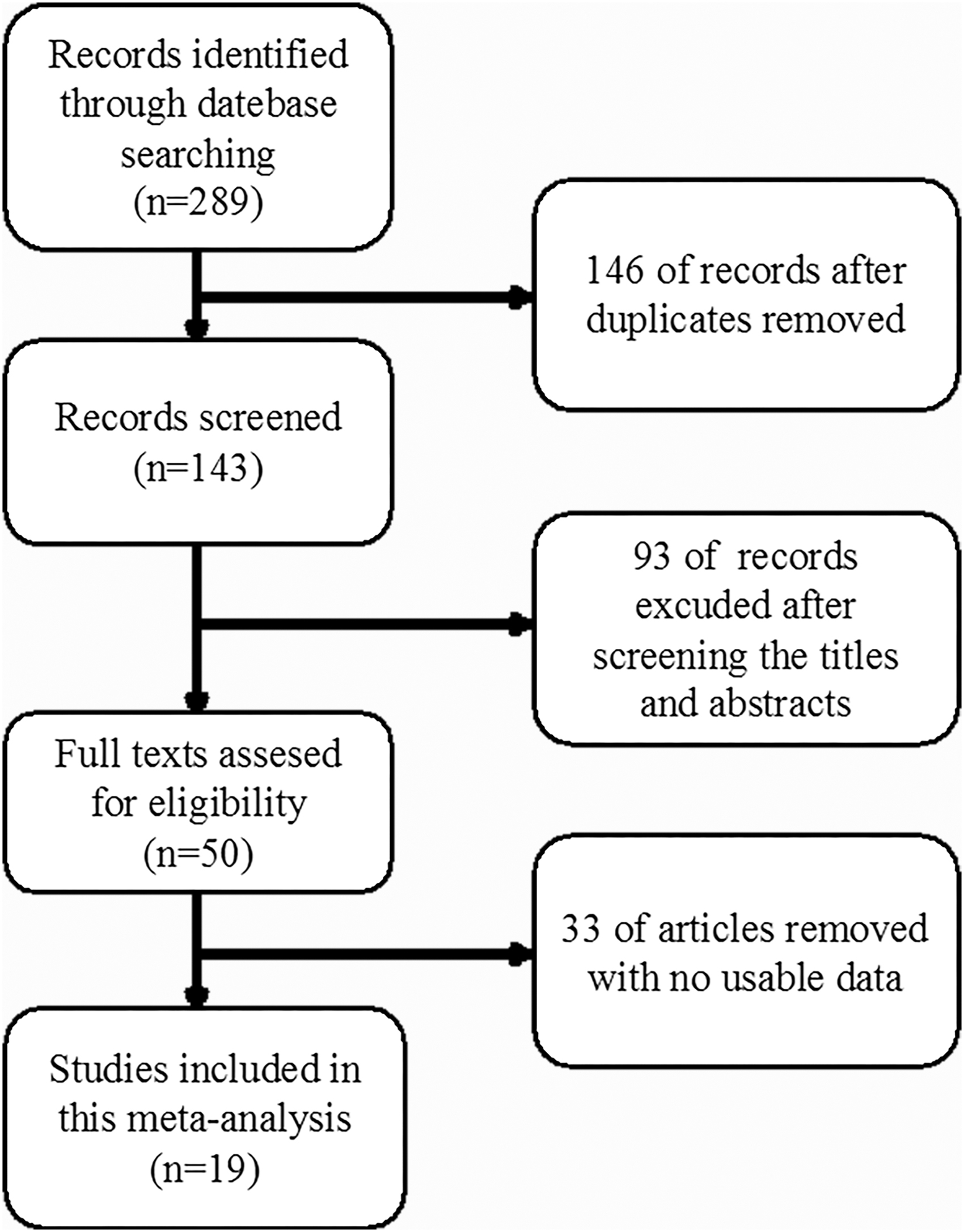
The process of literature search.
As a result, a total of 19 studies, including 1491 patients, were included in our meta-analysis (Xu and Fei, 2017; Li et al., 2018; Luo et al., 2018; Qi et al., 2018; Shan et al., 2018; Zhong et al., 2018; Chen et al., 2019; Cheng et al., 2019; Chi et al., 2019; Wang et al., 2019; Wu et al., 2019, 2020; Xu et al., 2019; Zeng et al., 2019; Pang et al., 2020; Xia et al., 2020; Zhang et al., 2020a, 2020b; Zheng et al., 2021). The main features of the included studies are presented in Table 1. The sample size ranged from 40 to 162 patients. The quality assessment's NOS score for all studies ranged from 5 to 8, moderate to high-quality classification.
Characteristics of Studies Included in This Meta-Analysis
NA, not acquire; NOS, Newcastle-Ottawa Scale; qRT-pCR, quantitative real-time polymerase chain reaction; TNM, tumor, nodes and metastases.
The forest plot and hierarchical summary ROC curve estimating the associations between SNHG7 and cancer metastasis are presented in Figure 2. Eleven studies included data on the relationship between SNHG7 and distant metastasis of the cancers. The fixed-effects model showed that there is a significant association between SNHG7 and distant metastasis of the cancers. Specifically, patients with elevated expression levels of SNHG7 had ∼4 times higher odds of having distant metastases of cancers (OR = 4.19, 95% CI = 2.93-5.99, I2 = 34%). The pooled sensitivity and specificity of SNHG7 levels for diagnosing distant metastases were 74% (95% CI = 66-82) and 57% (95% CI = 53-61), respectively. The Egger's (z = 0.19, p = 0.851) and Begg's tests (z = 0.93, p = 0.350) indicated no significant publication biases.
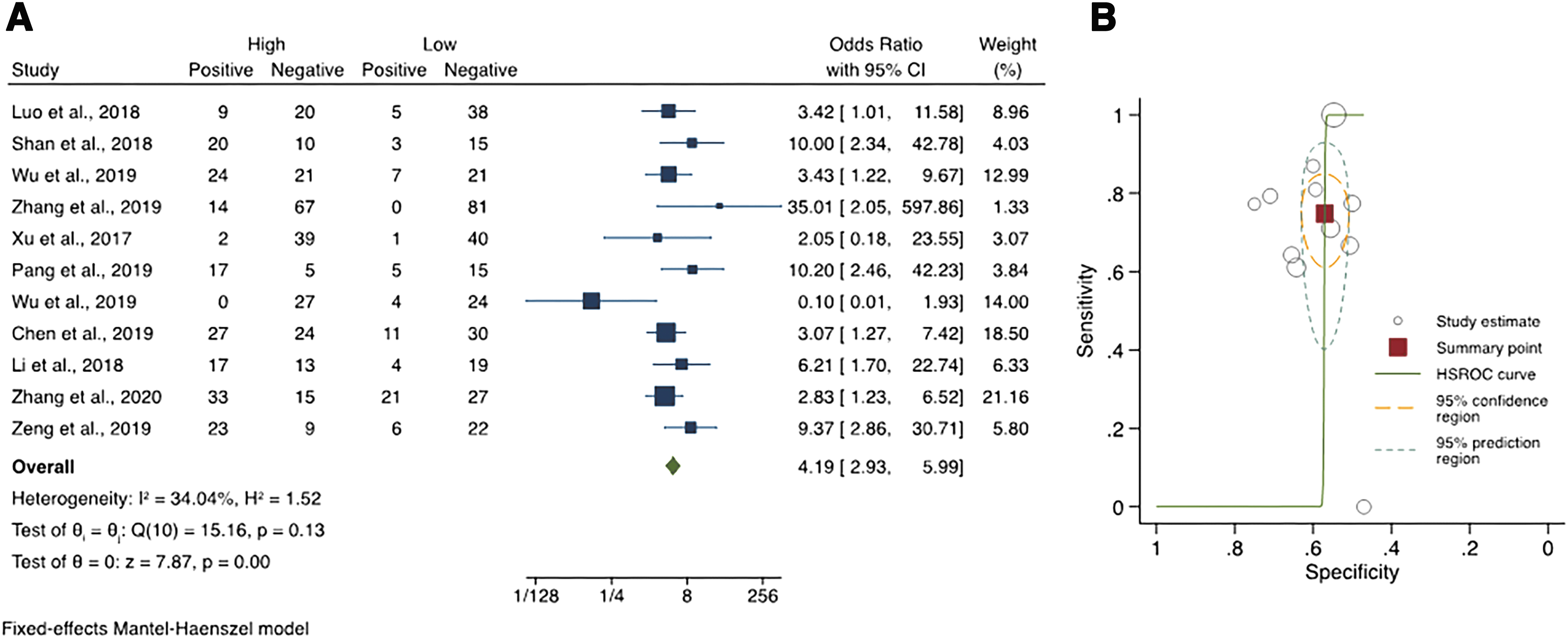
For the lymph node metastasis, there were 15 studies that included data on the relationship between SNHG7 expression and lymph node metastasis of the cancers. The random-effects model showed a significant association between SNHG7 and lymph node metastasis of the cancers (Fig. 3A). Specifically, patients with high expression of SNHG7 have ∼3 times higher odds of having lymph node metastasis of cancers (OR = 3.07, 95% CI = 1.65-5.68, I2 = 79.03%).

Due to the significant heterogeneity, a sensitivity analysis of the random effects model was conducted. The results showed that dropping out individual studies had little effect on our final results, which indicates that our results are relatively credible and stable (Fig. 4). The pooled sensitivity and specificity of SNHG7 toward diagnosing lymph node metastases were 72% (95% CI = 63-80) and 54% (95% CI = 46-63), respectively. The Egger's (z = 1.07, p = 0.078) and Begg's tests (z = 1.88, p = 0.060) indicated no significant publication bias (Fig. 3B).
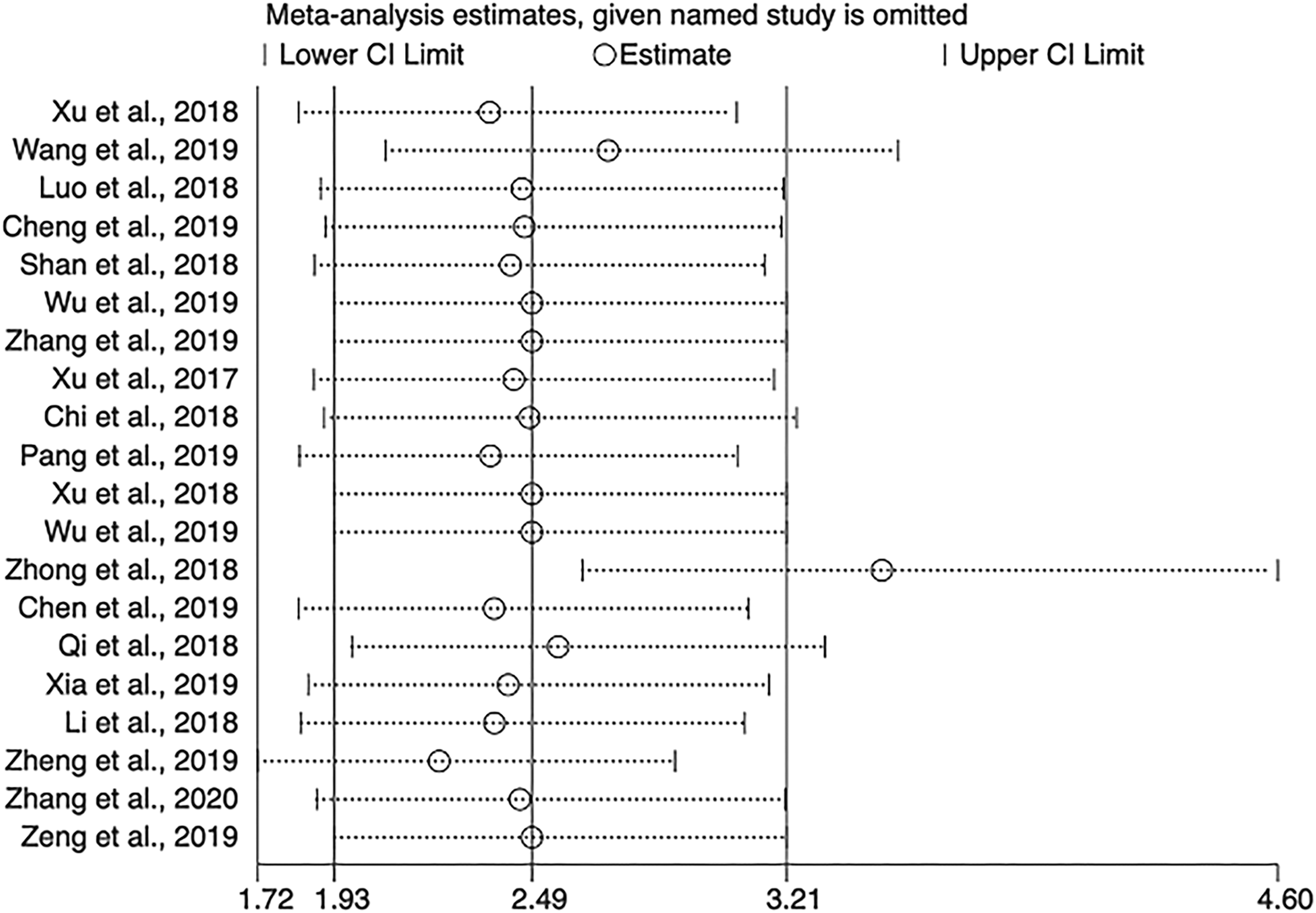
Sensitivity analyses of the random-effects model of the association between SNHG7 expression levels and lymph node metastasis.
Discussion
SNHG7 has been shown to have the potential to act as a biomarker to diagnose metastases of cancers. Due to the controversy of a SNHG7 metastasis diagnosis based on previous research, we conducted this meta-analysis, which included 19 original studies to carry out a comprehensive assessment of the reliability of SNHG7 on cancer metastases diagnoses. Our study showed that a high expression of SNHG7 is significantly associated with a greater likelihood of having both metastases and lymph node metastases among cancer patients. These results are consistent with the majority of previous clinical studies and indicate that SNHG7 may have the potential to act as a general biomarker of cancer metastasis.
Although previous researches and our meta-analysis showed a significant association between high expression levels of SNHG7 and cancer metastasis, the overall sensitivity of SNHG7 for diagnosing cancer metastasis is only ∼70%. The problematic reliability of SNHG7 is further illustrated by high false negatives. The overall specificity of 57% and 54% indicates that a false-negative occurred in almost half of the patients when using SNHG7 as a biomarker to diagnose distant metastasis and lymph node metastasis. These findings suggest that the clinical application for diagnostic metastasis evidence may require additional biomarkers in addition to SNHG7.
SNHG7 has been found to be associated with multiple cancers, including bladder cancer (Chen et al., 2019; Xu et al., 2019), breast cancer (Luo et al., 2018; Sun et al., 2019), colorectal cancer (Li et al., 2018; Shan et al., 2018) esophageal cancer (Xu et al., 2018), gastric cancer (Wang et al., 2017), glioblastoma (Ren et al., 2018), hypopharyngeal cancer (Wu et al., 2019), lung cancer (She et al., 2016, 2018), osteosarcoma (Deng et al., 2018; Zhang et al., 2019), pancreatic cancer (Cheng et al., 2019), and prostate cancer (Qi et al., 2018). The highest expression of SNHG7 was found in breast cancer by Luo et al., and it was strongly associated with the tumor stage, distant metastasis, and lymph node metastasis.
However, a large-scale study, including 831 patients from multiple countries, showed that although SNHG7 was more highly expressed in cancer tissues than normal tissues, there is no significant association of high expression of SNHG7 with tumor, nodes, and metastases (TNM) stage, lymph node metastasis, and distant metastasis in colorectal cancer patients (Hu et al., 2019). However, this study found that cell division cycle 6 (CDC6) and CDC45 are significantly associated with above clinicopathological parameters (Hu et al., 2019). These findings support the use of SNHG7 as part of a panel of to be used as a diagnostic tool for metastases. The discrepancy between these two studies also suggests that the expression of SNHG7 may vary by cancer type.
Although our meta-analysis indicates that the overall sensitivity and specificity of SNHG7 for diagnosing cancer metastasis is reasonable, it may have more potential as a single biomarker for a select group of cancers. Due to the limited number of studies concerning SNHG7 and the fact that most of the cancer types included in this meta-analysis were from a single study, further research is needed to assess the reliability of SNHG7 as a biomarker for cancer metastasis.
The results of this meta-analysis should be taken into consideration in the context of certain limitations. First, most of the results included in the studies are positive, which may be due to negative results being more difficult to publish. Although in this meta-analysis we endeavored to include multiple parameters to assess the reliability of SNHG7 as a biomarker for a cancer metastasis diagnosis, the findings may still be overestimated. In addition, the sample size may be a possible reason for different outcomes with different cancers. The limited number of studies prevents us from examining the association between SNHG7 and cancer metastases of each cancer type using multiple studies. Thus, large-scale multicenter studies will be needed to increase the accuracy of the findings from this study.
Finally, due to most of the included studies of this meta-analysis being conducted in China, the associations between SNHG7 and cancer were only examined under similar socioeconomic and environmental conditions as well as within a single ethnicity. Additional investigations among diverse settings will be needed to further generalize the findings of this study to other populations.
Conclusion
Despite the limitations acknowledged above, to our knowledge, this is the first meta-analysis that included multiple parameters to assess the reliability of SNHG7 as a biomarker for diagnosis of metastatic cancer. Our findings suggest that SNHG7 has the potential to be useful, perhaps as a member of a diagnostic biomarker panel for the metastasis of cancer; however, its clinical application requires stronger evidence.
Footnotes
Author Disclosure Statement
No competing financial interests exist.
Funding Information
This work was supported by the National Natural Science Foundation of China (Grant no.: 81672970); the Key Laboratory of Precision Oncology Medicine, Suzhou, China (Grant no.: SZS201618); the Foundation of Jiangsu Provincial Health and Family Planning Commission, China (Grant no.: CXTDA2017016), and the Suzhou Industrial Innovation Project (Grant no.: SS202088).