




Abstract
Background:
It has been reported that prostate stem cell antigen (PSCA) is overexpressed in certain cancer types and confers poor prognoses. The rs2294008 (C/T) polymorphism of PSCA is considered to be associated with risk for gastric, bladder, and colorectal cancers; however, these studies have produced inconsistent results, so we performed this meta-analysis to verify the association between the PSCA rs2294008 (C/T) polymorphism and cancer risk.
Methods:
A systematic literature search was performed using PubMed, EMBASE, and the Chinese National Knowledge Infrastructure, through October 20, 2022 according to the Preferred Reporting Items for Systematic Reviews and Meta-Analyses guidelines. We used odds ratios (ORs) with 95% confidence intervals (CIs) to assess the strength of the association between the PSCA rs2294008 (C/T) polymorphism and cancer risk. In addition, we explored PSCA mRNA expression in cancers through online tools.
Results:
In total, 45 articles met our inclusion criteria and were analyzed, including 37,586 cancer cases and 51,197 non-cancer controls. Except in the recessive model, the pooled effect indicated the PSCA rs2294008 T allele was associated with an increased overall cancer risk (T vs. C: OR = 1.120, 95% CI = 1.056-1.188, p < 0.01; TT vs. CC: OR = 1.206, 95% CI = 1.066-1.364, p = 0.03; CT vs. CC: OR = 1.249, 95% CI = 1.151-1.356, p < 0.01; [CT+TT] vs. CC: OR = 1.248, 95% CI = 1.147-1.359, p < 0.01; TT vs. [CT+CC]: OR = 1.051, 95% CI = 0.954-1.156, p = 0.314). In the subgroup analysis, there were significant associations between the rs2294008 T allele and increased risk of bladder and gastric cancer. Two different online tools were used to explore the PSCA mRNA levels in cancer and the corresponding normal adjacent tissues. We found that expression of PSCA was significantly lower in gastric cancer patients.
Conclusions:
The PSCA rs2294008 T polymorphism is related to increased cancer susceptibility, especially for gastric and bladder cancers. This polymorphism results in a decreased PSCA expression level in gastric cancer.
Introduction
Prostate stem cell antigen (PSCA) is a glycosylphosphatidylinositol-anchored 123-amino acid cell-surface glycoprotein belonging to the Thy-1/Ly-6 family. It was initially identified as a tumor antigen that is overexpressed in prostate cancer (Reiter et al., 1998). The gene is located on chromosome 8q24.2 and consists of three exons and two introns sharing 30% homology with stem cell antigen type 2 (SCA-2), a surface marker of immature lymphocytes. PSCA has also been reported to be upregulated in several other cancers, including clear cell renal cell carcinoma, bladder cancer, and pancreatic cancers (Argani et al., 2001; Elsamman et al., 2006; Saeki et al., 2010).
The expression of PSCA was positively associated with advanced clinical stages and metastases in prostate cancers (Gu et al., 2000). In contrast, PSCA is downregulated in esophageal, skin, and gastric cancers, and may have a tumor suppressing-like function in these malignancies (Bahrenberg et al., 2000; Ono et al., 2012). To date, although many studies have supported the important role of PSCA in carcinogenesis involved in cell adhesion, proliferation and survival, the precise function of PSCA still requires elucidation.
In a two-stage genome-wide association study (GWAS) of gastric cancer in the Japanese population, the authors identified two single nucleotide polymorphisms (SNPs) in PSCA, rs2976392 and rs2294008, which were significantly associated with gastric cancer in Japanese and Korean patients, especially for diffuse type gastric cancer (Sakamoto et al., 2008). They found that the C allele of the rs2294008 SNP in PSCA is replaced by T, the risk allele, reduced the transcription activity of the PSCA gene. In in vitro experiment, PSCA showed cell-proliferation inhibition activity in HSC57 cells. The rs2294008 (C/T) is a missense SNP in the first exon of PSCA, which changes the presumed initiation ATG codon to ACG and results in a 9-amino-acid truncation of the signal peptide, which leads to a difference in protein folding, intracellular processing, or subcellular localization (Saeki et al., 2010; Sakamoto et al., 2008).
The relationship between the rs2294008 SNP in PSCA and risks for cancers, including prostate, gastric, and bladder, have been further evaluated by many studies using different designs; yet the findings remain varied based on cancer type. To further ascertain the relationship between the PSCA polymorphisms and gastric cancer risk, meta-analyses evaluating the PSCA rs229008(C/T) polymorphism and cancer susceptibility was performed (Cui et al., 2019; Qin et al., 2017); however, the results were not conclusive. In addition, new studies have been published since the aforementioned meta-analysis were conducted; therefore, we conducted this meta-analysis to obtain a stable and reliable conclusion to establish a comprehensive picture of the relationship between the PSCA rs2294008 (C/T) polymorphism and cancer risks.
In this study, we also analyzed PSCA expression in cancer patients using databases, including the Gene Expression Profiling Interactive Analysis (GEPIA) (http://gepia2.cancer-pku.cn/#index) and Tumor Immune Estimation Resource (TIMER) (https://cistrome.shinyapps.io/timer/).
Methods
Publication search
This meta-analysis followed the Preferred Reporting Items for Systematic Reviews and Meta-Analyses (Page et al., 2021). A literature search was performed using the PubMed and EMBASE databases through October 20, 2022. We searched the databases using the following terms: (prostate stem cell antibody or PSCA) and (polymorphism or polymorphisms or variant or variants or genotype) and (cancer or carcinoma or neoplasm). The searches were limited to human-associated studies. To expand our investigation, we also searched the China National Knowledge Infrastructure (CNKI) database using the following terms in Chinese: PSCA, cancer risk, and polymorphism. In addition, we reviewed and collected references for these articles and eligible literatures from review articles.
Inclusion and exclusion criteria
To select articles for this meta-analysis, we used the following inclusion criteria: (1) information on the evaluation of the PSCA rs2294008 (C/T) polymorphism and cancer risk; (2) human subjects; (3) case-control study; and (4) sufficient genotyping data to calculate the odds ratios (ORs) with 95% confidence intervals (CIs). When the same or overlapping populations were included in several publications, the studies with the largest sample size were selected. When pertinent data were not included or data presented were unclear, we contacted the authors to garner additional information to clarify the study results. The exclusion criteria were the following: (1) no controls; (2) information on the evaluation of the PSCA rs2294008 (C/T) polymorphism and other clinicopathologic features of cancer, as diagnoses and prognoses; and (3) insufficient pertinent data.
Quality assessment and data extraction
We assessed the quality of the studies using the validated Newcastle-Ottawa Scale (NOS) for case-control studies. We processed NOS scales for studies. NOS awards nine points to each case-control study (four for quality of selection, one for comparability, and three for quality of exposure). A study can be awarded a maximum of one star for each point within the selection and exposure categories, and a maximum of two stars can be given for comparability (Ottawa Hospital Research Institute [ohri.ca] [Stang, 2010]). We defined studies with scores of more than seven as high-quality studies, and those with scores of seven or less as low-quality studies (Qin et al., 2017).
We extracted the following data from all eligible studies: the first author, publication year, cancer type, country and race of the study subjects, control source (population-based [PB], hospital-based [HB] and family-based [FB]), total number of cases and controls studied, number of cases and controls with the wild-type, heterozygous, and homozygous genotypes, and with the minor allele frequency. Ethnic subgroups were categorized as Caucasian, Asian, and African. For studies with populations from multiple races, data were extracted separately for each ethnic group and analyzed for each subgroup as a separate study whenever possible.
When detailed genotypes for each ethnic group in a study were not available, or if it was difficult to discriminate the ethnicity of participants according to the data presented, the study was termed “mixed.” If the study was performed in different counties or regions and the subgroups were indistinguishable in the report, the study was termed “multicenter.” All data were independently extracted by two investigators (Wang Xiao-feng and Liu Dong-li) according to these selection criteria. Disagreement was resolved by discussion. The Ethics Committee of the the first affiliated hospital of Zhengzhou University waived the need for ethics approval.
Statistical methods
ORs with 95% CIs were utilized to assess the strength of association between the PSCA rs2294008 (C/T) polymorphisms and cancer risk. The overall ORs with 95% CIs were calculated using the allelic model (T vs. C); the homozygote codominant model (TT vs. CC); the heterozygote codominant model (TT vs. CT); the dominant model (CT+TT vs. CC); and the recessive model (TT vs. CT+CC). Subgroup analyses were stratified by cancer type, ethnicity, and genotyping method.
The goodness-of-fit the χ2 test was used to evaluate Hardy-Weinberg equilibrium (HWE) for control subjects in each study, and p < 0.05 was considered as representation of significant departure from HWE (Song et al., 2012). The heterogeneity assumption was verified using the χ2-based Q-test. Q-test results of p > 0.05 suggested a lack of heterogeneity among studies, so the pooled OR of all studies was calculated using the fixed-effect model based on the Mantel-Haenszel method. Otherwise, the random-effects model was used, which is based on the DerSimonian-Laird method, and provides a larger pool of 95% CIs from studies differing among themselves (Ma et al., 2012).
In addition, we conducted a sensitivity analysis by excluding each study, one at a time, and recalculating the ORs and 95% CIs to assess the effects of each study on the pooled risk of cancer (Ke et al., 2013). Then we performed an estimate of potential publication bias using a funnel plot, in which the standard error of log (OR) of every study was plotted against its log (OR) (Wei et al., 2011). An asymmetric plot indicated a potential publication bias. We assessed funnel-plot asymmetry using Egger's linear regression test, a linear regression method of evaluating funnel plot asymmetry on the natural logarithm scale of the OR. The significance of the intercept was determined using the t-test suggested by Egger, and p < 0.05 was considered representative of statistically significant publication bias (Egger et al., 1997). In cases of publication bias, the Duval and Tweedie nonparametric “trim and fill” method was performed (Duval and Tweedie, 2000). All statistical tests were performed using STATA version 12.0 (Stata Corporation, College Station, TX).
PSCA mRNA expression analysis
GEPIA is an online tool used to analyze the RNAseq expression data from 9736 tumors and 8587 normal samples in The Cancer Genome Atlas (TCGA) and the Genotype-Tissue Expression database (Tang et al., 2017). TIMER is used to comprehensively investigate molecular characterizations of tumor-immune interactions (Li et al., 2017). Through use of the TIMER and GEPIA databases, we analyzed the differentially expressed genes between cancer and normal adjacent tissues.
Results
Eligible studies characteristics
In total, 242 articles from the MEDLINE, EMBASE, and CNKI databases and additional records identified from other sources were reviewed using the earlier specified key words. After a review of titles and abstracts, 188 articles were excluded according to our criteria. From the remaining 54 articles on PSCA polymorphisms and susceptibility to cancer that met our inclusion criteria, we eliminated five publications due to insufficient genotypic data, and four publications due to overlap with other studies. In the end, 45 eligible publications, including 47 studies with 37,586 cancer cases and 51,197 non-cancer controls, were included in this meta-analysis to access the relationship between PSCA rs2294008 (C/T) and cancer risk. A flowchart of the study selection procedure is shown in Figure 1. Quality assessment for the eligible studies were performed using NOS, the results showed all studies scored 7 stars or higher (Supplementary Table S1).
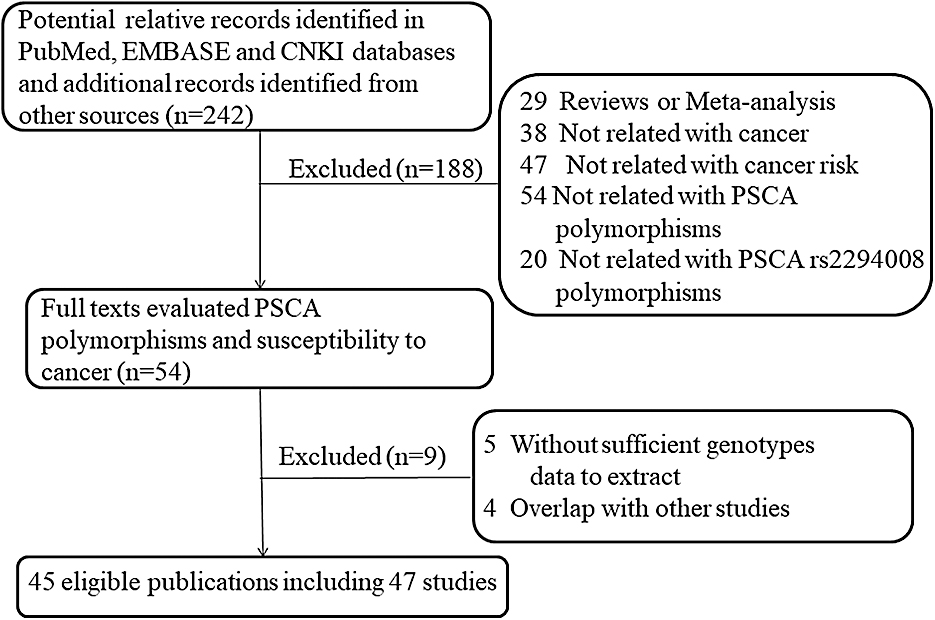
Flowchart of studies selected procedure of this meta-analysis.
The main characteristics of the studies are listed in Table 1. Twenty-six studies investigated gastric cancer (Cai et al., 2017; García-González et al., 2015; Gonzalez-Hormazabal et al., 2020; Ichikawa et al., 2015; Ju et al., 2015; Kupcinskas et al., 2014; Li et al., 2012; Lochhead et al., 2011; Lu et al., 2010; Matsuo et al., 2009; Mou et al., 2015; Ou et al., 2010; Qiu et al., 2016; Rizzato et al., 2013; Sakamoto et al., 2008; Sala et al., 2012; Song et al., 2011; Sun et al., 2015; Sun et al., 2014; Turdikulova et al., 2016; Wu et al., 2009a; Yan et al., 2019; Zeng et al., 2011; Zhang et al., 2015; Zhao et al., 2013), nine bladder cancer (Fu et al., 2012; Kadhum et al., 2021; Lee et al., 2014; Ma et al., 2013; Matsuda et al., 2015; Wang et al., 2014; Wang et al., 2010; Wu et al., 2009b; Yang et al., 2018).
Main Characteristics of Studies Involved in This Meta-Analysis for an Association Between Prostate Stem Cell Antigen rs2294008(C/T) Polymorphism and Cancer Risk
DHPLC, PCR-based denaturing high-performance liquid chromatography; GSA, Infinium Global Screening Array-24 BeadChip; GWAS, genome-wide association study; HB, hospital based; HRM, high-resolution melting; HWE, Hardy-Weinberg equilibrium; LDR, ligase detection reaction; MAF, minor allele frequency; NA, not available; PB, population based; PCR, polymerase chain reaction; PCR-RFLP, PCR-based restriction fragment length polymorphism; RT-PCR, real time-polymerase chain reaction; USA, United States of America.
In addition, two studies investigated gallbladder cancer (Ono et al., 2013; Rai et al., 2013), two esophageal cancer (Dai et al., 2014; Lochhead et al., 2011), two breast cancer (BRCA) (Almozyan et al., 2017; Kadhum et al., 2021; Kim et al., 2012; Wang et al., 2016a), two colorectal cancer (Kupcinskas et al., 2015; Smith et al., 2012), two prostate cancer (Joung et al., 2011; Lee et al., 2017), one cervical cancer (Wang et al., 2016b), and one oral squamous cell carcinoma (Zhao et al., 2018).
Thirty-four studies were carried out in Asian research subjects and 13 in Caucasians. Fourteen study designs were PB, 33 were HB, and not FB. In most studies, HWE for the control subjects were >0.05, with three exceptions (Cai et al., 2017; Qiu et al., 2016; Yan et al., 2019).
Quantitative analyses
The main results of this meta-analysis are listed in Table 2. The association between the PSCA rs2294008 (C/T) polymorphism and cancer risk were evaluated using five models employing a random pooling method due to the heterogeneity among studies being highly significant (p < 0.001). In all of the inheritance models except the recessive, the pooled effects indicated that the PSCA rs2294008 T allele was associated with an increased overall cancer risk (allelic model T vs. C: OR = 1.120, 95% CI = 1.056-1.188, p < 0.01; homozygote model TT vs. CC: OR = 1.206, 95% CI = 1.066-1.364, p = 0.03; heterozygote model CT vs. CC: OR = 1.249, 95% CI = 1.151-1.356, p < 0.01; dominant model [CT+TT] vs. CC: OR = 1.248, 95% CI = 1.147-1.359, p < 0.01; recessive model TT vs. [CT+CC]: OR = 1.051, 95% CI = 0.954-1.156, p = 0.314) (Table 2 and Fig. 2).

Forest plots of cancer risk associated with the PSCA rs2294008(C/T) polymorphism stratified by cancer type in five models:
Quantitative Synthesis of the Associations Between Prostate Stem Cell Antigen rs2294008(C/T) Polymorphism and Cancer Risk in Five Models
Bold values indicates p = 0.002.
CI, confidence interval; OR, odds ratio.
When stratifying by cancer type, the association between the rs2294008 T allele and cancer risk was maintained in gastric cancer (T vs. C: OR = 1.194, 95% CI = 1.086-1.3132, p < 0.01; TT vs. CC: OR = 1.322, 95% CI = 1.063-1.644, p = 0.012; CT vs. CC: OR = 1.448, 95% CI = 1.303-1.608, p < 0.01; [CT+TT] vs. CC: OR = 1.441, 95% CI = 1.278-1.625, p < 0.01; TT vs. [CT+CC]: OR = 1.051,95% CI = 0.881-1.252, p = 0.584) (Fig. 2), and bladder cancer (T vs. C: OR = 1.113, 95% CI = 1.039-1.193, p = 0.002; TT vs. CC: OR = 1.201, 95% CI = 1.055-1.366, p = 0.005; CT vs. CC: OR = 1.203, 95% CI = 1.083-1.335, p = 0.001; [CT+TT] vs. CC: OR = 1.204, 95% CI = 1.080-1.342, p = 0.001; TT vs. [CT+CC]: OR = 1.103,95% CI = 1.035-1.175, p = 0.002).
We also performed subgroup analyses by ethnicity and genotyping method, the PSCA rs2294008 (C/T) polymorphism increased cancer risk in all ethnic Asian and Caucasian populations, and in the study genotyped through GWAS, polymerase chain reaction (PCR)-RFLP and real time (RT)-PCR (Table 2 and Fig. 2). These results demonstrate that the PSCA rs2294008 (C/T) polymorphism increases the cancer risk in gastric and bladder cancer.
Heterogeneity, sensitivity analysis, and publication bias
Heterogeneity was determined using the χ2-based Q-test and was found in pooling models (p < 0.01 in all four models). The random model was utilized to generate a larger pool of studies with 95% CIs. We performed the sensitivity analysis by assessing the influence of each individual study on the overall OR. No individual study affected the pooled OR markedly. We also conducted Begger's funnel plot and Egger's test to assess the publication bias of all eligible literature.
The shapes of the funnel plot were symmetrical in five comparison models (Supplementary Fig. S1), and statistical results from Egger's test still did not show publication bias (p = 0.861 in T vs. C model, p = 0.297 in TT vs. CC model, p = 0.709 in CT vs. CC model, p = 0.524 in [CT+TT] vs. CC model, p = 0.310 in TT vs. [CT+CC] model). These findings demonstrate that publication bias, if any, did not significantly affect the results of our meta-analysis for the association between the PSCA rs2294008 (C/T) polymorphism and cancer risk.
PSCA mRNA expression levels in gastric cancer are downregulated
The transition from cytosine (C) to thymine (T) at the PSCA rs2294008 locus decreases transcriptional activity. To explore the PSCA mRNA levels in gastric cancer and the corresponding normal adjacent tissues, two different online databases were utilized. The GEPIA database contained mRNA expression data of the PSCA gene in gastric cancer samples and normal adjacent tissues (Fig. 3A). PSCA was significantly downregulated in stomach cancer. We next evaluated the expression of PSCA between gastric tumors and matched normal samples in TIMER data set with RNA-seq data from TCGA (Fig. 3B). The result was mostly consistent with the aforementioned online database. However, PSCA expression was significantly higher in BRCA, liver hepatocellular cancer, pancreatic adenocarcinoma, and uterine corpus endometrial carcinoma.

The expression level of PSCA in different types of tumor tissues and normal tissues.
Discussion
Genetic susceptibility is an important factor for the development of cancer, as well as interactions with environmental elements (Berlau et al., 2004). It is known that SNPs can contribute to interindividual differences in cancer susceptibility (Hellwig et al., 2010). The influence of the PSCA rs2294008 (C/T) polymorphism on cancer risks has been studied intensively (Saeki et al., 2010; Sakamoto et al., 2008). PSCA serves as tumor suppressor gene in gastric cancer; it is involved in cell adhesion, proliferation, and survival during carcinogenesis and its varying expression levels contribute to an individuals' susceptibility for cancer (Saeki et al., 2010).
The transition of cytosine to thymine at this locus changes PSCA transcriptional activity, resulting in decreased PSCA protein levels. In contrast, the PSCA rs2294008 T allele is related to an increased bladder cancer risk and mRNA expression in bladder tumor and normal adjacent bladder tissue (Fu et al., 2012). Notably, some reports revealed an inverse association between the rs2294008 C/T polymorphism and esophageal, cervical, and oral squamous cell carcinomas. These seemingly contradictory results were the cause of this meta-review.
This meta-analysis included 45 articles, with cancer cases and non-cancer controls, to demonstrate the effect of the PSCA rs2294008 (C/T) polymorphism on cancer risks. The results showed that the PSCA rs2294008 (C/T) SNP was associated with an increased cancer risk. In stratification analyses, we found that the PSCA rs2294008 T allele carriers with gastric or bladder cancer had higher cancer susceptibilities. A previous meta-analysis on the relationship between the PSCA rs2294008 (C/T) polymorphism and gastric and bladder cancer showed similar findings to our analysis.
They found that the PSCA rs2294008 (C/T) polymorphism was significantly associated with an increased risk of gastric cancer, especially in diffuse and noncardia gastric cancer (Mocellin et al., 2015; Qiao and Feng, 2012; Qin et al., 2017; Wang et al., 2017; Wang et al., 2012; Zhang et al., 2012). For bladder cancer, they found that the PSCA rs2294008 T allele was a risk factor; however, the OR of the meta-analysis was lower than that in gastric cancer patients (Deng et al., 2019; Li et al., 2015; Zhao et al., 2014).
Interestingly, we found the PSCA rs2294008 C/T allele frequencies were not consistent across different ethnic groups. The T allele is more prevalent in the Japanese population among both control and cancer subjects (Ichikawa et al., 2015; Ono et al., 2013; Sakamoto et al., 2008), which was inverse of other countries. The discrepant results likely originate from genetic background differences of different ancestries. Except for gastric and bladder cancer, there were no associations between the PSCA rs2294008 (C/T) polymorphism and cancer risk. Notably, there were inverse associations between the PSCA rs2294008 (C/T) polymorphism and cancer risk in cervical and oral squamous cell carcinoma. These discrepant results could originate from two aspects: first, there were different mutation spectrums in different types of cancer, so the role of PSCA on tumorigenesis and progression varied.
In gastric and esophageal cancer, PSCA was downregulated and served as tumor suppressor gene, However, PSCA was overexpressed in bladder, ovarian, and pancreatic cancers (Xu et al., 2020), so we scoped out the role of PSCA on tumorigenesis and progression varied in different cancers, the specific mechanism need to be fully explored. Second, the inconclusive findings from some cancer types were likely due to a dearth of relevant studies as there were only one or two studies on the association between the PSCA rs2294008 polymorphism and prostate, esophageal, breast, colorectal, gallbladder, cervical, and oral cancer risk.
There were different sensitivity and specificity in the studies that used different genotyping platforms, so we analyzed associations between the PSCA rs2294008 (C/T) polymorphism and cancer risk grouped by genotyping method. We found that the PSCA rs2294008 (C/T) polymorphism increased cancer risk in the study genotyped through GWAS, PCR-based restriction fragment length polymorphism (PCR-RFLP), and RT-PCR. These three genotyping methods has been very mature and used extensively, some methods, such as GSA and high resolution melting were rarely used, perhaps they are prone to genotyping error.
This meta-analysis is not without limitations. First, subgroup stratification analyses were conducted, but the results must be interpreted with caution, because the number of published studies on esophageal, colorectal, breast, and prostate cancer were limited to one or two for these cancer types Thus, these stratification analyses results should be further verified with additional studies in the future. Second, a crucial problem for our meta-analysis was heterogeneity among the included studies. Therefore, we used the random model to calculate the OR to minimize the interference from heterogeneity. Third, this meta-analysis was based on unadjusted data, as the genotypic information stratified for the main confounding variables was not available in the original articles and also the confounding factors addressed across the different studies were variable.
The adjusted estimates could give more precise and stronger associations, as they reduced the impact of possible confounding factors. Finally, although the p-value was >0.05 in the Egger's test to assess the publication bias, some plots in the funnel plot was out of a 95% CI (Supplementary Fig. S1), which could influence the conclusions of this meta-analysis. To garner a precise association between the PSCA polymorphisms and cancer susceptibility, it is essential to perform larger studies in the future.
It has been reported that the transition from cytosine to thymine at the PSCA rs2294008 locus reduces PSCA transcriptional activity (Saeki et al., 2010). We explored the PSCA mRNA levels in gastric cancer and the corresponding normal adjacent tissues in two online databases, GEPIA database and TIMER data set, and found PSCA mRNA expression levels in gastric cancer were downregulated. The transition of C to T at the PSCA rs2294008 locus confers susceptibility for gastric cancer; however, this conversion results in a decrease of PSCA expression, which is in conflict with PSCA acting as an oncogene. Thus, the underlying mechanisms need to be further studied.
Despite the aforementioned flaws, this current meta-analysis strongly supports an association between the PSCA rs2294008 (C/T) polymorphism and increased cancer genetic susceptibility, especially for gastric cancer in Asian populations.
Footnotes
Authors' Contributions
L.G. was involved in conception and designing this study, and revising the article. X.-f.W. and D.-l.L. collected, analyzed, and interpreted the data, drafted and revised the article.
Author Disclosure Statement
No competing financial interests exist.
Funding Information
This study was supported by a grant from The First Affiliated Hospital of Zhengzhou University, China. Grant nubmer: LHGJ20140051.

References
Supplementary Material
Please find the following supplemental material available below.
For Open Access articles published under a Creative Commons License, all supplemental material carries the same license as the article it is associated with.
For non-Open Access articles published, all supplemental material carries a non-exclusive license, and permission requests for re-use of supplemental material or any part of supplemental material shall be sent directly to the copyright owner as specified in the copyright notice associated with the article.
