




Abstract
Introduction:
Autoimmune thyroid diseases (AITD) are usually accompanied by anti-thyroid antibodies which can serve as early predictive markers. This study was designed to investigate the relationship between thyroid peroxidase (TPO) gene variants and the presence of TPOAb and to evaluate the effect of environmental factors associated with seroconversion from TPOAb-negative to TPOAb-positive.
Methods:
Participants from phases 1 and 2 of the Tehran Thyroid Study in (n = 5327, ≥20 years) were evaluated in terms of TPOAb positivity, and its relationship with 53 single nucleotide polymorphisms (SNPs) from within the TPO gene (cross-sectional approach). TPOAb-negative participants (n = 4815) were followed up for seroconversion for 5.5 years. The relationship between the TPO gene variants and the TPOAb seroconversion was evaluated (longitudinal approach).
Results:
There were 521 TPOAb-positive participants in the cross-sectional phase and 266 new TPOAb-positive cases observed during the follow-up period. After quality control (Hardy-Weinberg equilibrium (p < 1 × 10⁻⁵) and minor allele frequency < 0.05), 49 SNPs were qualified for association analyses. From this set fourteen SNPs were identified that were associated with TPOAb positivity. rs6605278, located in the 3′UTR TPO gene, was the most highly significantly associated of the variant and remained associated after adjustment for age, gender, body mass index (BMI), smoking, number of parity, and oral contraceptive consumption in both cross-sectional and longitudinal analyses (p < 0.05).
Conclusions:
TPOAb-positivity can be partially explained by variants in the TPO gene. New TPOAb-associated SNPs were observed in Iranians as an ethnically diverse population.
Introduction
Autoimmune thyroid diseases (ATIDs) are among the most prevalent autoimmune disorders (Delshad et al., 2012). Although the exact pathogenesis of these disorders is not yet understood, increasing evidence confirms the role of genetic factors in collaboration with environmental triggers (Zeitlin et al., 2008). The development of ATIDs is underpinned by antibody production against the infrastructures of the thyroid gland. Although thyroid peroxidase antibody (TPOAb) has not been identified as a direct cause of thyroid cell destruction, there is a strong association between TPOAb and autoimmune thyroid disorders as they are present in the serum of 90% to 95% of Hashimoto thyroiditis patients (Hansen et al., 2006). Accordingly, TPOAb can be a reliable serological marker for diagnosing AITDs.
The prevalence of antithyroid antibodies is 5-24% in different communities (Hollowell et al., 2002; Vanderpump et al., 1995). Its prevalence has been reported to be above 10% in a study conducted in the framework of the National Health and Nutrition Examination Survey (NHANES) (13% for TPOAb and 11.5% for thyroglobulin antibody [TgAb]) (Hollowell et al., 2002). The prevalence of TPOAb was 12.8% in the Tehran Thyroid Study (TTS) (Amouzegar et al., 2017).
Genetic background plays the most critical role in predisposing to an autoimmune disorder (Eschler et al., 2011; Lee et al., 2022; Tomer, 2010). Kwak et al. (2014), performed a two-stage genome-wide association studies (GWAS) on 4238 individuals and measured the serum levels of TSH, T4, and TPOAb. They identified a novel variant of the thyroid peroxidase (TPO) gene associated with the TPOAb positivity. Two meta-analysis surveys also assessed GWAS to demonstrate the association of genetic variant with TPOAb positivity and its serum levels. In a meta-analysis survey by Medici et al. (2014), the coexistence of multiple variants in an individual considerably increased the risk of positive TPOAb and increased levels of TSH. In the other meta-analysis by Matana et al. (2019), a novel variant in the GRIN3A gene was significantly associated with levels of TPOAb in women (Matana et al., 2019). No study has longitudinally evaluated the relationship between single nucleotide polymorphisms (SNPs) of the TPO gene and TPOAb seroconversion.
This study aimed to investigate the relationship between the variants of TPO locus (53 SNPs) and TPOAb positivity/seroconversion on a “candidate gene study” platform and evaluate the effect of some environmental factors on their conversion.
Materials and Methods
Subjects and study design
This study was conducted in the TTS framework, a cohort study in the Tehran Lipid and Glucose Study (TLGS), to collect comprehensive information on thyroid diseases and their long-term consequences in Tehran capital of Iran. TLGS and TTS have been described in other studies in detail (Amouzegar et al., 2017; Azizi et al., 2018). Briefly, TTS was introduced in 1997 and was designed in two stages: The first stage was cross-sectional (phase 1), and the second stage was a longitudinal study (phases 2, 3, and 4). The length of each phase was about 3 years. The total population of TTS was 5783 persons. There were 4174 persons in the first phase and 1609 new subjects in the second phase. The TTS subjects were adults (aged ≥20 years) with thyroid function test results (Amouzegar et al., 2017).
In the present study, the first stage was cross-sectional (the first phase of TTS), and the second one was a longitudinal study (phases 2-4 of TTS). The study population encompassed the TTS participants who had genotype data for the selected TPO gene variants and information for TPOAb test results at baseline (first and second phase of TTS). Pregnant women (n = 40) were excluded from this study. In the cross-sectional stage, we examined the correlation between different variant genotypes of the TPO gene and positive TPOAb. In the second stage of the study, TPOAb positive subjects (n = 521) were excluded from the analysis, and negative TPOAb subjects (n = 4237) were examined in subsequent phases until TPOAb seroconversion was noticed (Phase 4). Figure 1 shows the flowchart of the participant selection.
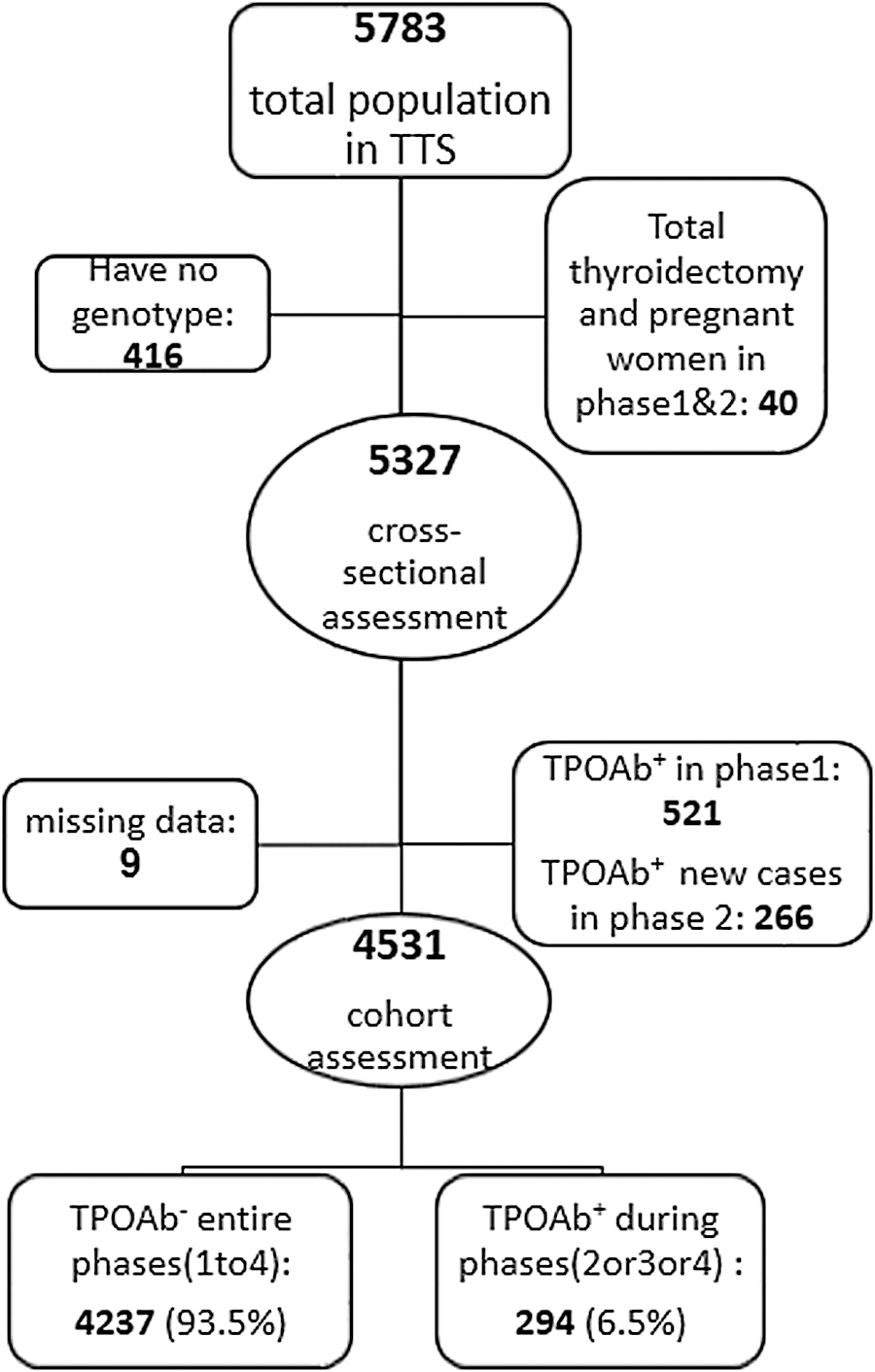
Flowchart of participants in TTS. TTS, Tehran Thyroid Study.
The effect of variants on seroconversion was evaluated in the presence of potential influential factors, including age and gender. Based on the reports that show the effect of obesity (Song et al., 2019), smoking (Zhang et al., 2019), use of oral contraceptive pills (OCPs) (Qiu et al., 2021), pregnancy, and the number of parity (Korevaar et al., 2017) on the incidence of thyroid autoimmunity, we also considered their probable effect in this association study. This study was reviewed by the Ethics Committee of the Endocrine and Metabolism Research Center of the Shahid Beheshti University of Medical Sciences (Code: IR.SBMU.ENDOCRINE.REC.1398.017).
Phenotypic measurements and covariates
The TPOAb measurements were performed on frozen serum samples. All samples were measured on the same day by the IEMA (Immunoenzymometric assay) method using the monoband, Inc. (Lake Forest, CA, USA) kit. Inter- and intra-assay CVs were 3.9% and 4.7%, respectively. This kit's normal (negative) range was below 35 IU/mL (Amouzegar et al., 2017). Body mass index (BMI) was calculated as weight in kilograms divided by the height in squared meters. Weight and height were taken by trained health care providers and were measured according to the standard protocol. Data on parity, smoking, and OCP consumption (biphasic or triphasic contraceptive tablets) were evaluated by a questionnaire. Smoking status was categorized as ever (daily or nonpermanent consumption) and never smokers according to the response to the relevant question in the questionnaire (Azizi et al., 2002).
Genotyping
Blood samples were used to extract genomic DNA from peripheral lymphocytes (Truett et al., 2000). The quality and quantity of the extracted DNAs were assessed by electrophoresis and spectrophotometry. Genotyping was performed with Illumina Human OmniExpress-24-v1-0 bead chip containing 649,932 SNP loci (Illumina, Inc., San Diego, CA) (Daneshpour and Fallah, 2017). Moreover, 65 SNPs of the TPO gene were recognized. Following the quality check, the genotype information for the selected markers was extracted from the chipped dataset for all individuals.
Quality control and genetic association
Deviation from Hardy-Weinberg equilibrium (HWE) (p < 1 × 10⁻⁵) and minor allele frequency (MAF) <0.05 were used to filter out low-quality SNPs. Ten SNPs were excluded from the study according to HWE, 2 SNPs were monomorphic, and 4 had MAF <0.05. Finally, 49 SNPs were considered for SNP association analysis. The readers can find detailed information about all SNPs and SNP-selection flowchart in Supplementary Table S1 and Supplementary Figure S1.
Statistical analysis
For describing the participants' characteristics, mean and standard deviation were presented for continuous variables (age, number of parities, and BMI), and median and interquartile ranges were presented for continuous variables with non-normal distribution (TPOAb level). Qualitative variables (gender, smoking, and OCP consumption) were reported in percentages and frequencies. Levene's test (for equality of variances), t-test (for equality of means), and chi-square test (for equality of proportions) were used to detect the differences. A logistic regression model was built by adjusting for age, gender, smoking status, BMI, the number of parties, and the first two principal components (PC1 and PC2). We used Bonferroni correction for multiple testing (as we compared genotype frequencies of 49 SNPs), to modify the raw p-values (Jafari and Ansari-Pour, 2019) using p.adjust function in R.
To calculate HWE and evaluate genetic association statistically, the researchers used PLINK2. The reference alleles were selected according to the GWAS catalog web reference, and the genotype was considered the count of such alleles to include the models. Sequence kernel association test (SKAT) was used to increase the study power by integrating the effects of rare and common variants (Wu et al., 2011). Accordingly, 53 SNPs were tested by SKAT (Supplementary Table S1). The SKAT model was designed and implemented in two steps. During the first step, the Haploview software and using the Four-gamete rule split SNPs into linkage disequilibrium (LD) blocks. In this step, SNPs were assigned into 17 blocks (Supplementary Figs. S2 and S3). The association between TPOAb positivity and the haplotype blocks was adjusted for age, gender, smoking, parity, BMI, OCP consumption, PC1, and PC2.
The statistical power of the cross-sectional (sample size of 5327) and the longitudinal (sample size of 4531) stages of the study was assessed by the SKAT package. The study power values were 76% and 72% for the first and the second stages, respectively (significance level = 0.05).
Results
The participants' main characteristics at the baseline are summarized and presented in Table 1. This study recruited 5327 of the 5783 individuals who participated in the TTS. In this regard, 40 pregnant women and 416 subjects without genotyping were excluded (Fig. 1). At the baseline TPOAb, negative and positive subjects were 4531 (85.2%) and 787 (14.8%), respectively. In the first stage of the study with a cross-sectional approach, we assessed 49 SNPs by the logistic regression model in PLINK2, considering the positive TPOA as the primary outcome. After modifying the raw p-values derived from the model for each SNP, 14 SNPs out of 49 revealed a significant correlation with positive TPOAb (p < 0.05) (Table 2). In this regard, only age and female gender increased the probability of positive TPOAb (OR >1; p < 0.05); however, smoking played a protective role (OR <1; p < 0.05) (Supplementary Table S2).
Baseline Characteristics of Participants
The number and percentage of TPOAb positive and negative individuals were evaluated based on all individuals in phases 1 and 2.
TPOAb ≥35 IU/mL.
Based on OCP use in Phase 2 (OCP consumption information in Phase 1 not available).
CI, confidence interval; OCP, oral contraceptive pill; OR, odds ratio; SD, standard deviation; TPOAb, thyroid peroxidase antibody.
Significant Associations Between 14 Single Nucleotide Polymorphisms and Positive Thyroid Peroxidase Antibody in Cross-Sectional Approach After Adjustment for Confounders
Confounders were age, sex, BMI, smoking, and the number of parities. Age, gender, and BMI significantly affected positive TPOAb, and smoking had a significant protective effect.
BMI, body mass index; SNP, single nucleotide polymorphism.
In the second phase of the study, with a longitudinal approach to follow-up TPOAb seroconversion, 294 subjects were identified as having seroconversion. After Bonferroni correction, rs6605278 revealed a significant association with the TPOAb seroconversion both before (OR = 0.408, p = 0.024) and after (OR = 0.283, p = 0.018) adjustment for the confounder variables (p < 0.05). Our findings showed that age and BMI significantly affected the relationship between this SNP and seroconversion in the longitudinal approach (Supplementary Table S3). Age had a protective effect on the TPOAb seroconversion risk (OR = 0.962, p < 0.001); however, BMI increased the risk (OR = 1.527, p < 0.001).
Using SKAT, 53 studied SNPs were divided into 17 blocks, according to their common LD (Supplementary Figs. S2 and S3). The results of the final analysis in the cross-sectional stage showed that two of the blocks had a significant association with positive TPOAb (block No. 4, including rs11211644, rs1546588, rs11675342, rs11675434, rs13400534, and rs11682968; p = 0.009, and block No. 11, including rs6588678, rs2048722, rs1126797, rs13430369, rs2276704, rs13431173, rs732609, rs3755551, and rs9383300; relationship = 0.015). In the longitudinal analyses, however, none of the blocks showed a significant relationship with the TPOAb seroconversion (p > 0.05) (Table 3). Table 4 shows all SNPs with a significant relationship in each study stage and the concerning statistical analyses.
Association Between TPO Gene Single Nucleotide Polymorphism Blocks (Based on Common Linkage Disequilibrium) and Thyroid Peroxidase Antibody Positivity in Cross-Sectional and Longitudinal Approaches with SKAT Software
MAP = minimum achieved p-value (significant is MAP <0.05).
MAP in cross-sectional stage.
MAP in cohort stage.
SKAT, sequence kernel association test.
Variants with Significant Association
Both the cross-sectional and longitudinal studies are significant.
Both the logistic regression and the SKAT analysis (in the cross-sectional stage) are significant.
Discussion
Factors affecting the production of antibodies against thyroid structure are not yet well-understood. Although the most genetic studies for recognition of the loci and variants associated with susceptibility or clinical manifestations of AITDs have focused on immune-related genes (Du and Zhu, 2022; Lee et al., 2022; Liu et al., 2020; Mestiri and Zaaber, 2020), thyroid-specific genes, including TPO, have also been investigated in recent decade (Ahmed et al., 2021; Faam et al., 2012; Khoshi et al., 2017; Tomari et al., 2017).
In the present study, we investigated the relationship between 53 SNPs near or within the TPO gene, with the TPOAb positivity and also TPOAb conversions from negative to positive (TPOAb seroconversion) over time. Our study included an adult sample of 5327 cases with TPOAb test results at the baseline and four phases of TTS. While the previous studies on GWAS have reported many variants associated with the TPOAb levels or its positivity, only a few of identified associated variants are located inside or near the TPO locus (Brčić et al., 2019; Kwak et al., 2014; Matana et al., 2019; Medici et al., 2014). Nevertheless, we found 14 TPO gene variants in association with TPOAb positivity and/or serconversion that are reported for the first time, according to dbSNP (https://www.ncbi.nlm.nih.gov/snp/). We also revealed the joint effect of grouped SNPs within four haplotype block, using sequence kernel association test (SKAT).
TPO is the major enzyme in thyroid hormone biosynthesis. The human TPO is a homodimer protein encoded by a single copy gene located on the short arm of chromosome 2 (2p25, Gene ID 7173). In this study, we recognized 14 variants that are introducing associated with TPOAb and/or serconversion for the first time. Among these variants, rs2071402 is located in 5′ untranslated region (5′UTR) and rs1126799 is located in exon 15 of TPO gene. These two SNPs have been investigated by Tomari et al. (2017), along with six other SNPs of the TPO gene, and showed no association with serum levels of TPOAb in AITD Japanese patients.
Rs6605278 is the most significant variant that remained associated with TPO levels after adjustment for covariates in both phases of this study (cross and longitudinal). This SNP is located in the 3′UTR TPO gene near the edge of a cis-regulatory element (EH38E1967272) and is classified as a mark for Acetylation of the lysine residue at N-terminal position 27 of the histone H3 protein (H3K27ac). It has been suggested that epigenetic modifications, including histone modifications, have been introduced as factors that affect splicing regulatory element function to promote or suppress alternative splicing. In contrast, noncanonical alternative splicing may be an important mechanism for the generation of untolerized epitopes that may lead to autoimmunity (Ng et al., 2004). To understand the molecular mechanisms that link this variant to the risk of thyroid autoimmunity, it is necessary to perform functional genetic variation study.
The other newly identified associated SNPs (except rs4490233) are located in the intronic sequences of TPO gene. Introns are contributing in the control of transcript levels by affecting the rate of gene expression (intron-mediated enhancement), nuclear export, transcript stability, splicing, and the efficiency of mRNA translation (Rigau and Juan, 2019; Shaul, 2017). There are remarkable number of reports of pathogenic intronic variants (Vaz-Drago et al., 2017). The role of intronic SNPs in elevation expression of the proteins has also been reported in association with a greater risk for autoimmunity (Sinha et al., 2019). The intronic SNPs may elevate the levels of TPO and trigger autoimmune thyroiditis by modifying thyrocyte homeostasis. Similar effect has been revealed for bacterial lipopolysaccharide that triggers experimental autoimmune thyroiditis in mice by enhancing TPO gene expression (Burek and Talor, 2009).
Haplotype analysis empowered the genetic association analysis compared to analysis of individual SNPs (Diao and Lin, 2020). We identified two haplotype blocks (Nos.4 and 11) significantly associated with TPOAb positivity in the cross-sectional stage of this study. Rs11675434, located near the TPO gene, was recognized in block No. 4. This SNP has been reported in GWAS meta-analyses in 18,297 individuals for TPOAb-positivity and 12,353 individuals for TPOAb serum levels (Medici et al., 2014), indicating a significant relationship with both phenotypes (p = 1.5 × 10⁻⁶ and 1.4 × 10⁻¹³, respectively). It can be assumed that block 4 has been recognized as an associated block owing to the presence of such a strongly associated SNP.
Intronic SNp rs2048722 in haplotype block No. 11 has been examined in Japanese AITD patients and showed significant association with serum levels of TPOAb (Tomari et al., 2017). Meanwhile, rs732609 in this block reported not being associated with TPOAb levels in Japanese, but has been associated with the TPOAb levels in Iranians with subclinical hypothyroidism (Khoshi et al., 2017) and with hypothyroidism in Indians (Balmiki et al., 2014). This variant is a missense mutation in exon 12 (Thr725Pro) and could affect the interactions with the heme prosthetic group in the catalytic site (Begum et al., 2019). Accordingly, slight changes in the TPO structure following a single residual substitution may trigger an autoimmune reaction.
Regarding the confounders, observations in the cross-sectional stage indicate that female gender and higher BMI increase the probability of positive TPOAb; however, smoking has a protective role in most variants. Several studies have reported decline in the concentrations of serum thyroid autoantibodies in smokers (Belin et al., 2004; Zhang et al., 2019). It has been suggested that the reduced risk of thyroid autoantibodies (TPOAb and TgAb) positivity in smokers may be due to the effect of smoke on adaptive immune cells; smoking can increase the number of CD3+ and CD4+ T cells while it reduces CD8+ T cell numbers. CD8+ T cells play a critical role in the thyroid antigen recognition process (Qiu et al., 2017).
We also observed statistically significant effect for age in increasing the risk of TPOAb positivity in the cross-sectional phase. However, adopting a longitudinal approach that enabled us to measure age-related changes in subjects, we found that aging did not always increase the likelihood of TPOAb positivity. In other words, the risk increases for a while with age and then decreases. A possible explanation for lower risk of thyroid autoimmunity in the elderly might be the expansion of several protective regulatory mechanisms highly characteristic in the elderly; of note is the higher production of peripheral T-regulatory cells (Vadasz et al., 2013). It has also been suggested that higher thyroid autoimmunity in the elderly might be an expression of age-associated processes rather than the consequence of the aging process itself (Keyhanian et al., 2019).
In the present study, the risk of TPOAb positivity increases in line with BMI. It is suggested that weight gain increases the incidence of thyroid autoimmunity. The relationship between obesity and the increased prevalence of autoimmune diseases, including AITDs, has been reported in some previous studies (Bhowmick et al., 2007; Gremese et al., 2014; Habib et al., 2020; Song et al., 2019; Zynat et al., 2020). Chronic low-grade inflammation in obesity seems involved in the pathogenesis of autoimmune diseases such as AITDs and TPOAb positivity (Gremese et al., 2014).
Findings of this research showed no effect for parity on TPOAb positivity. The same result has been previously documented in the TTS population (Takyar et al., 2020). The results show a small increase in the risk of TPOAb positivity due to taking the OCPs in women. The relationship between use of OCPs and hypothyroidism has been reported previously in cross-sectional and cohort studies (Qiu et al., 2021; Williams, 2017). Different studies indicated that synthetic estrogens, the dominant components of OCPs, and their metabolites induce thyroid autoimmunity by activating signaling pathways and apoptosis process (Antico-Arciuch et al., 2010; Ng et al., 2004).
This study examined the relationship between TPO gene variants and seroconversion during about 5.5 (5.54 ± 1.62)-year follow-up period. This longitudinal relationship has not been previously examined. There was a significant relationship between four and three variants before and after adjustment for covariates, respectively. Rs1126799 is common between cross-sectional and longitudinal-associated variants, and the other variants are reported for the first time regarding TPOAb.
The strengths of this study were an acceptable sample size in the cross-sectional approach, the prospective approach to evaluate confounder variables, and an acceptable follow-up period. Adopting a longitudinal approach that can examine the effect of the confounders on an outcome in the presence of a specific SNP is another strength of this study. Genetic statistical analysis methods, especially the “Sequence Kernel Association Test” such as SKAT software in the present study, can increase statistical analysis strength.
As a limitation in this study, decreasing the TPOAb positive subjects in a longitudinal approach resulted in an insufficient sample size for adequate power. Positive TPOAb levels alone would not indicate AITDs; hence, it is better to use thyroid function tests to diagnose the clinical condition of the thyroid. In the present study, genetic variants were extracted from the ChIP-PED data in the GWAS test; however, the number of SNPs selected for the final analysis is much lower than the conventional GWASs. In this regard, further studies on the whole genome would provide more reliable findings in genetic studies.
This study was performed on a gene. Considering GWAS review data, further studies are recommended to examine other genes (e.g., genes associated with thyroid structure, nonthyroid structures, and immune system) and even structural variants. Moreover, valuable findings would also be obtained by comparing the outcomes of clinical diseases such as hypothyroidism with genetic findings. Subsequent studies using a longitudinal approach with long-term follow-up of individuals can delve into more effective confounders in gene expression. Undoubtedly, such studies can open a new window to Personalized (Precision) Medicine and be used to detect, track, or treat autoimmune diseases such as Hashimoto's thyroiditis.
Conclusion
In this population-based study, for the first time, a significant relationship between some TPO gene SNPs and positive TPOAb was revealed and the effect of age, gender, and BMI as confounders on the incidence of TPOAb seroconversion.
Data Availability Statement
Basic information about TLGS and TTS studies is available in previously published articles like reference number 13. The datasets used or analyzed during the current study are available from the corresponding author on reasonable request after permission from the Endocrine and Metabolism Research Center of the Shahid Beheshti University of Medical Science.
Footnotes
Acknowledgment
The authors thank Dr. MirAlireza Takyar for his guidance and suggestions about genetic studies.
Authors' Contributions
F.A., A.A., and S.A.E. were involved in conceptualization and design of the study. A.H.G. and A.Z. were involved in data analysis, interpretation, as well as writing and revising the article. M.S.D. contributed to the whole study management, development of the final protocol of the data selection and analysis. M.A., D.K., and Y.M. were responsible for statistical analysis and quality control. B.R. and S.J.N. contributed to data collection and drafting the article. All the authors read and approved the final article.
Author Confirmation Statement
All authors are from Shahid Beheshti University of Medical Sciences (Tehran, Iran), where education and research are the primary functions.
Author Disclosure Statement
No competing financial interests exist.
Funding Information
No funding was received for this article.

References
Supplementary Material
Please find the following supplemental material available below.
For Open Access articles published under a Creative Commons License, all supplemental material carries the same license as the article it is associated with.
For non-Open Access articles published, all supplemental material carries a non-exclusive license, and permission requests for re-use of supplemental material or any part of supplemental material shall be sent directly to the copyright owner as specified in the copyright notice associated with the article.
