




Abstract
Aim:
Genetic predisposition is an important factor related to the enhancement of inflammation or immune responses in COVID-19 patients. This study aimed to explore the association between the IL-6 (rs1800795) polymorphism and COVID-19 severity in the southwest of Iran.
Methods:
We evaluated these variants in 100 patients with moderate and 100 patients with severe COVID-19 using an (Amplification Refractory Mutation System Polymerase Chain Reaction) ARMS-PCR assay. In addition, we collected clinical characteristics of patients to assess their association with the severity of COVID-19. Statistically, the significance in the present evaluation was p < 0.05.
Results:
Our findings showed a significant association with the SNP-174G/C of the IL-6 gene between the moderate and severe groups of COVID-19 patients under the dominant and codominant genetic models (p = 0.02 and 0.03, respectively). The frequency of the G allele was notably higher in the severe group compared to the moderate group (p = 0.02). Also, the rs1800795 genotypes, as well as the patients’ age and gender (p = 0.13 and 0.31, respectively), were detected. Additionally, we confirmed a significant correlation between clinical data known as risk factors for COVID-19 severity.
Conclusion:
Taken together, understanding the risk factors associated with the increased severity of COVID-19 may provide the opportunity for early and useful intervention in individuals at higher risk.
Introduction
Severe acute respiratory syndrome coronavirus 2 (SARS-CoV-2) belongs to the Coronaviridae family, a large family of single-stranded RNA viruses classified into four main types: α, β, γ, and δ. α- and β-type coronaviruses usually infect mammals, while γ- and δ-type viruses can infect birds (Ruiz-Aravena et al., 2022). SARS-CoV-2 is a β-type coronavirus that causes most of the morbidity and mortality worldwide. It is the cause of the infection known as coronavirus disease 2019 (COVID-19), which leads to death in humans due to respiratory complications (Ahmadi et al., 2022). Therefore, this disease has become a global emergency, and identifying all possible risk factors, such as genetic susceptibility, may influence the progression of infectious diseases (Wang et al., 2020b).
Cytokine storm is a common occurrence in severe infections, including SARS and influenza, which are associated with disease exacerbation and serve as predictors of mortality and disease outcome (Hu et al., 2021). Interleukin-6 (IL-6) is a pleiotropic cytokine located at position 7p15.3, playing a crucial role in host defense. It is rapidly produced by monocytes and macrophages, helping to remove infectious agents and repair damaged tissues by activating immune, hematological, and acute phase responses during infection or tissue damage. When the stress condition is completely removed from the host, IL-6 synthesis stops, and serum IL-6 concentration returns to normal. However, overexpression of IL-6 during periods of infection or tissue damage leads to acute and fatal or persistent production of IL-6 in chronic inflammatory diseases (Jugler et al., 2021). Several studies revealed that IL-6 levels above 80 pg/mL were correlated with a high risk of respiratory failure in COVID-19 patients (McElvaney et al., 2021). In addition, SARS-CoV-2 viral load, which is strongly linked to cytokine storms, is closely associated with IL-6 levels (Chakraborty et al., 2020). Therefore, investigating the potential contribution of IL-6 to the events occurring during SARS-CoV-2 infection would be valuable (Elahi et al., 2022).
Various single nucleotide polymorphisms (SNPs) associated with viral infections, such as SARS-CoV-2 infection, have been reported in the IL-6 gene (Adli et al., 2022). The rs1800795 polymorphism of the IL-6 promoter at position (−174) changes the C allele to G, which can affect the level of this cytokine in the blood. In addition, several studies have shown the importance of the rs1800795 variant in SARS-CoV-2 severity (Wang et al., 2020a; Karcioglu Batur and Hekim, 2021). The association between the rs1800795 polymorphism and the severity of COVID-19 disease has not yet been determined in southwestern Iran. Therefore, our objectives were to explore the association between COVID-19 severity and SNP rs1800795, as well as patients’ clinical status in southwestern Iran.
Materials and Methods
Participants
A total of 200 individuals (100 patients with severe COVID-19 and 100 patients with moderate COVID-19) were included in our study. The group of patients with moderate conditions was defined as those who were positive for the SARS-CoV-2 PCR test and exhibited diverse symptoms of COVID-19 (such as fever, cough, and headache), with blood oxygen levels >94%. Patients with severe conditions were defined as those with blood oxygen levels <94% or viral penetration of the lungs greater than 50%. Due to their need for ventilators, these patients were often cared for in the hospital (Intensive Care Unit) ICU. In our study, the individuals in both groups were unvaccinated at the time of infection.
Our study was conducted under the approval of the Ethics Committee (code: IR.AJUMS.REC.1400.324) of the
DNA isolation and ARMS-PCR
Approximately 5 mL blood samples were collected into EDTA tubes from selected patients, and subsequently the genomic DNA was isolated from them using the prepared kit (Sina Colon, Iran). To describe the properties of SNP by ARMS-PCR, specific primers designed for this polymorphism were used. The sequences of rs1800795 primers used were described by Ahmed and Ghali (2019): Forward: 5′-GAG CTT CTC TTT CGT TCC-3′, Reverse1(R1): 5′-CCT ATT GTG TCT TGC C-3′, Reverse2(R2): 5′-CCC TAG TTG TGT CTT GCG-3′. The PCR reaction solution volume (25 μL) included 10 μmol of Mastermix (2X), 20 pmol of each primer, 200 ng of DNA template, and 10 μL of distilled water. The ARMS-PCR reaction was carried out with initial denaturation for 5 min at 95°C, followed by 30 cycles for 45 s at 95°C (denaturation), 45 s at 60°C (annealing), 1 min at 72°C (elongation), and finally 3 min elongation at 72°C. The PCR products were loaded on an agarose gel (2%). Finally, the sequencing of PCR products confirmed the validity of our result. ABI-3130XL sequenced the final reaction, and DNA analysis was performed using the ABI PRISM 3130 L DNA Analyzer (Applied Biosystems, Foster City, CA, USA) (Fig. 1).
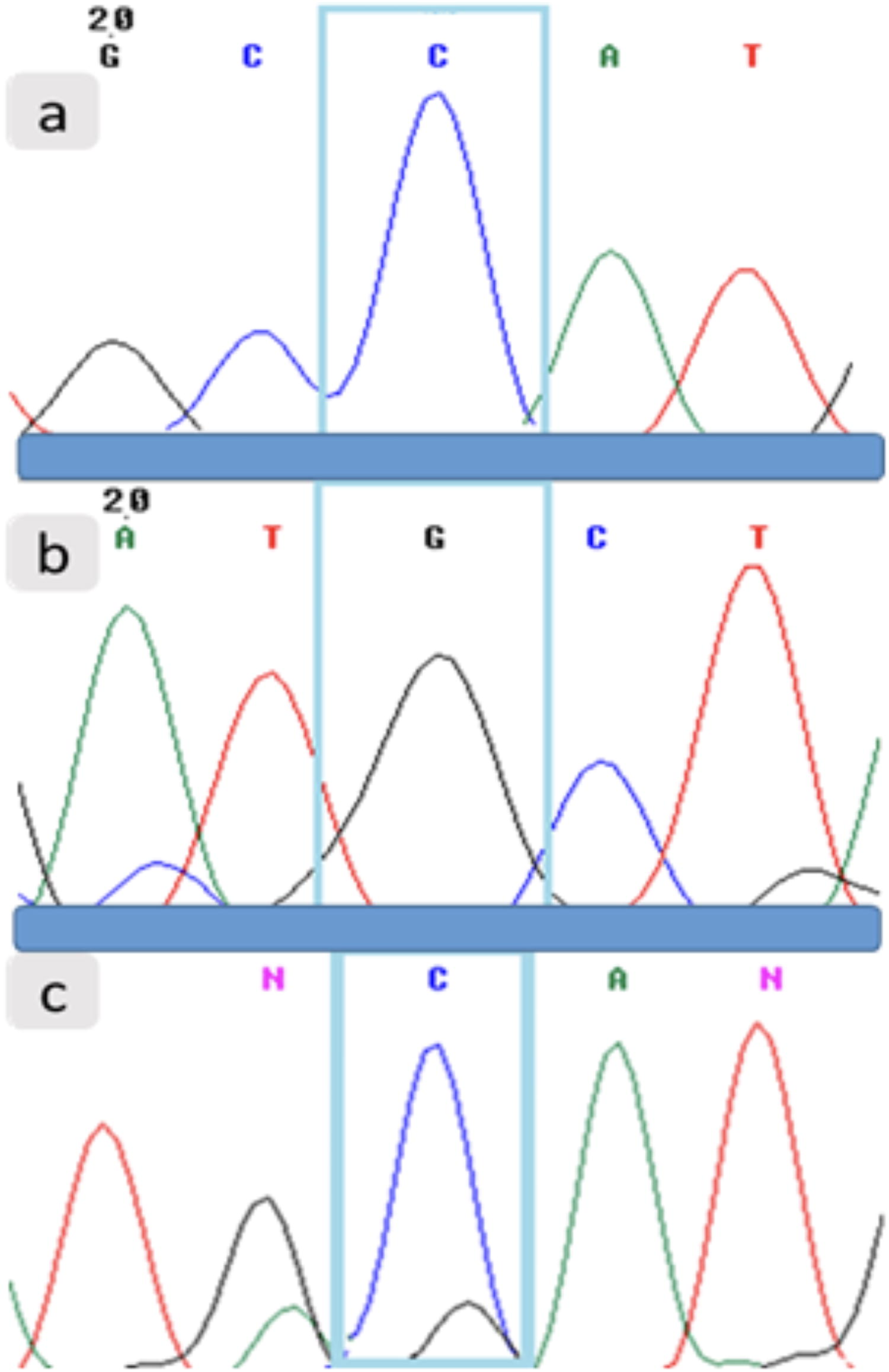
Sequencing report of rs1800795 polymorphism:
Statistical analysis
The software application used to analyze the data was SPSS Statistics version 22.0 for Windows (IBM Corp., Armonk, NY, USA). The genotype distributions and allelic frequency of rs1800795 SNPs between moderate and severe groups were analyzed using Pearson’s chi-squared test. Odds ratios (ORs) and 95% confidence intervals (CIs) were calculated using logistic regression to evaluate the effects of these differences. Also, comparisons of demographic and clinical data between moderate and severe groups were determined by chi-squared.
Results
Association of IL-6 gene polymorphism with the severity of COVID-19
The distributions of genotypes and allelic frequencies of the IL-6 (rs1800795) polymorphism in moderate and severe patients were analyzed to determine whether these variants affected COVID-19 severity (Table 1). Genotype frequencies of IL-6-174G/C (rs1800795) SNP showed significant differences between the moderate and severe groups of patients. There was an association with the severity of COVID-19 and the rs1800795 variant under dominant (GG vs. GC + CC: OR: 1.27; 95% CI: 1.03–1.57; p = 0.02), codominant (GC vs. GG: OR: 2.04; 95% CI: 1.07–3.9; p = 0.03 and CC vs. GG: OR: 1.57; 95% CI: 0.66–3.73; p = 0.30), and recessive (GG + GC vs. CC: OR: 0.49; 95% CI: 0.88–2.73; p = 0.41) genetic models.
Demographic Characteristic and Genotype Distribution of the COVID-19 Patients in the Studied Population
p Value obtained when comparing demographic characteristic and genotype distribution of patients between moderate and severe groups; table static test: χ2.
Codominant 1: GG versus GC.
Codominant 2: GG versus CC.
Dominant: GG versus GC+CC.
Recessive: GG+GC versus CC.
CI, confidence interval; OR, odds ratio.
On the other hand, a notable significant difference in frequency of G versus C alleles of rs1800795 SNP was observed between both patient groups (OR: 1.89; 95% CI: 1.09–3.26; p = 0.02). Furthermore, we stratified the rs1800795 genotype according to age and gender. The rs1800795 genotypes showed no significant association with patients’ age or gender (p = 0.13 and 0.31, respectively).
Association of demographic and clinical characteristics of patients with COVID-19 severity
A total of 200 COVID-19 patients were included in this study, with a mean age of 58.97 ± 15.24 years for the moderate group and 64.32 ± 12.66 years for the severe group. Patients older than 60 years were more frequent in the severe group, and a significant difference was observed in the age distribution (p = 0.001; 95% CI = 1.03; OR = 1.01–1.05). Our results showed that 84 patients (42%) were female and 116 patients (58%) were male, with a significant difference observed in gender distribution (p = 0.02; 95% CI = 0.29–0.91; OR = 0.5). In addition, a comparison of clinical characteristics with disease severity demonstrated notable differences in symptoms such as fever, cough, dyspnea, and fatigue, and in underlying diseases such as diabetes (p = 0.04) and hypertension (p = 0.008). However, no significant difference was found in cardiovascular diseases (p = 0.32) and rheumatoid arthritis (p = 0.29) (Tables 1 and 2).
Clinical Characteristic Distribution of the COVID-19 Patients in the Studied Population
p Value obtained when comparing clinical characteristics of patients between moderate and severe groups. Table static test: χ2.
PR, pulse rate; RA, rheumatoid arthritis; RR, respiratory rate; SaO2, arterial oxygen saturation; SD, standard deviation.
Discussion
In this study, we evaluated the possible correlation of the rs1800795 variant with COVID-19 severity between two COVID-19 patient groups consisting of moderate and severe cases in a southwest Iranian population. The results indicated a significant association of these polymorphisms with the moderate and severe groups. Various studies have assessed the association of the rs1800795 SNP of the IL-6 gene with viral infections. Recently, Kerget and colleagues studied the rs1800795 variant of the IL-6 gene in patients with COVID-19 in Turkey. The results of their study showed that patients with COVID-19 who had macrophage activation syndrome had a significant difference in this SNP (p = 0.002). Also, by measuring the level of interleukin 6 in the two groups, they found that its serum level was higher in patients with the GG genotype, and the G allele was the most common (p = 0.03), so this allele was considered a risk factor for COVID-19 (Kerget and Kerget, 2021). In another cohort study conducted in the Turkish population, the GG genotype and G allele frequency at rs1800795 were significantly increased in PCR-positive patients compared to the negative group, confirming our results (Sezer et al., 2024). We also consider the lack of a healthy control group as a limitation of our study, but we will continue to discuss studies that have also compared the severity of COVID-19 with a healthy control group and confirm the results of our study. The IL-6 rs1800795G allele increased the risk of severe COVID-19 outcomes in contrast to the healthy group, as shown by Ghazy in Saudi Arabia (Ghazy, 2023). In addition, the distribution of clinical parameters in the rs1800795 mutant genotype is associated with a higher risk of severe inflammation, blood clots, organ damage, and increased severity of COVID-19 (Cekin et al., 2025).
However, the results of the investigation conducted by Fallahi et al. did not show any statistically significant difference in the distribution of alleles and genotypes or different genetic models (dominant, additive, and recessive) between patients with severe COVID-19 and patients with mild COVID-19 in the west of Iran (Falahi et al., 2022). Although in a study conducted by Yektay and colleagues, it was shown that the IL-6 polymorphism in the promoter region 174G > C (rs1800795) was not significantly associated with COVID-19 and disease severity in patients from Khorramabad, Iran (Yektay et al., 2023). In another study, Khafaei and his colleagues proved that this polymorphism is directly related to the severity and mortality of COVID-19 (Khafaei et al., 2024).
Furthermore, clinical characteristics, including underlying diseases, presenting symptoms, and demographic factors such as gender and age, have been identified as important risk factors for the susceptibility, severity, and mortality of COVID-19. A meta-analysis of the association between clinical characteristics and disease severity demonstrated that male gender (risk ratio [RR] = 1.29, 95% CI = 1.07–1.54) and underlying diseases such as hypertension (RR = 1.79, 95% CI = 1.57–2.04) and diabetes (RR = 1.57, 95% CI = 1.25–1.98), along with presenting symptoms like fatigue (RR = 1.17, 95% CI = 1.02–1.35), were strong risk factors for the severity of COVID-19 (Rahman and Sathi, 2021). Another meta-analysis study showed that fever, cough, fatigue, dyspnea, and sputum, as well as underlying diseases like hypertension, diabetes mellitus, and cardiovascular disease, were strongly correlated with COVID-19 mortality (p < 0.001) (Shams et al., 2022). Ebinger et al. found that older age (p < 0.001) and male gender (p = 0.001) were significant risk factors for increased severity of COVID-19 (Ebinger et al., 2020). Additionally, Wang et al. demonstrated that hypertension and cardiovascular disease showed statistically significant differences between mild/moderate and severe/critical groups (p < 0.0001 and p = 0.031, respectively). These findings are consistent with the clinical data comparison between the two patient groups in our study.
Conclusion
In conclusion, understanding genetic factors such as the rs1800795 variant helps shed light on the risk factors within populations and contributes to therapeutic advancements in treating individuals at higher risk of severe infectious diseases, such as COVID-19. This study confirms the potential role of IL-6 gene polymorphisms in COVID-19 severity, emphasizing the importance of genetic markers in predicting the course of the disease. Further studies with larger sample sizes, as well as additional populations from different ethnic backgrounds in Iran, are necessary to better assess the association between IL-6 polymorphisms and COVID-19 severity. These studies may aid in identifying more reliable biomarkers for risk stratification and personalized treatment of COVID-19 patients, ultimately helping to improve clinical outcomes.
Author Confirmation Statement
All authors are from Ahvaz Jundishapur University of Medical Sciences, Ahvaz, Iran, where education and research are the primary functions.
Footnotes
Acknowledgments
The authors thank the patients and their families for their cooperation in this study. This article is a part of the thesis of Mohadeseh Sheykhi-Sabzehpoush, MSc student of medical immunology.
Authors’ Contributions
M.S.S.: Conception, performed the laboratory tests, wrote the article, and statistical analysis. A.K.: Supervisor of this study. M.S.: Collaboration in performing the laboratory tests. M.H.S. and H.R.: Medical diagnosis. A.A.G.: Conception, supervisor of this study, and revised the article. All authors have read and agreed to the published version of the article.
Author Disclosure Statement
The authors declare that they have no conflicts of interest.
Funding Information
This study was supported by the Air Pollution and Respiratory Diseases Research Center, Ahvaz Jundishapur University of Medical Sciences (IR.AJUM.APRD-0006).