




Abstract
Abstract
Introduction
Case
A 55-year-old female presented with radiation induced VVF (Fig 1). She had undergone sigmoid loop colostomy for a rectovaginal fistula. Clinically and on imaging, the whole pelvis was found to be frozen and there was bilateral hydroureteronephrosis. She did not have any evidence of residual local malignancy or secondary tumors. Repair of VVF and the option of diversion by ileal conduit were discussed.
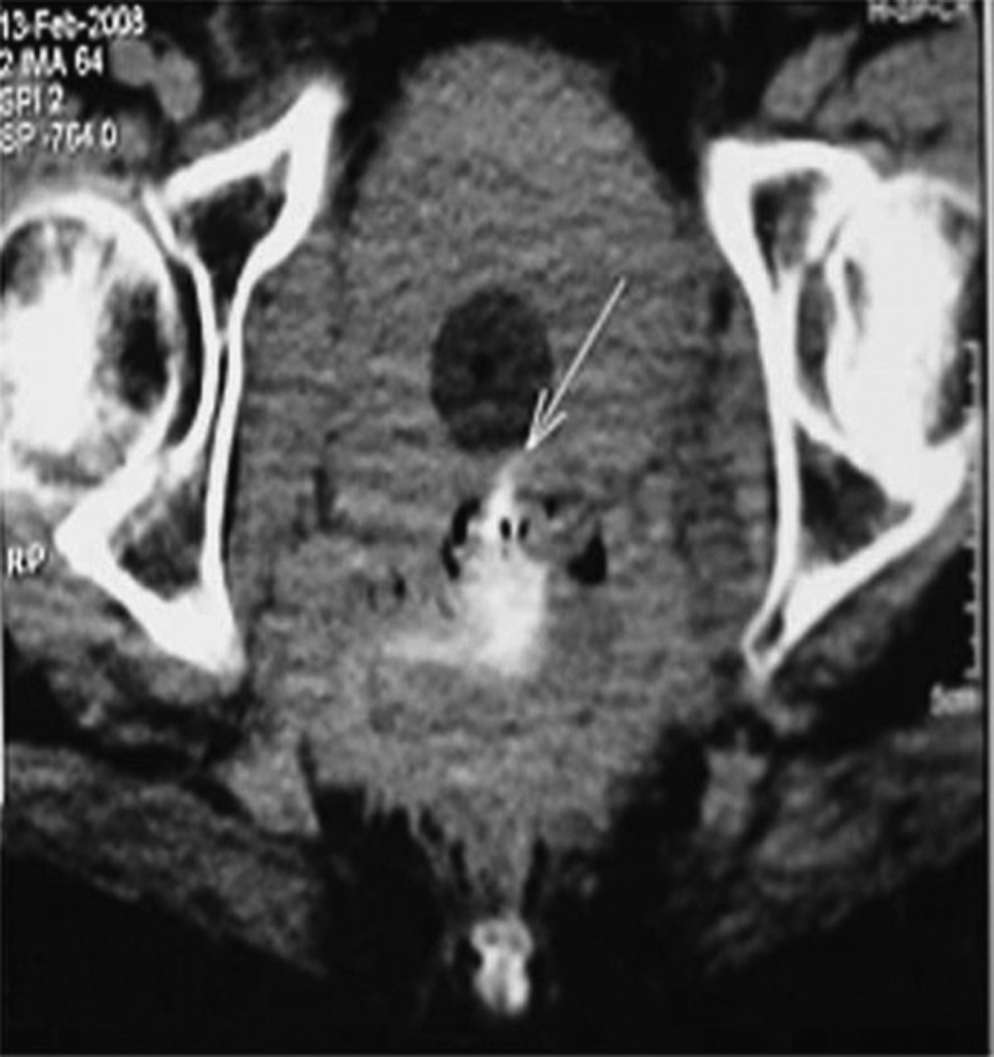
Computed tomography scan of vesicovaginal fistula.
Cystoscopy revealed a large fistulous communication above the neck of her bladder. The edges showed bullous edema. Biopsy of the fistula margin revealed only necrotic material, and there was no evidence of malignancy. The bladder capacity was small.
The patient was placed in the supine position. Using four ports (a supraumbilical telescope port, a 10-mm port in the right pararectus area in the proposed site of stoma, a 5-mm port in the left pararectus area, and a 5-mm right flank port), the abdominal cavity was inspected (Fig. 2). There were no obvious secondary tumors. As a result of postradiation changes, her bladder could not be dissected; hence, a repair of the VVF was ruled out. Both ureters were dilated and the left lower ureter was found to be adherent. Although, technically, the left ureter could have been anastamosed to the ileal conduit, the vascularity of the left ureter was likely to be jeopardized by the additional mobilization needed for a uretero-ileal anastamosis. In addition, a long loop of ileum could not be used to reach the left upper ureter in view of her renal impairment (her serum creatinine was 1.9 mg/dL). Hence, to salvage the left kidney, a left-to-right ureteroureterostomy was done with the left ureter brought behind the colon (Fig. 3). Anastomosis was carried out using 4-0 Vicryl sutures with a stent. Subsequently, an ileal loop was brought out transportally3,4 (through the right pararectus port; this 10-mm port was enlarged to a 20-mm port; Fig. 4). Isolation of the ileal loop (about 10 cm) and restoration of the ileoileal continuity was done extracorporeally (Fig. 5). Her right ureter was brought out through the same port and anastamosed end-to-side extracorporeally to the ileal conduit with a stent. The site of the 20-mm port was used as the stoma for the ileal conduit. A drain was placed through the right flank port and the ports were closed.
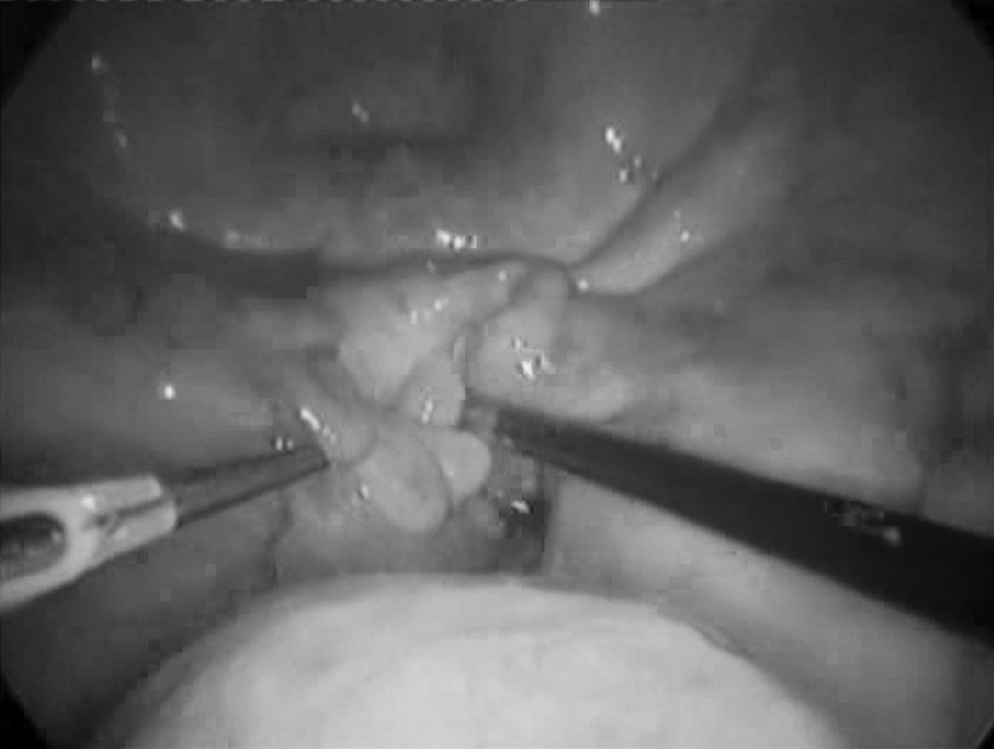
Initial laparoscopic view of frozen pelvis.

Left to right transureteroureterostomy.
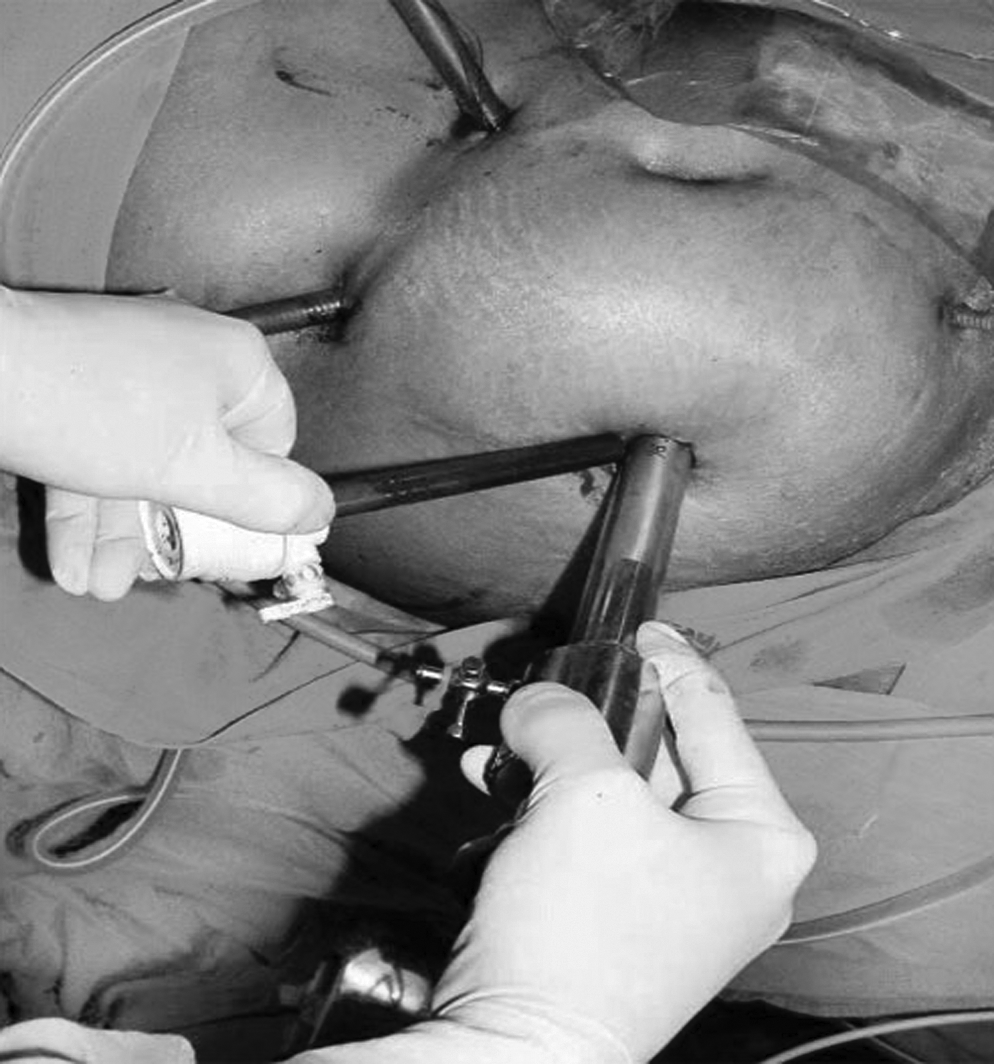
Ports and exchange of 10-mm port to 20-mm port for fashioning conduit.

Transportal isolation of ileal loop and ureter.
The operative time was 4 hours. The blood loss was ∼150 mL. The drain was removed on the 5th postoperative day. No intraoperative or postoperative complications were observed. She was fit for discharge on the 7th postoperative day but was discharged on the 13th postoperative day for social reasons. At 3 months, her serum creatinine stabilized to ∼1 mg/dL. At her 1-year follow-up she was comfortable and socially acceptable, and she was managing both stomas well (Fig. 6). Imaging did not reveal any evidence of recurrent disease.
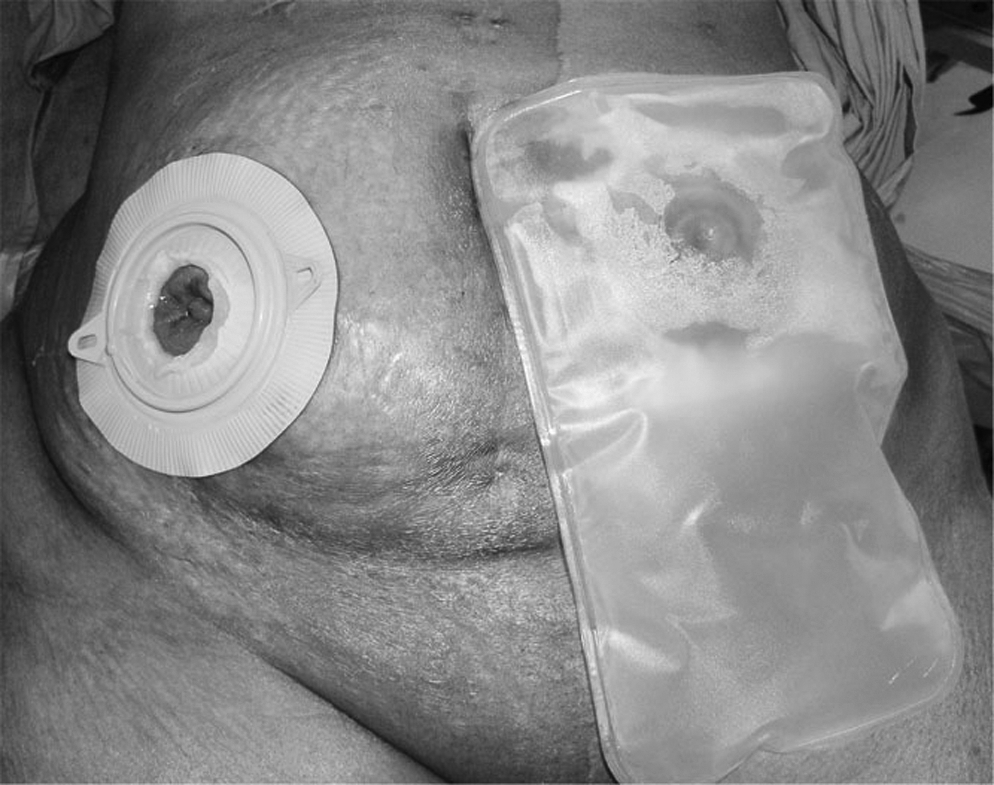
Final view of ileal conduit and colostomy.
Discussion
Managing complex vesicovaginal fistulae can be very frustrating both for the patient and treating physician. Corrective repair may not be possible always and, hence, other palliative options have to be discussed.
Treatment options are:
Abdominal repair
Diversion (viz ileal conduit or continent diversion 7 ) with or without cystectomy or anterior exenteration (continent urinary diversion has been reported in gynecologic malignancies in 40 patients at M.D. Anderson Cancer Center in Texas by Ramirez et al., but the complications directly related to the diversion were 65% and complications unrelated to the diversion were 60% 7 )
Among these options, abdominal repair, ileocystoplasty, and seromuscular intestinal graft were not possible as a result of this patient's postradiation frozen pelvis. Bilateral loop ureterostomy was not considered, as the patient had a colostomy on the left side. Transureteroureterostomy with loop ureterostomy was considered, but there was concern regarding the difficulty in fashioning the ureterostomy stoma because the patient was obese and had a thick abdominal wall. Hence, an ileal conduit was planned. This patient had a raised serum creatinine level, and part of her ileum was involved in the radiation; hence, a short-loop ileal conduit was selected. To salvage the left kidney and maintain the vascularity of the left ureter; transureteroureterostomy was done with a short ileal conduit.
Conclusions
To the current authors' knowledge, this is the first report of laparoscopic transureteroureterostomy with a laparoscopic-assisted ileal conduit (transportal) in a patient with postradiation complex VVF.
Laparoscopic transureteroureterostomy, along with laparoscopic-assisted ileal conduit (transportal), is technically feasible and is a less-morbid worthy palliation for complex VVF.
Footnotes
Disclosure Statement
No competing financial conflicts exist.