




Abstract
Abstract
Introduction
It is hypothesized that the relative hypoestrogenic states of children in these age groups predispose them to labial adhesions. 5 Children with labial adhesions usually have a history of a local inflammatory process, such as diaper rash. Most patients are asymptomatic; however, the adhesions occasionally cause local inflammation, recurrent vulvovaginitis, or recurrent urinary-tract infections. Adhesions do not occur in newborns, presumably because of the protective effect of circulating maternal estrogens.
Simple hygienic measures may be sufficient for asymptomatic children because, most adhesions resolve during early puberty. 6 Estrogen for several days to a few weeks, along with antiseptic solution, may be needed to disrupt adhesions in some patients, and surgical treatment is reserved for refractory cases. 7
Secondary labial and vaginal adhesions are relatively more common in developing countries as a result of various noxious materials placed in the vagina for induction of abortion and treatment of infertility; these adhesions may be severe enough to form vaginal atresias. 8 Similar labial adhesions (iatrogenic) can develop after vaginal delivery if proper repair of vaginal perineal tears or episiotomy is not undertaken.
Perineal and vaginal lacerations are common traumas following vaginal delivery especially in primiparus women. Episiotomy is one of the most common surgical procedures in Western medicine and is the most common procedure in obstetrics. 9 This procedure is currently considered to be the most common cause of iatrogenic perineal lacerations, especially third- or fourth-degree perineal tears. Spontaneous perineal and vaginal laceration can follow a mismanaged or unattended vaginal delivery, which is a common obstetric malpractice in developing countries.
Potential sequelae of obstetric perineal and vaginal lacerations include labial adhesions, chronic perineal pain, 10 perineal relaxation, gapping of the introitus, dyspareunia, and urinary and fecal incontinence. 11 These kinds of problems may have bad impacts on a woman life in the form of severe emotional, psychologic, and social traumas.
In our society, mismanagement of delivery is a common obstetric malpractice in which deliveries are usually attended by paramedical personnel (daias [midwives], nurses) or are not attended at all. When deliveries are not attended by qualified personnel, improper repair of perineal or vaginal tears usually occurs, which may lead to further perineal tears, labial adhesions, or vaginal stenosis, but near-total or pinhole closure of the vagina is relatively a very rare complication.
The article presents quite rare complication of a mismanaged vaginal delivery and improper surgical repair of obstetric lacerations—a severe form of labial adhesions—up to a pinhole vagina.
Case
A 22-year-old primiparus woman, married for 15 months and carrying a term pregnancy, attended a general health hospital for delivery. After spending 10 hours in the hospital, she delivered a single living boy. The woman was only attended by a nurse. She did not know about the details of the delivery or whether an episiotomy was performed on her at the time of the delivery.
However, according to this patient, after delivery, repair of the perineal vaginal tears (or episiotomy) was performed by the nurse in the absence of medical staff members, and, 6 hours later, the patient was discharged form the hospital. The postpartum course was smooth apart from severe perineal pain during the early postpartum weeks.
The rest of this patient's purperium was uneventful; she nursed her baby, had a normal locial flow for few weeks; and her first menstruation occurred 40 days postpartum.
The first attempts this woman made to have sexual intercourse failed, and she and her partner noticed that there was something abnormal preventing penetration. A few days later, the patient asked medical advice for the same problem and was told that she had complete vaginal block.
Clinical examination revealed that this woman had a young average body. Her vital signs were stable and her abdominal examination was clinically good, but her pelvic examination revealed total closure of the vaginal introitus (a severe form of labial adhesions) apart from very small hole in the anterior part of the vestibule mistaken for the external urethral meatus (Fig. 1).
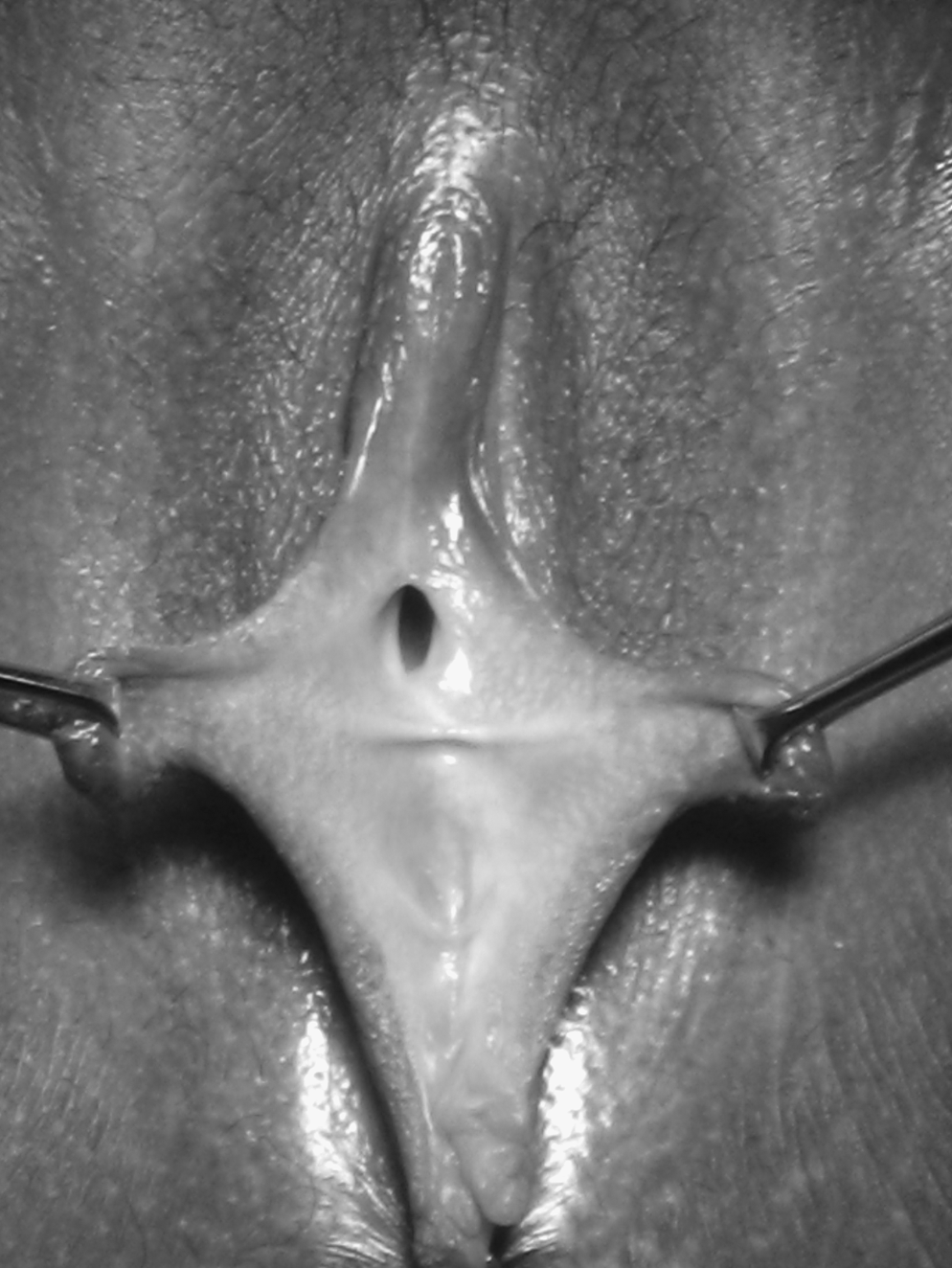
Preopeative labial adhesion up to pinhole vagina. Only a small hole in the anterior part of the vestibule is seen.
Transabdominal and transperineal ultrasonic examination revealed normal-looking abdominal and pelvic organs with no fluid collection in the Douglas pouch or vagina, and this patient's laboratory parameters were within normal limits.
Consultation with a plastic surgeon who examined the patient provided assurance that there was no tissue loss and that simple dissection or vaginoplasty would be a suitable operation.
A diagnosis of secondary labial adhesions or vaginal stenosis was made. The couple was informed about the condition, and the operation was planned.
After proper counseling and obtaining written informed consent, the patient was prepared for the operation. The day before the operation, she was given enemas until her fluids returned cleanm and antibiotic prophylaxis (ampicillin, sulbactam 1.5 g) was given to this patient 1 hour before the operation.
Under spinal anesthesia, the patient was placed in a lithotomy position. After proper sterilization, a vaginal examination revealed total closure of the vestibule apart from a very small hole in the anterior part of the vestibule, from which the external urethral meatus was seen (Fig. 1), passing the uterine sound through this orifice revealed labial flaps closing the whole vestibule. Incision of the labial flaps in the vertical plane was performed, and the resulting vagina looked of normal length and caliber, perfect homeostasis was achieved, and the incision was closed in the transverse plane (Fig. 2).
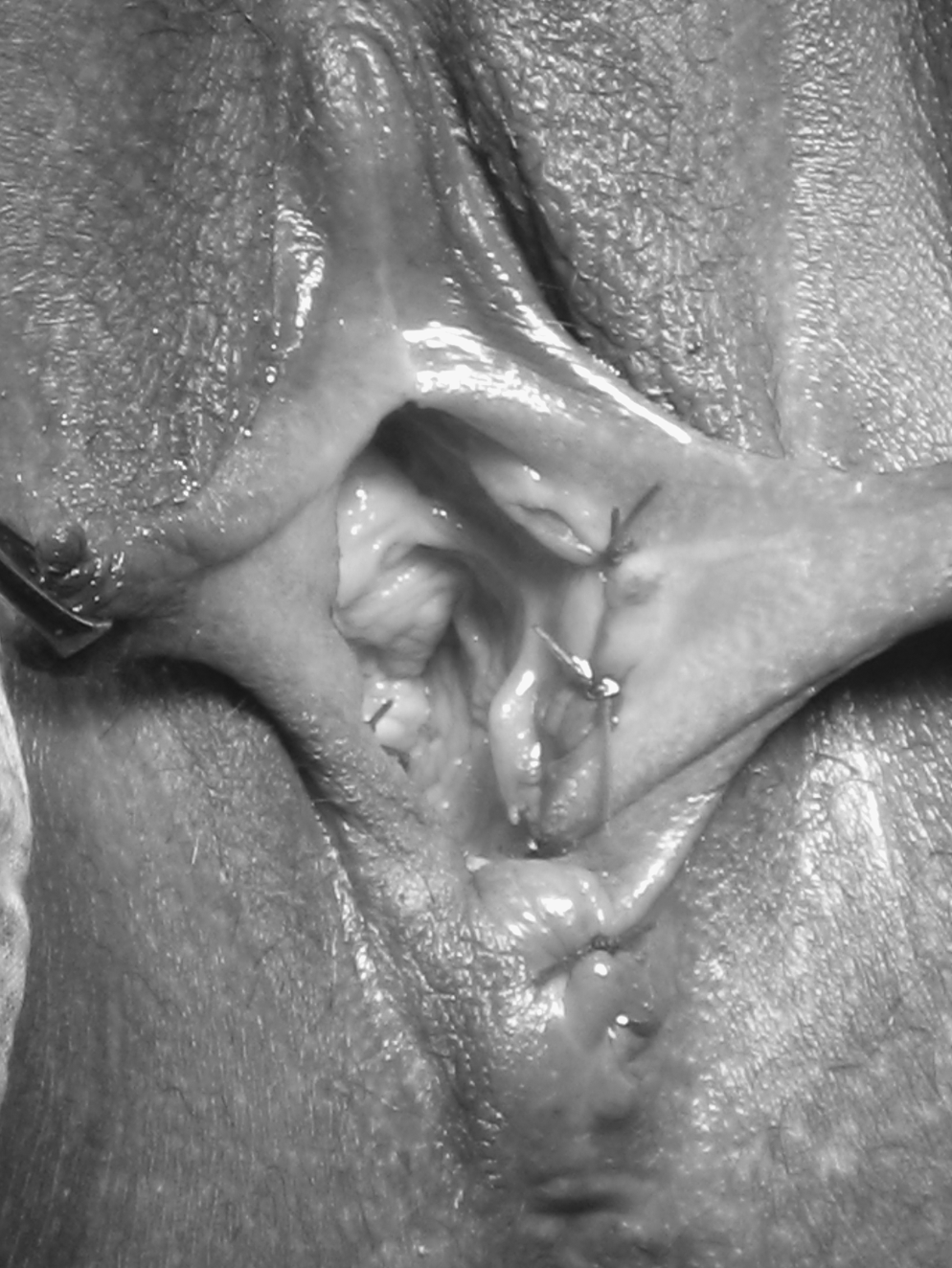
Postoperative view of the same case. After dissection of the adhesions, the external genitalia looked more or less normal.
Postoperatively, the patient remained afebrile and her recovery was uneventful.
On the 7th postoperative day, va aginal examination revealed a normal-length caliber of the vagina with no areas of adhesions. The patient was advised to have sexual intercourse as early as possible and KY Jelly was prescribed for her.
A week later, a vaginal examination revealed the same findings. No contracture or readhesions occurred, and the couple was very satisfied with the results of the operation.
Literature Review
Labial adhesions in the postpartum setting are rare. A MEDLINE® literature review using the terms labial adhesions in combination with postpartum was conducted. This search revealed relevant reviews of 9 previously reported cases of labial adhesions after vaginal delivery 12 in addition to another reported case with 1 patient. 7 Table 1 summarizes these reported cases.
Yoong A, Alderman B. A large labial adhesion following normal delivery. Acta Obstet Gynecol Scand 1990;69:443.
Steele E, Lowry D. Labial adhesions following normal delivery. J Obstet Gynaecol 2002;22:555.
SVD, spontaneous vaginal delivery; VAD, vacuum-assisted delivery.
As reported in this article, difficulty with resuming sexual activity was the most commonly reported complaint.5,7,13–15 Spontaneous vaginal delivery was the most common mode of delivery (11 cases), and only 1 case followed vacuum-assisted delivery.
Discussion
Labial adhesions are common in young girls and occasionally occur in elderly women. 16 Postpartum labial adhesions are rarely described in the medical literature, and their exact incidence has not been documented in articles. Postpartum labial adhesions have been described in reproductive-age women secondary to female circumcision, lichen sclerosis, herpes simplex, diabetes, pemphigoid, and acoustic vaginitis.2,3 These adhesions can occur secondary to badly managed vaginal delivery, causing vaginal injuries and subsequent scarring.
Superficial labial lacerations are often left unrepaired with good outcomes. Even larger vaginal-wall lacerations will generally heal with similar outcomes if left unsutured as reported in some of the midwifery literature. 17 Lin et al. theorized that significant perineal swelling may promote adhesion formation by mechanically pressing the labia together. 6
Surgical and nonsurgical methods of treatment of labial adhesions have been used. The nonsurgical approach relies on the use of local estrogen for a few days to a few weeks, especially for labial and vaginal adhesions following postmenopausal atrophic vaginitis. Surgery remains the most effective method of treatment for postpartum labial adhesions or vaginal stenosis. 18
Choosing the proper time to perform at surgery is of paramount importance. Surgical treatment should be considered as early as possible before the adhesions became dense. Usually the help of plastic surgeon is essential in this reconstruction process if there is extensive tissue damage, especially if it is associated with tissue loss. The amount of tissue loss determines the type of operation. In the current case, as there was no tissue loss, simple incision of the labial adhesions was quite sufficient to obtain a satisfactory result.
Conclusions
In our society, untrained female staff members (dais, nurses) attend most deliveries, especially home deliveries, thus playing a major role in the increasing incidence of peripartum complications. thus, Fully trained delivery assistance is therefore, essential for management of normal delivery. Acquiring the normal length and caliber of the vagina (functional vagina) can completely change the personality and social life of a patient as well as alleviating her suffering.
The occurrence of perineal, vaginal tears, labial adhesions, and improper repairs of these tears can be prevented easily, provided the delivery facilities and the staff are up to normal standards.
To achieve a complete recovery and a very satisfactory result, surgical dissection, performed under anesthesia should be attempted as first-line therapy for postpartum labial adhesions.
Footnotes
Disclosure Statement
No competing financial conflicts exist.