




Abstract
Abstract
Introduction
Case
A 38-year-old woman with no preexisting conditions underwent exploration because of a large abdominal tumor. Preoperative imaging showed a 16-cm partly cystic, partly solid mass originating from the right ovary as well as two foci in the liver suspicious for metastasis. The mass was extirpated and a frozen section showed a mucinous cystic adenoma in combination with a malignant yolk sac tumor. Adnexectomy with omentectomy as well as pelvic and para-aortic lymphadenectomy were performed. Intraoperatively, a small laceration of the right external iliac artery was repaired with a suture. The liver tumors were excised, and a frozen section showed hemangioma. The operating time was 5 hours and 45 minutes, and anesthesia time and time in lithotomy position was 6 hours and 45 minutes. Intraoperative blood loss was moderate; the patient received 1 unit of packed RBC intraoperatively. Systolic and diastolic intraoperative blood pressures were 90–140 mm Hg and 50–75 mm Hg, respectively.
On the first postoperative day, the patient reported pain and swelling in her lower left leg. Deep venous thrombosis was ruled out with duplex sonography. Peripheral pulses were present. Increasing CK (10552 U/l), LDH (478 U/l), and myoglobin (2696 ng/mL) confirmed the suspicion of an ACS. A plastic surgeon was consulted and an immediate fasciotomy with necrectomy of the soleus muscle was performed. The patient subsequently required resection of the hallucis longus externus and extensor digitorum longus muscles on the 4th postoperative day and of the tibialis anterior and peroneus longus muscles on the 6th postoperative day (Fig. 1). She was discharged with a limb splint on the 18th postoperative day. Five (5) months postoperatively, after adjuvant chemotherapy (bleomycin, etoposid, and cisplatin) and intensive physical therapy, the patient was well and mobile but her foot drop persisted.
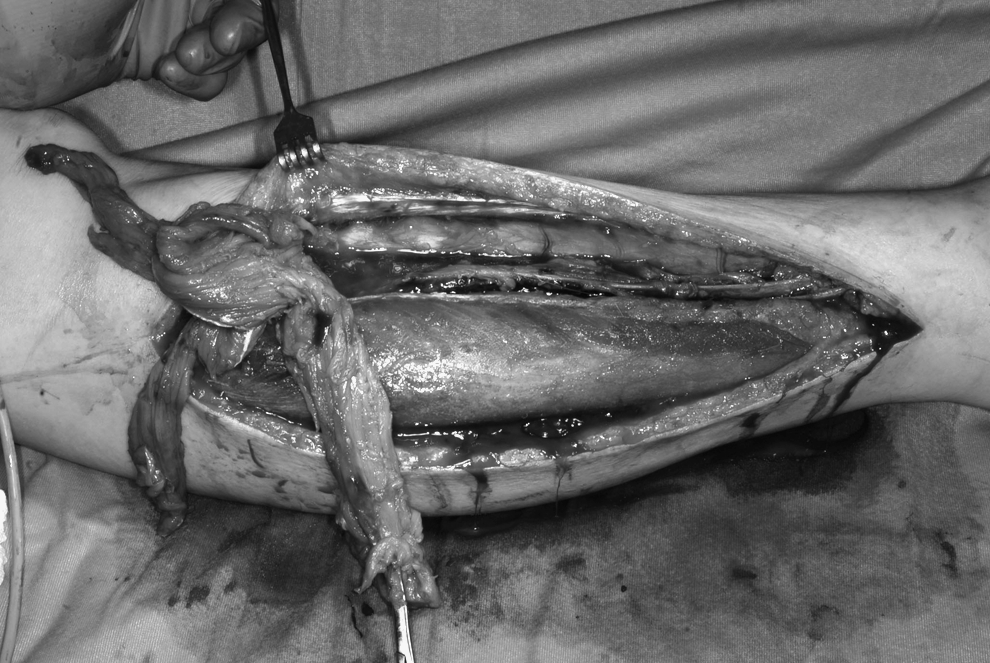
Third debridement. Partially necrotic part of the tibialis anterior muscle; behind it, the peroneal compartment with intact musculature.
Discussion
ACS is characterized by swelling, edema, and pain in the affected leg as a result of increased tissue pressure. Unrelieved high tissue pressure can lead to neuromuscular ischemia caused by anaerobic metabolism with acidosis and decreasing adenosine triphosphate (ATP) production. If arterial perfusion resumes before complete tissue necrosis, secondary reperfusion damage can occur. Endothelial damage results from free radicals with increased cell-wall permeability and interstitial edema following vasoconstriction and activation of neutrophiles. Cell destruction is associated with myoglobinuria, hyperkalemia, and metabolical acidosis and can cause renal failure, multiple organ failure, and death (crush syndrome).
Contributing factors are prolonged time in the lithotomy position,5–7 stockings, 8 and local external pressure or transient disturbance of the perfusion.
If the situation remains uncorrected for several hours, loss of function and even loss of limb viability can occur. Treatment of ACS consists of prompt fasciotomy to relieve the pressure in all affected compartments.
ACS is a clinical diagnosis confirmed by laboratory findings. It is well-known to trauma and plastic surgeons, but the well-leg variant is rare and may not be familiar to gynecologic surgeons. Cardinal features are pain, swelling, pain on passive stretching, and decreased peripheral pulses or paresthesia of a lower limb postoperatively after a prolonged gynecological procedure. Chase et al. reported that ACS in patients in the lithotomy position is more likely to occur if the period of positioning is more than 5 hours. 9 The differential diagnosis includes thrombosis, thrombophlebitis, acute nerve lesions, infections, and paresthesia caused by ischemia.
Conclusions
The cause of the ACS in the patient discussed in this article was probably multifactorial. Injury of the right iliac artery may have contributed to ischemia in this patient in combination with the prolonged time in lithotomy and Trendelenburg position for nearly 7 hours.
Gynecologic surgeons need to be aware of this potential problem in patients at risk.
Footnotes
Disclosure Statement
None of the authors have a commercial association that might create a conflict of interest in connection with this case report.