




Abstract
Abstract
Introduction
Information about the first reported total laparoscopic hysterectomy was published 20 years ago. 2 Initially, there was difficulty with accepting the procedure. Many opposing authorities cited increased costs, operating room times, and complication rates as deterrents. Subsequent research demonstrated that, after the learning curve was overcome, costs, operating room times, and complication rate were similar to that of total abdominal hysterectomy. 3 Advances in electrosurgical technology, smoke evacuation, and uterine manipulators have improved safety and reproducibility of the procedure. Despite all of these advances, the 2003 National Inpatient Sample indicated that only 11.8% of hysterectomies were done laparoscopically. One possible reason for the slow adoption of the procedure is the steep learning curve, which as been estimated to be between 10 and 80 procedures needed to gain proficiency. 4 It is very difficult during a 4-year residency program with limited work hours to gain experience with such a high surgical volume. Robotic assistance shorten the learning curve and promote increased acceptance of laparoscopic hysterectomy. 5 In 2005, the U.S. Food and Drug Administration approved the da Vinci® Surgical System for gynecologic surgery.
In 2008 the development of a multilumen surgical port made it possible to perform laparoscopic hysterectomy through a single umbilical incision. Many physicians who are proficient in laparoscopic surgery have begun to adopt single-incision surgery into their practices. However, the single-incision approach is very challenging. It is plausible that robotic assistance may simplify the procedure. A review of the current English literature, using the key words
Case
A 46-year-old gravida 2, para 2 woman with menorrhagia, dysmenorrhea, and symptomatic iron deficiency anemia was referred for evaluation. A clinical examination revealed an 8-week-size mobile uterus. A pelvic ultrasound confirmed an 8-cm uterus with normal adnexa. An endometrial biopsy was negative for malignancy. The patient reported no improvement with oral contraceptive pills and nonsteroidal anti-inflammatory drugs. Dysfunctional uterine bleeding was diagnosed. The patient desired definitive surgical management and declined endometrial ablation. Abdominal, vaginal, and laparoscopic hysterectomy options were discussed with the patient. Given the patient's dysmenorrhea symptoms, laparoscopy was recommended. Informed consent was obtained for a robotic single-incision hysterectomy. The patient was advised that conversion to conventional laparoscopy was a possibility.
The patient was given prophylactic antibiotics. She was placed in the dorsal lithotomy position and general endotracheal anesthesia was induced. Initially, a subumbilical 3-cm incision was made (Fig. 1). However, the incision was ultimately extended to 3.5 cm to accommodate the robotic trocars. An open surgical technique was used to place the first 8.5-mm trocar. Then pneumoperitoneum was established with CO2 insufflation. An 8-mm, 30° robotic laparoscope was used to survey the pelvis. Two 8-mm trocars were then placed immediately lateral and cephalad to the laparoscope port through separate fascial incisions. Figure 2 shows placement of the three trocars. The 30° up-angle scope permitted the robotic laparoscope arm to be deviated caudally to minimize collisions. The robotic arms were then docked (Fig. 3). The two operative port trocars were crossed to the opposite side within the abdominal cavity so that the left- sided arm was positioned in the right pelvis, and the right-sided arm was positioned in the left pelvis. At the robotic console, the surgical controls were reassigned so that the right hand controlled the left robotic arm, and vice versa. From this point, the laparoscopic hysterectomy was performed in the usual fashion. The utero-ovarian ligaments, uterine tubes, round ligaments, and broad ligaments were desiccated with bipolar forceps and transected with monopolar scissors. A bladder flap was created sharply with monopolar scissors, and then the uterine vessels were desiccated and transected. A colpotomy incision was performed with monopolar scissors, the uterus was removed vaginally, and the cuff was closed laparoscopically. The surgical time was 3 hours and 31 minutes. Significant delays occurred secondary to loss of pneumoperitoneum and an unanticipated difficulty encountered with the awkward backward suturing motion on the vaginal cuff. Excellent hemostasis was observed with an estimated blood loss of 25 cc. The patient tolerated the procedure well and was discharged 18 hours postoperatively. She was seen 1 week postoperatively and required no pain medication at that time. She had returned to work the previous day. At her 6-week postoperative visit, her single umbilical scar was barely visible (Fig. 4).
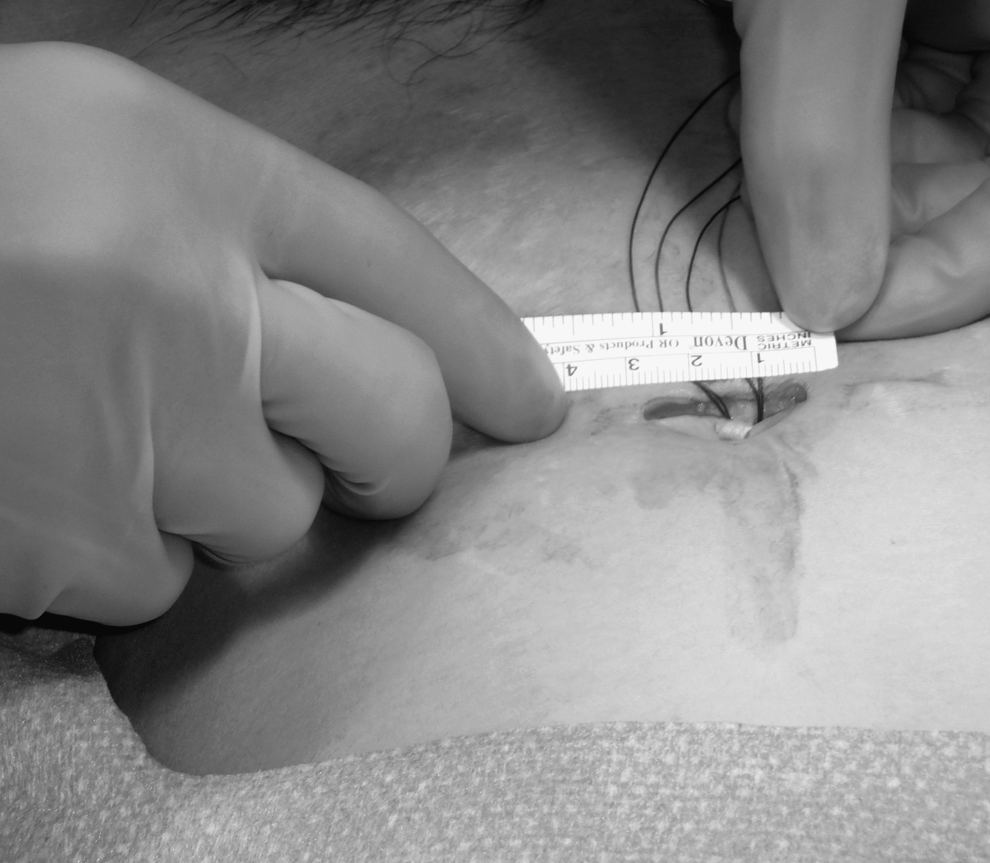
Three-cm subumbilical incision.

Trocar placement through a single skin incision and three fascial punctures.

Operative robotic arms docked.
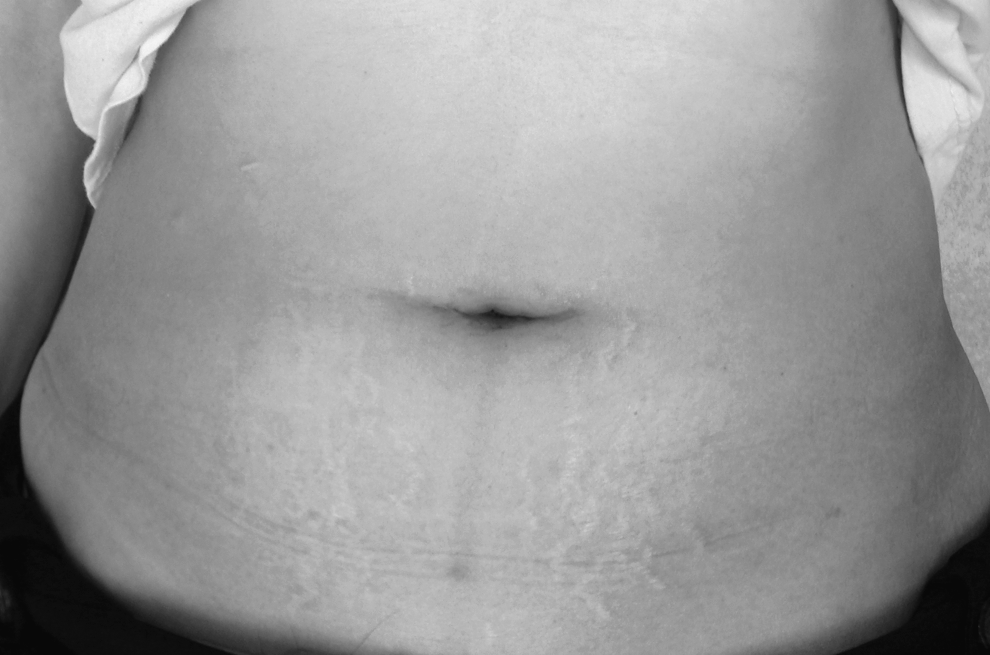
Six-week postoperative scar.
Conclusions
This report describes the first successful case of a robotic-assisted single-incision total hysterectomy through separate fascial punctures. This case demonstrates the feasibility of combining robotic and single-incision technology in gynecologic surgery. Robotic surgery and single-incision laparoscopy are both new techniques. It was previously considered unlikely that large robotic arms could operate effectively in the confined space of a 3.5-cm single incision. This case demonstrates a method whereby appropriate patient selection, laparoscope and robotic arm positioning, and reassignment of the robotic arms makes a single-incision robotic hysterectomy possible. Furthermore, estimated blood loss, postoperative pain, hospital stay, and recovery are comparable to conventional laparoscopy. 3 In addition, the cosmetic result is comparable to single-incision surgery.
The initial impression that the addition of robotic technology would simplify the procedure was not realized. Specifically, the robotic suturing was more difficult and extended the length of the procedure rather than shortening it. This was because the robotic arms were not able to perform the same natural suturing motion when directed away from the tissue and working backward. A second major obstacle encountered was the loss of pneumoperitoneum from the three separate fascial punctures. Despite suturing the skin edges and applying lubricated gauze around the initial incision, visualization was often impaired and resulted in prolongation of the surgery.
In conclusion, robotic single-incision hysterectomy may be a feasible alternative to laparoscopic single-incision hysterectomy. Several limiting factors need further evaluation and improvement before routine application of the procedure. A slightly larger single-incision port may resolve the issue of pneumoperitoneum. In addition, reengineering of the robotic articulation to facilitate reversed suture motion would expedite vaginal cuff closure. Additional study is needed.
Footnotes
Disclosure Statement
Dr. Farnam is an independent counsel for the following corporations: Covidien (Mansfield, MA) and Intuitive Surgical (Sunnyvale, CA).