




Abstract
Abstract
Introduction
Case
A 23-year-old third gravida with one living child was admitted at 34+3 weeks gestation for evaluation of ARM. She had had a history of fecal incontinence since birth and was passing stools through the orifice near the vestibular region. The first newborn had been delivered by cesarean section because the fetus was in a transverse position. This prior operation was performed elsewhere, and the infant had died at 2 months of age from a febrile illness. The second cesarean section had been performed for anorectal malformation, which had not been evaluated properly at that time, and a male infant was born with no anomalies.
On examination of the patient, a prominent skin tag was present at the anal dimple with a normal gluteal fold, and there was a fistulous opening in the region of vestibule with minimal prolapse of the rectal mucosa (Fig. 1). The spine and sacrum appeared to be normal clinically, and there was no history of neurologic disturbances. Surgery consultation confirmed the diagnosis as rectovestibular fistula on clinical examination, and the patient was advised to undergo elective cesarean section for the present pregnancy. Ultrasonography of the abdomen showed no associated genitourinary tract and renal anomalies. The patient underwent an elective cesarean section with sterilization at 38+3 weeks' gestation and a living female infant weighing 3110 g was born with no gross anomalies except for polydactyly of the right hand.
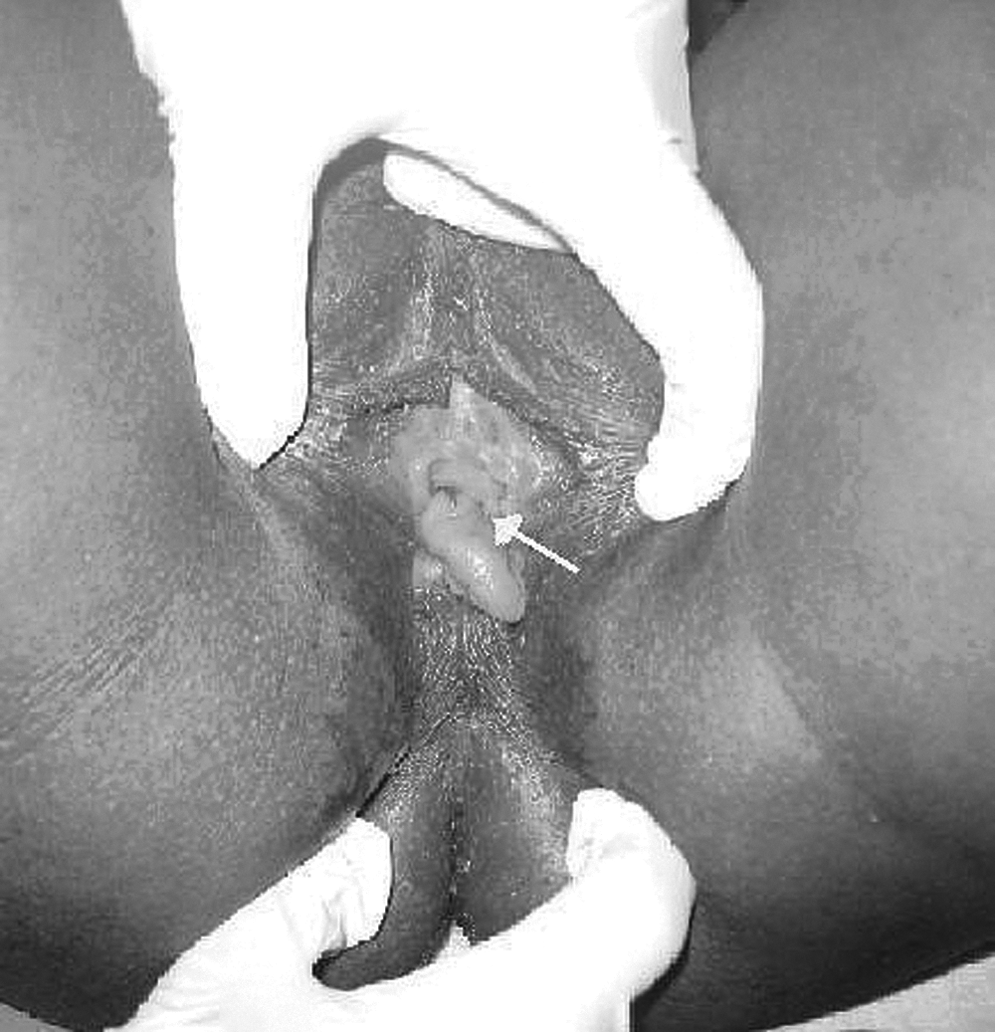
Rectovestibular fistula with prolapse of rectal mucosa (arrow) and imperforate anus.
Results
The patient's postnatal period was uneventful and she was discharged on the 7th postoperative day in a satisfactory condition, with subsequent follow-up in surgery.
Discussion
ARM represents a wide spectrum of congenital anomalies in which the anus fails to open normally onto the perineum, and it occurs in ∼1 in 5000 live births. 1 It is caused by the arrest of division of the cloaca by mesenchymal growth leading to a variety of malformations, which are correctable with reasonably good prognosis. 4 The cause of ARM is unclear and it has been described in patients with chromosomal abnormalities such as Down syndrome, trisomy 18, and other genetic syndromes such as vertebral, anorectal, cardiac, trachea-esophageal, renal and limb anomalies (VACTERL) and Currarino syndromes. 2 ARM ranges in severity from imperforate anal membrane to complete caudal regression. 3 In females, the most common ARM is an imperforate anus with a rectovestibular fistula, followed by an imperforate anus with a rectoperineal fistula and cloacal anomalies. 5 The incidence of associated anomalies in ARM patients may be as high as 60%, with the genitourinary tract and spine being the most common. Female patients with ARM have a strong likelihood of uterovaginal anomalies, which is cited as being 53%–67%. 2 Vaginal septum is the most common associated finding in female patients with rectovestibular fistula. The intimate association of embryological development of the anorectal, genital, and urinary systems explains the frequency of associated malformations.
The common symptoms are fecal and urinary incontinence, whereas in patients with associated uterovaginal anomalies, cryptomenorrhea and development of endometriosis have been described.3,5 This patient had fecal incontinence, which she did not consider to be a significant problem, and therefore did not seek medical advice. Usually patients with ARM present early in the newborn period, but can present later, as reported in a study by Banu et al., with the mean age at presentation being 8.67 years. 6 Delayed diagnosis increases the surgical and functional complications for the patient, which are more common in developing countries because of inadequate treatment, failure to diagnose associated urogenital anomalies, wrong advice, and lack of social support. The diagnosis is confirmed by clinical examination in the majority of cases, with ultrasound of the abdomen and radiography of the spine and sacrum being performed to rule out associated anomalies. Occasionally, contrast radiography, fistulogram, or distal colostography and magnetic resonance imaging are required when the diagnosis is in doubt.
The traditional classification of ARM into “high,” “intermediate,” and “low” defects is arbitrary and somewhat inaccurate as a guide to management.
7
Hence, Pena attempted to classify the defects according to the site of fistula and degree of caudal regression, and, therefore, prognostic outcome.
8
The non-syndromic ARM classification in females is:
• Cloaca with short common channel (<3cm) • Cloaca with long common channel (>3cm) • Rectovestibular fistula • Rectal atresia • Perineal fistula • Imperforate anus without fistula.
In rectovestibular fistula, the rectum opens in the vestibule, which is the space between the hymen and perineal skin, and most of these have a good sacrum and anal sphincteric mechanism. 2 For high-type anomalies, colostomy is recommended at birth, followed by corrective surgery. 9 The suggested treatment for imperforate anus with a rectovestibular fistula as in this patient, is posterior sagittal anorectoplasty (PSARP).1,5
There are limited data available on the optimal management of an uncorrected rectovestibular fistula in pregnancy. Women with ARM can conceive and have a successful pregnancy outcome even in the most complex type of ARM, such as cloaca. Pregnancy rates and outcomes appear to be similar to the rest of the population in women born without any associated reproductive anomaly, whereas in those with an associated anomaly, the specific type will influence the potential for conception and pregnancy risks. 5 Malpresentations and preterm labor are increased in ARM patients with associated Mullerian tract anomalies and infections caused by fecal soiling. In a study by Iwai et al, a 10–30 year follow-up of results of surgical corrections of ARM, most of the patients had normal sexual activity and 1 patient had a normal pregnancy and delivery. 10
Conclusions
In general, patients with with a history of an imperforate anus and a rectovestibular or rectoperineal fistula are candidates for a vaginal delivery. The adequacy (size and scarring) of the perineal body should be assessed by the obstetrician before making the decision. Cesarean section is recommended for women with a history of a cloacal anomaly. Also, patients who had a neovaginal replacement or interposition graft require cesarean section to avoid irreparable damage to the graft. 5 In this patient, elective repeat caesarean section had been performed to avoid any possible injury to the rectum caused by perineal tears or episiotomy, which might have occurred if vaginal delivery had been allowed. As this patient was not willing to have surgical correction, she was advised to follow up with the surgeons for further management.
Knowledge of reproductive-related issues in females with ARMs allows the pediatric surgeon to provide optimal surgical management in infancy, childhood, and into young adulthood. Consultation with a gynecologist is essential to diagnose and treat associated gynecologic anomalies and to provide appropriate counseling for patients and families about potential reproductive concerns that may develop many years after the definitive surgical repair.
Footnotes
Disclosure Statement
No competing financial conflicts exist.