




Abstract
Abstract
Introduction
Case
A-52-year old multiparous woman with no specific medical history presented with a lesion on her left labia majora that she had had for 2 prior to presentation. This lesion was gradually increasing in size. On inspection, it was noted that the lesion was confined to her left labia majora and was ∼3×3 cm in dimension with a smooth surface and no congestion (Fig. 1). On palpation, no tenderness was noted and the skin appeared to be thickened. A provisional diagnosis of a sebaceous cyst was made. The patient did not recall any history of trauma or injury. She visited the gynecology department because of her cosmetic concerns regarding the lesion and because she occasionally experienced pain. The lesion was excised under spinal anesthesia (Fig. 2). Histopathology testing revealed a polypoid skin lesion lined with hyperkeratotic epidermis, and the dermis revealed granulation-tissue formation and capillary proliferation with chronic inflammatory-cell infiltration. The picture was suggestive of a lobular capillary hemangioma (Fig 3).
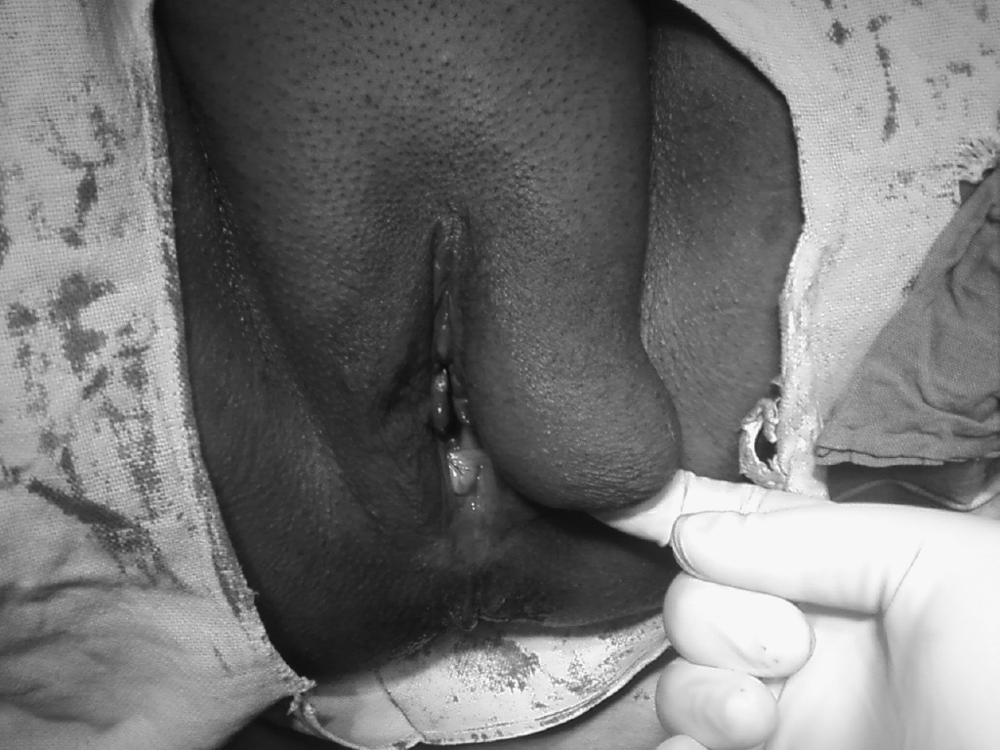
Lesion in left labia majora.
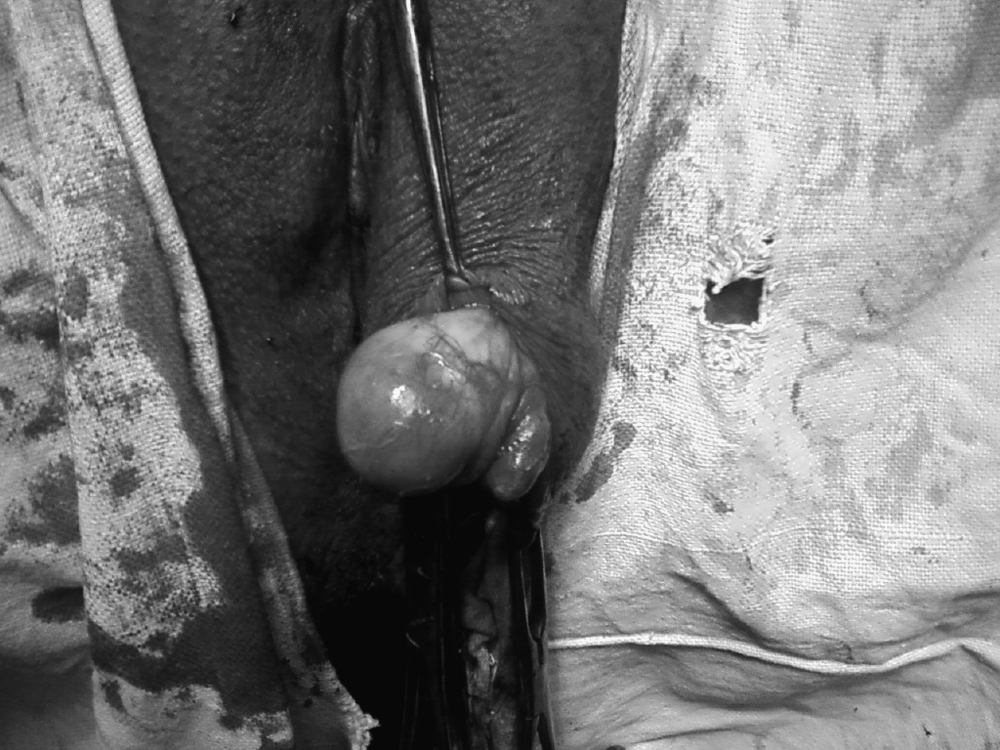
Excision of cyst.

Photomicrograph showing capillary proliferation with inflammatory cell infiltration (H&E 40 ×).
Results
On follow-up, the patient was not found to have any recurrence of this type of lesion.
Discussion
Lobular capillary haemangioma or pyogenic granuloma usually presents as a solitary, lobulated, pedunculated or sessile benign growth over the face, arms, or hands. 1 The name “pyogenic granuloma” is a misnomer, because the condition is not associated with pus and does is not a granuloma histologically. 4 In the current patient, the lesion was solitary and sessile. Its characteristic bright red color and granulation tissue–like appearance is determined by the integrity and thickness of the overlying epidermis and stage of the disease. In chronic lesions, these characteristic features may not be evident as observed in the current patient.
The etiopathogenesis of pyogenic granuloma remains unclear. It has been considered as a reactive, hyperproliferative vascular response to a variety of stimuli rather than a true hemangioma. 1 Trauma, hormonal influences, viral oncogenes, underlying microscopic arteriovenous malformation, and production of angiogenic factors have been implicated. While trauma was considered a primary cause, one large study by Patrice et al. found that 74.2% of cases had no history of preceeding trauma or a predisposing dermatologic condition. 2
Various cutaneous pathologies that have been reported to be associated with pyogenic granuloma are port wine stains, insect bites, localized viral infections, psoriasis, eczema, burns, erythroderma, and cutaneous changes caused by retinoid therapy.2,5
The current patient did not have a history of trauma, and there was no evidence of underlying cutaneous pathology in noted on histopathologic examination.
Pyogenic granulomas are always benign. Although cancer rarely mimics pyogenic granulomas, there is always a concern that such lesions could be cancerous. Patrice et al. reported 43.5% and 13% recurrence after intradermal excision and cauterization or cauterization alone, respectively. 2 At times, many smaller pyogenic granulomas form following treatment. It appears that pieces of pyogenic granuloma may spread through local blood vessels. 6 Pyogenic granulomas in pregnant women may resolve spontaneously after delivery, and conservative therapy is sometimes the best strategy in those cases. Laser surgery can also be performed, but it has not been proved to be superior. 7 Patrice et al. reported that full-thickness skin excision closed with stitches appears to yield the lowest chance of recurrence, as was done in the current case. 2
Conclusions
Unfamiliarity with these types of lesions on the vulva can cause confusion with other common polypoid morphologies at this site, such as warts, bowenoid polyposis, giant condylomas, and verrucous carcinomas. This case was presented to help physicians become aware that lobular capillary hemangiomas may occur at this site.
Footnotes
Disclosure Statement
No competing financial conflicts exist.