




Abstract
Abstract
Introduction
Case
A 25-year-old woman gravida 2 para1 underwent an uncomplicated vaginal delivery at a private clinic. Her first delivery was conducted at home with no history of the use of forceps or intrauterine manipulation. A massive postpartum hemorrhage developed after delivery. Uterotonic agents were given, along with the repair of vaginal tears in the same clinic. Despite this treatment, bleeding persisted, and patient was then transferred to our hospital 2 hours after delivery. At admission, she suffered from hemorrhagic shock; her systolic blood pressure was 60 mm Hg. Her pulse was 120/min. After arranging for sufficient blood, the patient was prepared for examination under anesthesia. Examination revealed no cervical tear, but repaired vaginal lacerations were present. The patient was bleeding profusely from the cervix, but the uterus was well contracted. Careful inspection of the cervix revealed endocervical lacerations. Therefore some stitches were applied to the endocervix, but the patient continued to bleed. An emergency laparotomy was therefore carried out. On entering the peritoneal cavity, it was evident that there was excellent uterine tone. Because of her poor general condition, however, we thought it best to remove the organ, which was the source of massive bleeding, to avoid disseminated intravascular coagulation. After the hysterectomy, we put in an abdominal drain. The cut section of the uterus revealed a 4-cm vertical inner myometrial laceration, situated midline along the posterior uterine wall (Fig. 1). After the procedure, the patient was transferred to the intensive care unit (ICU) until her condition stabilized. The specimen was sent for histopathological examination, which revealed a laceration 0.4 cm deep. Microscopically, fibrin and coagula, along with many vessels and capillaries, were observed at the wound site. The myometrium and vessels were lacerated, and marked bleeding was noted between the muscle fibers. No sacculation or arteriovenous malformation was noted histopathologically. Patient expired on the second postoperative day due to refractory hypotension.
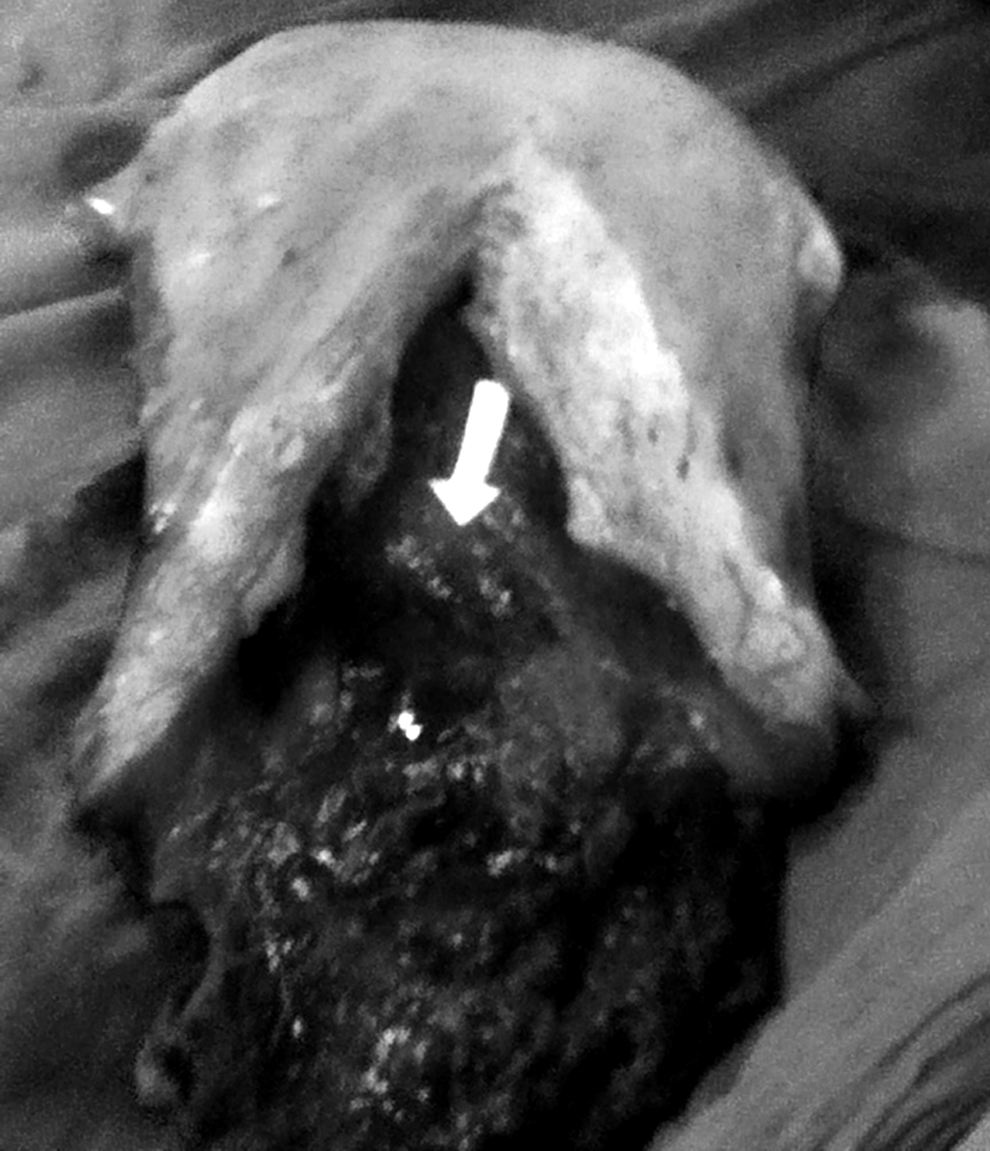
Cut open section of uterus showing an inner myometrial laceration (arrow).
Discussion
Postpartum hemorrhage remains one of the most frequently encountered obstetrical complications resulting in significant maternal mortality and morbidity. Postpartum hemorrhage may develop due to uterine atony, cervical lacerations, uterine rupture, placenta accreta, uterine inversion, vaginal lacerations, perineal lacerations, and rupture of varicose veins. The pathology and pathophysiology of massive postpartum hemorrhage must be correctly identified and treated. Although its causes are well established, rare cases remain refractory to medical treatment and may be attributable to inner myometrial lacerations.
Hayashi et al. first described inner myometrial lacerations in 2000. 3 They described three patients over the course of 15 years who developed massive postpartum hemorrhage unresponsive to medical treatment and with no apparent known cause. These patients underwent a postpartum hysterectomy, and inner myometrial lacerations were discovered in all three cases. A model was then developed to measure the forces acting on the uterine muscle. In their study, subjects were 37 patients, of whom three were patients with inner myometrial laceration; 23 were women without inner myometrial laceration who underwent cesarean section, and 11 were women in the first stage of labor. The three resected uteri were examined both microscopically and macroscopically. They measured the thickness of wall of the uterine muscle at the widest point of the uterine corpus and the thickness of the myometrial wall at a transverse section of the uterine cervix, as well as the radius of the inner lumen at the widest point of the uterus in 23 women during cesarean section. They also measured the thickness of the myometrial wall at the widest point of the uterine corpus in 11 women at the end of the first stage of labor during ultrasonic examination. The data were then used to estimate the stress on the uterine muscle. Hayashi et al. concluded that an abnormal rise in intrauterine pressure intrapartum might result in strong stress on the uterine cervix, leading to inner myometrial lacerations. Using ultrasound, they found that the average thickness of the myometrial wall of the uterine corpus is 0.0128±0.0007M, as well as measuring during a cesarean section. So an inner myometrial laceration may be defined as a breech in the continuity of the myometrium confined to the inner half of the uterus. It can also be considered a partial rupture of the uterus.
During labor, uterine contractions increase both the intrauterine pressure and fetal head to uterine cervix force. In the first stage of labor, the greatest force of labor acts on the uterine cervix touching the margin of the parietal bone of the fetal head. Generally speaking, intrauterine pressure remains constant during labor, according to the hydrostatic law of Pascal, which states that the pressure should be equally distributed. However, the fetus sometimes acts as a piston, or loculation of fluid around the fetus occurs, and consequently intrauterine pressure is not always equally distributed throughout the amniotic fluid. With dilatation of cervix and descent of the fetal head, the strongest force acts on the upper part of the uterine cervix at the time of delivery of the baby, and consequently, inner myometrial lacerations may develop. 3
Hayashi et al. stated that prevention of inner myometrial lacerations is very important and that to avoid these lacerations appropriate use of uterotonic agents and ripening of the cervix should be done to avoid excessive and strong uterine contractions. 3
Conclusion
Another cause of postpartum hemorrhage, namely inner myometrial lacerations, has been discovered. These lacerations appeared to result from a strong stress on the uterine cervix caused by an abnormal rise in intrauterine pressure during labor. Inner myometrial lacerations must be considered in the differential diagnosis of postpartum hemorrhage when all other commonly established causes have been excluded. During laparotomy and hysterotomy, evaluation and repair of an inner myometrial laceration controls the bleeding and avoids a hysterectomy. 4
Footnotes
Disclosure Statement
No competing financial interests exist.