




Abstract
Abstract
Introduction
A case of rectovaginal fistula that occurred during consensual sexual intercourse in a woman who did not have any anomaly or genital malformation is reported.
Case
A 22-year-old woman was admitted in April 2009 to Mbour Health Center in Senegal for vaginal bleeding and release of fecal matter through the vaginal route. She had no specific medical antecedents. She was newly married and reported having had sex for the first time 2 days before her admission in the health center.
The symptoms had started just after a painful and difficult sexual intercourse, marked by rather abundant bleeding, which stopped 24 hours later, associated with release of fecal matter through the vaginal route. The patient reported having experienced painful vaginal penetration while she was in dorsal recumbent position, with her hips bent.
On admission, the medical examination showed a slender and tall type of morphology. The patient weighed 61 kg and was 1.76 m tall. Her general state was good, American Society of Anesthesiologists 1, and the mucous membrane were normochromic. Perineal examination showed an inferior base triangular shaped outer end rectovaginal fistula 3 cm in the longitudinal axis, located above the anal sphincter (Fig. 1). A detachment on ∼1 cm of the posterior vaginal wall in relation to the rectum (Fig. 2) was also observed. The hymen was in place, partially perforated, but compliant. The vaginal wall, however, had a fine and soft aspect. The anal canal was gaping and the sphincter was tonic. No additional trauma injuries were observed.
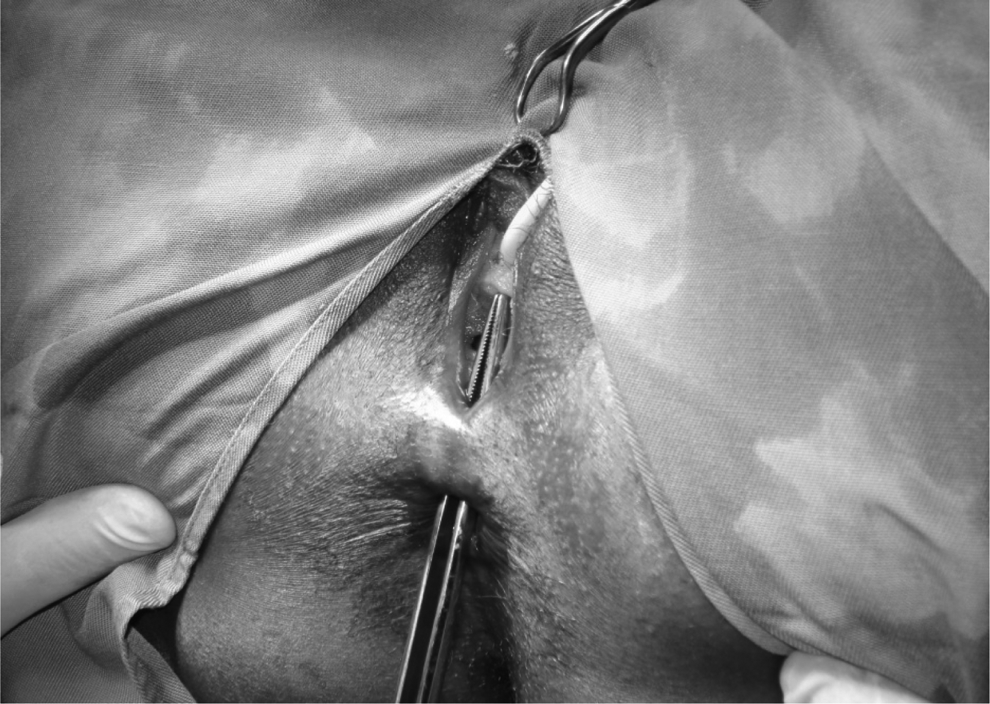
Low rectovaginal fistula with partially perforated hymen.
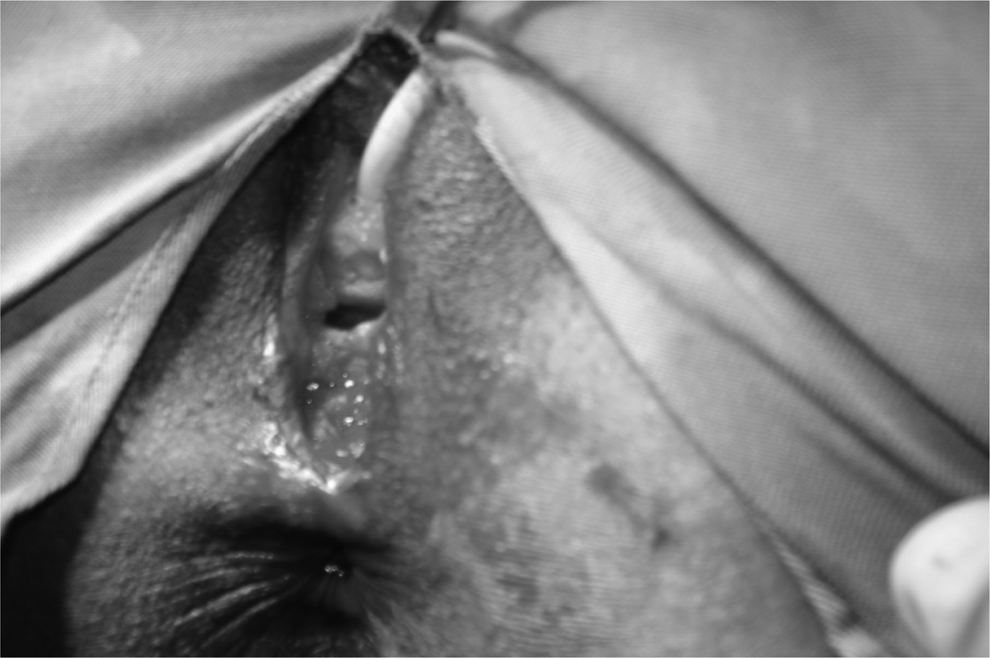
Detachment of the posterior vaginal wall in relation to the rectum.
Through transvaginal access, a dissection of the rectal wall from the vaginal wall, followed by an over-and-under suture in two planes of the rectal wall, were performed. The rectal wall was sutured using over-and-over stitching followed by the reconstitution of the posterior commissure of the vulva.
The patient had an uneventful postoperative course and was discharged 5 days after the surgical operation with a prescription of laxative, analgesic, and local care medication. Antibiotic treatment, which included clavulanic acid/amoxicillin and metrodinazole, was prescribed for 7 days. The patient was re-examined 6 months later and the clinical examination showed no problems.
Discussion
Coital trauma is known to cause vaginal bleeding. This can be a minor laceration, a vaginal laceration, or, more seriously, abundant bleeding with a shock that may require ligation of the internal iliac artery. 1 The rupture of the rear vaginal dead-end or pouch of Douglas rupture as the origin of hemorrhage, hemoperitoneum, pneumoperitoneum, or vaginal evisceration is more frequently encountered in gynecologic emergencies. 2 The occurrence of rectovaginal fistula caused by coital trauma necessitates, however, specific anatomic predisposition and/or special circumstances. The rare cases reported in the literature most often occur in a context of sexual abuse, rape, sexual violence, and use of foreign objects. 3 The perversion that characterizes the sexual orientations of certain groups can cause genital mutilations that are sometimes important. Muleta, 3 reported in Ethiopia 91 cases of genital trauma that occurred in a specific sociocultural context characterized by forced marriage, kidnapping, and rape of young girls. Genital malformations of the agenesis type or vaginal diaphragms also offer favorable conditions for the development of rectovaginal fistula. Kriplani 4 has reported 2 cases of Mayer–Rokitansky–Küster–Hauser syndrome with postcoital rectovaginal fistula. Conversely, the occurrence of rectovaginal fistula in consenting sexual intercourse remains exceptional. It is prompted by young age, virginity, nonsex, and the existence of genital disproportion. 1 The dorsal recumbent position with thigh hyperflexion and abduction, as well as brutality, vaginal dryness, or repeated aggressive use of foreign objects can encourage rectovaginal fistulas.1–5 In the reported case, virginity and the absence of sex education for the couple were probably the major underlying factors. In conservative communities, such as Senegal, sex remains a taboo subject and girls remain virgins until marriage. Sex education is lacking, and first sexual intercourse is always a difficult experience.
Several surgical techniques enable the repair of rectovaginal fistula. This can be performed as a one-time treatment through the transvaginal, perineal/vaginal, or transanal route, or as a two-time treatment based on the technique described by Musset. 6 That technique treats the rectovaginal fistula as a third degree laceration through open and deliberate section of the anal sphincter. Reconstitution is achieved 3–6 months later. Others techniques using interposition of healthy tissues, such as the bulbocavernous muscle or the gracilis muscle can be prescribed in complex cases. Rectovaginal fistulas of <2.5 cm diameter, caused by trauma or infections, are considered uncomplicated fistulas. The prognostic is better and treatment can be performed via the perineal route.
Conclusions
Rectovaginal fistula after consenting sexual intercourse is exceptional. Virginity and lack of sexual education were the main catalyzing factors in the case reported here.
Footnotes
Disclosure Statement
No competing financial conflicts exist.