




Abstract
Abstract
Introduction
Case
A 27 year old gravida 3 para 2 L2 at 20 weeks of gestation came to the outpatient clinic with a history of abdominal pain that occurred at intervals for a period of 3 weeks prior to her presentation. On examination, she was noted to be hemodynamically stable. An abdominal examination revealed a mass of 20 weeks' size in the suprapubic region. On vaginal examination, the patient's cervix was patulous, the fetus' head was felt in the posterior and left lateral fornix and the patient's uterus was deviated to the right side, which raised the suspicion of an abdominal pregnancy. Her hemoglobin was 11 g/dL, and her coagulation profile, liver, and renal-function tests had normal results. An ultrasound (US) revealed a single live fetus of 20 weeks' gestation and a placenta outside the uterine cavity to the left of the uterus in the region of the broad ligament. These findings were confirmed by magnetic resonance imaging (MRI; Fig. 1). The patient was given a systemic injection of methotrexate, administered intramuscularly at a dose of 50 mg (1 mg/kg), 24 hours prior to an elective laparotomy, as she was hemodynamically stable.

A well-delineated hypointense sac containing the placenta and fetal parts seen in the lower abdomen with the uterus seen separately and pushed to right.
Laparotomy showed that there was a left-broad ligament pregnancy, measuring 15×20 cm, extending into the pouch of Douglas with the omentum and bowel adherent to the wall of the sac (Fig. 2). An incision was made over the sac and extraction of the fetus, which weighed 320 g, with placental removal and a partial omentectomy was carried out (Fig. 3). This patient had no previous history of removal of either her left Fallopian tube or ovary. Yet, her left Fallopian tube and ovary were not visualized separately, suggesting the possibility of a tubal rupture in the mesosalpingeal border between the anterior and posterior leaves of the broad ligament. The ovary was also probably incorporated into the wall of the sac. Her uterus was intact.
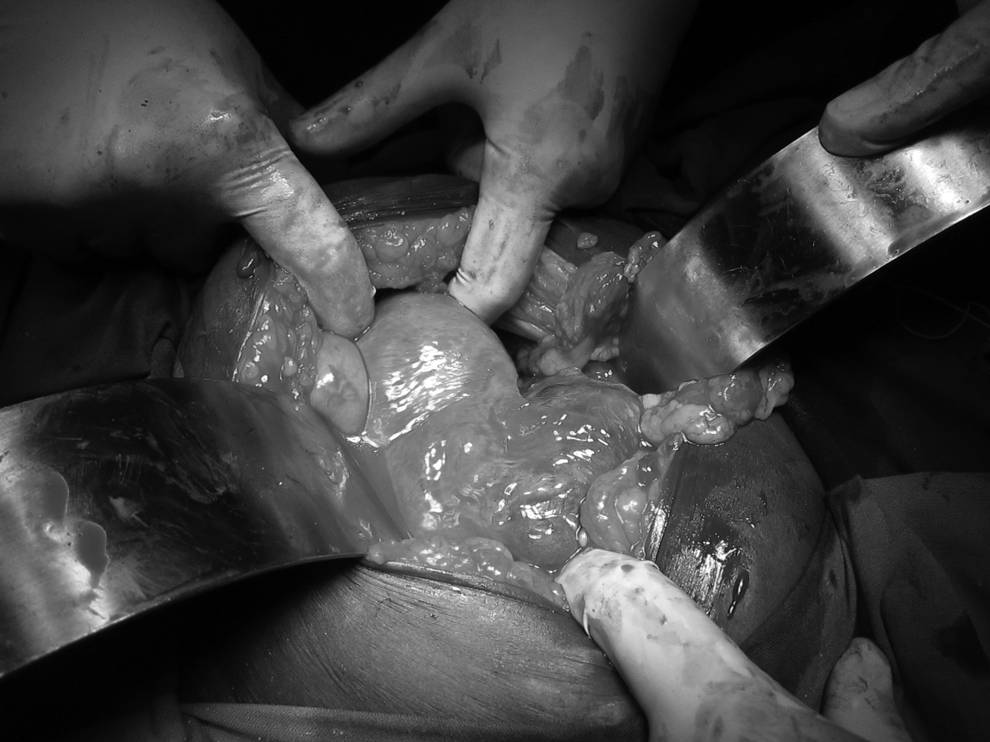
Laparotomy in left broad-ligament pregnancy.

Extracted fetus and sac in broad ligament.
Her right Fallopian tube and ovary were edematous and enlarged, and sterilization was carried out by a Modified Pomeroy's method. The patient's total intraoperative blood loss was ∼600 mL, and she did not require any blood transfusion. The intraperitoneal drain that had been placed during the procedure was removed after 3 days.
Results
Her postoperative period was uneventful, and she was discharged to home on the eight postoperative day.
Discussion
Broad-ligament pregnancy is a rare event affecting 1 in 18,3900 pregnancies. 1 It can be either primary, resulting from implantation in the broad ligament (which is rare), or secondary following implantation either in the tube, ovary, or peritoneal surface. The required anatomical relationships to make the diagnosis include the location of the uterus medially, the pelvic side walls laterally, the pelvic floor inferiorly, and the Fallopian tubes superiorly. Broad-ligament pregnancy can occur either after a spontaneous conception, 2 or any of the following: assisted reproductive techniques 3 ; twin gestation 4 ; heterotrophic pregnancy 5 ; and even extraction of a live infant6,7 in the broad ligament has also been reported. Complications include abdominal pain; rupture of the gestational sac, with hemorrhage into the peritoneal cavity; vaginal bleeding; abnormal lie; placental insufficiency; pseudolabor; and fetal death. In the patient described in this case report, the cause was most probably tubal rupture into the broad ligament and continuation as a secondary broad-ligament pregnancy.
Patients are either asymptomatic, with the diagnosis being made on US, or may complain of vaginal bleeding, not feeling fetal movements, nausea, vomiting, flatulence, diarrhea, and/or lower abdominal pain all in varying degrees. 8 The diagnosis is usually made in the first and second trimesters, or, occasionally, in the third trimester7,8 on US imaging. Approximately 50% of diagnoses are missed on ultrasound but MRI and computed tomography provide more accurate information when the diagnosis is in doubt. 8
Treatment of broad-ligament pregnancy conventionally involves immediate laparotomy with excision of the fetus. As broad-ligament pregnancy is a life-threatening condition, expectant management carries a risk of sudden life-threatening intraabdominal bleeding and a generally poor fetal prognosis. Successful treatment with laparoscopy 9 has also been reported with the advantages of less blood loss, faster recovery, and lower surgical morbidity. Various techniques have been tried preoperatively to control massive hemorrhaging intraoperatively, including embolization and methotrexate. Preoperative methotrexate therapy was described for abdominal pregnancy in 1 patient by Worley et al. 10 Postoperative methotrexate has been administered by some physicians for placental absorption when the placenta is left in situ because of attachment to blood vessels or vital structures, but leaving the placenta in situ leads to accumulation of necrotic tissue caused by accelerated placental absorption and increases morbidity.11,12 Rahaman et al. 12 described 5 patients treated postoperatively with methotrexate. Although they had rapidly declining urinary gonadotropin levels, all of the patients developed severe intraabdominal infections, and 2 patients died. Gupta et al. reported easy removal of placenta with minor blood loss, using preoperative systemic methotrexate administration in 1 patient with a secondary abdominal pregnancy similar to the current case. 8
Conclusions
As broad ligament pregnancy is a rare condition, the current authors' experience is limited. A review of literature showed 2 cases in which preoperative methotrexate had been tried with success to reduce blood loss during surgery. Hence this was tried in the current case to observe the effect of administering methotrexate preoperatively.
Preoperative systemic methotrexate with subsequent laparotomy 24–48 hours later in a hemodynamically stable patient would minimize blood loss and is a reasonable approach for managing secondary abdominal pregnancy with placental implantation in vital structures or major blood vessels. Early diagnosis helps to reduce maternal morbidity and mortality by performing proper preoperative assessment and taking measures to reduce blood loss either by embolization or by methotrexate therapy.
Footnotes
Disclosure Statement
No competing financial conflicts exist.