




Abstract

Dear Editor:
Fewer than 100 cases of cervical adenoid basal carcinoma (ABC) have been documented thus far, and only a few cases have been reported among the Asian population. 1 We report a Thai patient with cervical ABC, and vulvar papilloma and squamous-cell carcinoma in situ (CIS). The indolent course this patient had had is interesting.
This 58-year-old, para 5, menopausal woman presented with asymptomatic cervical cancer, at International Federation of Gynecology and Obstetrics (FIGO) stage IB1, for a radical operation. This patient's past history showed probable pulmonary tuberculosis (TB). On examination, we noted a right vulvar tumor of 1.5 cm in size, a bluish patch on the posterior commissure of the labia majora, and a uterine cervix was that was smooth without a visible tumor. A chest X-ray showed a mild fibrotic change in the left upper-lung field. The remainder of the examination results were normal.
A biopsy in the clinic revealed the presence of a squamous-cell papilloma of the vulva, a squamous-cell CIS of the perineum, and moderate-to-severe dysplasia of the cervix (for abnormal Papanicolaou results). Cervical conization revealed invasive squamous-cell carcinoma (SCC) that was poorly differentiated. Computerized tomography confirmed only cervical cancer, which was 4×2.1×3 cm (Fig. 1).
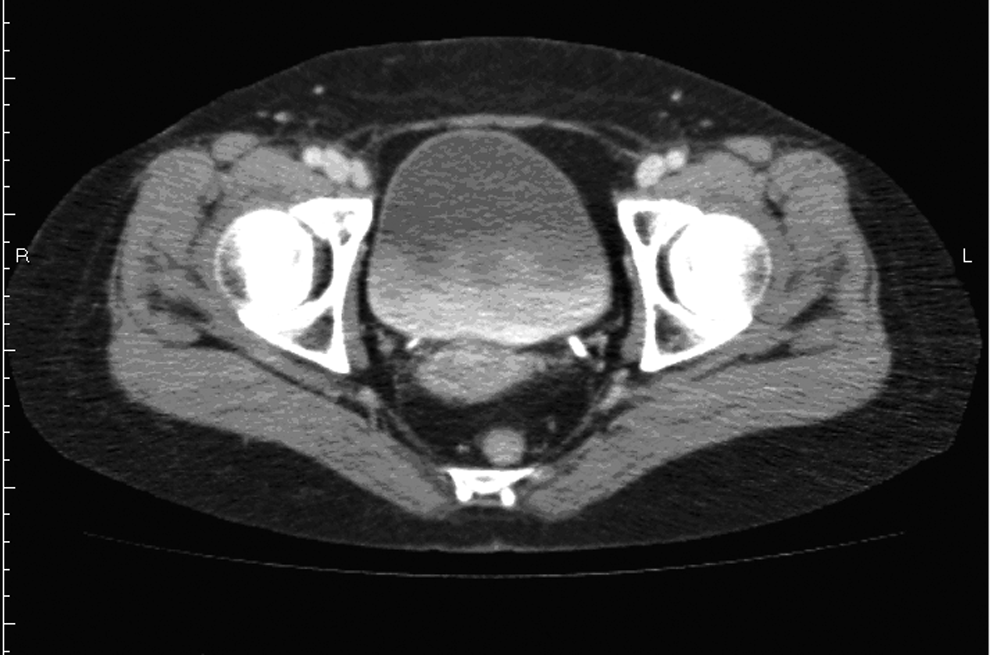
Computed tomography showing wall thickening of uterine cervix, compatible with cervical cancer, ∼ 4×2.1×3 cm.
Therefore, this patient underwent a radical hysterectomy with bilateral pelvic lymph-node dissection and a simple vulvectomy. ABC of the cervix was diagnosed, and the tumor had invaded to the full thickness of the cervical wall but was confined in the cervix (Fig. 2). At 6 months' follow-up, a vaginal smear revealed the presence of SCC. Two months later, because of respiratory symptoms and a positive TB culture, she received anti-TB medication for 9 months. A partial vaginectomy showed the presence of ABC and squamous-cell CIS 1 year after her positive vaginal smear. She agreed only to have treatment with local fluorouracil. She remained relatively well and living with the disease in her vagina without other metastasis for 4 years following initial surgical treatment.
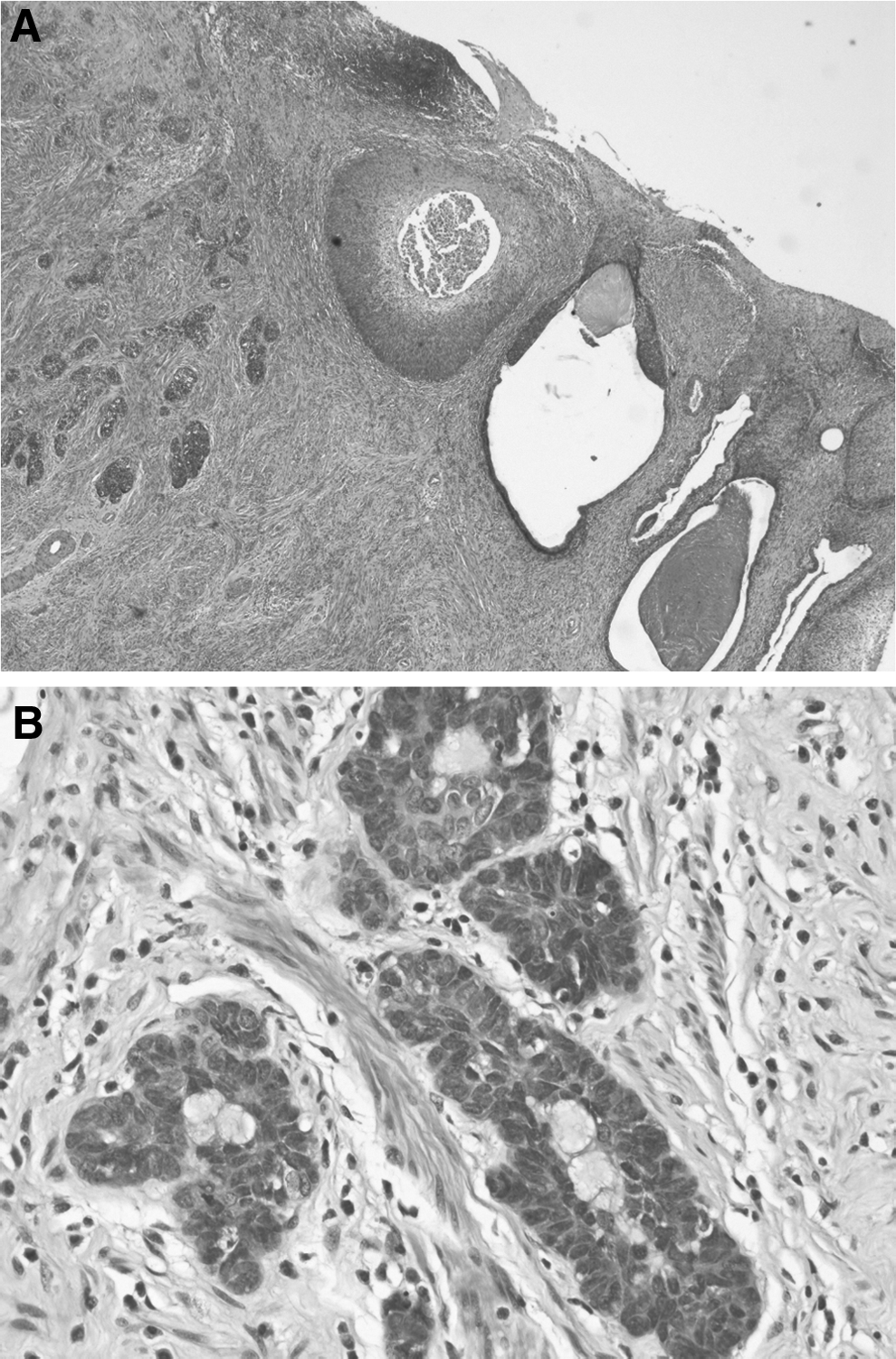
The cervical stroma with infiltrated small basaloid nests of adenoid basal carcinoma component without stromal desmoplastic reaction.
Patients with ABC are usually asymptomatic, without gross abnormality of the cervix. Microscopic examination discloses small nests of basaloid cells, almost always beneath, and often arising from CIS or SCC. Morphologically pure ABC, in contrast to adenoid cystic carcinoma (ACC), has largely been associated with favorable patient outcomes, as none of the 66 reported patients had experienced tumor recurrences, metastases or tumor-associated deaths, irrespective of the modalities of treatment given to the patients. 2
A cervical adenoid basal tumor may be associated with separate malignancies, such as, most commonly, cervical SCC. Utilizing various modalities, a role for human papilloma virus in the pathogenesis of the lesion has been demonstrated. 3 Our patient had a vulvar papilloma and CIS; as she also had TB, immunologic compromise was considered. Clinically and histopathologically, our patient fits into the category of ABC, but not ACC. She has been followed up continuously.
Footnotes
Disclosure Statement
The authors have no conflicts of interest to declare.