




Abstract
Abstract
Introduction
H
To reduce the invasiveness of the conventional laparoscopic procedure further, transumbilical single-incision laparoscopic hysterectomy was developed gradually. The single-incision approach in gynecologic surgery is not a new idea. A single-incision laparoscopic procedure was described in cases of sterilization in the 1970s. 2 Poststerilization hernias were often reported in the past, but single-incision surgeries have rare reports of hernia occurrences The first laparoscopic total abdominal hysterectomy with bilateral salpingo-oophorectomy using only a single incision was reported by Pelosi and Pelosi in 1991. 3 That technique was similar to that of tubal sterilization, wherein a laparoscope was used with an offset eye piece and a 5-mm working channel through which standard laparoscopic instruments were inserted.
Single-incision laparoscopic surgeries have different names: single-access/port/incision; laparoendoscopic single-site surgery (LESS); natural-orifice transluminal endoscopic surgery (NOTES), and one-port umbilical surgery OPUS.4,5 Three types of access have been described for the LESS procedure: (1) single umbilical incision with multiple fascial punctures; (2) single incision with use of a wound retractor and surgical gloves; and (3) use of multichannel ports. The authors have performed LESS—scarless stitchless hysterectomy (LESS-SSH) with a different technique than the existing ones and named it after the senior author “Dhillon's technique.” Most of the existing techniques require special equipment, which increases the cost of surgery. This technique does not require any extra instruments than those used in conventional laparoscopy, without any need to suture the rectus sheath or skin resulting in SSH. This is a stitchless operation because there is no stitching of the skin incision although there are vaginal stitches. This is scarless as no scar is readily apparent at surgery, at a 1 week follow-up, or at a 3-month follow-up. The LESS-SSH designation was given based on the abdominal incisions and external appearance of the surgical site. The present study was carried out to evaluate the this technique.
Materials and Methods
The present prospective observational study was performed in the Department of Advanced Gynaecologic Laparoscopy and Hysteroscopy, at Max Super speciality hospital, in Mohali, Punjab, India, from February 2012 to February 2014. Patients who required hysterectomy for benign gynaecologic conditions and gave informed consent were included in the study. The study was approved by the ethics committee of the hospital. Exclusions were malignancy, uterine size >16 weeks, presence of an associated ovarian mass that required frozen section, grade IV endometriosis, and extensive intra-abdominal adhesions.
All women underwent detailed history interviews, physical examinations, and routine preoperative investigations (complete blood count, liver-function test, renal-function test, random blood sugar, prothrombin time, international normalized ratio, human immunodeficieny virus, hepatitis B surface antigen, anti–hepatitis C virus, electrocardiogram, and chest X-ray), ultrasonographic pelvis/transvaginal sonography (TVS), endometrial biopsy if a patient had an abnormal menstrual pattern or postmenopausal bleeding. The usual symptoms of these patients were menorrhagia, polymenorrhea, dysmenorrhea, and pelvic pain. Indications for surgery were benign conditions, such as fibroid uterus, adenomyosis, and complex endometrial hyperplasia, which were confirmed by TVS and endometrial biopsy.
Operative technique
All of the procedures were performed under general anaesthesia, and the patients were placed in a modified Lloyd-Davies position. In each case, the urinary bladder was emptied. The umbilicus was inspected and an incision of 5 mm was made at the upper margin of the umbilicus. The first port was made with a safety trocar 5-mm inserted through the superior incision by a closed method. After insertion, pneumoperitoneum was induced with CO2. The peritoneal cavity was inspected with a 5-mm 30° laparoscope to assess the feasibility of performing the procedure. If extensive dense adhesions were found then the surgical plan was changed to conventional laparoscopy. To proceed with the surgery, a second 5-mm incision was made on the lower margin of the umbilicus. Then a second 5-mm trocar was inserted through the lower incision. Each incision was made at the upper and lower margins in the skin crease along the lines of Langerans (Fig. 1). The uterine manipulator (Marva model, Hospiinz International, Coimbatore, India) was inserted in the uterine cavity when the cavity was visualized.

Skin incision before inserting ports (left) and with ports (right).
The operating surgeon's position was at the head end on the left side of the patient. Both of the ports, the camera, and the instruments were controlled by the surgeon (Fig. 2). The rest of procedure was completed as would be performed in conventional laparoscopy. Pedicles were coagulated with bipolar cautery and cut with a Harmonic Ace instrument (Ethicon Endosurgery, Cincinnati, OH). The assistant at the vaginal end helped with using the manipulator and colpotomizer and helped delineate the vagina during the colpotomy. The uterus was removed through vagina. The vaginal vault was stitched with delayed absorbable polyglactin 1-0 from the vaginal end.
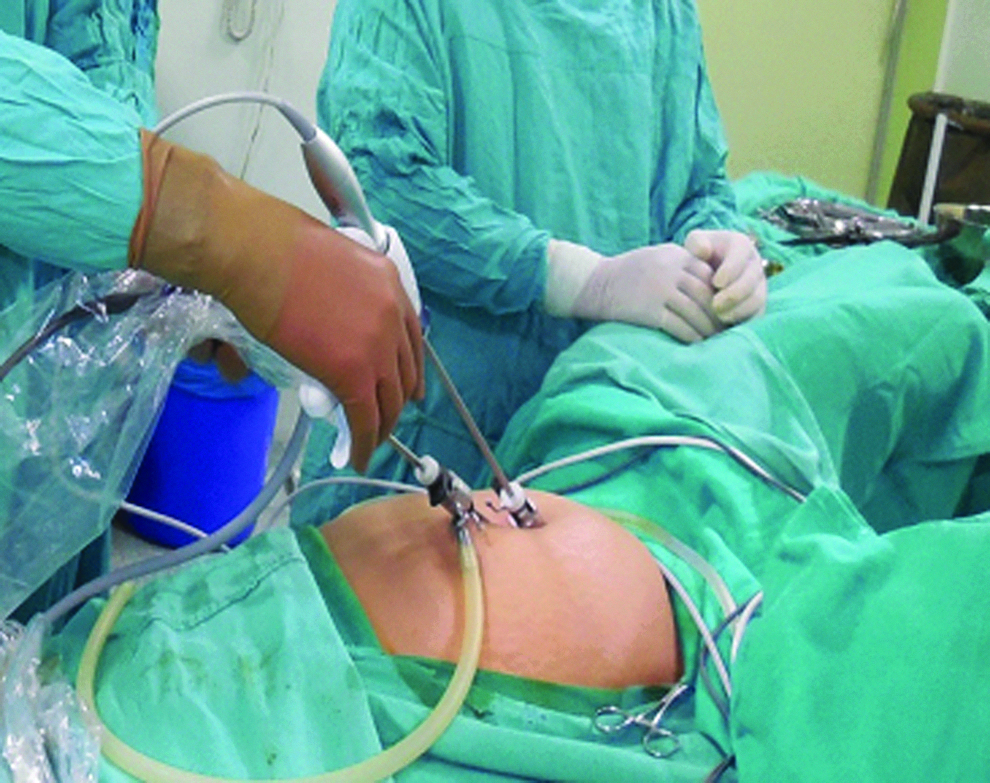
Port position during surgery.
After securing hemostasis, the camera and instruments were removed. Given that the ports' size was 5 mm, the rectus sheath was not sutured. No suture was performed in the skin. As the incision is in the skin crease the margins of incision were approximated. Plain gauze dressing was placed at the umbilicus which was removed on postoperative days (POD) 3–5. Skin approximation and umbilical shape was retained as they were in the preoperative state. This resulted in aan excellent cosmetic outcome,, as there was no visible scar.
Patients were followed up during postoperative period on the surgery day, POD 1, after 1 week, and after 3 months for pain scoring, postoperative morbidity, and hernias.
Postoperative pain was assessed by single observer in all the patients on POD 0 and POD 1. Postoperative pain intensity was rated with the patient at rest by using a visual analogue scale (VAS). The scale was presented as a 10-cm line with verbal descriptors anchored using ‘‘no pain’’ and ‘‘worst imaginable pain.’’ Operative time was defined as time from skin incision to time of closure.
Statistical analysis
The results were expressed in means±standard deviation (SD; range).
Results
A total of 27 patients were operated using LESS-SSH. The mean age of patients was 44.93±3.67 years (39–55 years) and the mean body mass index was 25.47±1.62 kg/m2 (23.2–29.3 kg/m2). All of the patients were multiparous. Six of the patients had had previous lower-segment casearean sections, and 3 had had previous cholecystectomies. The mean operative time was 62.04±11.29 minutes (50–90 minutes). The mean estimated intraoperative blood loss was 34.44±6.98 mL (30–50 mL). The blood loss was mostly backflow from the uteri. The length of hospital stay was 0–1 day. The mean VAS pain scores on POD 0 and POD 1 were 3.26±0.95 (2–5) and 2.34±1.11 (1–4), respectively. There was no conversion to conventional laparoscopy or laparotomy. There were no intraoperative complications. None of the patients received blood transfusions. On follow-up, after 1 week, there were no complaints of pain and there was no visible scar, the skin had healed and umbilicus was reconstructed as before (preoperative; Fig. 3). On follow-up at 3 months, patients did not have any complaints nor visible scars (Fig. 4), and there were no incisional hernias. There were no occurrences of port-site infections during the study period.

Scarless skin on postoperative day 7.
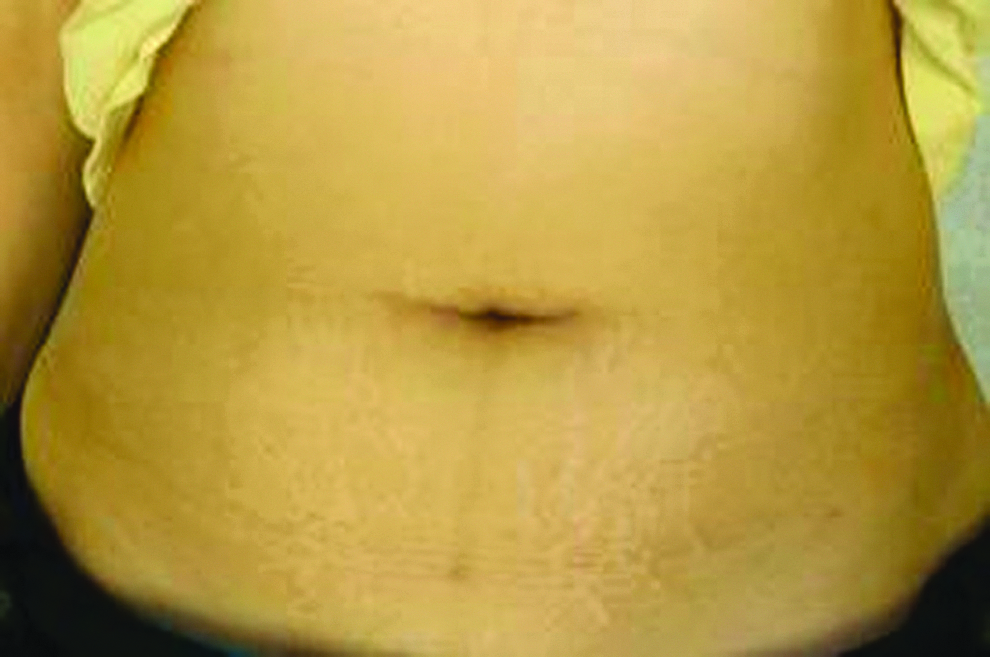
No visible scar at follow-up.
Discussion
The LESS procedure for gynecologic surgery is still evolving. The current authors started performing LESS for hysterectomy in 2010. Initially, the current authors offered this surgery to patients solely for cosmetic purposes, but when analysing the patients' responses and thefeasibility of completing this surgery without complications in optimal time, the authors found LESS to be a good alternative to conventional laparoscopy. The response of patients was overwhelming as their pain levels were reduced remarkably postoperatively. The requirements for analgesics were also reduced. The patients were discharged and able to use analgesics on a si opus sit (SOS; if necessary) basis. Twelve (44.4%) patients were discharged on the same day of surgery.
Although, intraoperative blood loss, recovery times, and surgical outcomes were similar to those of conventional laparoscopic hysterectomy, this study found there were marked reductions in pain scores and excellent cosmetic outcomes. The patient satisfaction rate was high. The present study showed reduction in pain scores, which were comparable to a randomized controlled trial (RCT) from Taiwan, which also showed significantly lower postoperative pain in single-port hysterectomy than in conventional hysterectomy. 6
However, another RCT from South Korea did not find a significant difference in pain scores. 7 The reduction in pain can be the result of less nerve damage because of fewer skin incisions. There is no risk of injury to inferior epigastric vessels as the incision is only at the umbilicus. The present study did not reveal any case of port-site infections. The patients were ambulatory, mostly on the same day. This study found a mean operative time of 62.04 minutes, which is similar to that of conventional laparoscopic hysterectomy.8,9 This could be because of vaginal suturing of the vaginal cuff in this study. The present study finding is similar to other studies that have used three channels in LESS hysterectomy.10,11
The problem of “sword fighting” was reduced as only two instruments were used, compared to single-incision laparoscopic surgery, in which three instruments are used, and a 30°-laparoscope was used. The number of changes in operative instruments was kept as minimal as possible to improve vision. The pedicles were cut with the Harmonic instrument, so that, if oozing occurred, it could be controlled instantly with the same instrument. Hemostasis was maintained very strictly with adequate bipolar coagulation and surgery proceeded to the next step only after securing any bleeders. There were no conversions to conventional laparoscopy or laparotomy, which can be attributed the current study's strict exclusion criteria, selection bias, and expertise of surgical team.
The present study did not require suturing of the rectus sheath (5-mm trocars used) and the skin. Glue was not used, and the skin creases at the umbilicus were used. The incision was made in such a way that it coincided with the lines of Langerans at both borders of the umbilicus. That is why this procedure was termed named LESS-SSH.
There is a definite advantage of LESS other than cosmesis but this advantage needs more well-planned RCTs and evaluation. Recently, many advances have been made in this field in terms of new access ports and use of robotics for single-incision surgery. Some new developments include the following ports: Octoport (DalimSurgNet, Seoul, Korea); X-Cone (S-Portal X-cone; KarlStorz, Tuttlingen, Germany); Cuschieri Endocone (Karl Storz); Tri port (Advanced Surgical Concepts, Wicklow, Ireland); Airseal (SurgiQuest, Orange, CT); and Uni-X (Pnavel Systems, Morganville, NJ). These ports are disposable and expensive and thus of limited usefulness in low-resource countries.
Conclusions
It is quite premature to say that LESS will replace standard conventional laparoscopic surgery, but the feasibility of surgery and patient satisfaction with reduction of postoperative pain has shown that LESS is going to be an area of interest for conceptual and technical development. However, LESS needs a high level of surgical skills and proper case selection. Introduction of robotics might improve the future of LESS. 12 Future studies are needed to evaluate this surgery.
Footnotes
Disclosure Statement
The authors have no commercial, proprietary, or financial interest in the products or companies described in this article.