




Abstract
Abstract
Introduction
T
We report a case of unsuccessful methotrexate (MTX) treatment of unilateral tubal twin ectopic pregnancy following in vitro fertilization and embryo transfer (IVF-ET).
Case
A 26-year-old woman was admitted for suspected ectopic pregnancy 6 weeks after her last menstrual period without any clinical manifestation. She had conceived after IVF and two ET. The serum β-human chorionic gonadotropin (β-hCG) level was 17,641 mIU/mL. Ultrasonography showed no intrauterine gestational sac and enlarged multicystic ovaries. In addition, two separate gestational sacs 10 and 12 mm in diameter within the Lt. adnexa, each containing a vital embryo, were observed (Figs. 1 and 2). No free fluid was observed in the pouch of Douglas. A diagnosis of unruptured tubal twin ectopic pregnancy was made. The therapy of MTX based on the hemodynamic stability and the small size of the gestational sacs was proposed. The patient was administered systemically as a two-dose regimen (MTX 50 mg/m2 i.m on days 1 and 4 without folinic acid). In the follow-up, an asymptomatic increase in serum β-hCG levels was observed. Heartbeat still persisted. Laparoscopy was proposed after counseling. At laparoscopy, two separate bulges were seen on the left tube and a salpingectomy was performed.
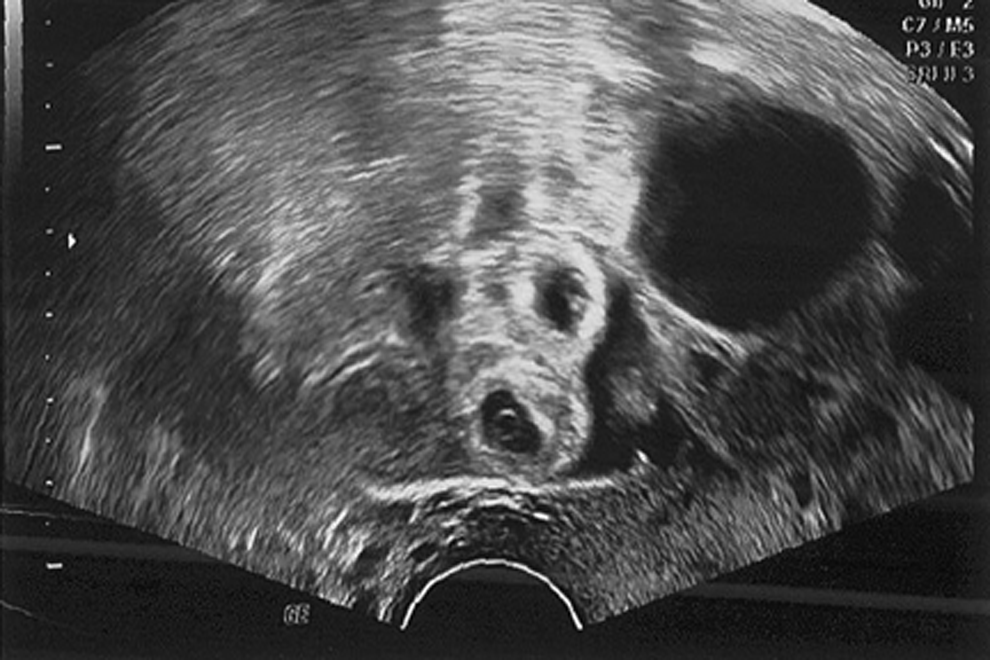
Transvaginal ultrasound shows two separate gestational sacs, each containing an embryo.

Transvaginal ultrasound shows the Doppler waveforms recorded from two live twin tubal ectopic pregnancies.
Discussion
Although ectopic pregnancies are increasing, unilateral tubal ectopic pregnancies are still rare. There are about 100 cases reported in the literature, and only 10 of these cases had live twin tubal ectopic pregnancy diagnosed by ultrasonography. 3 However, the incidence is most likely increased after assisted reproductive technology procedures. 4
Diagnosis of unilateral tubal twin pregnancy is critical as such twin pregnancies may grow faster and may, therefore, have a higher risk of rupture. 5 However, an early diagnosis is difficult. Especially among those undergoing IVF, the presence of ovarian hyperstimulation syndrome may obscure the possibility of ectopic pregnancy.
Most unilateral twin tubal pregnancies have been managed with laparoscopy or laparotomy. Until now, only three cases of MTX management have been attempted. Fernandez et al. 6 first reported a successful use of a combination of ultrasound-guided local injection and intramuscular administration of MTX. In both fetuses, the cardiac activity was negative and initial β-hCG was 3640 mIU/mL. In the second case reported by Karadeniz et al., MTX treatment according to the multiple-dose regimen was chosen, which failed to induce a decrease of β-hCG levels. The pretreatment β-hCG was 763 mIU/mL and no information about the fetal cardiac activities was present. 7 Finally, Arikan et al. 1 reported a case that was successfully treated with a single-dose MTX. Initial β-hCG was 18,780 mIU/mL, and the fetal cardiac activities are negative.
Our patient is a rare case of dizygotic unilateral tubal twin pregnancy with fetal heart rate activity detected by ultrasonography. The pretreatment of β-hCG level was 17,641 mIU/mL. Based on an early stable stage, the small size of the gestational sacs, and the trend in the treatment of ectopic pregnancies toward noninvasive conservative management, the therapy of MTX was performed, but unsuccessful in our case.
In conclusion, the therapy of MTX in cases of unilateral tubal twin ectopic pregnancy with demonstrable fetal heartbeats should be reconsidered.
Footnotes
Disclosure Statement
No competing financial interests exist.