




Abstract
Abstract
Introduction
C
C. dubliniensis has the ability to rapidly develop resistance to the most commonly prescribed antifungals. Consequently, a high degree of suspicion and precise identification are essential to recommend an effective treatment.
Candida Genus
The genus Candida consists of about 200 species. These fungi are sexually imperfect (anamorphic) and belong to the form class of blastomycetes. 2 Most Candida species are characterized by their polymorphic nature and their capability to form blastoconidia (budding yeast cells), mycelia, pseudomycelia, and blastospores. 3
The most common species involved in human vaginal colonization in immunocompetent patients are as follows: C. albicans, Candida glabrata, Candida tropicalis, Candida parapsilosis, Candida krusei, and Candida lusitaniae. The microscopic appearance at wet mount preparations of these fungi has been recently reported. 4
Candida dubliniensis
C. dubliniensis is a dimorphic fungus phenotypically similar, but genotypically different to C. albicans. This fungus forms small hyphae, produces chlamydospores in pairs, chains, and clusters and it has been commonly misclassified as C. albicans. 5 In addition, this fungus characteristically adheres to the vaginal epithelial cells and by producing aspartic proteinases it supports vaginal colonization. 5
Figure 1 shows single chlamydospores with long pseudohyphae - 200× magnification.
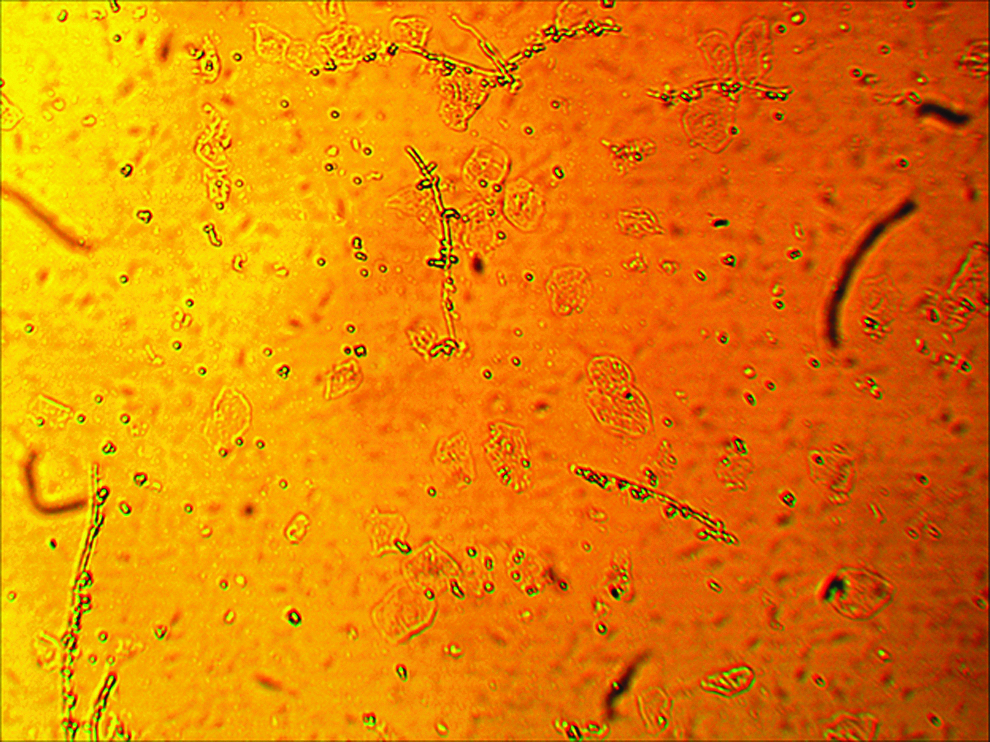
Microphotograph that shows single chlamydospores with long and plentiful pseudohyphae typical of Candida albicans. Fungal culture confirmed the wet mount preparation assumption.
Figure 2 shows chlamydospores in pairs, chains and clusters, and short pseudohyphae - 200× magnification.

Microphotograph that shows abundance of chlamydospores in pairs, chains, clusters, and short pseudohyphae typical of Candida dubliniensis. Fungal culture confirmed the wet mount preparation assumption.
Clinical Importance
The ability of C. dubliniensis to rapidly develop resistance to fluconazole and itraconazole makes it a difficult fungus to treat. Boric acid in gel capsules vaginal is the preferred treatment.
Wet Mount Appearance
At wet mount microscopic preparations, 200× to 400× C. albicans and C. dubliniensis have different appearances.
Conclusion
Vaginal candidiasis may include several species. It is essential to identify resistant species like C. dubliniensis in patients with recurrent fungal vaginitis for accurate treatment. Wet mount preparation may lead to suspect the diagnosis, although fungal culture or PCR identification is necessary to confirm it.
Footnotes
Disclosure Statement
No competing financial interests exist.