




Abstract
Abstract
Introduction
T
NOTES reaches the abdominal cavity without visible scars. To this end, numerous surgical procedures are performed via a natural body orifice. In recent years, this technique has gained popularity among general surgeons, gynecologists, urologists, and gastroenterologists; and NOTES has been approved for feasibility and safety. 3
NOTES can be performed via several approaches, including the stomach, esophagus, bladder, and rectum, but the majority of NOTES procedures have been performed transvaginally, as the vagina provides direct access to the peritoneal cavity. 4 Operations performed in the abdomen through transvaginal NOTES are referred to as vNOTES operations. Culdotomy has been used widely for several surgical procedures (not only by gynecologists, but also by general surgeons for extraction of large specimens), and it has been approved for safe and easy to closure. 5
For hybrid NOTES, the surgical procedure is performed through a natural body orifice with transabdominal assistance. The term pure NOTES refers to procedures that involve only transluminal access.
Because of this technique's potential benefits—including no visible scars, fewer port-related complications, and less-painful and faster postoperative recovery—transvaginal pure NOTES for benign adnexal masses was included in the current authors' surgical repertoire in November 2013. After initial experience with vNOTES for adnexal surgery, 6 vNOTES adhesiolysis, 7 vNOTES salpingectomy, 8 vNOTES ovarian cystectomy, vNOTES myomectomy, vaginally assisted NOTES hysterectomy (VANH), 9 and total vaginal NOTES hysterectomy (TVNH) 9 were introduced in the current authors' daily surgical practice.
Initially, all of the procedures were performed with only conventional, reusable laparoscopic instruments and an inexpensive, self-constructed single-port device.6–9 In March 2015, GelPOINT ports and GelPOINT mini ports (both from Applied Medical, Rancho Santa Margarita, CA) were introduced to replace gloveports for vNOTES procedures in the current authors' department.
This study aimed to demonstrate that the GelPOINT advanced-access platform and GelPOINT mini–advanced-access platform is a good alternative to a self-constructed gloveport. Both platforms were developed for transumbilical single-site surgery, but can potentially offer benefits over a gloveport when used transvaginally for vNOTES. The GelPOINT and GelPOINT mini are each consisted of two parts: (1) a wound protector, as used in a gloveport; and (2) a lid that clicks onto the wound protector and contains a gel cushion that can be perforated with trocars.
Materials and Methods
Patients
Between March and October 2015, a total of 110 vNOTES hysterectomies, salpingectomies, adnexectomies, and cystectomies were performed by a single surgeon (B.J.) using the GelPOINT port for transvaginal access.
Each patient was selected based on a benign gynecologic disease diagnosis, and on the following criteria: no contraindication for general anesthesia, pneumoperitoneum, or Trendelenburg position; no fixed uterus, strong pelvic adhesions, or nodularity in the pouch of Douglas (POD) on clinical examination; no history of pelvic inflammatory disease; and no suspicion for malignancy. Obesity, a body mass index (BMI) >30 kg/m2, and the absence of vaginal delivery, were not exclusion criteria, whereas virginity and pregnancy were.
The following patient and perioperative data were collected and analyzed retrospectively: patient age; BMI; parity; history of vaginal delivery; previous pelvic surgery; type of surgery; total operation time; serum hemoglobin (Hb) drop (change between the preoperative and postoperative Hb 1 day after surgery); perioperative complications; and postoperative pain score.
Duration of surgery was defined as the time from the placement of the Foley catheter to the completion of vaginal closure. Bowel, bladder, urethral, or vascular injuries, and blood loss >300 mL, were considered to be intraoperative complications. Short-term postoperative complications were considered to be urinary-tract infection, postoperative ileus, vaginal- vault bleeding or infection, or hematuria.
Postoperative pain was assessed using a visual analogue scale (VAS) to assess pain (scoring from 0 = no pain to 10 = worst imaginable pain). VAS score was evaluated at 6 and 24 hours postoperatively for each patient. All patients received the same intraoperative analgesia: 1000 mg of intravenous (IV) paracetamol and 20 mg of ketorolac trometamol. Postoperative pain was managed by 1000 mg of paracetamol, and ketorolac trometamol was administered on the patient's demand.
Prophylactic IV antibiotic therapy (2 g of cefazolin and 500 mg of metronidazole) was administered during surgery.
No vaginal intercourse was allowed for 6 weeks after the procedure. Each patient was reassessed at a postoperative visit 6 weeks after surgery.
Surgical techniques
VANH
The patient was placed in a lithotomy position on a vacuum mattress. The operation field was disinfected and draped. A Foley catheter was inserted into the bladder.
A circular incision was made around the cervix using a cold knife. The POD and vesicouterine peritoneum were opened with cold scissors. Both uterosacral ligaments were clamped, transected with cold scissors, and tied off with a Vicryl®-1 suture. A GelPOINT port, used as a vNOTES port, was inserted into the peritoneal cavity. CO2 was insufflated until a maximal intraperitoneal pressure of 15 mm Hg was reached. A laparoscope was inserted and the peritoneal cavity was inspected. The patient was then placed in a Trendelenburg position. Three trocars were inserted into the GelPOINT lid. The laparoscope was inserted in the bottom central trocar and was held by the first assistant. The surgeon manipulated the endoscopic instruments through the two top trocars (Fig. 1).

GelPOINT setup for transvaginal natural orifice transluminal endoscopic surgery.
The ureter was identified but not routinely dissected. The decision to dissect it was based on whether or not it could be identified transperitoneally. The uterine artery, the ovarian ligament, and the meso of the fallopian tube, were coagulated, using a bipolar grasper, and then transected. In patients requiring adnexectomy, the infundibulopelvic ligament was coagulated, using a bipolar grasper, and then transected. Hemostasis was checked and the peritoneal cavity was rinsed. The NOTES port and uterus were removed transvaginally and the pneumoperitoneum was deflated. In cases when the uterus was too large to extract in toto, it was manually morcellated so that it could be removed vaginally.
The colpotomy was closed using a running Vicryl-1 suture. A vaginal plug (Betadine® gauze 10 cm × 5m) was placed to compress the vaginal vault and was removed after 3 hours together with the Foley catheter.
Adnexal surgery
The patient was placed in lithotomy position on a vacuum mattress. The operation field was disinfected and draped. A Foley catheter was inserted into the bladder.
A 2.5-cm posterior colpotomy was made with a cold knife and the POD was opened with cold scissors. A GelPOINT mini port, used as a vNOTES port, was inserted into the POD. CO2 was insufflated until a maximal intraperitoneal pressure of 15 mm Hg was reached. An optic was inserted, and the peritoneal cavity was inspected. The patient was then placed in a Trendelenburg position. Three trocars were inserted into the GelPOINT lid. The laparoscope was inserted in the bottom central trocar and was held by the first assistant. The surgeon manipulated the endoscopic instruments through the two top trocars (Fig. 2).
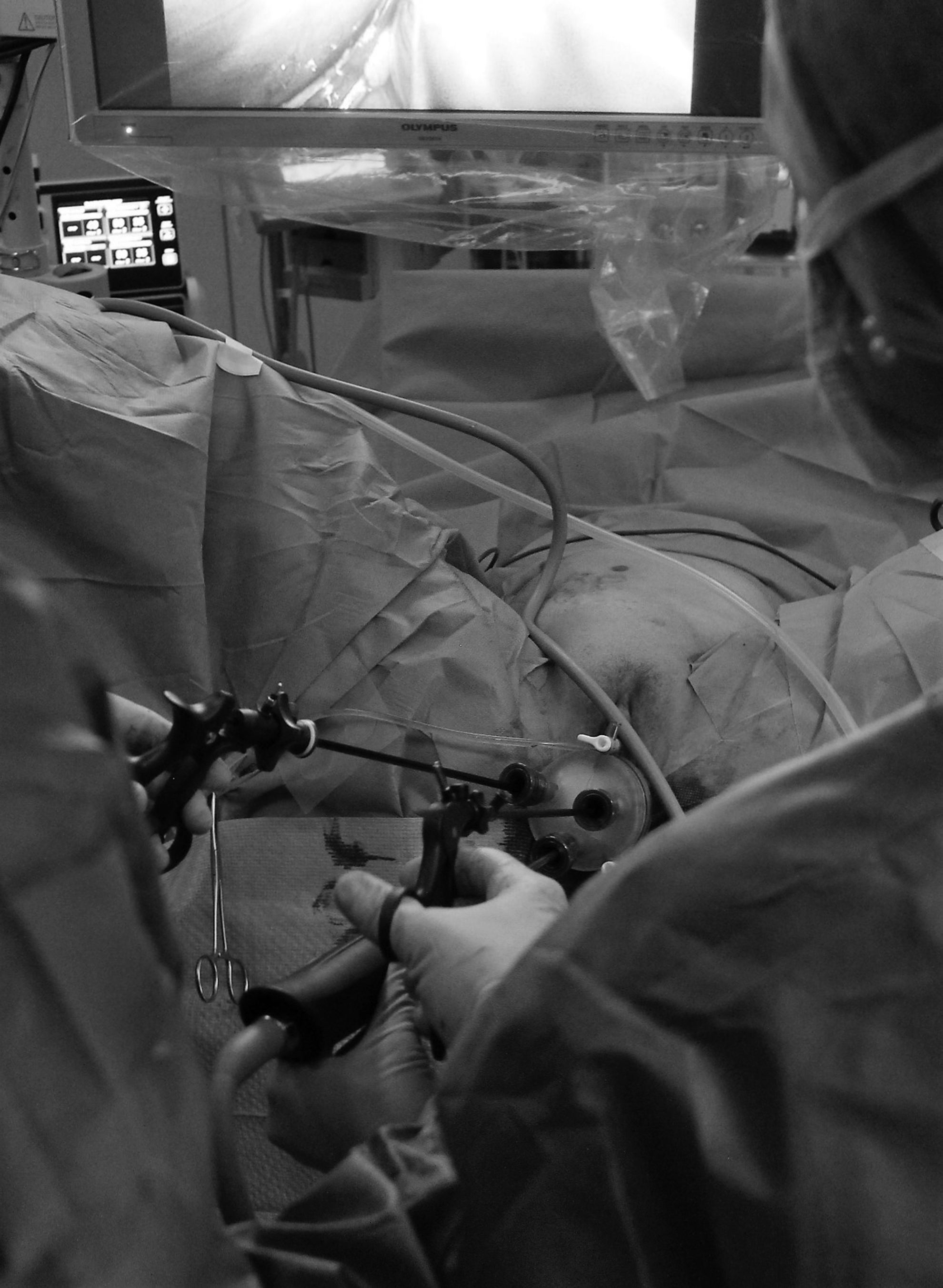
GelPOINT mini-setup for transvaginal natural orifice transluminal endoscopic surgery.
Salpingo-oophorectomy
The ureter was identified, but not routinely dissected. It was only dissected if it could not be identified transperitoneally. The proximal end of the fallopian tube was coagulated at its uterine origin with a reusable bipolar grasper, and was transected with cold scissors. The ovarian and infundibulopelvic ligaments were coagulated and transected. The adnexa were resected. If necessary, the same procedure was repeated for the contralateral adnexa. The peritoneal cavity was rinsed and hemostasis was checked.
Small and benign adnexa were removed directly through the wound-protector part of the GelPOINT mini port. Large adnexa or adnexa that were macroscopically suspicious, were placed in an endobag (MemoBag, Teleflex, Dublin Ireland). The purse string of the endobag was pulled through the wound protector and the purse string was released. The content of the cyst was aspirated to reduce the volume of the adnexa. The endobag was removed with the adnexa inside it.
Salpingectomy
After applying medial traction to the fallopian tube, the mesosalpinx was coagulated and transected using a standard bipolar forceps and cold scissors.
This process was repeated distally to proximally until the insertion of the fallopian tube into the uterus. The fallopian tube was then transected at its origin. The fallopian tube was removed through the wound-protector part of the GelPOINT mini.
Ovarian cystectomy
The ovarian cortex was incised with cold scissors. An ovarian cystectomy was performed. Ovarian hemostasis was obtained with a bipolar forceps. The ovarian cyst was removed as described above for salpingo-oophorectomy.
The GelPOINT mini port was then removed.
The colpotomy was closed, using three interrupted figure-of-eight Vicryl 2/0 sutures. A vaginal plug (Betadine gauze 10 cm × 5 m) was placed to compress the vaginal vault and was removed after 3 hours together with the Foley catheter.
Results
One hundred and ten procedures were performed successfully through vNOTES, using the GelPOINT port in combination with conventional reusable laparoscopic instruments. These procedures included 77 hysterectomies, 25 adnexectomies, 4 salpingectomies and 4 ovarian cystectomies. No conversions to standard laparoscopy or laparotomy were necessary. There were no intraoperative complications. The short-term postoperative complications were limited to 7 patients with cystitis.
Table 1 presents an overview of patients' and perioperative data. The mean operation time for a hysterectomy was 56 minutes, and, for adnexal surgery, the mean operation time was 25.5 minutes. The mean drop in Hb level was 1.5 g/dL for the hysterectomies. These data were not available for the adnexal surgery, as most patients were treated on an outpatient basis. Most patients had low postoperative pain scores with a mean score of 1.8 24 hours after surgery for the hysterectomies and a mean score of 1.6 for the adnexal surgeries. Uterine weight ranged from 25 to 642 g, with a mean of 155.9 g. The mean size of the adnexal masses was 45.5 mm, with the largest cyst measuring 110 mm.
BMI, body mass index; min, minutes; h, hours.
Each patient was examined 6 weeks after surgery. There were no vaginal wound infections or occurrences of dehiscence, and no patients complained of pain during pelvic examinations. All patients were in good health.
Discussion
In this study, 110 operations were performed successfully through vNOTES, using a GelPOINT port as the access port. There were no conversions to a different port type. In addition, there were no conversions to laparotomy or conventional laparoscopy, and no technical problems occurred. The procedures were completed within reasonable operating times, and there were no perioperative complications. Postoperatively there, were only minor complications: 7 patients presented with cystitis. Overall, patients had low pain scores at 6 and 24 hours postoperatively.
To the best the current authors' knowledge, this comprises the first report on the use of the GelPOINT port for vNOTES.
Multiple techniques exist for performing a hysterectomy (Table 2). A classical vaginal hysterectomy is a total hysterectomy performed entirely through vaginal access under direct vision using conventional surgical instruments. A VANH is a total hysterectomy wherein, first, the caudal part of the uterus is dissected vaginally under direct vision (as in a classical vaginal hysterectomy), and, thereafter, the rest of the hysterectomy is performed through vNOTES, using an endoscopic camera and endoscopic instruments.
NOTES, natural orifice transluminal endoscopic surgery.
Over the last few years, the use of robotic and laparoscopic techniques has increased, while conventional vaginal and abdominal hysterectomies have been performed less frequently. 10
According to the Cochrane Database, the preferred technique to perform a hysterectomy is conventional vaginal surgery. When a vaginal hysterectomy is not possible, a laparoscopic hysterectomy might avoid the need for an abdominal hysterectomy. 11 Making use of the advantages of endoscopic surgery, vNOTES hysterectomy broadens the indications for vaginal hysterectomy and helps overcome its limitations, while the NOTES approach avoids abdominal-wall wounds and trocar-related complications. 12 A study on vNOTES appendectomies also reported shorter hospitalization, quicker recovery, less analgesic requirement, and better cosmetic satisfaction. 13
One could argue that some of the hysterectomies in this case series could have been performed by conventional vaginal hysterectomy in the hands of a skilled vaginal surgeon. In the current authors' experience, the vNOTES approach broadened the indications for vaginal hysterectomy. In the 6-month period before vNOTES hysterectomy was introduced in the current authors' department, 80% of benign hysterectomies were performed laparoscopically, 19% were performed vaginally, and 1% were performed through laparotomy. In a 6-month period after the introduction of the vNOTES hysterectomy, 88% of benign hysterectomies were performed transvaginally (65% vNOTES and 23% conventional vaginal hysterectomy), 10% laparoscopically, and 2% through laparotomy.
Compared with a conventional vaginal hysterectomy, the vNOTES approach facilitates removal of the fallopian tubes, which is routinely performed in all hysterectomies in the current authors' department. It also facilitates adnexectomy, when indicated, during hysterectomy. The improved visualization facilitates hemostasis and resection of larger uteri.
When compared to SILS, comparable technical difficulties appear to be related to instrument collision, limited triangulation, and reduced traction of tissue.14,15 Because colpotomy provides a more flexible entry, compared to infraumbilical fascia opening, these difficulties are less restricting, compared to SILS. 6
One could argue the possibility of pelvic infection after vaginal surgery; however, none of the 110 patients presented with this complication after the vNOTES procedures. Previous studies have shown that this complication is unlikely to happen, especially when prophylactic antibiotics are administered.16,17 In addition, there is no evidence to suggest a difference in prevalence of dyspareunia between conventional and endoscopic transvaginal surgery, and studies have shown no reports of dyspareunia in mid- and long-term follow-ups.16–18 As was the case for the current study protocol, sexual abstinence was recommended for 6–8 weeks, as this is the recommendation for conventional transvaginal surgery. 18
Some contraindications should be considered before performing vNOTES. When here is a massive hemoperitoneum, the endoscopic view will be disturbed. 19 When POD adhesions are expected, a thorough pelvic examination should be performed prior to surgery, and, when there is unexpected POD obliteration, conversion to transabdominal laparoscopy should be considered. Another contraindication for vNOTES is virginity. However, nulliparity or the absence of vaginal delivery should not be contraindications for performing vNOTES, and obesity is also not a contraindication. If a good Trendelenburg position can be achieved, the bowel and mesenterium can be lifted out of the pelvis and will not impair visualization.
The major limitation of vNOTES is the inability to overview the pelvic area—in particular, the vesicouterine pouch—and, thus, lesions, such as bladder endometriosis or anterior uterine-wall myomas, can be missed. Innovations in endoscopes will help overcome this limitation and provide the ability to explore the entire abdominal cavity using vNOTES. 19
The GelPOINT advanced-access platform was used successfully in 77 VANH procedures and the GelPOINT mini–advanced-access platform was successfully used in 33 vNOTES adnexal procedures. Both were used in thin and obese patients (BMI range: 17.9–36.7) and provided a good CO2 seal for pneumoperitoneum.
The GelPOINT port offers several advantages over a self-constructed gloveport. These include a shorter setup time (as there is no need to construct a gloveport), easier instrument transfer through the trocars, better ergonomics, and a less-fragile port, reducing the risk of accidental puncture and CO2 leakage.
The greatest disadvantage is the higher cost. There is also a limitation to 4 trocars, compared to the 5 trocars used with the gloveport. In this study, all procedures were performed without difficulty, using only 3 trocars, as easier port transfer reduces the need for a larger number of ports.
Conclusions
The feasibility and potential benefits of VANH and vNOTES adnexal surgeries have been demonstrated previously.6,8,9,17
In this study, 110 vNOTES procedures were performed successfully, using GelPOINT ports, demonstrating that the GelPOINT advanced-access platform the GelPOINT mini– advanced-access platform are suitable for VANH and vNOTES adnexal surgery, respectively. Both ports can be used in slim and obese patients, providing a good CO2 seal and good access to the peritoneal cavity.
The main advantages of GelPOINT ports over self-constructed gloveports are shorter setup time, easier instrument transfer through the trocars, better ergonomics, and less-fragile ports. These advantages need to be weighed against the higher cost of the GelPOINT port. The current authors found the limitation to 4 trocars, compared to 5 in a gloveport, was not quite that disadvantageous, as the easier port transfers with GelPOINT ports reduced the need for more than 3 trocars.
Footnotes
Author Disclosure Statement
No competing financial conflicts exist.