




Abstract
Abstract
Objective:
The goal of this research was to explore physicians' perceptions of uterine morcellation and minimally invasive hysterectomy in the setting of new hospital regulations, comparing gynecologists and internal medicine providers, geographic locations, and levels of training.
Design:
This was a multicenter cross-sectional study.
Materials and Methods:
A 17-question, anonymous, electronic survey was administered to resident, fellow, and attending gynecologists, and internal medicine physicians at three institutions.
Results:
Two hundred and twenty-two gynecologists responded for a response rate of 46%. Most gynecologists believe morcellation is safe and acceptable, and the benefits of minimally invasive surgery outweigh the potential risk of cancer dissemination as a result of morcellation. The majority reported that the incidence of occult leiomyosarcoma is rarer than 1 in 350. Physicians from Boston, MA, responded less favorably toward morcellation than providers in Pittsburgh, PA, and Chapel Hill, NC (p < 0.001). Trainees were not significantly different from attending gynecologists. One hundred and forty-seven internal medicine physicians responded for a response rate of 40%. Compared to internal medicine providers, significantly more gynecologists believe minimally invasive approaches, as opposed to laparotomy, yield the best overall outcome (p < 0.001), and the benefits of morcellation outweigh its potential risks (p < 0.001). Compared to gynecologists, more internal medicine physicians felt morcellation should be banned (p < 0.001).
Conclusions:
Most gynecologists highly value morcellation as a means of tissue extraction to facilitate minimally invasive approaches in order to provide the most optimal patient outcomes. Gynecologists' opinions regarding morcellation differ by geographical location but not by level of training. Gynecologists responded more favorably toward minimally invasive hysterectomy and morcellation, compared to internal medicine physicians. (J GYNECOL SURG 33:12)
Introduction
G
Given the extent to which internal medicine physicians are involved in well-woman care, the current authors were particularly interested in exploring internal medicine physicians' perceptions of morcellation in the setting of intense media coverage. Three-quarters of all women identify their family practice or internal medicine physicians as their regular healthcare providers, 22 with more than half of women's preventative care visits performed by nongynecologic primary care physicians. 23 The Affordable Care Act has and will continue to increase the number of women seeking routine health visits from family medicine and internal medicine physicians. 24 Furthermore, the nationwide press coverage may make it challenging for patients to interpret the medical science and understand the surgical options available to them. Thus, assessing the perceptions of primary care physicians is critically important to patient-centered care for women with fibroids in the current climate.
The objective of this study was to explore physicians' knowledge and perceptions of uterine morcellation and minimally invasive gynecologic surgery in the setting of extensive media coverage and new hospital regulations, comparing differences between gynecologists and internal medicine providers in different geographic locations and at different levels of training.
Materials and Methods
A multicenter, cross-sectional study was conducted at three tertiary-level, academic institutions in the United States: the University of Pittsburgh Medical Center in Pittsburgh, PA; the University of North Carolina Hospital in Chapel Hill, NC; and Beth Israel Deaconess Medical Center in Boston, MA. Subjects were identified as actively practicing resident, fellow, or attending physicians in obstetrics and gynecology or internal medicine at each institution at the time of survey. Each subject was asked to complete the same 17-question, multiple-choice anonymous survey regarding minimally invasive hysterectomy, uterine morcellation, and leiomyosarcoma. Subjects were solicited by electronic mail, participation was voluntary, and subjects were not given compensation for participation. The computer-assisted self-interview was administered using a secure web-based platform (Qualtrics, Provo, UT). Subjects were able to respond using a desktop, laptop, or mobile device. An attempt was made to maximize the response rate by using a short questionnaire that was evaluated for readability, feasibility, and accessibility, and that offered repeated mailings to personalized addresses. 25
Individual, de-identified, data were exported from Qualtrics to Microsoft Excel (Microsoft Corporation, Redmond, WA) for data review, and then statistical analyses were conducted using Stata version 14.0 (Stata Corp., College Station, TX). All variables were categorical and analyzed using the Pearson's chi-square test. Fisher's exact test was used when expected frequencies were <5. Statistical significance was noted for a p-value ≤0.05. Institutional review board approval was obtained at each institution, and implied consent was granted by participants voluntarily completing and submitting the survey.
Results
General responses from gynecologists
There were 222 gynecologists from all three institutions who completed the survey for a response rate of 46%. Of the sample, 100% responded that they were familiar with morcellation prior to survey administration. Of gynecologists, 51% currently performed some method of morcellation, and 83% of gynecologists correctly indicated that the FDA safety communication addressed electromechanical or power morcellation devices only.
As patient counseling often involves discussing the risks of occult leiomyosarcoma and the possibility of tissue dissemination, and as new morcellation techniques are continuing to evolve, questions were included exploring providers' perceptions of leiomyosarcoma incidence and the use of specimen containment systems. Forty-five percent of gynecologists responded that the incidence of occult uterine leiomyosarcoma in women undergoing surgery for fibroids was 1 in 1000, 26% believed the incidence to be 1 in 10,000, and 11% believed the incidence to be 1 in 100,000. Only 17% responded that the incidence of occult leiomyosarcoma was 1 in 350. Forty-eight percent of gynecologists responded that the risk of cancer spread was “somewhat lower” with contained as opposed to uncontained morcellation, 23% responded that the risk of dissemination was “a lot lower,” and 13% responded that the risk was the same regardless of specimen-containment bags.
Regional differences among gynecologists
Among the total 222 responses from gynecologists, 114 (51%) were from Pittsburgh, PA, 51 (23%) were from Chapel Hill, NC, and 55 (25%) were from Boston, MA. The response rate was 69% for Pittsburgh, PA, 36% for Chapel Hill, NC, and 30% for Boston, MA. Gynecologists in Boston, MA differed significantly from providers in Pittsburgh, PA, and Chapel Hill, NC, with regard to their perceptions of morcellation (Fig. 1). There were no significant differences between the opinions of gynecologists from Pittsburgh, PA, and Chapel Hill, NC. Twelve percent of participants from Boston, MA, felt that morcellation should be banned, compared to only 1% in Pittsburgh, PA, and 2% in Chapel Hill, NC (p = 0.001). In addition, 87% of gynecologists in Pittsburgh, PA, and 83% of gynecologists in Chapel Hill, NC, believed the benefits of morcellation outweighed its potential risks, compared to only 45% in Boston, MA (p < 0.001). Thirty-six percent of participants from Boston, MA, believed the risks of morcellation outweighed its benefits, compared to only 6% in Pittsburgh, PA, and 8% in Chapel Hill, NC (p < 0.001). Gynecologists in the three regions did not differ in their opinion of laboratory tests and imaging studies, with the majority responding that preoperative testing is not reliable for the diagnosis of leiomyosarcoma.
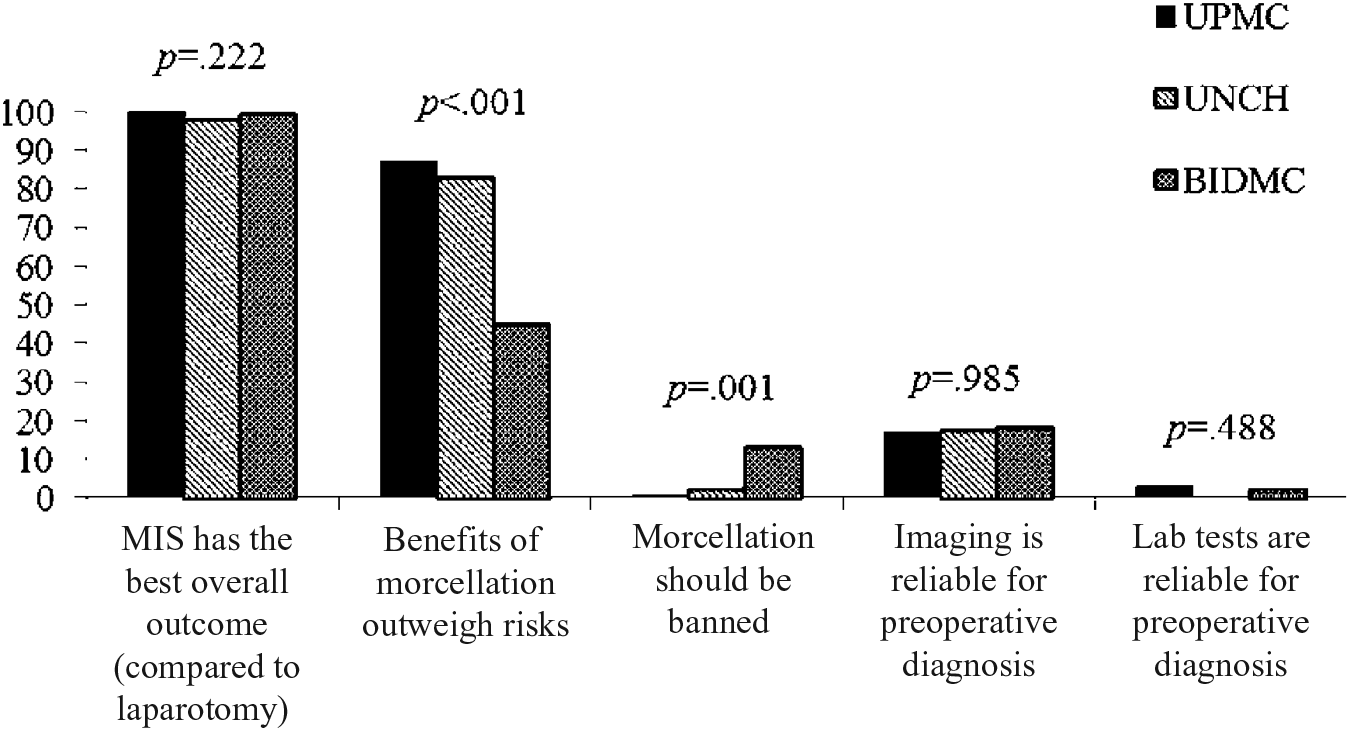
Perceptions of gynecologists stratified by location. MIS, minimally invasive surgery; UPMC, University of Pittsburgh Medical Center; UNCH, University of North Carolina Hospital; BIDMC, Beth Israel Deaconess Medical Center.
Trainees compared to attending gynecologists
For this analysis, trainees were defined as resident and fellow physicians in their departments of obstetrics and gynecology. A total of 89 trainees completed the survey for a trainee response rate of 75%. Among gynecologists, the opinions of trainees and attending physicians from all three institutions did not differ significantly with one exception: compared to trainees, more attending physicians believed the risks of morcellation outweighed its benefits (19% versus 8%; p = 0.044). Given the data indicating significant differences in opinion among providers in different regions, a secondary analysis was performed excluding trainees in Boston, MA, to assess the perceptions of trainees and attendings independent of the specific geographical influences observed in Boston, MA. After participants from Boston, MA, were excluded from the analysis, there were no significant differences found between the opinions of trainees and attendings with regard to risks and benefits of morcellation and minimally invasive surgery (Fig. 2).
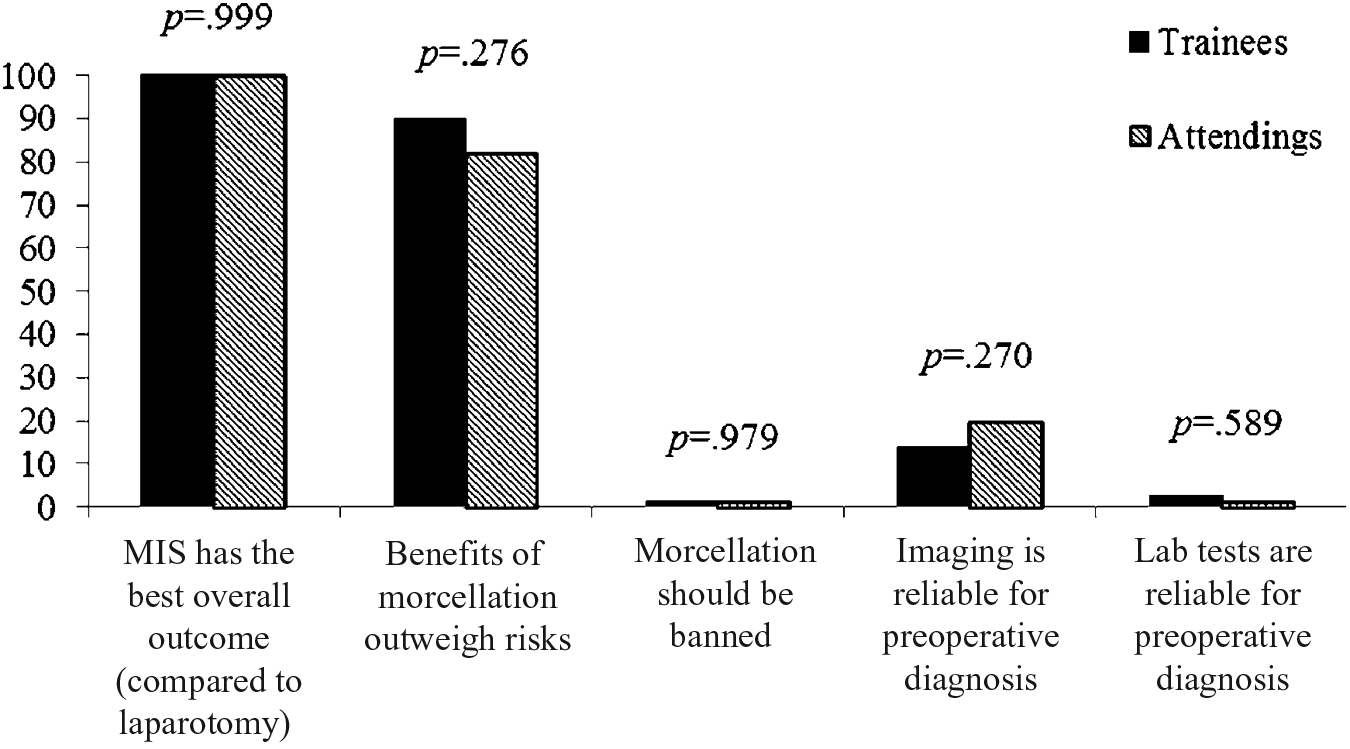
Perceptions of gynecologists stratified by level of training, excluding participants from Boston, MA. MIS, minimally invasive surgery
Gynecologists compared to internal medicine physicians
There were 142 internal medicine providers who completed the survey for a response rate of 40%. When surveying the responses from all three institutions, 99.6% of gynecologists replied that minimally invasive surgery, as opposed to laparotomy, yielded the best overall patient outcomes, compared to only 85% of internal medicine providers (p <0.001; Fig. 3). The majority (76%) of gynecologists felt the benefits of morcellation outweighed the potential risks, compared to only a minority (21%) of internal medicine physicians (p < 0.001). Among the other 79% of internal medicine physicians, 45% responded that the risks of morcellation were greater than the benefits (compared to 14% of gynecologists) and the remaining 34% responded that the benefits of morcellation were equal to its risks (compared to 10% of gynecologists). Furthermore, only 4% of gynecologists felt that morcellation should be banned, compared to 28% of internal medicine providers (p < 0.001). More internal medicine physicians reported that imaging would be reliable for preoperative diagnosis of leiomyosarcoma, but both gynecologists and internal medicine providers responded that laboratory tests are not reliable for identifying leiomyosarcoma preoperatively.
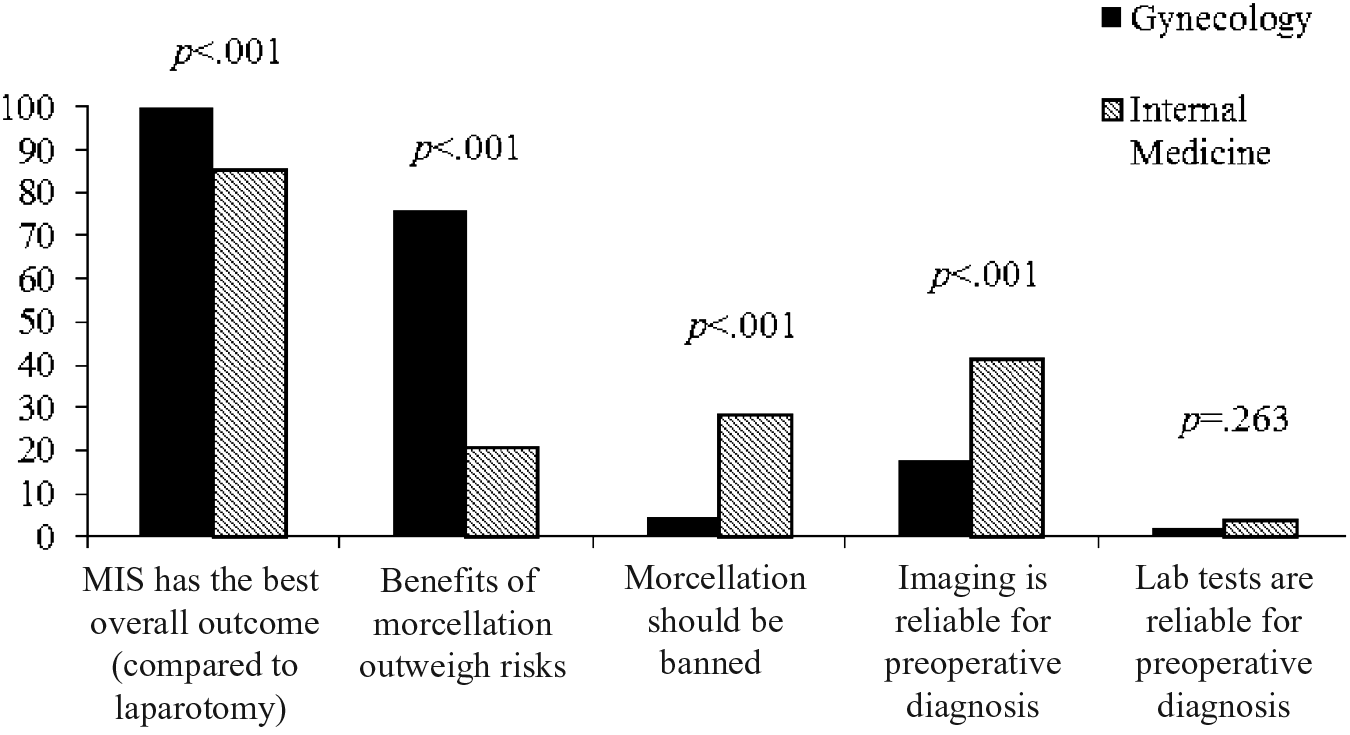
Perceptions of gynecologists, compared to internal medicine providers. MIS, minimally invasive surgery.
Discussion
In the current study, all gynecologists who responded were familiar with morcellation. All three institutions in this study have had morcellation polices in effect since 2014; approximately half of the gynecologists sampled currently performed some method of morcellation that adhered to new regulations. Overall, it appears that, despite the FDA safety communication, 14 extensive media coverage, and new hospital regulations, most gynecologists surveyed believed morcellation was safe and acceptable in the appropriately selected and well-counseled patient and the benefits of minimally invasive surgery outweighed the potential risks related to morcellation.
The incidence of leiomyosarcoma, contained morcellation, and preoperative testing for leiomyosarcoma are critical components of patient-centered counseling and surgical planning. The majority of gynecologists surveyed reported that occult leiomyosarcoma in women undergoing surgery for fibroids is substantially rarer than the incidence of 1 in 350 presented by the FDA 14 and, though unsupported by the existing literature, more than one-third of the gynecologists sampled believed the incidence of occult leiomyosarcoma to be rarer than 1 in 10,000. Notably, even if the risk of cancer were as high as 1 in 350, more than two-thirds of women with fibroids would still opt for a minimally invasive approach to surgery due to its numerous benefits. 16 While data regarding the effects of specimen-containment systems have yet to emerge, most gynecologists in this study felt that contained morcellation with the use of a specimen containment bag would decrease potential cancer dissemination. Additionally, the majority of survey participants felt that neither imaging nor laboratory testing were reliable for the preoperative diagnosis of leiomyosarcoma.
Significant regional differences existed with regard to gynecologists' perceptions of morcellation. Physicians from Boston, MA, responded less favorably toward morcellation, compared to providers in Pittsburgh, PA, and Chapel Hill, NC. All three hospitals implemented morcellation policies following the FDA safety communication; however, providers in Pittsburgh, PA, and Chapel Hill, NC, still responded positively toward morcellation. Additionally, the geographical differences in opinion did not appear to be mediated by clinical experience or level of training, given that responses from trainees and attendings were not different for all the study questions after adjusting for location. The survey was not designed to conclude the reasons for regional differences. It is possible that a highly publicized case in Boston, MA, increased awareness of the risks of fibroid morcellation, which may have raised concerns particularly in this location, compared to Pittsburgh, PA, and Chapel Hill, NC.
After adjusting for location, trainees in obstetrics and gynecology did not differ from attending physicians. Despite differences in clinical experience, the current study results suggest that the FDA safety communication 14 and media coverage did not differentially affect the perceptions of either group. Furthermore, the analysis suggests that location, not level of training, significantly affected physicians' opinions regarding morcellation.
It was found that a significant proportion of internal medicine physicians appear to undervalue the benefits of minimally invasive surgery, believe the risks of morcellation outweigh its benefits, and that morcellation should be banned. The differences between the perceptions of gynecologists and internal medicine physicians may reflect opportunities for continuing medical education so primary-care physicians can offer evidence-based and patient-centered counseling for women who identify these physicians as their primary healthcare providers. Particularly in this climate, patients desiring surgical management of fibroids should be referred to gynecologic specialists for the complex discussions of leiomyosarcoma incidence, contained morcellation, and preoperative testing for leiomyosarcoma.
Despite the large number of physicians sampled and this study's multicenter approach, the response rate might have resulted in a response bias. The current authors do not have data about the physicians who declined to participate. All of the survey sites were large academic hospitals with a minimally invasive gynecologic surgery division, which might have influenced the perceptions of the providers sampled and the generalizability of the study findings.
The results of the current study are consistent with other recent reports15–18 that, although rates of minimally invasive surgery and morcellation have decreased as a result of new hospital mandates, gynecologists still believe that, based on the available evidence, minimally invasive surgery facilitated by morcellation continues to yield a favorable risk–benefit profile for appropriately selected patients.
Conclusions
Most gynecologists believe that occult uterine leiomyosarcoma is rare. Most gynecologists highly value morcellation as a means of tissue extraction to facilitate minimally invasive approaches in order to provide the most optimal patient outcomes. Important differences exist between gynecologists in different geographical locations and between gynecologists and internal medicine physicians with regard to their perceptions of morcellation and minimally invasive surgery.
Footnotes
Author Disclosure Statement
None of the authors have any commercial associations that might create a conflict of interest in connection with this article.