




Abstract
Abstract
Background:
Surgical outcomes in patients with systemic sclerosis, and the effect of concomitant treatment with immunosuppressant agents, are not well-studied in gynecology research. This article presents the case of a patient, with scleroderma and complete pelvic organ prolapse (POP), who desired surgical management. Current literature, clinical course of the patient, and further considerations for immunosuppressed patients with POP are discussed from a multidisciplinary perspective, including urogynecology, dermatology, and rheumatology.
Case:
A 56-year-old female with a history of five prior deliveries, including one Cesarean section, presented to a urogynecology clinic with complete procidentia and occult stress urinary incontinence. Multiple pessary fittings failed while she awaited medical optimization for surgery. She had diffuse scleroderma and diabetes mellitus, as well as a prior laparoscopic cholecystectomy. Her laboratory tests were positive antinuclear antibody and rheumatoid factor. She underwent robotically assisted supracervical hysterectomy, sacral colpopexy, bilateral salpingectomy, posterior repair, perineorrhaphy, midurethral sling, and cystoscopy.
Results:
The patient tolerated the surgery well. Seven months postsurgery, she had stage I POP and no recurrence of symptoms or postoperative complications.
Conclusions:
Patients with scleroderma can undergo reconstructive surgery successfully with careful multidisciplinary management, although further research is needed to clarify the specific risks in this patient population. (J GYNECOL SURG 33:198)
Introduction
S
This article addresses this gap in the literature by reporting the current authors' experience with surgical management of a patient with severe systemic sclerosis who was receiving immunosuppression therapy. Concerns in management of the case included the potential implications of this fibrosing skin disease on wound healing and the effect of immunosuppression on postsurgical infection. The authors describe their experience with managing this patient's POP and the considerations to take into account when deciding on surgical repair.
The institutional review board at the Los Angeles Biomedical Research Institute (LA BioMed) determined that this case report is nonhuman research.
Case
A 56-year-old female with a history of five prior deliveries, presented to a urogynecology clinic with complete procidentia and occult stress urinary incontinence. Multiple pessary fittings failed while she awaiting medical optimization for surgery. Her past medical history was significant for diffuse scleroderma (Fig. 1) and diabetes mellitus, type II, with a hemoglobin A1c of 6.6 mmol/mol. Surgically, the patient had a history of one Cesarean section and a laparoscopic cholecystectomy, both occurring prior to her scleroderma diagnosis. The patient's scleroderma included the following manifestations: diffuse skin thickening involving the breasts, abdomen, and hands, breast ulcerations, severe Raynaud's disease, and esophageal dysmotility. To control her symptoms, she was treated with mycophenolate, an immunosuppressant that inhibits B- and T-lymphocyte proliferation, after methotrexate for joint pain failed due to transaminitis. She was previously receiving cyclophosphamide for pruritus and hydroxychloroquine sulfate, but these medications were discontinued due to transaminitis.
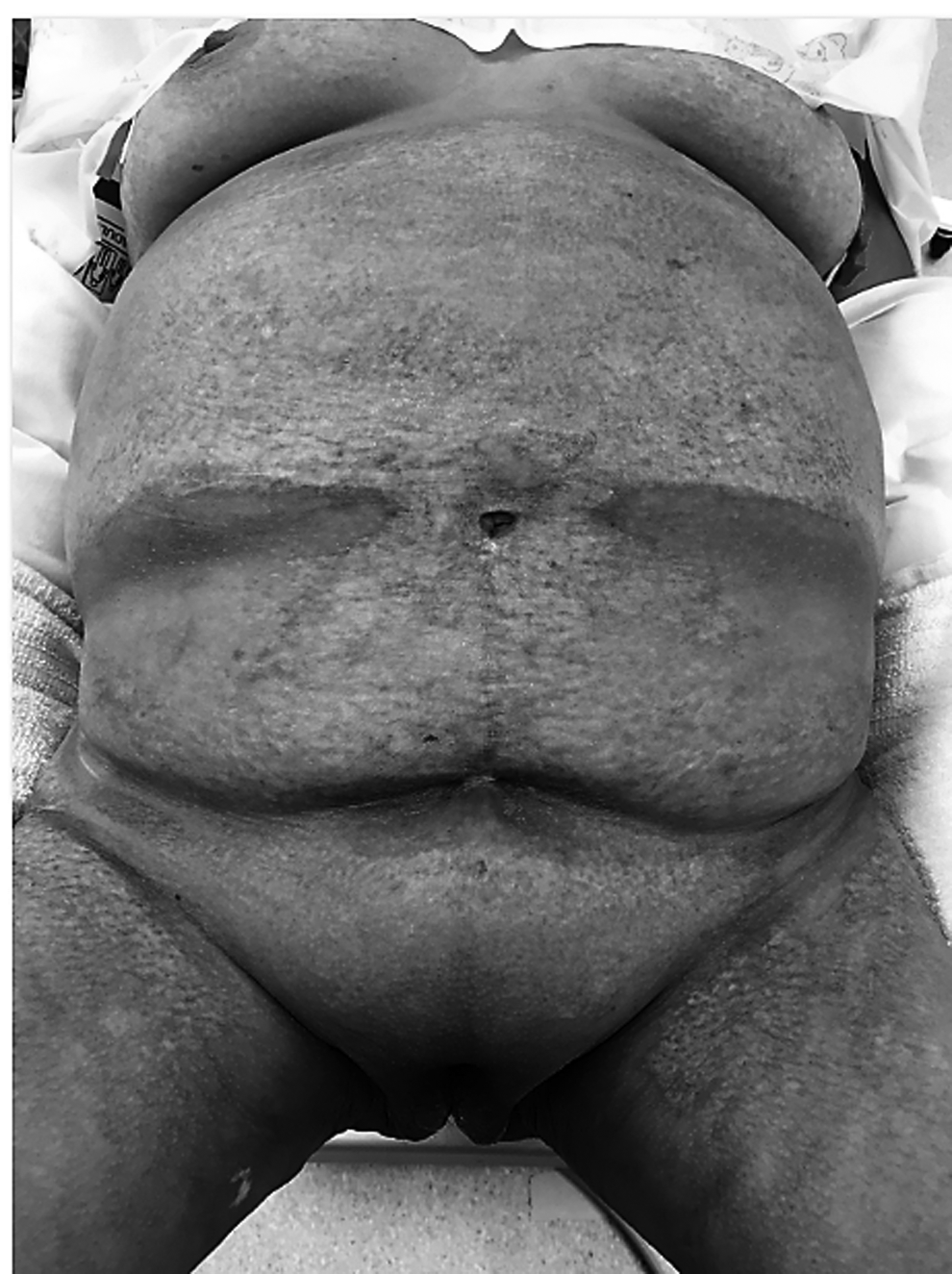
Examination under anesthesia: Woody poikilodermatous hyperpigmentation due to diffuse scleroderma.
The patient's reduction cough stress test was positive and she had a normal postvoid residual. Her vaginal tissue appeared to be unaffected by scleroderma skin changes. She had characteristic woody induration, with firm taught skin of the distal digits, sclerodactyly, and digital ulcers. Proximally, her abdomen had mild woody induration and poikilodermatous hyperpigmentation. She also had calcinosis cutis of the bilateral breasts.
Preoperatively, her chest X-ray and pulmonary function testing yielded normal results. The results of her laboratory tests were significant for positive antinuclear antibody and rheumatoid factor (1280 IU/mL). The surgical plan was discussed with the patient's rheumatologist who stopped her immunosuppressant medication prior to the procedure, given a concern for postsurgical infection. The potential risk of delayed wound healing was also discussed, given that individuals with scleroderma can have abnormal connective tissue not just in their skin, but also in many organs, including those with mucosal surfaces such as the esophagus.
There was extensive dialogue regarding the surgical options for this patient including vaginal uterosacral ligament suspension, sacrospinous ligament fixation, colpocleisis, and sacral colpopexy. Although the vaginal approach was discussed, with such advanced prolapse in the setting of scleroderma, the current authors wanted to give her the most durable repair with the lowest risk of recurrence. 3 A decision was made for a robotically assisted supracervical hysterectomy, sacral colpopexy, bilateral salpingectomy, posterior repair, perineorrhaphy, a midurethral sling, and cystoscopy, based on the patient's relatively young age, sexual and daily activities, life expectancy, quality of vaginal tissue, and risk of recurrence. This procedure could have been performed laparoscopically but, due to physician preference, a robotic approach was performed. The mesh was attached to the vagina and cervix with a delayed absorbable suture. Medical adhesive tape was used on the port sites after closure with a 4-0 absorbable braided suture.
Results
The patient tolerated this uncomplicated procedure well and the estimated blood loss was 75 mL.
During the patient's 24-hour admission, dermatology was consulted for recommendations on wound management and recommended application of microporous surgical tape once the medical adhesive released to help keep the skin approximated. Two months after surgery, immunosuppression was resumed. In the 7 months since her surgery, this patient was found to have stage I POP and no recurrence of symptoms or postoperative complications.
Discussion
There are few studies focused specifically on immunosuppression and urogynecology surgeries involving mesh placement. It is known, however, that immunosuppressive agents can impair postoperative wound healing after transplantation. 4
How is wound healing affected by scleroderma?
Like many patients with systemic sclerosis, the current patient had extensive and severe skin involvement. The digital ulcer is a common feature of scleroderma, exemplifying the pathology of scleroderma, as well as the difficulties involved with treating injuries in affected skin. Digital ulcers can be categorized as ischemic, due to Raynaud's phenomenon, or traumatic, worsened by the pathologic deposition of collagen. Diffuse systemic sclerosis is more likely to have proximal involvements of the skin and other organs. Poor wound healing and surgical wound dehiscence can be seen in affected skin. There are limited data characterizing this phenomenon but clinical experience demonstrates that even punch biopsy sites can be difficult to appose with suture. Many nonpharmacologic therapies for wound healing and digital ulcers have been studied—including hyperbaric oxygen therapy, negative pressure therapy, intermittent compression, and acoustic pressure wound healing—with limited efficacy. 5 Conservative wound therapy includes healing by secondary intent and autolytic debridement of ulcers using moist hydrocolloid dressings. 2
Cervicovaginal surgical specimens of patients with scleroderma have been found to have at least 3 vascular and connective tissue histopathologic alterations; duplication and disruption of the internal elastic layer, medial hypertrophy, adventitial changes, vasculitis, and connective tissue fibrosis. 1 One study found that, although collectively more frequent in scleroderma patients, vascular alterations in the cervix and vagina previously attributed solely to the disorder could be related, in part, to factors other than direct involvement by the disease. 6
How is skin or wound healing affected by immunosuppression?
Immunosuppressive agents may impair postoperative wound healing after transplantation. 4 In a case report of a 25-year-old woman with premature ovarian failure and scleroderma, who developed stage III uterine prolapse, the researchers came to the conclusion that scleroderma and estrogen withdrawal had a synergistic effect in the development of this patient's pelvic prolapse. 7 Increased collagen and decreased estrogen might have affected the normal functioning of the pelvic fascia and ligaments negatively. In the current patient, the prolapse symptoms worsened acutely after menopause.
Is there a higher risk of mesh complications in patients who are immunosuppressed?
The primary objective of one retrospective study was to determine the incidence of surgical-site occurrences in patients with ventral hernia repairs and to examine the use of macorporous synthetic mesh in these patients. Comorbidities included obesity, diabetes mellitus, chronic obstructive pulmonary disease, smoking, and immunosuppression; having multiple comorbidities was associated with an increased risk of surgical-site occurrences, including wound and mesh infections (p = 0.02). The researchers concluded that the use of synthetic mesh in the retrorectus space is a durable repair (5% recurrence rate) for patients with grade II incisional hernias but noted the increased risk of mesh and wound complications with multiple comorbidities. 8
In another study, pelvic reconstructive surgery, including anterior and posterior repairs with or without a transobturator sling, was performed in 16 female renal transplant recipients with POP with or without stress urinary incontinence. The mean time to renal transplantation was 54.2 ± 15.1 months (range: 38–123). Pelvic-floor examinations at 12-month follow-ups showed stage I vaginal-wall prolapse in 4 patients (25%), without any cases of recurrent prolapse. Although no mesh colpopexies were performed in this study, no patient had evidence of de novo incontinence, synthetic sling infection, erosion, or rejection and all women reported an improved quality of life. The renal graft function remained stable in all patients. Although none were reported in this series, the researchers acknowledged the issue of impaired graft function, infection, and wound healing in this population of immunosuppressed patients. 9
Are patients with scleroderma at a higher risk of pelvic organ prolapse?
There have been no studies examining this issue directly. Bhadauria et al. reported that 7 of 16 (44%) women with systemic sclerosis, compared with 6% of normal women, attained natural menopause before age 45. Menstrual abnormalities, including early menopause, affect many patients' tissue quality and may predispose them to POP, 10 although the specific risk in scleroderma is unknown.
Perioperatively, can a patient with scleroderma stop immunosuppressive medications?
With regard to immunosuppressive medications, there is not a specified drug withdrawal prior to or after surgery. In the current case, the rheumatologist discontinued mycophenolate mofetil prior to surgery. There is a lack of research regarding if—and for how long—immunosuppressants should be held back prior to prolapse surgery, necessitating further research.
Conclusions
This article reported the case of a woman with scleroderma, who was receiving immunosuppressive medication, and who was treated successfully for POP with robotic-assisted laparoscopic supracervical hysterectomy and sacral colpopexy with vaginal repairs. The results of this intervention were consistent with limited literature that patients with scleroderma can undergo reconstructive surgery successfully with careful management, although further research is needed to clarify the specific risks in this patient population. With surgical planning, the following should be considered: patient age; life expectancy; severity of disease; organ involvement; and immunosuppressive therapy, with close consultation with a multidisciplinary team.
Footnotes
Author Disclosure Statement
The authors report no conflicts of interest.