




Abstract
Abstract
Objective:
This study was conducted to determine if women with neuroproliferative-associated vestibulodynia who had vulvar vestibulectomy had less vulvar pain and sexual distress than women with neuroproliferative-associated vestibulodynia who chose not to have this surgery.
Materials and Methods:
This was a retrospective analysis study of a vulvar disorders clinic database. A database review was used to identify 227 women diagnosed with neuroproliferative-associated vestibulodynia for whom conservative treatment failed and who were advised to have vulvar vestibulectomy. Of the 227 women, 101 elected to undergo vestibulectomy and 126 declined the procedure. Ninety-eight of the 101 women who had surgery and 40 of the 126 who declined surgery answered an online questionnaire.
Results:
Compared to women who had vestibulectomy, women who declined this surgery were more likely to report significant persistent vulvar burning (29.58% versus 80%; p < 0.001), vulvar rawness (23.450% versus 67.5%; p < 0.0001), vulvar cutting (9.18% versus 30%; p < 0.002), and sexual distress, as measured by the Female Sexual Distress Scale (18.88 versus 25.925; p = 0.005). In addition, 97% of surgical pathology specimens met the histopathologic criteria for neuroproliferative-associated vestibulodynia.
Conclusions:
This study demonstrated the importance of the 2015 International Society for the Study of Vulvovaginal Disease/International Society for the Study of Women's Sexual Health/International Pelvic Pain Society vulvodynia nomenclature emphasizing that treatment should be chosen according to possible associated factors rather than using a “shotgun” approach. The correlation between the presumptive preoperative diagnoses and the confirmatory postoperative histology validates the vulvar-pain diagnostic algorithm previously published by King and colleagues. Finally, this study provides further evidence that vulvar vestibulectomy can be an appropriate first-line treatment for women with neuroproliferative-associated vestibulodynia. (J GYNECOL SURG 34:58)
Introduction
P
Included in this consensus terminology of PVD is a neuroproliferative associated vestibulodynia in which there is up to a 10-fold increase in the density of C-afferent nociceptors in the vulvar vestibular endoderm.3,4 Due to the increased density of C-afferent nociceptors, women with neuroproliferative-associated vestibulodynia experience allodynia and hyperalgesia at the vulvar vestibule. In women for whom conservative treatments—such as lidocaine, topical capsaicin, and/or topical gabapentin cream—fail, a vulvar vestibulectomy with vaginal advancement can be performed to remove the abnormal vestibular endoderm.5–7 In 1983, Woodruff and Parmley described vulvar vestibulectomy as the excision of a semicircular segment of perineal skin, the mucosa of the posterior vulvar vestibule, and the posterior hymeneal ring. 8 Subsequently, roughly 3 cm of the vaginal mucosa is undermined and approximated to the perineum. 8
Since this first published report, there have been more than 40 published peer-reviewed articles about studies conducted to examine variations of vulvar vestibulectomy. A 2010 meta-analysis of 33 studies revealed that vulvar vestibulectomy provided significant relief of dyspareunia in 78.5% of patients, some relief in 88.8% of patients, and no relief in 12.2% of patients. 9 In the 9 studies that produced improvement in sexual function as a measure of surgical success, all 9 had produced significant improvement in sexual function following vestibulectomy. As such, the role for vulvar vestibulectomy in the treatment of vestibulodynia has been sustained. 10
In contrast, there have been several recent longitudinal studies that showed remission rates between 22.2% and 50.6% in patients with vulvodynia without surgery. 11 This suggests that conservative treatments may be preferred in patients who experience some improvement with these treatments in order to avoid potential surgical complications and the long recovery period associated with vestibulectomy.
The goal of this study was to determine if women who have undergone vulvar vestibulectomy for neuroproliferative-associated vestibulodynia have less dyspareunia, vulvar pain, and sexual distress than women with neuroproliferative-associated vestibulodynia who did not undergo surgery in favor of conservative treatments or no treatment.
Materials and Methods
This was a retrospective analysis study of a center specializing in the treatment of vulvovaginal disorders.
Institutional review board (IRB) approval was obtained from the Anne Arundel Medical Center investigational review board on June 17, 2013 (IRBnet 464662-1). A database review of a center specializing in the treatment of vulvovaginal diseases identified 227 women diagnosed with neuroproliferative-associated vestibulodynia from January 1, 2010 until December 31, 2013 for whom conservative treatment had failed and who had been recommended to have vulvar vestibulectomy. Women were only offered surgical treatment if they met the criteria of neuroproliferative-associated vestibulodynia, as determined by a previously published diagnostic algorithm (Fig. 1). 12 The specific criteria for neuroproliferative-associated vestibulodynia includes provoked tenderness throughout the entire vestibule, consistent pain since the first attempt at penetration (with a tampon, finger, or penis), or a history of a severe inflammatory reaction of the vestibule, such as a severe allergic reaction, as well as exclusion of other causes, such as hormonal, dermatologic, overactive pelvic-floor musculature, or infectious etiologies. 12 Of the 227 women, 101 elected to undergo vestibulectomy and 126 declined the procedure in favor of additional conservative treatments or no treatment.
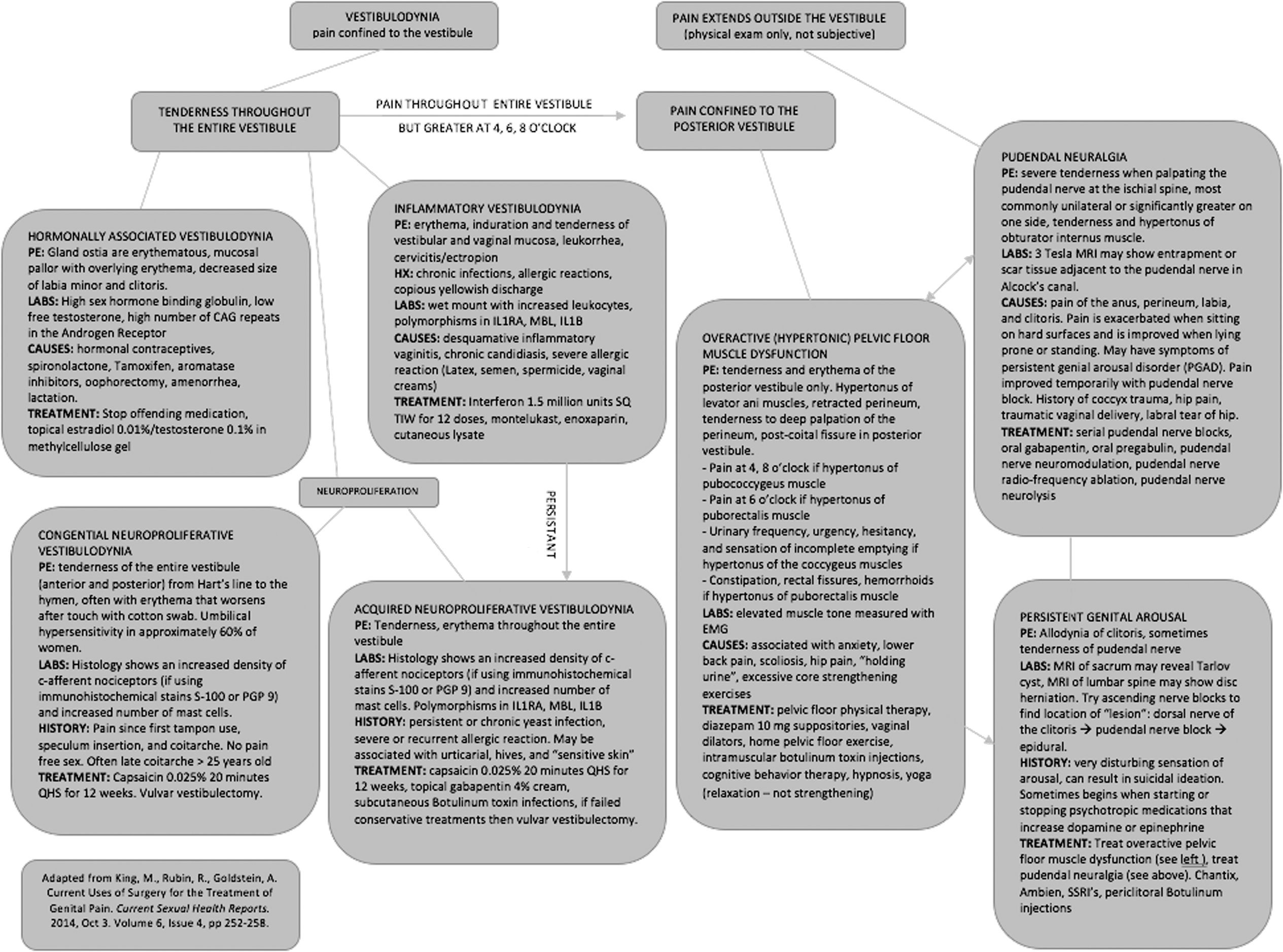
Diagnostic and treatment algorithm for vulvar pain. PE, physical examination; CAG, cytosine–adenine–guanine; HX; history; IL, interleukin; IL1RA, IL 1 receptor antagonist; MBL, mannose-binding lectin; SQ, subcutaneous; MRI, magnetic resonance imaging; EMG, electromyography; QHS, every night before bedtime; SSRIs, selective serotonin reuptake inhibitors; PGP, protein gene product. Adapted from king et al. 12 .
An independent research assistant attempted to contact all 227 patients via telephone and e-mail. Ninety-eight women who had vulvar vestibulectomy and 40 women who declined this surgery in favor of alternative treatments completed an online survey and the Female Sexual Distress Scale (FSDS) questionnaire. The remaining 139 women did not respond to multiple attempts to contact them via telephone and/or e-mail. All participants completed a de-identified electronic survey to evaluate patient satisfaction with the decision to have or to decline the vulvar vestibulectomy, as well as identifying any alternative treatments utilized and assessing the efficacy and satisfaction of the alternative treatments. Question topics included satisfaction with the decision to undergo or defer vulvar vestibulectomy; reasons behind the treatment decisions; quantitative ratings and qualitative descriptions of dyspareunia and vulvar pain following the treatment choice; and treatments utilized after the surgery or in lieu of surgery. Informed consent was obtained and patients were advised that their responses would be de-identified so that their participation would not affect future patient–doctor interactions. Survey and questionnaire responses were analyzed using a two-proportion Z-test.
Results
Prior to being offered vulvar vestibulectomy, 98 of the 139 respondents had tried at least one of the following treatments: lidocaine; internal pelvic-floor physical therapy; external pelvic-floor physical therapy; muscle relaxants; BOTOX® injections; biofeedback; corticosteroids; topical estrogen; topical testosterone; tricyclic antidepressants; cognitive–behavioral therapy (CBT); sex therapy; and a low-oxalate diet. Women who did not have surgery were more likely to report sensations of persistent vulvar burning (80%; Z-score [Z] = 5.4; p < 0.001), vulvar rawness (67.5%; Z = 4.9; p < 0.0001), and vulvar cutting (30%; Z = 3.1; p < 0.002), compared to women who underwent vestibulectomy (29.59%, 23.45%, and 9.18% respectively). Only 2 of the 40 women (5%) who did not have surgery reported being pain-free within the past 3 months, 20% (8 of 40) reported mild pain, and 75% (30 of 40) had moderate-to-severe pain (Table 1) in the same timeframe. Of the 2 women who were pain-free without surgery, 1 had complete resolution without treatment and the other had resolution with topical estrogen and testosterone.
The 38 other women who did not have surgery have tried at least one of the following treatments: lidocaine; internal pelvic-floor physical therapy; external pelvic-floor physical therapy; muscle relaxants; BOTOX injections; biofeedback; corticosteroids, topical estrogen; topical testosterone; tricyclic antidepressants; antiseizure medications; CBT; sex therapy; interferon; acupuncture; heat therapy; and pudendal nerve blocks. In contrast, 31 of the 98 women who had surgery reported no pain within the past 3 months (31.63%; p < 0.022), 52.52% (52 of 98) reported mild pain, and 15.31% reported moderate-to-severe pain (Table 1). Women who did not have vestibulectomy had more sexual dysfunction as measured by the FSDS with a mean (M) = 25.925 and a standard deviation (SD) = 14.088; p = 0.005, compared to women who underwent vestibulectomy (M = 18.88, SD = 14.6; p = 0.005).
Eighty-one percent of the women who had the surgery were pleased with this decision, 10.2% were unsure, and 9.18%, were not pleased with this decision. In contrast, only 30% of the women who opted not to have surgery were pleased with the decision, 60% were unsure, and 10% were not pleased with the decision. Finally, 95 of the 98 surgical pathology specimens met the histologic criteria for neuroproliferative-associated vestibulodynia, which had been identified by Bornstein and colleagues as a tenfold increase in nerve endings within a tissue sample. 4
Discussion
The findings of this study elucidate several aspects about vestibulectomy as a treatment for neuroproliferative-associated vestibulodynia. First, the agreement between the presumptive preoperative diagnoses of neuroproliferative-associated vestibulodynia and the confirmatory postoperative histology results in 96.94% of cases helps validate King et al.'s vulvar-pain diagnostic algorithm further (Fig. 1). 12 More specifically, the diagnosis of neuroproliferative-associated vestibulodynia can only be made if there is hyperpathia and allodynia of the entire vulvar vestibule and if hormonal factors have been evaluated and ruled out as causal agents. Although almost all postoperative pathologic specimens did confirm the presence of neuroproliferation, this finding was not uniform throughout the entire excised vestibular mucosa. Consequently, this makes preoperative biopsy to confirm the diagnosis prior to surgery less reliable. Of note, neuroproliferative-associated vestibulodynia is more likely if there is associated umbilical hypersensitivity and if the PVD is primary, meaning that the patient has never experienced painless contact to the vulvar vestibule. 13
Second, this study provides evidence to support the importance of the new ISSVD/ISSWSH/IPPS vulvodynia nomenclature that divides vulvodynia into subcategories based on different associated causative factors. 2 In the present study, women were only offered surgery if they were presumed to have neuroproliferative-associated vestibulodynia. These presumptive diagnoses were obtained by using a diagnostic algorithm previously published by King and colleagues (Fig. 1) and supported by the histology of the postoperative surgical specimens. 12 With the exception of 5% of women who reported remissions—either spontaneously or with conservative treatment—women who elected to not have surgery continued to have very significant discomfort and sexual dysfunction.
This stands in stark contrast to the recent Woman to Woman Health Study (WTW) that showed a greater than a 50% remission rate in women with vulvodynia. 14 The difference in remission rates could be attributed to the varied pathologies and characteristics present in the populations of the two studies. More specifically, in the WTW study, women were diagnosed with vulvodynia from a validated web-based questionnaire without physical examination. As such, the WTW study cohort likely represents a heterogeneous group of patients with vulvodynia of varied etiologies. While some women may have had generalized vulvodynia or multimodal causes of pain, others might have only had neuroproliferative-associated vestibulodynia. In addition, their cohort likely had a mixture of associated factors, such as overactive pelvic-floor muscle dysfunction and conditions related to hormonal causes, of which some are more likely to resolve spontaneously than others.
In contrast, the current study cohort was selected to rule out these specific associated factors, resulting in more patients with fewer confounding causes of pain. Again, this highlights the importance of following the recommendation made in 2015 ISSVD/ISSWSH/IPPS vulvodynia nomenclature that treatment should be chosen according to the characteristics of the individual case and the possible associated factors, rather than as a “one-size-fits-all” approach. For instance, physical therapy could be recommended if musculoskeletal factors were suspected, whereas surgery could be recommended if neuroproliferation was thought to be the main contributor to pain. 2
Third, like many other previous studies, vulvar vestibulectomy was found to be an effective treatment for women with neuroproliferative-associated vestibulodynia. Unlike other studies, however, this study used the validated FSDS as well as a nontraditional questionnaire specific to women diagnosed with congenital neuroproliferative-vestibulodynia. In addition, this study included information from a cohort of women who elected not to have surgery after surgical recommendation. This group continued to report vulvar pain, sexual dysfunction, and sexual distress at higher levels than the group who underwent vestibulectomy.
However, there were a few limitations to this study. First, women, who made the decision to undergo the vulvar vestibulectomy, might have experienced bias scanning and cognitive dissonance reduction in response to questions in the questionnaire.15,16 Second, this study lacked a sham surgery control group, which was not included for obvious ethical considerations. Third, women were not randomized prospectively. Fourth, the nontraditional questionnaire (other than the FSDS) had not been statistically validated. Fifth, while there was a very high response rate in women who did have surgery, only a third of the women who did not have surgery responded to the questionnaire. It is possible that the women who did not respond to the questionnaire had greater improvement in their symptoms in contrast to the only minimal improvement in the women who did answer the questionnaire.
Conclusions
Despite the aforementioned limitations, this study provides strong support that women who are properly diagnosed with neuroproliferative-associated vestibulodynia may be offered vulvar vestibulectomy as a first-line treatment.
Footnotes
Acknowledgment
The authors would like to thank Sarah Jutrzronka, PhD, for her assistance with the database used in this study.
Author Disclosure Statement
Andrew Goldstein has received research funding from Bayer, Palatin, and is on the Medical Advisory Board of Emotional Brain, Ipsen, and Amag. Zoe Belkin, Leia Mitchell, and Michelle King have no relevant disclosures.