




Abstract
Background:
A large percentage of cases of hysterectomy involves symptomatic myomas. It can be challenging to retrieve a large uterus after laparoscopic hysterectomy through the natural orifice of the vagina. Moreover, if there is a hard, calcified huge myoma, the task is even more difficult.
Case:
A 53-year-old gravida 4, para 3, female had a huge uterine myoma. Computed tomography scans showed a multilobulated heterogeneous uterine mass ∼13.8 × 9.8 × 11 cm with coarse calcifications at its mid and anterior aspects.
Results:
This patient underwent total laparoscopic hysterectomy with bilateral uterine-artery ligation, and a specimen was removed through her vagina. Manual morcellation was achieved, using 9 No.11 scalpels and a bone cutter. There were no intraoperative complications. This patient had an uneventful postoperative recovery. Her histopathology results were compatible with a leiomyoma.
Conclusions:
Vaginal morcellation of a uterus with a huge calcified myoma is feasible, using multiple scalpels and a bone cutter. This is the only case in cited in the literature in which a bone cutter was used to morcellate a uterus.
Introduction
Hysterectomy is the most-common surgical procedure performed worldwide. Because of superior benefits in terms of shorter hospital stay, faster recovery, fewer wound infections, and lower blood loss, minimally invasive surgery is becoming established as the preferred mode of surgery. 1 As more gynecologists perform more hysterectomies through this route, more-complex procedures are being performed. However, retrieval of a uterus with its associated pathology, such as a myoma, through a small abdominal wound or the vagina is occasionally challenging although this has been done for decades.2,3
Introduced in 1993, power morcellators are electromechanical devices that are used to shave or cut tissue to enable tissue extractions, such as chips of myoma, through an abdominal-port wound. 4 However, the U.S. Food and Drug Administration (FDA), issued a Safety Communication in November 2014 warning against the use of laparoscopic power morcellators in the majority of women undergoing myomectomy or hysterectomy for treatment of fibroids. In that communication, the FDA discouraged the use of power morcellators. 5
Other means of specimen removal and reducing uterine size—including myomectomy, bivalving, wedge resection, or coring—have also been described. This article presents a case in which conventional methods of morcellation were deemed to be inadequate because of dense calcifications of the myoma; thus, an innovative technique was utilized. To date, this is the only case in the literature for which a bone cutter was used vaginally to morcellate a uterus manually.
Case
A 53-year old gravida 4, para 3 woman noticed a palpable mass in her abdomen 7 months prior to presenting with this complaint. She was asymptomatic and denied having any pain or bleeding. Computed tomography scans showed that her the uterus was converted into a multilobulated heterogeneous mass measuring ∼13.8 × 9.8 × 11cm, with coarse calcifications at its mid and anterior aspects. The mass compressed the bladder anteriorly and the rectum posteriorly (Fig. 1).
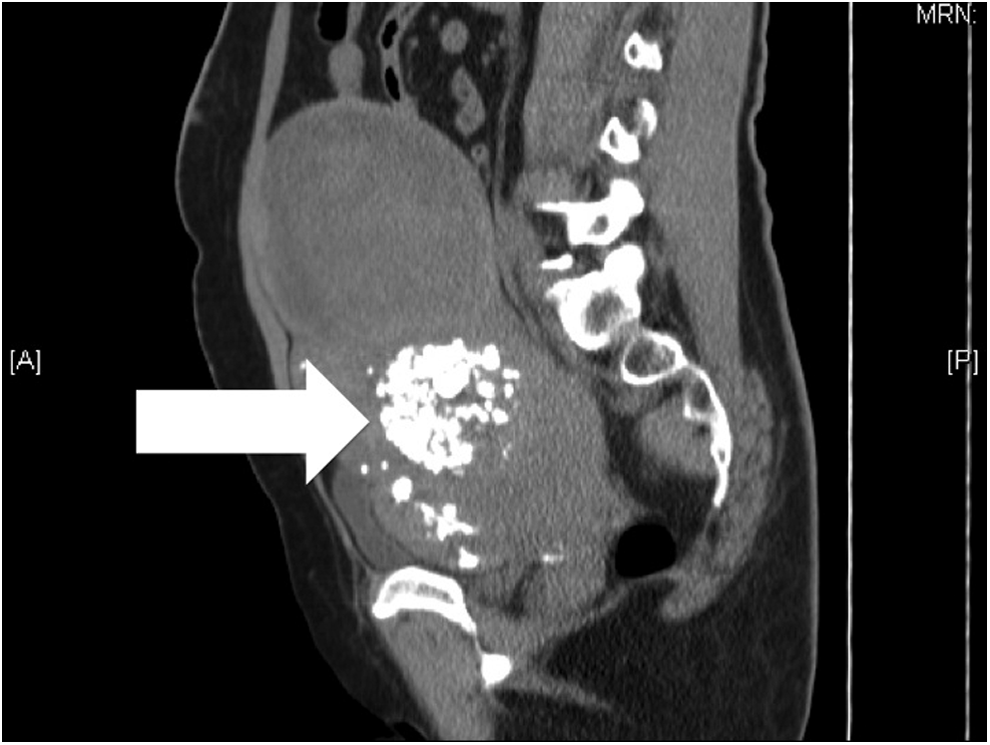
Computed tomography image shows a huge, calcified uterine myoma (white arrow).
This patient underwent laparoscopic hysterectomy with a bilateral salpingo-oophorectomy. She received a preoperative dose of intravenous antibiotics per the institutional protocol and all preoperative preparations were performed. After induction of general anesthesia, she was positioned in the dorsal lithotomy position and pneumoperitoneum was established with a Veress needle at the standard Lee–Huang Point. 6 After adequate pneumoperitoneum at 20 mm Hg was achieved, an 11-mm primary trocar and cannula were inserted through the Lee–Huang point. After inserting a 0° 10-mm telescope through this port, this patient was placed in the Trendelenburg position. Three accessory ports were then used: two 5-mm accessory trocars were placed on the left side and one 5-mm accessory trocar was placed on the right side. Standard 5-mm laparoscopic instruments were used for the assistant ports. Electrocoagulation was achieved through a 5-mm LigaSuretm vessel sealing system (Covidien, Valleylab, Boulder, CO).
The uterus was enlarged to 20 weeks' size, and was nodular with several subserous myomas. The largest myoma measured ∼8 cm. The bilateral ovaries and fallopian tubes were grossly normal. A total laparoscopic hysterectomy and a bilateral salpingo-oophorectomy were performed after bilateral uterine artery ligation. The specimen was removed through the vagina by manual morcellation. In this procedure, the cervix was grasped with a tenaculum under camera visualization and was brought into the vagina. Breisky–Navratil vaginal retractors were used to provide exposure and protect the vaginal walls, rectum, and bladder. Then manual morcellation was performed within the vagina using a wedge-resection technique. The specimen was pulled out, using towel clips. Given that the uterus contained a huge calcified myoma, multiple scalpels (9 No.11 scalpels) were used (because scalpels become blunted when working on calcified tissues); in addition, a bone cutter was borrowed from the orthopedic department to help remove the specimen. The uterus weighed 1318 g (Fig. 2). Estimated blood loss was 50 cc, and the total operating time was 130 minutes. Once the specimen was removed vaginally, the vaginal apex was reapproximated with a laparoscopic approach.

Bone cutter and scalpels used during morcellation with uterine chips.
Results
There were no intraoperative complications. The patient had an uneventful postoperative recovery. Histopathology results were compatible with a leiomyoma.
Discussion
Removing a very large uterus presents a challenge to any surgeon because this kind of uterus limits the area for maneuvering the specimen. 7 Positioning the trocar is a critical initial step in such cases. The primary trocar should be at least 8 cm away from the fundus. 8 Using the Lee–Huang point 5 in this procedure made the laparoscopic phase of the procedure possible by providing a wider operative space. This enabled the surgeon to maneuver despite the enormous size of the uterus. 8
Blood loss is another important consideration when operating on large uteri. Surgeons who perform laparoscopic hysterectomies for large uteri should consider reducing intraoperative blood loss and the need for blood transfusion as well as avoiding complications associated with this procedure. 8 In this case, blood loss was only 50 cc because uterine-artery ligation was performed. Other alternative methods of reducing blood loss include using gonadotropin-releasing hormone preoperatively, or using oxytocin infusions or vasopressin injections intraoperatively. 8
Calcification occurs in 10% of myomas and is usually present after menopause, 8 as evidenced by the current patient. Due to the large size of the myoma in this case, the biggest hurdle that had to be overcome was how to deliver the specimen. A procedure known as helical incision and the “paper-roll” morcellation technique have been described in cases that involved large uteri.8,9 However, such a procedure could not be performed in this case because of the calcifications that were present. The specimen was so hard, that morcellation using a bone cutter had to be performed. To date, this is the only case in the literature regarding use of a bone cutter to morcellate a uterus.
Other than direct morcellation, other procedures for removing large uteri have been described, such as supracervical amputation followed by trachelectomy.10,11 However, the current authors believe that this procedure is time-consuming and that it could increase operative time. Other methods, such as using a power morcellator, were considered. However, this would have entailed additional cost to the patient. Aside from cost, using an electric morcellator could have increased spillage of myomatous fragments inside the cavity. This could have led to leiomyomatosis and spread of cancer cells if the mass had been a sarcoma.7,9 This is why the FDA released a Safety Communication discouraging its use. 5 Use of an electric morcellator would have also entailed increasing the size of the ancillary ports to 10–12 mm; this would have resulted in a poor esthetic outcome and increased the chances of infection and herniation.7,9 In this case, manual morcellation through the vaginal stump was the method of choice given that the patient was undergoing a hysterectomy. Other alternative methods could have included morcellating the specimen in an endobag through the laparoscopic incision or the posterior cul-de-sac, or performing a minilaparotomy. 12
Conclusions
Using the Lee–Huang point 6 during the laparoscopic phase of the procedure and use of a bone cutter for manual morcellation comprise an alternative to the conventional means of removing a large uterus and mass.
Footnotes
Acknowledgments
The authors thank the Asia-Pacific Association for Gynecologic Endoscopy and Minimally Invasive Therapy (APAGE) for providing the International Fellowship Endoscopy Training Program at Chang Gung Memorial Hospital.
Author Disclosure Statement
No financial conflicts of interest exist.
Funding Information
No funding was received for this article.