




Abstract
Background:
Laparoscopic entry is challenging especially in cases with previous surgeries.
Case:
In this study, we report a direct trocar entry from Jain point (left lateral port) in a 50-year-old female patient, who has two cesarean sections with a phannenstiel incision, one laparotomic cholecystectomy with a Kocher incision, and a lumber disk operation.
Results:
There is no adhesion under Jain point (left lateral port) but there is adhesion under the cholecystectomy scar till to the umbilicus. There is no entry-related, intraoperative, or postoperative complications with the use of direct trocar entry.
Conclusions:
So, direct trocar entry from Jain point (left lateral port) in cases with previous surgeries has potential alternative to existing entry techniques.
Introduction
Inside abdomen might be just like Pandora's box: enigmatic especially in cases with previous surgeries. Because you can never be sure about inside of abdomen within those cases and adhesions could be anywhere, laparoscopic entry can become anxious and exciting, moreover considering the occurrence of ∼50% of complications during this step 1 makes it harder. After all, laparoscopic entry may become the most challenging steps of the laparoscopic surgery.
The traditional way of laparoscopic entry into the abdomen in cases with previous surgeries is the Palmer's point2–4 ; however, Palmer's point has some limitations such as cases with previous splenic or gastric surgery, portal hypertension, or significant gastropancreatic masses, 2 so what is supposed to be done in those cases, one option has come from India.
Recently, Jain et al. defined a new safe entry point not only in previous surgery cases but also they claimed that this entry point could be performed even when Palmer's point is contraindicated. In this technique, they create pnuemoperitoneum with Veress needle from left lateral port (Jain point).3,5 However, direct trocar entry is as safe as Veress needle entry and less failed entry over Veress needle entry, so we prefer the direct trocar entry technique at our clinic. 6
So, herein we share our experience with a direct trocar entry from the left lateral port (Jain point) in a case with previous surgeries.
Case and the Technique
A 50-year-old female patient attended to our gynecology outpatient clinic at Antalya Education and Research Hospital, with complaints of pelvic pain, dysmenorrhea, and menstrual irregularity. She is married and she had four pregnancies with two living children and two abortions. The patient's medical history was unremarkable. According to the visual analog scale, her dysmenorrhea was 7/10 and her dyspareunia was 4/10.
The patient's surgical history included two cesarean sections with a phannenstiel incision, one laparotomic cholecystectomy with a Kocher incision, and a lumber disk operation. On her physical examination, there was tenderness at the bilateral subquadrants. Previous phannenstiel incision and Kocher incision scar were observed on her abdomen (Fig. 1a). Bimanual examination revealed a big uterus.
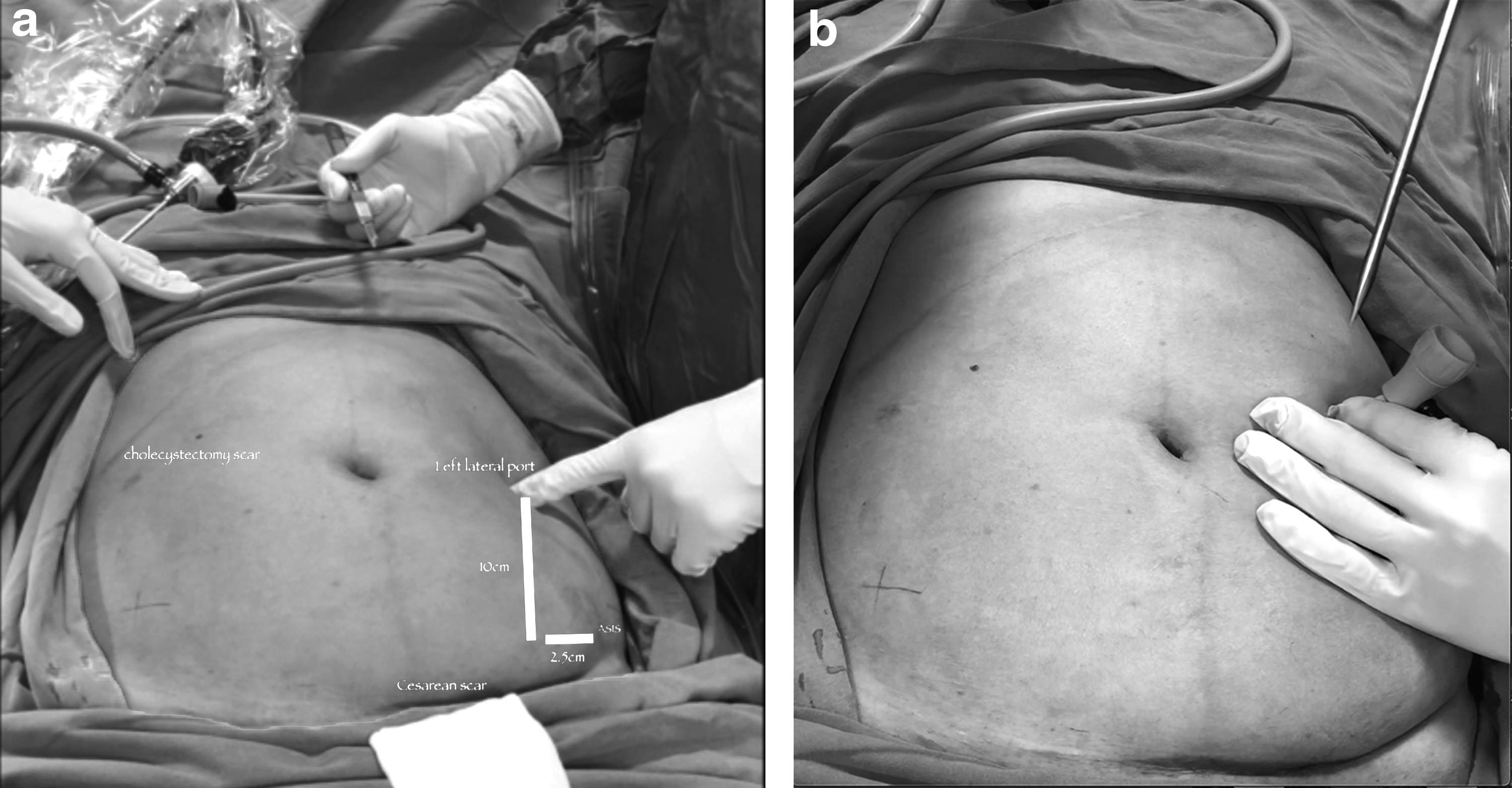
On transvaginal ultrasonography, endometrial thickness was 7 mm, the uterus was adenomyotic, and there was 69 × 53 × 60 mm type 7 fibroid at the right side of the uterus corpus, both ovaries were normal. Adnexal pathology and intra-abdominal free fluid were not detected.
Laboratory tests revealed follicle stimulating hormone was 25.73 mLU/mL, luteinizing hormone was 21.07 mLU/mL, and estradiol was 342 pg/mL. Thyroid function tests, prolactin level, and biochemical tests were normal. In the complete blood count, hemoglobin was 12.1 g/dL and hematocrit was 39.6%. The pathology result of endometrial sampling was endometrial stromal fragments.
Laparoscopic total hysterectomy and bilateral salpingo-oophorectomy were planned. Direct trocar technique from left lateral port (Jain point) was chosen as the entry point due to history of two cesarean sections and cholecystectomy with laparotomy.
Left lateral port (Jain point) is located in the left paraumbilical region at the level of umbilicus, in a straight line drawn vertically upward from a point 2.5 cm medial to anterior superior iliac spine (Fig. 1a). We entered the abdomen with a 5 mm trocar with direct trocar entry technique from left lateral port (Jain point) and created pneumoperitoneum (Fig. 1a, b). Then, a 5 mm camera was introduced from this trocar site. It was observed that the mesenteric adipose tissue of the bowel was adherent under the cholecystectomy scar till to the umbilicus and the bladder was adherent to the cesarean section scar. Palmer's point was checked at the same time and it was free of adhesions. Afterward, we entered the abdomen with a 10-mm trocar from Lee Huang point, which lies centrally between the xiphoid process and the umbilicus, 7 for 10 mm 30° camera, under the direct visualization of 5 mm camera from the left lateral port (Jain point). Then, 5 or 10 mm ancillary trocars were placed as your port configuration (to the right, left inguinal, and suprapubic regions); left lateral port (Jain point) trocar could be used as an ancillary port, as well. Intraligamental fibroids of ∼7 cm were observed to the right of the uterus. Bilateral ovaries and tubes were normal. After adhesiolysis, total laparoscopic hysterectomy and bilateral salpingo-oopherectomy were performed. The patient was discharged uneventfully after 48 hours.
The local institutional review board did not require ethical approval. Written informed consent to publish clinical case records and surgical pictures was also taken from patient and her relatives.
Discussion
The myth of Pandora's box is considered one of the most descriptive myths of human behavior not only to instruct themselves about the weaknesses of humans, but also to explain several misfortunes of the human race. When Pandora could not hold herself anymore, she opened the box and all the illnesses and hardships that gods had hidden in the box started coming out. Just like entering the abdomen during laparoscopy, you cannot predict what the gods had hidden inside abdomen especially in cases with previous surgeries besides if the things have gone wrong as entry complications, all hard work started coming out at the beginning of laparoscopy.
Palmer's point is the recommended site for laparoscopic entry in cases with previous surgeries or history of umbilical hernia and after failed attempts from umbilicus; however, Palmer's point has limitations in cases with previous splenic or gastric surgery, portal hypertension, or significant gastropancreatic masses. 2 Moreover, Palmer's point is not 100% safe8,9 for sure. So, new entry points might have overcome these issues.
Recently, Jain et al. described a new safe point in cases with previous surgeries; they reported that in 624 patients with a history of abdominal surgeries, intra-abdominal adhesions were found in 487 (78.0%) patients, and umbilical adhesions in 404 (64.7%) patients with past abdominal surgeries. They added that there were no significant entry-related, intraoperative, or postoperative complications with the use of this entry point. They claimed that they could have overcome the contraindications or limitations of Palmer's point by entering from this point. 3 However, they did not look under Palmer's point for adhesions whether adhesions exist or not, if this had been done, they could have compared the entry points as well.
Jain et al. advised that in a recently published case wherein Palmer's point is contraindicated, left lateral port entry is good not only for low transverse pfannensteil incision, midline, and paramedian incision, but also for upper abdomen incisions, once more. 5
According to the Cochrane review concerning laparoscopic entry techniques, trial results showed a reduction in failed entry into the abdomen with the use of a direct trocar in comparison with Veress needle. However, evidence was insufficient to show whether there were differences between groups in rates of vascular injury, visceral injury, or solid organ injury. 6 Moreover, shorter operating time and immediate recognition of visceral/vascular injuries are the potential benefits of direct trocar entry.
So in our case, we modify Jain point entry, direct trocar entry rather than Veress needle for creating pneumoperitoneum, thus we have combined the aforementioned advantages of Jain point and direct trocar entries. Although this is the first case report concerning direct trocar entry from the left lateral port (Jain point), this entry technique is a potential alternative to existing methods.
Interestingly, despite improvement in technology or newer strategies being defined, incidence of laparoscopic entry complications has not decreased for years.
Actually, there is no guarantee that any entry is safe for sure from any point, but it is a kind of relief and wealth to have different options or choices while entering the abdomen during laparoscopy especially in cases with previous surgeries or suspicion of adhesions. Of course, we need many more articles and cases concerning direct trocar entry from the left lateral port (Jain point).
Footnotes
Author Disclosure Statement
The authors report no conflicts of interest.
Authors' Contributions
All authors contributed equally to article preparation. B.M. and O.A. were involved in the clinical care of the patient.
Funding Information
No funding was received for this article.