




Abstract
Background:
Immune thrombocytopenic purpura (ITP) is a bleeding disorder characterized by isolated thrombocytopenia, which is related to an autoimmune process. ITP is considered a diagnosis of exclusion.
Cases:
This article presents 3 cases of pregnant women who were previously diagnosed with ITP. These patients showed had platelet counts of <20 × 109/L at prenatal assessments.
Results:
The three patients were managed prenatally by intravenous immunoglobulin (IVIG) to raise their platelet counts before delivery. Two of these patients completed the 5-day course of treatment and delivered at the planned time; the third patient required an emergency cesarean section before she could complete her course of IVIG treatment.
Conclusions:
IVIG treatment is effective for treating severe ITP. IVIG increases platelet count to a good level that can enable a safe delivery without any maternal or fetal complications.
Introduction
Immune thrombocytopenia (ITP) occurs in ∼3 of 10,000 pregnancies. 1 ITP is an autoimmune condition in which antiplatelet autoantibodies interfere with platelet production and cause destruction of circulating platelets.1,2 ITP is a diagnosis of exclusion. 3 ITP becomes more severe during pregnancy. 4 ITP often has a similar presentation to cases with other causes of thrombocytopenia but can require completely different management approaches. 5 Thrombocytopenia might lead to maternal bleeding, neonatal thrombocytopenia, and even neonatal hemorrhage. 6 Corticosteroids and intravenous immunoglobulin (IVIG) are first-line treatments for ITP during pregnancy.5,7
Case 1
A 29-year-old pregnant woman was in her third pregnancy. She had experienced two vaginal deliveries 7 and 3 years prior, without any bleeding complications. Yet, she was known to have ITP for the last 15 years, with platelet counts in a range of 10–15 × 109/ L. She had undergone a splenectomy 10 years prior.
She presented to the current authors at 32 weeks of gestation for prenatal care. Because she was pregnant, she suspended her corticosteroid therapy due to her own fear of an iatrogenic effect of the medication. She remained clinically stable without any bleeding or bruising complaints. At this visit, her complete blood-cell (CBC) count revealed severe thrombocytopenia (2 × 10⁹/L). Comanagement with a hematologist was arranged, and she was admitted to the hospital for treatment of her ITP with 0.4 g/kg/day of IVIG for 5 consecutive days. She maintained a stable clinical status with platelets counts of 75, 85 then 118 × 109/L on the third, fourth, and fifth days, respectively, of treatment with IVIG. She was discharged to go home on maintenance steroid therapy with 30 mg/day of oral prednisolone.
Yet, the patient missed her planned follow-up after going home. She then came back at 38 weeks of gestation with a platelet count of 3 × 10⁹/L and this required that she be readmitted to the hospital and have repeated IVIG treatment. Her platelet count on fifth day of this treatment increased to 120 × 109/L. A decision was made to induce labor. She achieved a vaginal delivery without anesthesia and with an intact perineum. The newborn was a full-term boy of 3.2 kg with a fair general condition and a normal platelet count. The maternal intrapartum and postpartum timeperiods passed uneventfully without any signs of excessive bleeding. She was discharged to go home with a platelet count of 98 × 109/L and was given a recommendation to have regular follow-ups with a hematologist.
Case 2
This patient was a 31-year-old pregnant women. She has a known history of ITP for the last 13 years with platelet counts ranges between 6 × 10⁹/L and 100 × 109/L while she was under the care of hematologists. She had undergone a splenectomy 6 years ago. She was gravida 2, para 1 + 0, with a history of mild postpartum hemorrhages following her first vaginal delivery that required transfusions of 1 unit of packed red-blood cells and 3 units of platelets. Unfortunately, she did not have a detailed medical report regarding her antenatally, intrapartum, or postpartum conditions for her previous pregnancies.
During her current pregnancy, she presented at 35 weeks of gestation. Her CBC count showed a low platelet count of 25 × 109/L. She had no complaints or signs of bleeding or bruising. She was still under the care of a hematologist, with a history of receiving 2 courses of IVIG (0.4 g/kg/day for 5 days) during this current pregnancy, as her platelet counts were <20 × 109/L. At 37 weeks of gestation, her platelet count was 16 × 109. The current authors communicated with her hematologist to arrange a course of IVIG to raise her platelet count to a suitable level before a planned induction of labor at 38 weeks of gestation.
Induction of labor after the IVIG treatment course was performed with this patient's platelet count at 128 × 1010 on the day of delivery. She delivered vaginally with a second-degree perineal tear that was repaired properly under epidural anesthesia and that did not cause any abnormal postpartum bleeding. She delivered a female baby of 3100 g with Apgar scores 8, 9, and 10 at 1, 5, and 10 minutes, respectively. The newborn was completely normal with a normal platelet count. The patient was discharged to home with her new daughter on the next day, with a platelet count of 96 × 1010. Surprisingly, on the 30th day postdelivery, this patient came for a routine checkup and her platelet count was only 7 × 10¹⁰. She was advised to have an immediate consultation with her hematologist.
Case 3
A 34-year-old pregnant woman presented with a known history of ITP for 8 years duration. She had undergone a splenectomy 4 years prior. She was admitted to the hospital under care of the hematologist for IVIG treatment, as her platelet count was 15 × 109/L. She was in her third pregnancy; her first pregnancy resulted in a spontaneous abortion at 10 weeks of gestation and her second pregnancy went to a full-term vaginal delivery with healthy baby 3 years prior.
She was at 35 of weeks gestation at her current presentation. On the next day of her hospital admission, she had preterm premature rupture of her membrane that was proven both clinically and radiologically. The ultrasound study revealed that the fetus was in a breech presentation. Unfortunately, her platelet count was 23 × 109/L and delivery should have been arranged after bringing up her platelet level. Thus, 10 units of platelet substitutes were prepared in case bleeding developed.
On the following day, this patient was brought to the delivery room, as she developed preterm labor contractions. Cesarean delivery was performed under epidural anesthesia for the preterm breech presentation. Her platelet count just before delivery was 96 × 109/L. The peripartum period including the anesthesia and surgical procedures passed uneventfully without any abnormal bleeding. The newborn was a girl of 1950 g with Apgar scores of 9, 10, 10, at 1, 5, and 10 minutes, respectively. The newborn was admitted to the neonatal intensive care for mild respiratory distress due to her prematurity. The platelet count of the newborn was within normal range. The mother was discharged to go home on the fourth postoperative day, after completion of her IVIG doses, with a platelet count of 144 × 109/L.
Results
Three pregnant women with sever ITP were treated with IVIG for 5 days. Two patients completed the course of IVIG and their labor was induced at 38 weeks of gestation after completion of the IVIG courses of treatment. The third case turned emergent due to preterm premature rupture of the patient's membrane and preterm labor with a breech presentation during the second day of her course of IVIG treatment. All 3 patients delivered with good responses to IVIG, which induced platelet counts suitable to enable safe deliveries without bleeding complications. Two patients delivered vaginally, 1 without anesthesia and 1 with epidural analgesia. The third patient had a cesarean delivery with epidural anesthesia (See flow chart in Fig. 1)
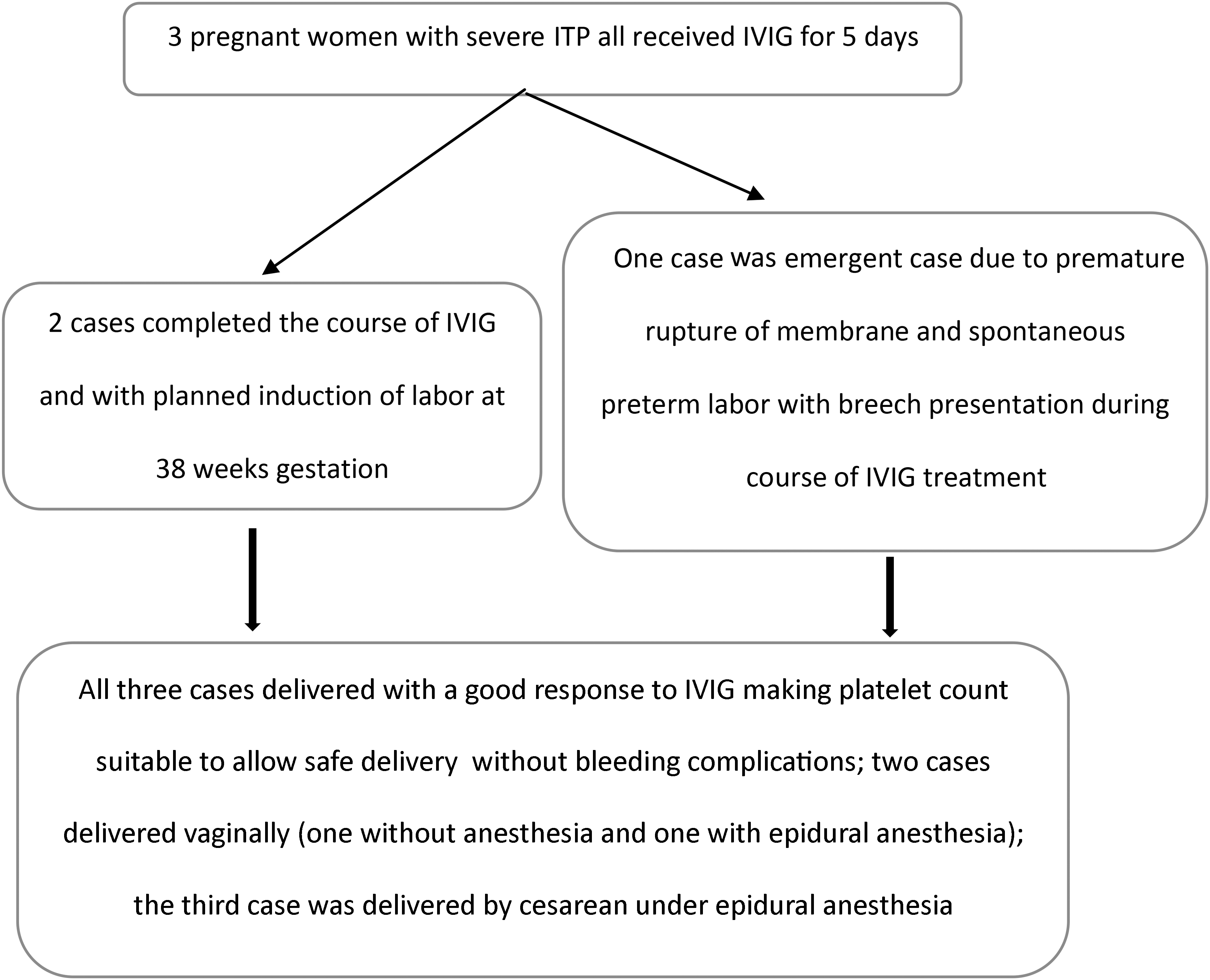
Flow chart. ITP, immune thrombocytopenic purpura; IVIG, intravenous immunoglobulin.
Table 1 shows, the starting platelet counts before IVIG treatment were 3 × 10⁹/L, 16 × 109 and 15 × 109/L, respectively in the 3 patients. Fortunately, the patients' platelet counts at the times of delivery were 120 × 109/L and 128 × 1010 respectively in the first 2 cases, after completing the 5-day course of IVIG treatment. However, the platelet count was 96 × 109/L at the time of the third patient's emergent cesarean delivery. None of these 3 patients developed any maternal or neonatal bleeding complications.
The 3 Cases
IVIG, intravenous immunoglobulin.
Discussion
Thrombocytopenia in pregnancy might lead to maternal bleeding, neonatal thrombocytopenia, and even neonatal hemorrhage.2,6,7 Management of ITP during pregnancy is generally the same as ITP in a nonpregnant patient.3,8 There is a need to optimize the platelet count to a safe level as pregnancy advances to support the mode of delivery, facilitate use of regional analgesia and anesthesia, and minimize the risk of peripartum complications.1,3 In the first and second trimester, in the absence of symptoms or planned interventions, treatment is initiated when the platelet count falls below 20–30 × 109/L or if there is symptomatic bleeding. 3
At the time of delivery, management of ITP is based on an assessment of maternal bleeding risks associated with delivery, epidural anesthesia, and the minimum platelet counts recommended to undergo these procedures (70 × 109/L for epidural placement and 50 × 109/L for cesarean delivery).6,9 The current cases highlight that IVIG therapy is effective and can increase the platelet counts rapidly to levels that overcome some of the challenges seen in the management of patients with severe ITP during pregnancy and in especially peripartum timeperiod.
When therapy is indicated, IVIG may be appropriate especially if a more-rapid platelet increase is necessary. 9 The increase in platelet count with IVIG is usually temporary. IVIG needs to be administered from 1 to 3 days to induce initial response, and then from 2 to 7 days to induce a peak response. IVIG can be used ∼1 week in advance to raise platelet count prior to delivery or neuraxial anesthesia.10,11 IVIG administered during pregnancy is safe for fetuses. 12
It is recommended that better to avoid splenectomy, rituximab, and thrombopoietin-receptor agonists during pregnancy due to concerns about maternal and fetal adverse effects.1–3,13 However, rituximab can be used in some patients with refractory ITP who do not respond to steroid- and IVIG-therapies. 13 Splenectomy might be required for a patient with severe thrombocytopenia and bleeding who is unresponsive to glucocorticoids, IVIG, and rituximab. 6 Platelet transfusions should be used only as temporary measures to control life-threatening hemorrhages or to prepare patients for urgent surgery.3,4,6,14 The effect of platelet transfusion appears to be short-lived. 14
Conclusions
The goal of ITP treatment is to induce a safe platelet count to facilitate the safe administration of neuraxial anesthesia and minimize the risk of postpartum hemorrhage. In the current cases, the use of IVIG succeeded relieved our concerns about the 3 patients who had severe ITP. IVIG raised the patient's platelet counts to satisfactory levels that enabled safe deliveries without any bleeding complications.
Footnotes
Author Disclosure Statement
No financial conflicts of interest exist.
Funding Information
No funding was received for this article.