




Abstract
Objective:
This study compared the long-term outcomes of polypropylene mesh (PPM) and transobturator rectus fascia (RF) slings in transobturator tape (TOT) surgery in obese women.
Materials and Methods:
Data were analyzed retrospectively of patients who underwent TOT surgery between May 2012 and November 2018, with a diagnosis of pure stress urinary incontinence or stress-predominant mixed urinary incontinence,. Patients whose body mass indices were >30kg/m2 were divided into 2 groups: PPM and RF, according to the sling materials used. The patients were compared in terms of clinical data and surgical outcomes.
Results:
There were 133 (82.09%) in the PPM group and 29 (17.91%) in the RF group. The mean age in the PPM group was 53.74 ± 10.15 years, and the mean age in the RF group was 48.69 ± 7.22 years. The decrease in the number of pads used daily in both groups was similar (p = 0.560). Mean operation time, hospitalization time, and visual analogue scale score were higher in the RF group than in the PPM group (p < 0.001, p < 0.001, and p < 0.001, respectively). There was no significant difference between the groups in terms of postoperative ıncontinence quality of life questionnaire scores (p = 0.705), improvement in International Consultation on Incontinence Questionnaire—Short Form scores (p = 0.242), improvement in number of pads used daily (p = 0.292), and complications (p = 0.908).
Conclusions:
TOT surgery can be performed safely and effectively with PPM or RF as a sling material for treating stress incontinence in obese women. However, the transobturator RF sling prolongs operation and hospitalization times significantly. (J GYNECOL SURG 37:246)
Introduction
The International Continence Society defines urinary incontinence as involuntary loss of urine that is objectively shown, and that creates social and hygiene problems.1,2 Stress urinary incontinence (SUI) is the dominant type of urinary incontinence seen in 30%–80% of all patients with incontinence. 3 Midurethral sling procedures are now the most-frequently used surgical treatments for SUI. 4 A surgical approach using a transobturator rectus fascia (RF) sling in SUI surgery was first reported in the 1940s, 5 while synthetic materials were introduced in the 1960s. 6 Synthetic sling materials have now become the primary materials of choice for surgical procedures to address SUI. 7 However, synthetic-sling materials can lead to foreign-body reactions 8 and several postoperative complications, such as vaginal-mesh exposure or extrusion and intraurethral or intravesical erosion. 9 Therefore, autologous fascia grafts may be the choice of sling materials, especially in patients with histories of hypersensitivity to polypropylene sutures in previous surgeries or similar substances such as nylon clothes, powder, synthetic dyes, etc.
Obese women are at a higher risk of developing urinary incontinence. 10 However, the results of studies comparing the outcomes of using transobturator tape (TOT) as a treatment for obese and nonobese women are conflicting.11,12 Furthermore, studies investigating transobturator RF slings for SUI surgery in obese women are very limited.13,14 Therefore, the aim of the current study was to compare the long-term outcomes of a transobturator RF sling with one composed of polypropylene mesh (PPM) for TOT procedures in obese women.
Materials and Methods
After obtaining permission from the local board (January 29, 2020; institutional review board number: 43278876-929), the data were retrospectively analyzed for patients with body mass indices (BMIs) >30 kg/m2 who underwent TOT at the Keçiören Training and Research Hospital, in Ankara, Turkey, for pure SUI or stress-predominant mixed urinary incontinence between May 2012 and November 2018. Patients with predominantly urge-urinary incontinence were excluded from the study. The International Consultation on Incontinence Questionnaire—Short Form (ICIQ-SF) and the Incontinence Quality of Life Questionnaire (I-QoL) form (both validated in Turkish),15,16 and a visual analogue scale (VAS; graded 0–10) were used to evaluate quality of life (QoL) and postoperative pain scores of the patients. Urinary ultrasonography, cystoscopy, preoperative urodynamics, stress, and Q-type tests were performed routinely for all patients before their surgeries. Cystocele grading was classified according to Swift's classification. 17
Before the operation, each patient was informed in detail about the PPM sling material and possible side-effects and complications of transobturator RF sling surgery, and a decision was reached about the most-appropriate sling procedure. Patients were informed about the need for an additional abdominal incision and the secondary morbidity associated with the transobturator RF sling procedure, that an abdominal incision may cause more pain, and that a wound infection and incisional hernia might develop. Regarding PPM, each patient was informed that such synthetic sling material could cause a foreign-body reaction in the tissue, potentially resulting in vaginal-mesh exposure and extrusion, or intraurethral or intravesical erosion, and that this risk could increase even more in the case of early sexual intercourse in the postoperative timeperiod in sexually active women. Especially, history of hypersensitivity to polypropylene sutures in previous surgeries was questioned and RF sling procedure was first recommended for patients with histories of hypersensitivity.
After an informed discussion, a decision for sling material and surgical procedure was made according to each patient's preference and the physician's recommendation. Grade of urinary incontinence was determined preoperatively and postoperatively by the number of pads used per day.
The procedure was performed under spinal anesthesia in both groups. Each patient was placed in a lithotomy position, and the genitalia and lower abdomen were prepared and draped in a sterile manner. After a Foley catheter was inserted, hydrodissection was performed with a saline injection to the anterior vaginal wall, beginning from ∼1–1.5 cm under the urethra longitudinally. Then, a 2-cm longitudinal vaginal incision was made at the midurethral level. Dissection advanced bilaterally until reaching the inferior ischiopubic ramus. Two minimal incisions were made on both sides over the medial aspect of the obturator foramen at the level of the clitoris. A half-moon–shaped TOT needle (I-STOP TOMS®) was used for a transobturator passage. TOT procedures were applied from an external to internal (out-to-in) technique, as described by Delorme. 18
In the PPM group, the PPM was placed in the midurethral position with proper tension. If the tip of the right-angle clamp passed easily between the mesh and vaginal wall, this tension was accepted as appropriate. İn the RF group, a 5-cm suprapubic transverse incision was made to remove the rectus fascia. After reaching the anterior rectus fascia, the top of the fascia was cleaned and a 1.5 × 6–cm section was harvested (Fig. 1). Then, the opened part of the fascial area was closed with a 1-0 absorbable polydioxanone (PDS-Ethicon®) suture. The rectus fascia graft was prepared as a suspension material by passing 2-0 absorbable PDS® sutures on both ends (Fig. 2). The following part of the procedure was performed in the same way as the TOT procedure with placement of PPM material, and the rectus fascia graft was placed in the midurethral area at the appropriate tension. Cystocele repair was also performed in case of grades 2 or 3 cystoceles in both procedures.
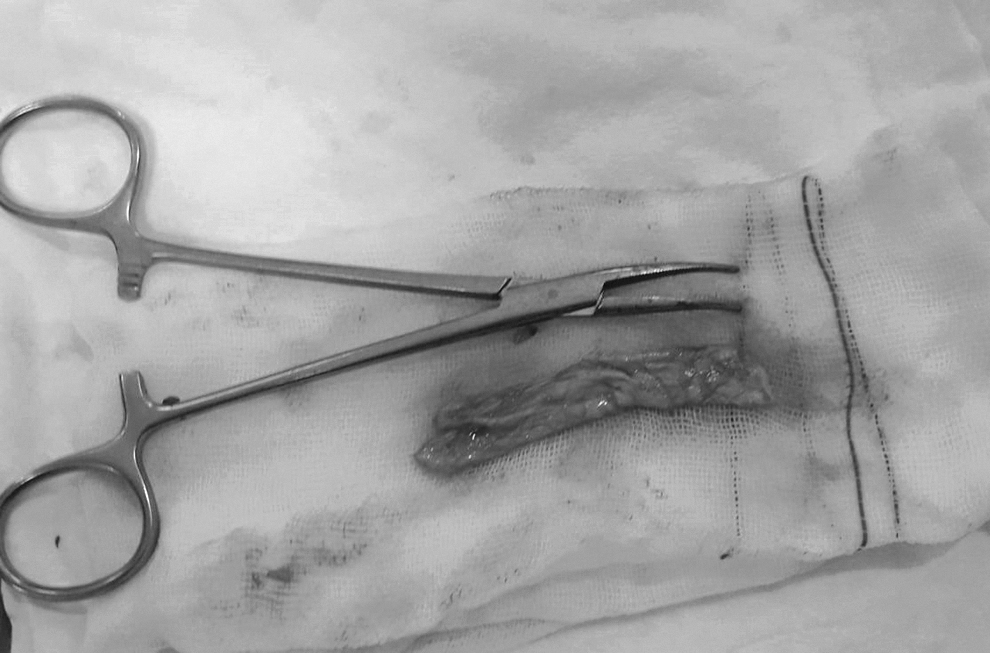
Harvested rectus fascia.

Rectus fascia prepared as a sling material.
İn the postoperative timeperiod, patients were checked at the 1st, 3rd, 6th, and 12th months, and the data records in the 12th month of the postoperative timeperiod were examined and evaluated. After the 12th month, the patients were called for control once a year. Patients without postoperative 12th-month control records were not included in the study. The patients were divided into 2 groups; PPM and RF, according to the sling materials used. Perioperative parameters, including age, BMI, ICIQ-SF score, operation, and hospitalization time, postvoiding residual urine volume (PVR),VAS scores, I-QoL scores, decrease in the number of pads used per day, and complications were compared between the 2 groups.
Categorical variables were compared using a χ 2 test, while continuous variables were compared using a t-test for univariate analyses. Mean ± standard deviation and median (minimum–maximum) were used for continuous data. Data were analyzed with SPSS 25.0 (IBM Corp.) software. Statistical significance was set at p < 0.05.
Results
A total of 162 patients was included in the present study
Demographics and Preoperative Characteristics of the Patients
Bold italics indicates significance.
PPM, polypropylene mesh; RF, rectus fascia; yr, year(s); SD, standard deviation; mo, month(s); BMI, body mass index; ICIQ-SF, International Consultation on Incontinence Questionnaire—Short Form; min–max, minimum–maximum.
Perioperative and Postoperative Outcomes in the Groups
Bold italics indicates significance.
PPM, polypropylene mesh; RF, rectus fascia; I-QoL, Incontinence Quality of Life Questionnaire; ICIQ-SF, International Consultation on Incontinence Questionnaire—Short Form; min–max, minimum–maximum; VAS, visual analogue scale; SD, standard deviation; mo, month(s); PVR, postvoiding residual (urine volume); d, day(s); min, minute(s).
There was no significant difference between the 2 groups in terms of postoperative I-QoL scores (10.84 ± 9.71 versus 12.06 ± 16.55; p = 0.705). The preoperative median daily pad usage was 4 (3–6) pads/day in the PPM group and 4 (3–5) pads/day in the RF group. In addition, there was no difference between the 2 groups in the postoperative timeperiod. In terms-of decrease in the number of pads used per day (3.20 ± 1.04 versus 3.07 ± 1.13; p = 0.560) and the rate of patients with improvements in the number of pads used daily (97% versus 93.1; p = 0.292).
A total of 12 patients (7.40%) had postoperative complications after TOT including reintervention for vaginal mesh exposure (n = 9; 5.55%), mesh excision (n = 1; 0.62%), urinary-tract infection (n = 1; 0.62%), and surgical site infection (n = 1; 0.62%). While 8 (6.01%) patients who developed postoperative vaginal mesh exposure were in the PPM group, only 1 (3.44%) patient was in the RF group. There was no significant difference between the 2 groups in terms of postoperative complications (7.50% versus 6.90%; p = 0.908). Postoperative median ICIQ-SF score was 4 (0–21) in PPM group and was 5 (0–16) in the postoperative period; there was no significant difference between the groups (p = 0.654). Similarly, in the postoperative timeperiod, a median 11 (0–19)–point improvement was detected in the PPM group in ICIQ-SF score, while a median 9 (0–20)–point improvement was in the RF group; there was no difference between the groups (p = 0.242; Table 2).
Discussion
Surgical treatment for addressing SUI previously consisted of sling procedures, colposuspensions, and injections of bulking agents.4,19 Midurethral-sling procedures are now the most-frequently used surgical treatments for SUI. 4 Various autologous and synthetic materials have been used in midurethral sling procedures. 20 All of the materials used have several pros and cons4,9,21; and different host responses to these sling materials were shown. 8 It has been shown that a foreign-body reaction can occur against synthetic meshes 8 and that these meshes can lead to complications such as intraurethral and intravaginal erosion, vaginal mesh exposure or extrusion, mesh infection, and mesh migration.9,21 Using autologous sling materials does not cause hypersensitivity reactions and inflammatory responses 8 ; however, there is a need for extra incisions to obtain the sling materials.
The long-term results of TOT surgery with synthetic materials are available in the literature22,23; however, there were not enough data comparing the long-term results of using RF and PPM in obese women.13,14 Therefore, this study was conducted to review retrospectively the records of the current authors' patients with SUI and obesity who underwent TOT surgery either with PPM or RF. Vaginal-sling surgeries are not procedures without complications in obese patients. In the current study, the postoperative complication rate was 7.40% and was similar between the PPM and RF groups. Other series in the literature have reported postoperative complication rates varying between 3% and 19.5%, which was similar to the current series.13,23,24
One of the most-common postoperative complications after SUI surgery is vaginal-mesh erosion, including mesh exposure and extrusion. 25 Zambon and Badlani stated that vaginal erosion can be seen as a result of patient-related, surgical technique–related, and mesh-related factors. 26 Haverkorn et al. reported lower vaginal-mesh erosion rates (2.6% versus 4.5%) in patients who underwent sling surgery with PPM compared with RF. 13
Yet, in the current study, revision for vaginal-mesh exposure was required in 6.78% of the PPM group and in 3.45% of the RF group. Mesh excision was performed in 1 patient (0.75%) in the PPM group. Vaginal-mesh exposure was detected twice as frequently in the PPM group as in the RF group; but the difference between the 2 groups was not statistically significant. It was thought that, due to the small number of subjects in the study, this difference did not reach statistical significance. Similar to the current results, Khan et al. reported a high vaginal-mesh erosion rate (1.6% versus 0%) for a synthetic-sling group. 27 Considering the data in the current literature, a randomized prospective study might be the next best method to address this question. As stated very well in the literature, vaginal exposure and extrusion of PPM mesh causes pain during sexual intercourse (dyspareunia) and consequent sexual dysfunction, especially in younger, sexually active women.8,9,22,23 İt is likely that this might influence selection of the RF preoperative mesh procedure, especially in younger, sexually active women. The possible reason why women in the RF group in the current study were younger than the PPM group can be explained by the fact that the RF procedure was preferred more frequently by younger women in preoperative mesh selection due to the abovementioned concerns.
In the current study, the rate of patients with improvement in the number of pads used per day was used to evaluate objective cure rates between the 2 groups. The postoperative improvement rates of both groups were similar. Mourad et al., 28 Wadie et al., 14 and Sharifiaghdas et al., 29 reported that the improvement rates of pad usage in patients in RF or PPM groups were similar. Khan et al. stated that long-term success rates were similar between autologous and synthetic materials, and that autologous materials provided more durable dry rates, compared with synthetic materials. 27 The current study suggested that using RF as sling material can provide similar success rates, compared to PPM.
Patients' satisfaction after vaginal-sling surgeries were evaluated by using different questionnaires in different studies.28,29 In the current study, I-QoL scores were used to determine the patient satisfaction rate, and there was no difference in postoperative I-QoL scores between the 2 groups. It can be speculated that, although the VAS scores and hospitalization times were higher in the RF group, low postoperative vaginal-mesh exposure–rates and revision requirements led to slightly better—not statistically significant—postoperative I-QoL scores in this group. Mourad et al. 28 evaluated postoperative satisfaction, using the ICIQ-UI-SF questionnaire, and reported similar postoperative scores between patients who underwent sling operations with synthetic materials and RF. Similarly, Sharifiaghdas et al. used the I-QoL questionnaire and stated that there was no difference between patients operated on with synthetic materials and RF. 29 Similar to the literature data, in the current study, the ICIQ-SF scores of the PPM and RF groups improved significantly in the postoperative time period, and no significant difference was found between the groups. These results showed that use of synthetic materials and RF produces similar postoperative subjective cure rates in patients.
Mourad et al. reported high postoperative pain scores in patients who underwent TOT surgery with RF. 28 Similarly, in the current study, postoperative VAS scores were significantly higher in the RF group. Yet, Haverkorn et al. stated that postoperative VAS score was higher in patients operated on with PPM, compared with patients operated with RF. 13 The need for a second incision for removal of RF plays a role in higher postoperative pain scores in obese patients due to their high subcutaneous adipose tissue. TOT surgery with RF significantly increased operation and hospitalization times in obese patients. Other series in the literature have reported longer operation14,28,9 and hospitalization 29 times with RF, which were similar to the current results. As expected, the need for a secondary incision and subsequent preparation of the mesh led to prolonged operating times in the RF group. The wound care of suprapubic incisions and high postoperative VAS scores might have been the factors prolonging the time of hospital stays in the RF group.
The current study had some limitations. The most-important limiting factor was the retrospective nature of the study. The other limiting factors were that: the patients in the RF group were significantly younger than the patients in the PPM group; and the preoperative ICIQ-SF score was significantly higher in the PPM group than the score in the RF group. Yet, the low number of patients in the RF group, compared to the PPM, group was another important limitation. Despite these limitations, the current authors believe that the results of this study will make a significant contribution to the current literature as this study provided the long-term outcomes of TOT surgery using either PPM or RF in obese patients.
Conclusions
TOT surgery can be performed safely and effectively, using either PPM or RF as sling material to treat stress incontinence, and both procedures induce similar postoperative I-QoL scores and improvements in ICIQ-SF scores in obese women. The choice of the sling material should involve a detailed discussion with each patient about the advantages and disadvantages of both methods. However, using RF significantly prolongs the operation and hospitalization times. Therefore, in the current authors' opinion, PPM should be the first choice of surgeons when treating obese patients and RF may be reserved for the patients with histories of hypersensitivity to polypropylene sutures and similar substances.
Footnotes
Author Disclosure Statement
No financial conflicts of interest exist.
Funding Information
This research was not supported by any specific grant.