




Abstract
Objectives:
This trial examined the effectiveness of intrauterine alginate carboxymethylcellulose hyaluronic acid–(ACH) gel application after vacuum aspiration as a treatment in first-trimester abortion to reduce formation and severity of intrauterine adhesions (IUAs).
Materials and Methods:
This prospective, single-blinded, randomized controlled trial included 68 pregnant women, at a gestational age of ≤13 weeks, who were diagnosed with abortion without previous histories of curettage, and who underwent termination of pregnancy by vacuum aspiration. After vacuum aspiration, the participants were assigned randomly to an intervention group (with ACH-gel application; n = 34) or a control group (no ACH gel application; n = 34). All participants were scheduled for office hysteroscopy 8–12 weeks after vacuum aspiration to evaluate the IUAs.
Results:
Six participants did not undergo hysteroscopy. Therefore, outcomes were available for only 62 patients—32 in the intervention group and 30 in the control group. IUAs were noted in 17 patients (27.42%), with 5 participants (8.06%) in the intervention group and 12 participants (19.35%) in the control group (relative risk = 0.39; 95% confidence interval: 0.16-0.98; p = 0.04). The severity of IUAs was not significantly different between both groups (p = 0.61).
Conclusions:
The application of ACH gel after vacuum aspiration in patients who have miscarriages without previous histories of curettage can reduce IUA formation significantly.
Introduction
Currently, miscarriages occur in 10%–20% of all pregnancies, with 80% of the miscarriages occurring in the first trimester of pregnancy. 1 Furthermore, ∼1% of pregnant women experience repeated miscarriages. 2 Intrauterine adhesions (IUAs) account for 5%–39% of the repeated abortions. Upon checking the histories of these women, it was found that 40% of the women who had IUAs had histories of abortions and that had been induced by curettage. 3
IUAs were first discovered in 1894 by Fritsch (cited by Asherman), 4 while Asherman's syndrome—which is characterized by IUAs combined with menstrual abnormality, cyclic pelvic pain, and infertility—was first reported in 1948 by Asherman. 5 Intrauterine adhesion is mainly caused by injury to the basilar endometrium, resulting in failure of the endometrium to create an endometrium functionalis, and, instead, causing fibrosis. One study reported that 19% of women after dilatation and curettage (D&C) for miscarriages have IUAs, with 42% of these events being moderate-to-severe. 6 More importantly, moderate-to-severe IUAs are related to impaired fertility.7,8
Various treatment methods for abortion include expectant management, medical treatment, and curettage. Curettage remains widely used today. 9 Previously, sharp curettage was the method of choice, although it has been recently changed to using vacuum aspiration, wherein a small plastic tube is attached to a large syringe-like device. Vacuum aspiration is more convenient, quicker, less-expensive, causes fewer complications and less blood loss, and results in shorter hospitalization stays.1,7,10,11
Although short-term complications in vacuum aspiration are fewer than with sharp curettage, long-term complications, especially IUAs, do, nonetheless, occur. A study has indicated that IUAs caused by vacuum aspiration to treat first-trimester abortion occurred in ∼17.3% of cases, with most of these complications being were mild (64.3%), moderate (21.4%), or severe (14.3%) adhesions. 12
Alginate carboxymethylcellulose hyaluronic–acid (ACH) gel is an adhesion barrier that uses biodegradable biomaterials consisting of alginate, carboxymethylcellulose, and hyaluronic acid. The combination of carboxymethylcellulose and hyaluronic acid has a preventive effect on formation of adhesions. Alginate has hemostatic and antimicrobial effects, 13 and there is much evidence proving the efficacy of ACH gel for preventing IUA formation after hysteroscopic surgery.13,14
Previous studies have shown that using this barrier gel can reduce the occurrence of IUAs significantly after curettage by almost 50%–60%.15–17 Hooker et al.'s study 15 revealed that the incidence of IUAs after D&C with application of hyaluronic-acid gel for patients having miscarriages, who had at least 1 previous curettage, was 13%, which was significantly lower than the incidence caused by D&C alone at 30.6% (relative risk [RR] = 0.43; 95% confidence interval [CI]: 0.22–0.83). Another study by Li et al. 16 also showed that the incidence of IUAs in patients who underwent D&C for delayed miscarriage with the use of the new crosslinked hyaluronic gel was 9.5%, which was significantly lower than the incidence caused by D&C alone at 24.1% (RR = 0.39; 95% CI: 0.21–0.72). However, these studies were conducted in specific groups of patients with risk factors for IUAs and the D&C's involved used sharp curettage.
There is very little information on the use of antiadhesive gel to prevent adhesion formation in general patients who have no risk factors and who underwent curettage by vacuum aspiration, which can cause intrauterine adhesion formation as well. Therefore, this current study evaluated the effectiveness of ACH gel after vacuum aspiration to prevent IUA formation among patients at low risk for IUAs. The hypothesis was that ACH gel after aspiration abortion can reduce IUAs by 60%.
Materials and Methods
This prospective, single-blinded, randomized controlled trial was conducted at Ramathibodi Hospital of Mahidol University, in Bangkok, Thailand. The study protocol was approved by the research ethics committee of the University's faculty of medicine. All patients signed informed consents before participating in the study, which was conducted from September 1, 2019, to July 31, 2020. This study was registered at the Thai clinical trials registry (TCTR20200314005).
Pregnant women, who were diagnosed with blighted ova, incomplete abortions, inevitable abortions, or embryonic deaths; and who underwent termination of pregnancy by vacuum aspiration, were counseled to participate in this study. The inclusion criteria were pregnant women at a gestational age of ≤13 weeks without histories of uterine curettage, pelvic infections, clinical evidence of genital-tract cancer, intrauterine surgeries, intrauterine devices used, uterine anomalies, endometriosis, and intolerance or hypersensitivity to ACH gel and its derivatives. All participants agreed to have their partners use condoms as a contraceptive measure during the follow-up period. Exclusion criteria were use of hormonal contraception during the follow-up period, pregnancy before the scheduled hysteroscopy, occurrence of complications during or after the procedure (such as uterine perforations, infections, incomplete abortions, or requiring D&Cs after vacuum aspiration). Participation could be terminated by investigators for safety considerations, or by the participants upon voluntary withdrawal from the study for any reason at any time.
The participants were randomly assigned to vacuum aspiration without antiadhesive gel application or vacuum aspiration with application of ACH gel with 1:1 allocation. The randomization and grouping were assigned after the vacuum aspiration to avoid bias from the surgeons. The information on ACH-gel application was not registered in the medical record. Therefore, the hysteroscopic examiners were unaware of the allocations of the participants.
The vacuum aspiration was performed under general anesthesia by highly trained residents according to the standard protocol of vacuum aspiration recommended by the World Health Organization's safe abortion publication. 18 This procedure was done by using a 60-mL plastic syringe attached with an appropriately sized cannula based on the patient's gestational age and the dilatation of the cervix that was needed. At the end of the procedure, each participant in the intervention group had 5 mL of ACH gel (Protescal, LG Life Sciences) applied in the uterine cavity. Participants in the control group did not receive ACH-gel applications. All participants received an oral antibiotic (200 mg per day of doxycycline) prophylaxis for 5 days and were advised to have their partners use condoms for contraception during the follow-up period.
The participants were scheduled for 2 follow-up visits. During the first visit at 2 weeks after the procedure, each patient was informed on her pathologic results and was asked regarding any potential complications and adverse events after the vacuum aspiration; the questions involved included pattern of bleeding, menstrual cycle, and use of contraception. The second visit was at 8–12 weeks after the procedure. For the second visit, each participant was scheduled to undergo hysteroscopy in the office during the proliferative phase of her menstrual cycle. The office hysteroscopy, using a flexible 30-mm hysteroscope (Olympus and STORZ equipment), was performed by an experienced physician who did not perform vacuum aspiration and did not know the group of each patient. The hysteroscopic results were recorded and evaluated by 2 other physicians, including the surgeon who performed the hysteroscopy and the other physician who observed from the recorded video. If the results of the 2 physicians did not match, a third doctor will determined the results. IUA severity was classified according to the American Fertility Society (AFS) classification. If adhesions were detected, adhesiolysis would be performed or scheduled after a patient expressed a preference to undergo treatment.
The primary outcome was the number of women with IUA formation after vacuum aspiration in each group, and the secondary outcome was the severity of the IUAs that did occur at the 8–12-week follow-up, comparing between vacuum aspiration alone and vacuum aspiration with ACH-gel application. Moreover, postoperative complications and adverse events related to the ACH-gel application were recorded.
The sample size calculation was based on a previous study's results with an IUA incidence of 10% in participants who received hyaluronic-acid gel and 50% of participants who did not receive antiadhesion gel. 17 A relative reduction of 60% in IUAs was assumed after application of the ACH gel (from 50% to 20%); and a 2-sided significance level of 5%, a power of 90%, and a loss rate during follow-up period of 10% were considered. Therefore, the number of participants in each group was 34 women.
All data were analyzed using STATA SE, version 15.1, to determine the RR ratio, the 95% CI, and the p-values. The continuous variables were described using mean, standard deviation, median, and minimum–maximum value. A t-test was used for normal distribution, and median regression was used for abnormal distribution. The categorical variables were described using counts and percentages. A Student's t-test/median regression and χ 2 /Fisher's exact test were used to check the homogeneity of the patients' baseline characteristics. All randomized women who completed the follow up were included for treatment analysis. Binary regression was performed to compare the outcomes of the 2 groups.
Results
Between September 1, 2019, and July 31, 2020, 68 women were enrolled and randomly assigned into either the intervention group or the control group, with 34 patients in each group. One participant in the intervention group was excluded because of because she got pregnant before undergoing her hysteroscopic examination. Five participants did not undergo hysteroscopic evaluations because they were lost to follow-up. Therefore, outcome data were available for 62 women only as follows: 30 in the control group and 32 in the intervention group (Fig. 1).

Flow chart of the participants. ACH, alginate carboxymethylcellulose hyaluronic acid; F/U, follow-up.
There was no difference in baseline characteristics between both groups (Table 1). The level of expertise of the surgeon performing the vacuum aspiration, the number of cannula applications, and the operative time were compared between both groups (Table 2). Blood loss in the intervention group was significantly lower than in the control group (5 mL versus 7.5 mL; p = 0.01). Postoperative complications after vacuum aspiration and hysteroscopy were not detected. There were no adverse events caused by the ACH gel.
Baseline Characteristics
t-test; bPearson's χ 2 ; cFisher's exact test.
yr, year(s); SD, standard deviation; BMI, body mass index; GA, gestational age; d, days.
Baseline Characteristics of the Vacuum-Aspiration Procedure
Pearson's χ 2 ; bt-test; cmedian regression.
yr, year; min, minutes; SD, standard deviation.
There were 62 of 68 participants who underwent the hysteroscopic procedure (91.18%). The data illustrated that IUAs occurred in 17 women (27.42%), of whom 5 women (8.06%) were in the intervention group and 12 women (19.35%) were in the control group (RR = 0.39; 95% CI: 0.16–0.98; p = 0.04; Fig. 2).
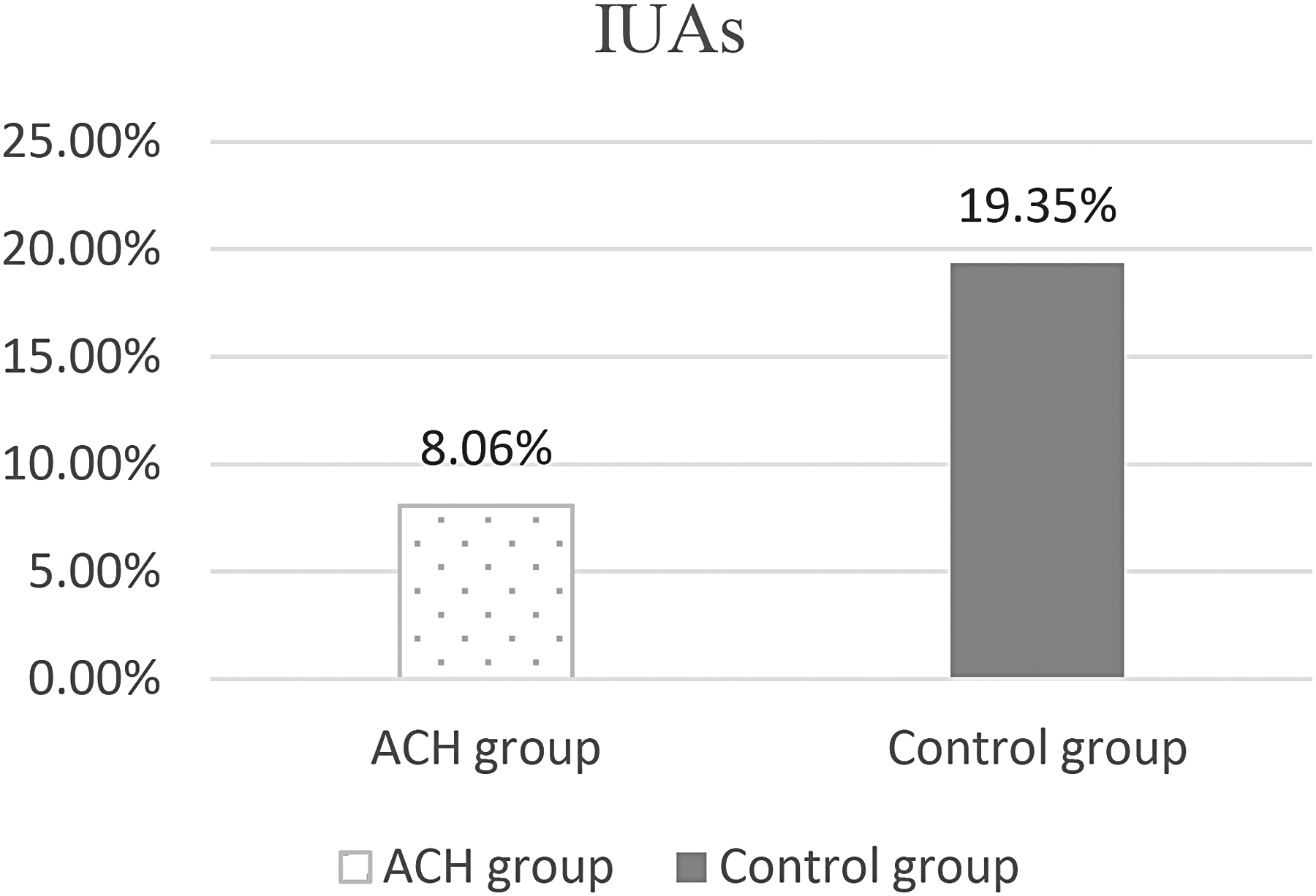
Incidence of intrauterine adhesions. IUAs, intrauterine adhesions; ACH, alginate carboxymethylcellulose hyaluronic acid.
The median adhesion scores assessed using the AFS scoring system in the intervention group were not significantly different from those of the control group. For severity of the IUAs according to AFS classifications, the IUAs in the intervention group were identified as 4 (80%) mild degree and 1 (20%) moderate degree. No participant in this cohort had severe IUAs. Meanwhile, the IUAs in the control group were identified as 6 (50%) mild degree, 4 (33.33%) moderate degree, and 2 (16.67%) severe degree. The difference of severity between both groups was not statistically significant (p = 0.61; Table 3). In addition, the data revealed that 13 of 17 cases of IUAs (76.47%) were cannulated more than 3 times. Moreover, 6 of 7 cases (85.71 %) of moderate-to-severe IUAs were also in this group.
IUAs Scores and Severity
Median regression; bFisher's exact test.
IUAs, intrauterine adhesions.
Discussion
IUA is one of the main causes of infertility problems that can develop from postabortion curettage. Although vacuum aspiration instead of sharp curettage has been currently used to reduce the occurrence of IUA and other complications, this current study showed that using vacuum aspiration can still cause IUAs. 12 Consequently, there have been studies that applied barrier agents into the uterine cavity after postabortion curettage to reduce the occurrence and severity of the IUA.15,16 This current study's results are consistent with those of the previous studies, wherein intrauterine application of ACH gel after vacuum aspiration in women who had miscarriages significantly reduced IUA formation, compared to what occurred when performing vacuum aspiration alone. However, there were no significant differences in IUA severity and median adhesion scores as shown in Table 3.
Gestational ages of the current study participants were rather high (mean gestational age in the intervention group was 71.44 ± 13.59 days and was 73.26 ± 12.23 days in the control group), compared to a prior study. This might have been because of the difference in antenatal-care protocol. In the current authors' hospital, the indications to perform first-trimester ultrasonography examination are vaginal bleeding, pelvic pain, or any concerns regarding the potential for ectopic pregnancy. This protocol might result in a more-advanced gestational age during diagnosis.
With respect to the occurrence of IUAs, the current study results showed that IUAs occurred in 17 women (27.42%), which was higher than in previous studies with an ∼16%–22% reported incidence of IUAs. 12 The higher number of IUAs in this study might have been due to a large number of cases requiring multiple cannula applications. The cannula was applied ≥3 times which is up to 39 cases (62.90%) in this study. Moreover, 13 of 17 participants (76.47%) who had IUAs had a cannula inserted ≥3 times. The cause of these multiple cannula applications might have been because of the advanced gestational ages of the participants, who had greater intrauterine contents, thus requiring multiple application of the cannula for complete removal of these contents. However, further study may be needed to evaluate the effect of multiple cannula applications to IUA formation.
Furthermore, this study's outcome reveals that the incidence of IUAs in the intervention group, 5 cases (8.06%), was significantly lower than that in the control group, 12 cases (19.35%; RR = 0.39; 95% CI: 0.16–0.98; p = 0.04). Compared to previous studies,15,16 the outcome was quite similar. The studies were consistent in that antiadhesive gels, including autocrosslinked hyaluronic acid, new crosslinked hyaluronan, or ACH gel (in this study), were able to reduce the occurrence of IUAs significantly.
Meanwhile, IUA severity and adhesion scores, according to AFS classification, were not significantly different between both groups, in contrast to the 2 previous studies in which the outcomes were significantly different. This inconsistency in outcomes might be because the number of participants in the current study was lower than in those of the 2 previous studies; this might have resulted in an inability to detect a significant difference. Moreover, this current study's population was at a low risk for having IUAs before study participation. Conversely, the populations in the previous studies had the risk factors of previous IUAs, including histories of previous curettage or delayed miscarriages, which can lead to a more-severe degree of IUAs. Although the results for IUA severity and adhesion scores were not significantly different, no participants in the ACH gel group had severe IUAs, and the adhesion scores in this group was lower than those in the control group.
The data showed that the total number of IUAs detected in this study was 17 cases wherein 13 of 17 cases (76.47%) had multiple applications of the cannula. Moreover, 6 of 7 cases (85.71%) of moderate-to-severe IUAs also were in this group. Multiple applications of the cannula can cause basilar endometrium and myometrium injury, which eventually leads to IUAs. Therefore, multiple applications of the cannula might potentially be one of the most-important causes of IUA formation after vacuum aspiration. Thus, further study is needed.
This study had several strengths worthy of attention. This was a single-blinded, randomized controlled study in which randomization and grouping were assigned after vacuum aspiration has been completed to avoid bias from the surgeons performing the vacuum aspirations. Moreover, the physicians evaluating the hysteroscopic results were blinded as well. Evaluation of the IUAs was by hysteroscopy, which is the “gold standard” for diagnosing IUAs. The hysteroscopic procedures were all performed by the same surgeon who is well-experienced in hysteroscopy. Therefore, every procedure was performed with the same standard and quality.
Although assessment of IUA severity by hysteroscopy can be subjective, 2 experienced physicians assessed the hysteroscopic finding to reduce bias. Additionally, the population in this study was at a low risk of previous IUAs, which is more suitable for evaluating the effectiveness of the ACH gel in preventing IUAs after vacuum aspiration.
Nevertheless, the study also has some limitations. It was still not possible to identify if the detected IUAs occurred prior to vacuum aspiration. Hysteroscopy to evaluate IUAs was not performed before the patient's underwent vacuum aspirations. However, an attempt was made exclude any participants who had some risk factors related to previous IUAs. Furthermore, this study had no long-term follow-up which might not have predicted long-term fertility and reproductive outcomes. Thus, again, further study should be conducted.
For clinical application, although IUAs occur after vacuum aspiration, most adhesions were mild in this study. The clinical effect of the mild IUAs on reproduction is unknown. Meanwhile, moderate-to-severe IUAs are of concern and could have a significant impact on future fertility. Therefore, the ACH gel should be used to reduce the occurrence of IUAs after vacuum aspiration for miscarriage especially in patients who are at high-risk for IUA formations such as patient who have multiple cannula applications. Further study may be needed to confirm this data, and patients should be counseled on the potential long-term effects and cost-effectiveness prior to use of the gel.
Future researchers should consider having a larger and longer period to follow-up the fertility and reproductive outcomes of using ACH gel as well as its cost-effectiveness.
Conclusions
IUAs occurred in this study even with vacuum aspiration for the treatment of abortion, and most adhesions were of a mild degree in this study. Application of ACH gel after vacuum aspiration in these patients who are miscarrying and who do not have previous histories of curettage can reduce IUA formation significantly. However, IUA severity was not significantly decreased in this study. Multiple applications of a cannula could potentially be one of the most-important causes of IUA formation after vacuum aspiration.
Footnotes
Acknowledgments
The authors would like to thank Mr. Nattawut Unwanatham for his kind guidance on statistical analysis, the patients who participated in this study, the nurses, and the Department of Obstetrics and Gynecology, Faculty of Medicine, of Ramathibodi Hospital, Mahidol University.
Author Disclosure Statement
No financial conflicts of interest exist.
Funding Information
Faculty of Medicine Ramathibodi Hospital, Mahidol University, Thailand (Grant number: RF_63005).