




Abstract
Effective and safe acute-pain management practices are imperative for patients undergoing gynecologic surgery. Well-managed perioperative pain is associated with fewer postoperative complications, decreased hospital lengths of stay, lower readmission rates, better functional capacity, and improved health-related quality of life. This article reviews the available analgesic modalities used to provide high-quality acute pain control for patients undergoing gynecologic surgery. These modalities include topical agents, wound and intraperitoneal infusions, regional anesthetics, neuraxial blocks, peripheral nerve stimulation, and opioid and nonopioid analgesics. This article focuses on when each technique can be practically integrated into clinical practice, based on a thorough review of the current evidence. (J GYNECOL SURG 39:271)
Introduction
Gynecologic surgeries are among the most-common procedures for adult women, and postoperative pain control remains a significant concern for surgical patients. Poorly managed acute postsurgical pain is associated with increased morbidity, functional impairment, health care cost, length of stay, and risk of developing chronic pain.
Opioids have long been a mainstay of pain control, despite their multifarious side-effects. Therefore, one of the pillars of Enhanced Recovery After Surgery (ERAS) protocols is multimodal postsurgical pain management and minimizing opioids. Strategies to reduce the use of opioids and achieve better pain control after surgery can improve patient care and reduce the development of chronic postsurgical pain and associated sequelae.
Regional anesthesia plays a significant role in pain control, and reduction of opioid requirements but is often poorly understood by clinical teams. This review provides a concise and easy guide to regional anesthesia techniques for maximizing their benefits in gynecologic surgery to improve pain management and reduce opioid usage. For a summary of different modalities of pain control, see Table 1.
Modalities of Pain Control by Mechanism
Hughes MJ, Ventham NT, McNally S, et al. Analgesia after open abdominal surgery in the setting of enhanced recovery surgery: A systematic review and meta-analysis. JAMA Surg 2014;149(12):1224–1230; doi: 10.1001/jamasurg.2014.210
Levy BF, Tilney HS, Dowson HM, et al. A systematic review of postoperative analgesia following laparoscopic colorectal surgery. Colorectal Dis 2010;12(1):5–15; doi: 10.1111/j.1463-1318.2009.01799.x
Turan A, Cohen B, Elsharkawy H, et al. Transversus abdominis plane block with liposomal bupivacaine versus continuous epidural analgesia for major abdominal surgery: The EXPLANE randomized trial. J Clin Anesth 2022;77:110640; doi: 10.1016/j.jclinane.2021.110640
hr(s), hour(s); LOS, length of stay; SHP, superior hypogastric plexus; RCT, randomized controlled trial; TAP, transversus abdominis plane; VAS, visual analogue scale; MED, morphine-equivalent dose; QLB, quadratus lumborum block; TAH, total abdominal hysterectomy; ESP, erector spinae plane; PCA, patient-controlled analgesia; CNS, central nervous system; ERAS, enhanced recovery after surgery.
Local Anesthetic
One of the most-accessible adjunct modalities of surgical pain control is the administration of local anesthetic (LA) at the incision. LA blocks the nociceptive signal at its origin and is recommended as a part of ERAS protocols. 1 The surgeon's use of local incision infiltration in combination with nonsteroidal anti-inflammatory drugs (NSAIDs) can result in reduced morphine consumption during the early hours following surgery. 2
Intraperitoneal (i.p.) LA infusion is another modality for blocking the nociceptive signal close to its origin. A systematic review by Marchand et al. showed a small reduction in pain scores with i.p. bupivacaine infusion versus placebo in 8 clinical trials on laparoscopic gynecologic surgery. 3
The ERAS guidelines incorporate perioperative intravenous (i.v.) lidocaine infusions as part of a multimodal approach to pain management. In a study by Taiym et al., the researchers showed a significant reduction in opioid consumption by patients receiving lidocaine infusions post planned laparotomy for oncologic surgery. 4 However, overall literature on the efficacy of lidocaine infusions is very heterogeneous, making meta-analysis comparison impossible because of differences in dosing, duration, and types of procedures. 5 Furthermore, because of the potential for severe complications associated with inappropriate dosing, the most-recent guideline from the Royal College of Anaesthetists supported by the European Society of Regional Anaesthesia recommends lidocaine infusions only for selected patients with appropriate monitoring. 6
Anti-Inflammatory Agents
Anti-inflammatory agents also target the nociceptive signal at its origin by reducing inflammation at the site of the surgery. NSAIDs are recommended as a part of ERAS protocols. 1 NSAIDs overall have a low rate of side-effects, but dosing needs to account for renal function. Interestingly, lidocaine also has shown an anti-inflammatory effect in the reduction of inflammatory markers. 6
Autonomic System Nerve Block
The visceral sensory pain signals originating from the pelvis are transmitted through different pathways, including the para-aortic ganglia, hypogastric plexus, or presacral nerves. Attempts to block acute visceral postsurgical pain have not been as promising. The largest randomized controlled trial (RCT) did not significantly reduce pain scores or morphine-equivalent doses (MEDs) for patients undergoing laparoscopic surgery. 7
Transverse Abdominis Plane Block
The most-common nerve block for gynecologic surgery is the transverse abdominis plane (TAP) block because of its technical ease and low-risk profile. TAP blocks hinder the transmission of nociceptive sensation to the anterior and lateral abdominal wall and parietal peritoneum, providing somatic but not visceral coverage. TAP blocks, in the form of single-shot and continuous-infusion catheters, have been extensively used in gynecologic surgeries; however, evidence is mixed on their effectiveness for pain control.
Initially, in 2016, Brogi et al. published a large systematic review and meta-analysis of 51 RCTs that compared TAP blocks to placebo. The researchers found that TAP blocks reduced the patients' visual analogue (VAS) pain scores at 6 hours by 1.4 points (of 10), at 12 hours by 2.0, and at 24 hours by 1.2. Similarly, compared to placebo, TAP blocks reduced morphine consumption 24 hours after surgery. 8 Both open and laparoscopic procedures were included in this analysis.
Yet, an updated systematic review and meta-analysis by Shin et al. in 2020 comparing TAP blocks to a control group for laparoscopic and robotic hysterectomies showed no significant improvement in VAS pain scores at 24 hours post operation and no reduction in 24-hour opioid use. 9 The likely explanations for the discrepancies in these studies are the difference in the technique (open versus minimally invasive) and the rise of ERAS protocols with increased utilization of multimodal systemic agents, decreasing the impact of TAP blocks alone.
Furthermore, a recent prospective double-blinded RCT (2023) by Bernard et al. of surgeon-administered TAP blocks for 79 patients undergoing open gynecologic surgery compared TAP blocks to placebo, and this RCT showed no significant reduction in opioid consumption, time-to-bowel function, and length of stay among patients who had midline laparotomy. 10 The researchers concluded that a surgeon-performed TAP block “should not be considered standard of care in postoperative multimodal analgesia.” 10 This may be caused by a landmark approach or laparoscopic guidance lacking the final confirmation that the local anesthetic is placed in the correct fascial plane.
Interestingly, another RCT published in the same year involved 80 patients undergoing open gynecologic surgery. This study compared experienced anesthesiologist–administered TAP blocks to a saline placebo in a setting of all patients receiving multimodal analgesia (dexamethasone, acetaminophen, flurbiprofen, and celecoxib). The researchers found a small but statistically significant reduction in pain scores and opioid requirements. 11
Of note, it is well-known that laparoscopic techniques are associated with less pain, compared to open abdominal procedures; thus, open approaches have entirely different pain-control needs. Based on the current evidence, TAP blocks do not provide additional benefits for patients undergoing gynecologic surgery via minimally invasive approaches in the context of robust multimodal analgesics. Patients undergoing open procedures may benefit from TAP blocks if no other blocks (including epidural) are available or germane.
Paravertebral Block
Paravertebral blocks (PVBs) target similar pain generators as do TAP blocks. However, because PVBs are done more proximally, they result in numbness of the chest and abdominal wall in a dermatomal fashion based on the specific level of injection. Melnikov et al. analyzed data of 58 patients in a prospective, randomized, controlled, observer-blinded study to compare the effectiveness of TAP block versus PVB among women undergoing major gynecologic surgery. 12 The researchers found that both blocks were associated with significant reductions in opioid consumption and pain scores compared to the control group. The PVBs are technically more challenging, even with ultrasound guidance, and pose an increased risk of pneumothorax, hypotension from sympathectomy, and possible epidural spread.
Quadratus Lumborum Block
The quadratus lumborum block (QLB) is a fascial-plane block that anesthetizes nerves that provide sensory and some visceral coverage to the anterior and lateral abdominal wall. A 2022 systematic review and meta-analysis examined 36 RCTs for open total abdominal hysterectomies (TAHs). The researchers reported that the QLB prolonged time to the first analgesia requests and significantly improved resting pain scores. 13
Erector Spinae Plane Block
The erector spinae plane (ESP) block involves injection of LA deep into the erector spinae muscle overlying the transverse process of the spine. In a 2022 study by Warner et al. comparing ESP and TAP blocks for laparoscopic hysterectomy, the researchers showed no additional benefits for reducing pain scores or opioid consumption, therefore concluding that there are no additional analgesic benefits of using the ESP block. 14
Rectus-Sheath Block
The rectus-sheath block is another regional technique that can be used for gynecologic surgeries with midline incisions. Bakshi et al. placed bilateral rectus-sheath catheters in 74 female patients undergoing gynecologic oncology surgeries with midline laparotomies under general anesthesia. 15 At 24 hours, patients randomized to receive an infusion of LA had lower morphine consumption, compared to a group of patients who had received normal saline. The researchers also found a significant reduction in opioid-related side-effects at 48 hours in the LA-infusion group. The researchers concluded that intermittent LA boluses through rectus-sheath catheters provided effective morphine-sparing pain management.
Paracervical and/or Pudendal Nerve Block
Surgery in the lower pelvis and pelvic floor warrants a separate set of blocks because of different innervation pathways. The obstetrician or gynecologist may perform a paracervical and/or pudendal nerve block, which is frequently a 1-time injection of LA adjacent to the sacral plexus. The duration and density of the block depend on the dose, concentration, and pharmacology of the LA of choice. A small study of patients undergoing colporrhaphy showed the potential benefit of a pudendal block with slightly lower VAS pain scores, lower analgesic consumption, and quicker return to activity, compared to a sham block. 16 However, an RCT of women undergoing pelvic reconstruction found no difference in pain scores; opioid consumption was lower but not significantly when comparing pudendal block versus sham. 17
The paracervical block can also be used for patients undergoing gynecologic procedures involving cervical dilation and uterine intervention. Meta-analysis of 3 RTCs evaluating paracervical block for laparoscopic hysterectomy found a significant reduction in VAS pain scores and opioid requirements but no change in length of stay. 18
Neuraxial Anesthesia
One of the oldest regional anesthesia modalities is neuraxial anesthesia. Neuraxial techniques for gynecologic surgery can be used as a primary anesthetic or in combination with general anesthesia. These blocks can range from intrathecal opioids to epidural catheters. Intrathecal opioids, in combination with general anesthesia, can reduce postoperative opioid consumption. Hein et al. reported that intrathecal morphine supplementation among women undergoing abdominal hysterectomy under general anesthesia significantly reduced the first 24-hour patient-controlled morphine consumption. 19
In a meta-analysis by Wu et al. comparing epidural analgesia versus i.v. patient-controlled analgesia with opioids, they reported that an epidural provided superior postoperative analgesia compared to i.v. opioids. 20 In a systematic review of TAP blocks versus epidural catheters for abdominal surgeries, Desai et al. found epidural analgesia to be statistically superior to TAP blocks for postoperative pain scores at rest, i.v. morphine-equivalent consumption at an 0- to 24-hour interval, and time to first ambulation. 21 While neuraxial anesthesia techniques can be effective, patient refusal, altered coagulation profile, improper discontinuation of anticoagulant medication, and spine deformities may warrant exploring alternatives, such as peripheral nerve blocks, for postoperative pain control.
Opioid and Multimodal Analgesics
Opioids have long been a mainstay of pain control since the first use of morphine in the early nineteenth century. Opioid analgesics have systemic effects through their interaction with μ-, ∂-, κ-, and γ-receptors and thus also result in undesirable side-effects such as nausea, emesis, ileus, and respiratory depression. ERAS protocols lean on utilization of multimodal analgesia to minimize the disagreeable side-effects of opioids. Examples of medications that can facilitate the reduction of opioid requirements include acetaminophen, NSAIDs, dexamethasone, anticonvulsants,
Ketamine has an established history as an analgesic. A 2021 meta-analysis by Wang et al. showed a reduction in opioid consumption at 4 and 12 hours after surgery and no significant difference at 24 and 48 hours; however, these findings have to be interpreted cautiously because of the high degree of heterogeneity among the studies. 22 Clinicians also must consider the risk of psychotomimetic symptoms associated with ketamine. Consensus guidelines by the American Society of Regional Anesthesia and Pain Medicine recommend careful patient selection and subanesthetic doses (up to 1 mg/kg per hour). 23
Another NMDA agonist is magnesium, which can be used as an adjunct in pain control. A meta-analysis by De Oliveira et al. in 2013 showed a reduction in pain scores and opioid consumption; however, those results need to be interpreted very cautiously because of the very high level of heterogeneity among the studies. 24 Furthermore, with the widespread implementation of ERAS in the past decade, the effectiveness and role of magnesium are yet to be determined, and, at this time, no updated meta-analysis has been performed.
Dexmedetomidine is an α-2 receptor agonist that has been used in pain control. A Cochrane Review in 2016 reviewed 7 studies involving 492 participants and found low-quality evidence that i.v. morphine-equivalent consumption was reduced with dexmedetomidine at 4 and 24 hours after surgery. 25 Similarly, the quality of evidence was low for reduction of pain scores at 4, 6, 12, and 24 hours after surgery, and this reduction was not clinically significant. 25 Meta-analysis was not possible because of the substantially high heterogeneity of the studies.
Conclusions
For an optimal pain-control plan, multimodal analgesics need to be considered according to each case together with their side-effects to achieve the best combination for specific patient needs.
Pain after gynecologic surgery is common, especially with large abdominal incisions and extensive tissue manipulation. Optimal pain management should be considered in all phases of perioperative care (see Fig. 1) —more specifically, preemptive treatment with oral multimodal analgesics as a part of an ERAS protocol and postoperative pain management that facilitates return to function. Long-term recovery should focus on the restoration of quality of life.
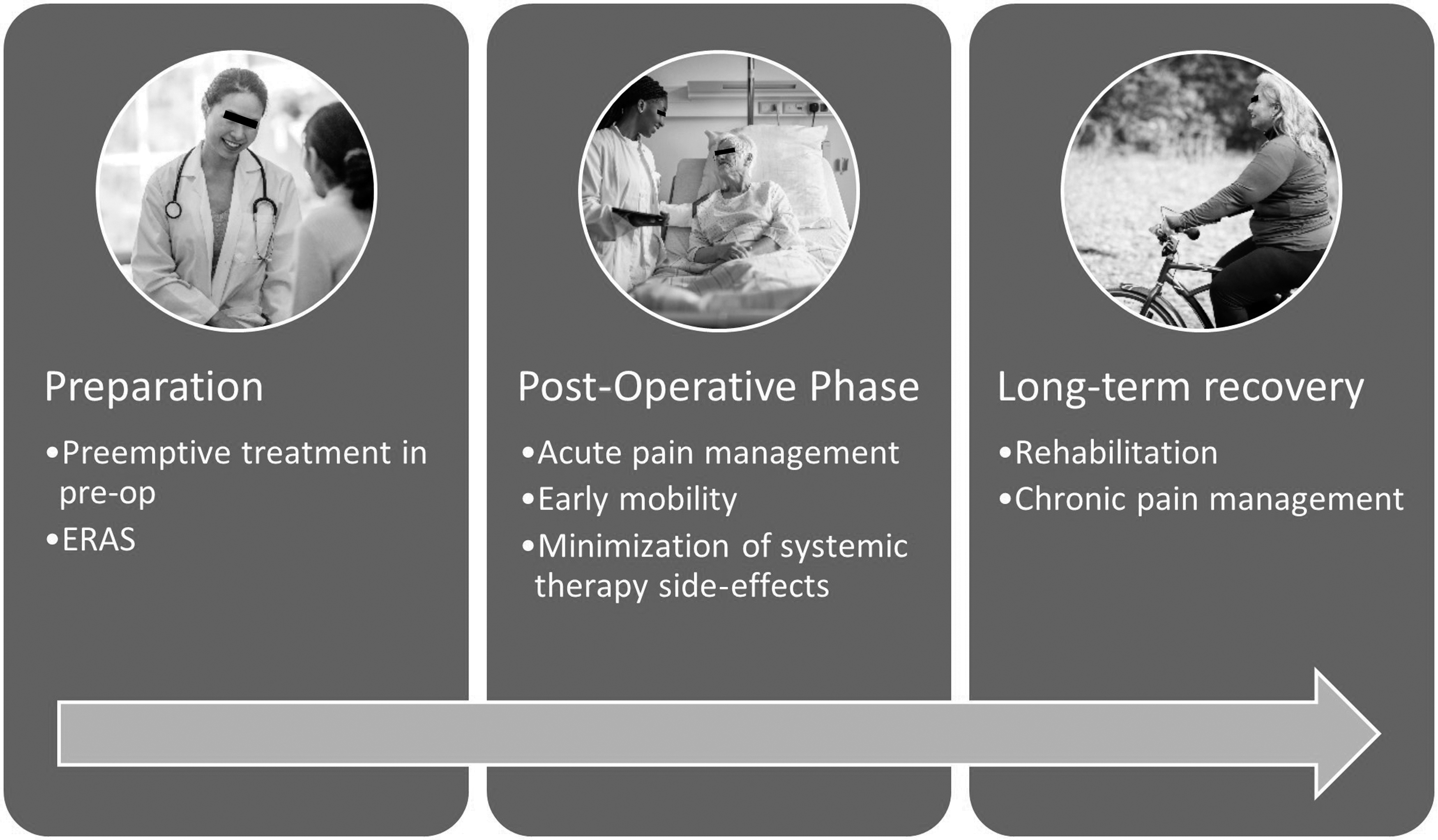
Phases of perioperative care and pain control. pre-op, pre-operation; ERAS, Enhanced Recovery After Surgery.
An ideal pain-management plan uses multiple modalities of analgesics, targeting pain relief from the distal nerve endings to the pain-processing center in the brain (see Table 1). The benefits of systemic anti-inflammatory agents targeting the pain signal's transduction have been well-demonstrated and widely accepted as part of ERAS protocols. Successful blockade of pain signals through the peripheral and central nervous system hinges on selecting an appropriate target location and the extent of surgical manipulation.
Postoperative pain management should reduce or eliminate the need for opioids with minimal interference with mobilization, enteral intake, and other avenues of enhanced recovery. While no regional-block technique is superior for patients undergoing all types of gynecologic surgery, it is recommended that regional anesthesia should be offered to provide effective acute postsurgical pain relief. Pain management is an interdisciplinary effort in which the collaborating teams select specific modalities to maximize benefits and minimize side-effects specific to the patients and types of surgery.
Footnotes
Acknowledgments
The authors thank Gerard Hebert, MA, for editorial assistance through the Moffitt Cancer Center's Office of Scientific Publishing.
Authors' Contributions
Dr. Jones conceptualized and visualized the study, conducted a literature review with Ms. Quach and Dr. Tanios, and curated the data. All of the authors participated in the writing and editing of the original draft of this article. Dr. Jones worked on manuscript revisions.
Author Disclosure Statement
No financial conflicts of interest exist.
Funding Information
There was no funding for this research and writing.