




Abstract
Abstract
Chen, Chung-Yu, Chien-Wen Hou, Jeffrey R. Bernard, Chiu-Chou Chen, Ta-Cheng Hung, Lu-Ling Cheng, Yi-Hung Liao, and Chia-Hua Kuo. Rhodiola crenulata- and Cordyceps sinensis-based supplement boosts aerobic exercise performance after short-term high altitude training. High Alt Med Biol 15:371–379, 2014.—High altitude training is a widely used strategy for improving aerobic exercise performance. Both Rhodiola crenulata (R) and Cordyceps sinensis (C) supplements have been reported to improve exercise performance. However, it is not clear whether the provision of R and C during high altitude training could further enhance aerobic endurance capacity. In this study, we examined the effect of R and C based supplementation on aerobic exercise capacity following 2-week high altitude training. Alterations to autonomic nervous system activity, circulatory hormonal, and hematological profiles were investigated. Eighteen male subjects were divided into two groups: Placebo (n=9) and R/C supplementation (RC, n=9). Both groups received either RC (R: 1400 mg+C: 600 mg per day) or the placebo during a 2-week training period at an altitude of 2200 m. After 2 weeks of altitude training, compared with Placebo group, the exhaustive run time was markedly longer (Placebo: +2.2% vs. RC: +5.7%; p<0.05) and the decline of parasympathetic (PNS) activity was significantly prevented in RC group (Placebo: −51% vs. RC: −41%; p<0.05). Red blood cell, hematocrit, and hemoglobin levels were elevated in both groups to a comparable extent after high altitude training (p<0.05), whereas the erythropoietin (EPO) level remained higher in the Placebo group (∼48% above RC values; p<0.05). The provision of an RC supplement during altitude training provides greater training benefits in improving aerobic performance. This beneficial effect of RC treatment may result from better maintenance of PNS activity and accelerated physiological adaptations during high altitude training.
Introduction
H
At present, it is known that hypoxia is the major environmental factor associated with improved endurance performance following high altitude training (Katayama et al., 2003; Bonetti and Hopkins, 2009). Thus, the literature supports the fact that high altitude training modulates the autonomic nervous system and increases erythropoietin (EPO) level, red blood cell (RBC) content, hemoglobin (Hb) content, and maximal oxygen uptake (V
Rhodiola crenulata and Cordyceps sinensis are widely grown at high altitudes (∼3500–5000 meters) in plateau and mountainous areas. Both plants are popular in traditional medicine in Europe and Asia, with functions of anti-fatigue, anti-stress, improved work performance, and the prevention of mountain sickness (Mei et al., 1989; Chen and Li, 1993; Kuo et al., 1994). Recently, Rhodiola has often been used as an ergogenic aid to enhance endurance exercise performance and antioxidant capacity (De Bock et al., 2004; De Sanctis et al., 2004; Parisi et al., 2010). An earlier study showed that long-term Rhodiola rosea (50 mg/kg) and Rhodiola crenulata (50 mg/kg) root extract supplement could significantly increase endurance exercise performance and prevent the occurrence of fatigue in rats (Abidov et al., 2003). Additionally, 4-week Rhodiola rosea extract treatment has been reported to promote exhaustive swimming tolerance (Lee et al., 2009), suggesting that Rhodiola supplement could be used as an effective strategy to elevate exercise performance.
Similar to Rhodiola supplements, Cordyceps sinensis supplement has been shown to stimulate vessel dilation, possibly by stimulating the release of nitric oxide, and increasing the efficiency of tissue oxygen utilization, lending to its potential to enhance endurance exercise performance (Chiou et al., 2000). However, there are only a few investigations documenting the effects of Cordyceps sinensis supplement on improving endurance exercise performance (Li et al., 1993; Koh et al., 2003). Li and colleagues found those 5 days of Cordyceps sinensis supplementation (100–150 mg/kg) significantly increased blood hemoglobin concentration, thereby improving tissue oxygenation and endurance exercise performance (Li et al., 1993). In addition, provision of Cordyceps sinensis supplement (150 and 300 mg/kg/day) for 8 days markedly prolonged the swimming endurance capacity of mice by ∼33% compared with controls, suggesting the ergogenic effects of Cordyceps sinensis on endurance exercise performance (Koh et al., 2003). According to the ergogenic effects of Rhodiola crenulata and Cordyceps sinensis, the benefits on endurance training adaptation might be greater if these two herbs are combined. However, it is not well understood whether the combination of these two herbs can promote exercise adaptation, particularly in human performing altitude training.
Taken together, altitude training, Rhodiola crenulata, and Cordyceps sinensis appear to enhance endurance exercise performance through distinct routes. Therefore, it is possible that combining altitude training with Rhodiola crenulata and Cordyceps sinensis supplementation could further promote aerobic capacity in athletes. However, whether altitude training with Rhodiola crenulata (R) and Cordyceps sinensis (C) supplement produces an improvement in endurance exercise capacity in athletes is currently unknown. In an effort to explain the benefits of a novel supplement consisting of R and C on aerobic performance, we investigated the effect of altitude training plus a novel R/C supplement on aerobic exercise capacity. Additionally, we also examined the alterations of autonomic nervous system activity, circulatory hormonal, and hematological profiles.
Methods
Subjects
Eighteen male long-distance track and field athletes (19.66±0.18 years) voluntarily participated in this study. Subjects were matched by their maximal oxygen consumption, and divided into two groups: Placebo (Placebo group, 19.78±0.32 years, 177.21±2.41 cm; 67.99±3.44 kg, 58.31±2.84 mL/kg/min, n=9) and Rhodiola crenulata plus Cordyceps sinensis (RC group, 19.56±0.17 y, 176.80±2.41 cm; 67.01±3.11 kg, 60.59±2.72 mL/kg/min, n=9). All participants were instructed to maintain their normal daily routine activities and to refrain from using any supplements (3 months prior to and during the experimental period). Subjects completed a health screening questionnaire and were provided a written informed consent after a thorough explanation of the procedure. This study was approved by the Institutional Review Board of the Taipei Physical Education College (IRB of TPEC, Taipei City, Taiwan).
Study and experimental design
A double-blind and placebo-controlled experimental design was used in the current investigation. The study consisted of two main sections: 1) All data collection at sea level at pre- and post-altitude training; and 2) a 2-week altitude training period at 2200 m altitude (Fig. 1). After an overnight fast, a venous blood sample was collected and automatic nervous activity, maximal oxygen consumption, and aerobic capacity were measured for both pre- and post 2-week altitude training values. In addition, post-altitude training blood sample collection and physical performance measurements were both performed at sea level within 2 days after the completion of altitude training. The blood samples were used to determine hormonal responses (i.e., testosterone, EPO, and cortisol) and hematological profiles (i.e., erythrocyte, hematocrit, hemoglobin, and leukocyte). Subjects consumed either Rhodiola crenulata plus Cordyceps sinensis supplement (RC: 1000 mg in capsule with breakfast at 0730 and 1000 mg in capsule with dinner at 1730; TCM Biotechnology International Corp, Taipei City, Taiwan) or a starch placebo (1000 mg starch capsule, twice daily at the same time as RC group; Taiwan Sugar Corporation, Tainan City, Taiwan) during the entire 2-week altitude training period.
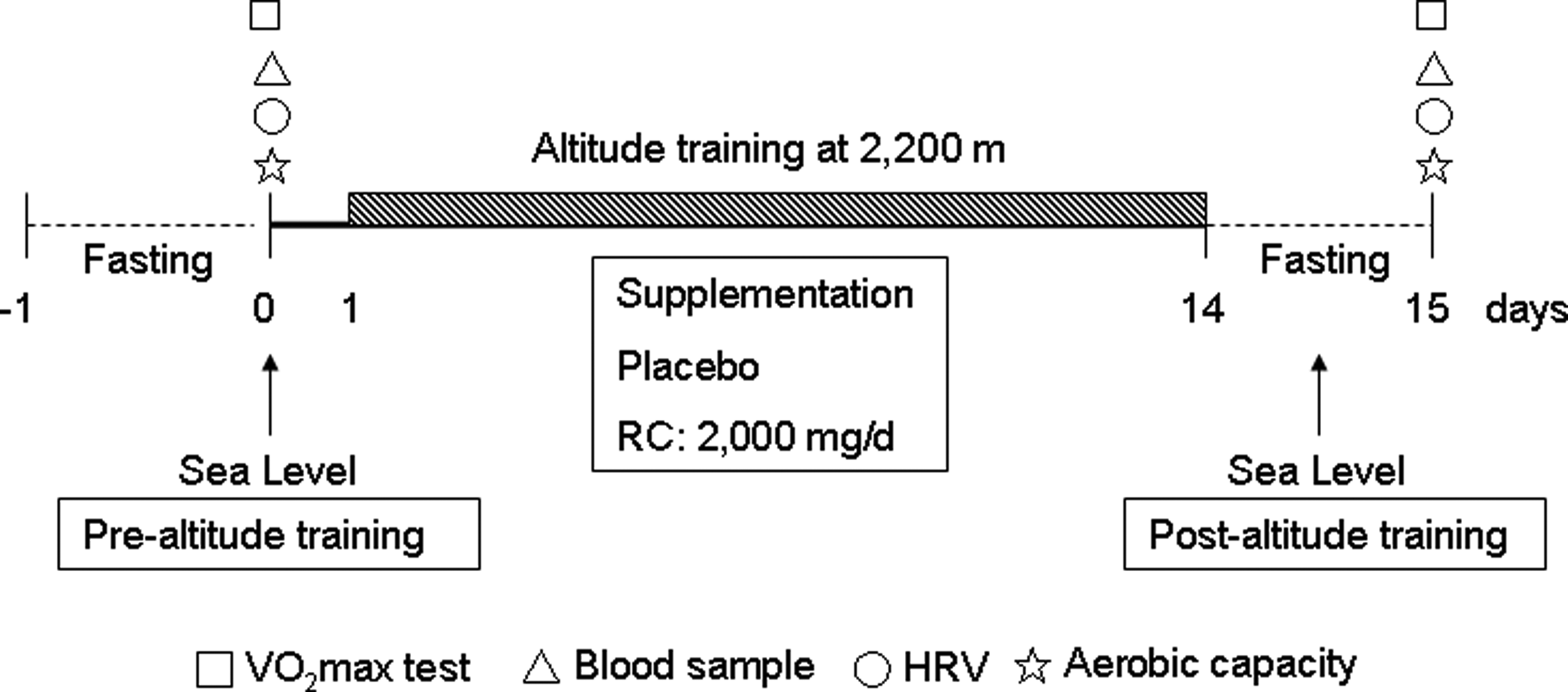
Time line of study design.
Exercise training program at high altitude
The 2-week high altitude exercise training program consisted of 10 km mountain running (duration: 3 hours, frequency: 2 times/week), fartlek training (duration: 60 min, frequency: 3 times/week), speed training (up/down hill sprint; duration: 60 min, frequency: 2 times/week), high intensity interval training (shuttle running; duration: 60 min, frequency: 2 times/week), basic running skill practice (duration: 30 min, frequency: 6 times/week), weight training (loaded up/down stairs abdominal curls, squat and squat jump with load; loading intensity: 10–15% body weight; exercise time: between 3–5 PM, frequency: 2 times/week), and ball activity (basketball playing; duration: 60 min, frequency: 4 times/week). All the training procedures were monitored by professional personal trainers and coaches to ensure the quality and consistence of training.
Chemical analysis of supplement containing Rhodiola/Cordyceps
Chromatographic fingerprints of the Rhodiola/Cordyceps containing supplement and detection of salidroside, the major functional ingredient of Rhodiola crenulata, were analyzed using high-performance liquid chromatography (HPLC). The HPLC system (Jasco International Co., Ltd., Tokyo, Japan) consists of a Model PU-2089 pump, Model MD-2015 photodiode array detector and Model AS-2055 autosampler. The separation column employed was Cosmosil 5C18-AR-II HPLC column (4.6 * 250 mm) and 5 μm particle size (Nacalai Tesque, Inc., Kyoto, Japan). The standard pure salidroside was obtained from Extrasynthese (Extrasynthese Inc., Genay Cedex, France); reagents and chemicals used in HPLC measurements were all in HPLC grade (Sigma-Aldrich, St. Louis, MO, USA). The wavelength for detecting salidroside was set at 223 nm. The result of chromatographic fingerprints of the Rhodiola/Cordyceps-containing supplement (salidroside) is shown in Figure 2.
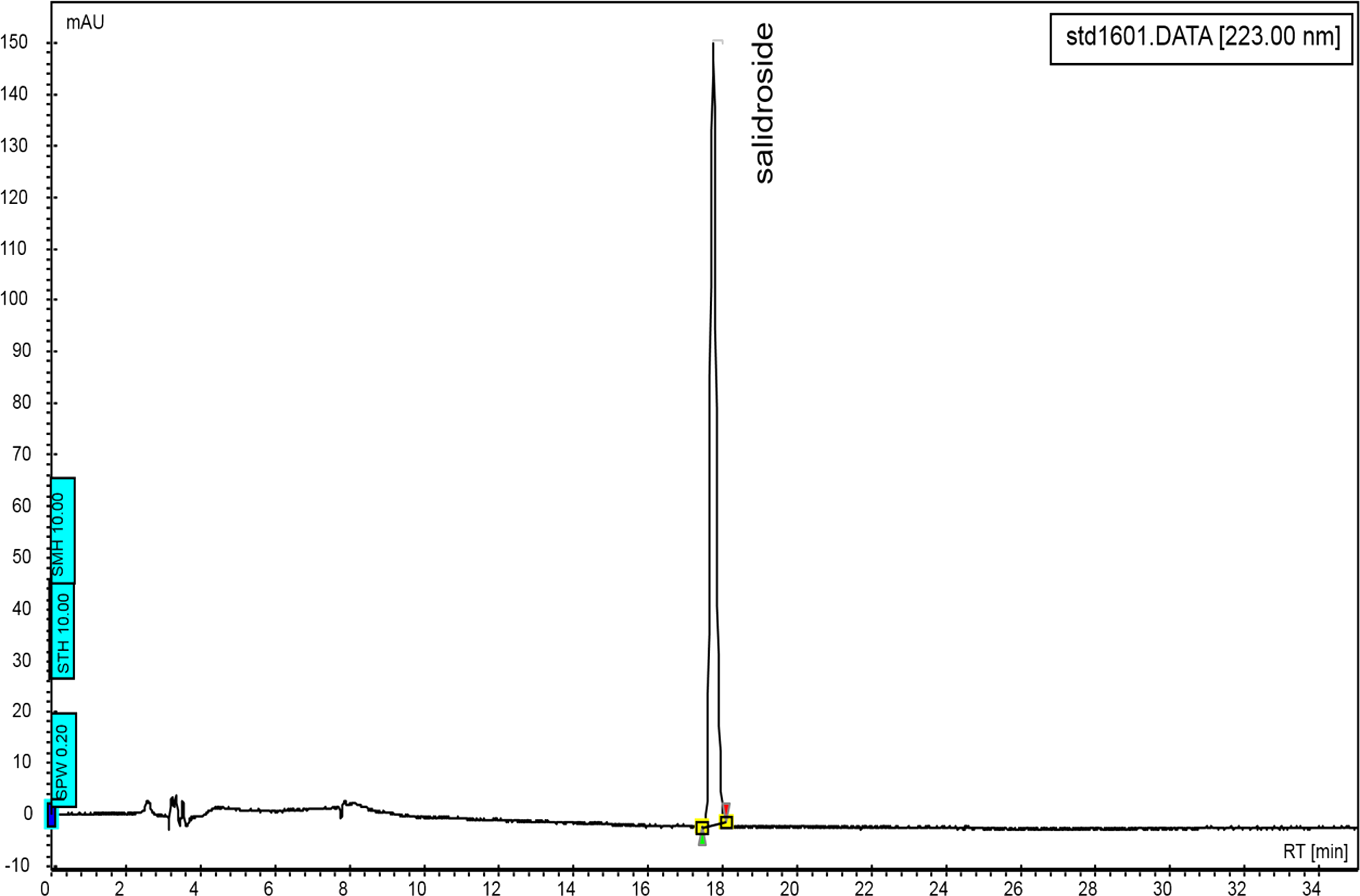
Chromatogram of a supplement containing Rhodiola crenulata and Cordyceps sinensis analyzed by HPLC. Column: Cosmosil 5C18-AR-II HPLC column (4.6 * 250 mm) and 5 μm particle size. Detection wavelength: 223 nm.
Assessment of autonomic nervous activity
The assessment of automatic nervous activity was measured through detecting resting heart rate variability (HRV) by Autonomic Nervous System Analyzer (TTDC Inc., Taiwan). The resting HRV was measured in a quiet, dim lighting environment with temperature controlled at 23±2°C to minimize external influences on participant HRV. After 5-minute resting in a sitting position, the subjects underwent 5 minutes of HRV measurement. The high frequency (HF) value obtained in HRV measurement represents the parasympathetic activity, while the low frequency/high frequency ratio (LF/HF ratio) represents the sympathetic autonomic nervous system activity.
Maximum oxygen consumption (Vo 2max) and running time to exhaustion
Maximum oxygen consumption (V
The Bruce incremental load method was also used to determine run time to exhaustion using a motor-drive treadmill (Johnson, Taichung, Taiwan). Run time to exhaustion was recorded as the time from when the subject started to run until he placed his hand back on the handrails of the treadmill or he was unable to perform at the level of load. When the subjects were running on the treadmill, research staff verbally encouraged the subjects for their best efforts. For both measurements of aerobic exercise capacity, at the end of each trial, the treadmill speed was immediately reduced to a recovery speed (4 km/h) until subject's heart rate lowered to less than 100 beats per minute.
Testosterone, erythropoietin (EPO), and cortisol
Before the pre-altitude training period and after the altitude training period, fasting venous blood samples (5 mL) were collected at 0700 and used to determine the serum levels of testosterone, EPO, and cortisol. After sample collection, all blood samples were centrifuged at 3500 rpm for 10 min (4°C) to obtain serum samples, and the serum samples were then kept at −80°C until analyzed. Testosterone and cortisol concentrations were measured using commercially available enzyme-linked immunosorbent assay (ELISA) kits (Diagnostic Systems Laboratories Inc., Webster, TX, USA), and serum EPO levels were determined using an EPO ELISA kit (eBioscience, Centennial, CO, USA) in accordance with manufacturers' instructions. All the ELISA hormonal assays were performed on the TECAN Genios microplate reader (Salzburg, Austria) and the visual light signals (optical density) were detected to represent the amount of hormones within the serum samples.
Hematology analysis
Fasting venous whole blood samples (1 mL) were collected to analyze hematological profiles (i.e., red blood cells, white blood cells, hematocrit, and hemoglobin) using an automated hematology analyzer (Sysmex KX-21N, Sysmex, Singapore) according to manufacturer's instruction.
Statistical analysis
All the data were analyzed using SPSS 10.0 software (SPSS, Chicago, IL). Normality of the subjects was tested using the Kolmogorov-Smirnov method. The characteristics, hormonal, automatic nervous activity, aerobic capacity, and hematological profiles of subjects from both experimental groups (RC and Placebo groups) were compared using an independent unpaired t-test. In addition, the paired t-test was used to compare the difference between pre-altitude training and post-altitude training within the same experimental group. All the values were displayed as mean±standard error (Mean±S.E.), and a statistical level of p<0.05 was set for significant difference for all measurements in this study.
Results
Heart rate variability (HRV)
The values of LF/HF and HF and percentage change of these values between pre- and post-altitude training are shown in Table 1. In comparison with pre-altitude training, the resting LF/HF ratio for both Placebo and RC groups were significantly higher at post-altitude training. In addition, in comparison with the RC group, although the LF/HF ratio showed a trend toward a greater increase in the Placebo group, there were no significant differences between both treatments. After 2-weeks altitude training, the significant decline of HF values was found in both Placebo and RC groups. However, we also observed the decline of HF percentage change in RC group was significantly less than that in the Placebo group, representing a greater parasympathetic activity in the RC group.
Values are expressed as mean±SE. HF represents parasympathetic activity; LF/HF represents sympathetic activity, †denotes significant difference between at pre-altitude training and post-altitude training (p<0.05). *Significant difference between Placebo group and RC group after high altitude training (p<0.05).
Run time to exhaustion and maximum oxygen consumption
Table 2 shows the run time to exhaustion using the Bruce incremental load protocol. There were no differences in run time to exhaustion at pre-altitude training between both experiment groups. Here we observed that the run time to exhaustion was significantly prolonged after the 2-week altitude training in the RC group but not in the Placebo group. Furthermore, in comparison with pre-altitude training, the run time to exhaustion was significantly longer in RC group (+5.65%) than in the Placebo group (+2.20%) in the end of altitude training. The results of the maximal oxygen consumption are also shown in Table 2. There were no differences in V
Values are expressed as mean±SE. †denotes significant difference between pre-altitude training and post-altitude training (p<0.05). *Significant difference between Placebo group and RC group (p<0.05).
Hematological profiles
Table 3 shows the hematological profiles for both Placebo and RC groups at pre and post altitude training. As expected, the value of red blood cells (RBC), hematocrit (Ht), and hemoglobin (Hb) were all elevated after 2-week altitude training in both groups; however, these values were not significantly different between Placebo and RC groups.
Values are expressed as mean±SE. †Significant difference between pre-altitude training and post-altitude training (p<0.05).
Hormonal responses to treatments
Serum levels of testosterone, cortisol, and EPO for the two treatment groups are illustrated in Table 4 and Figure 3. There were no differences in serum testosterone, cortisol, and EPO levels at pre-altitude training between both treatment groups. Additionally, there were no effects on serum testosterone and cortisol levels in Placebo and RC groups following 2-week altitude training. However, after 2-week altitude training, only the Placebo group showed an significant increase in serum EPO level above pre-altitude training by approximately ∼48%, whereas there was no difference in the RC group.

Serum EPO concentration at pre and post-altitude training. Values are expressed as mean±SE. †Significant difference between pre and post-altitude training in P group (p<0.05). *Significant difference between Placebo group and RC group at post-altitude training (p<0.05).
Values are expressed as mean±SE.
Discussion
High altitude training and herbal supplements have both been used as ergogenic aids to promote endurance exercise performance (Basset et al., 2006). However, it is not completely understood whether the combination of altitude training and supplementation with Rhodiola plus Cordyceps could further enhance endurance exercise performance. The primary finding from our study is that provision of a novel Rhodiola/Cordyceps (RC) supplement significantly prolonged exhaustive run time after altitude training compared to the subjects taking placebo. Moreover, we also observed that RC treatment was able to attenuate the decline of parasympathetic activity during high altitude training. Meanwhile, the altitude training-stimulated EPO secretion was significantly less in the RC group than the Placebo group, whereas the increases in RBC and hematocrit were not different between groups. Our result therefore confirms previous findings that a supplement consisting of Rhodiola/Cordyceps improves aerobic exercise capacity, and further provides the evidence to support the idea that the anti-stress actions of a novel Rhodiola/Cordyceps supplement may lead the beneficial effects of high altitude training towards to the improvement in endurance exercise performance.
A key finding of this study was that the RC supplement was capable of prolonging exhaustive run time after 2-week high altitude training (Placebo: +2.2% vs. RC: +5.7% above pre-altitude training; see Table 2). Rhodiola (Abidov et al., 2003; De Bock et al., 2004; Lee et al., 2009; Zhang et al., 2009; Parisi et al., 2010) and Cordyceps (Li et al., 1993; Chiou et al., 2000; Koh et al., 2003) supplements have been documented to enhance endurance exercise capacity, blood oxygen carrying capability, and/or antioxidant capacity. To date, the underlying mechanisms for the benefits of RC supplement on aerobic exercise capacity during high altitude training are not fully understood. Zhang and colleagues (2009), investigating the effects of Rhodiola supplement during endurance training at sea level, reported that this herbal supplement resulted in an improvement in endurance performance by increasing oxygen consumption. However, in this study, there were no differences in V
Although we found that total RBC and hemoglobin were unchanged between treatments after altitude training, we still cannot rule out the possible roles of hemoglobin function and mitochondrial respiratory activity in the improved endurance performance by RC supplement. The phenomenon of oxidative stress by hypoxic exposure in RBC has been described by Devi et al. (2007) and Vani et al. (2010). Devi et al. (2007) exposed Wistar rats to the altitude of 5700–6300 m to examine the effects of hypoxia on oxidative stress in erythrocytes. These investigators reported that osmotic fragility, hemolysis, and lipid peroxidation increased in erythrocytes following intermittent hypobaric-hypoxic exposure (Devi et al., 2007), suggesting that low ambient oxygen induces oxidative stress in erythrocytes and might subsequently impair hemoglobin oxygen-carrying capacity. Interestingly, one recent in vitro study revealed that salidroside, an aqueous glycoside extract of Rhodiola, can enhance the ability of hemoglobin to carry oxygen, particularly under extremely low oxygen environment (Yang et al., 2007). Because Rhodiola are also well known for its antioxidant capacity against oxidative stress (Huang et al., 2009; Qu et al., 2012), these findings help to explain why consuming RC supplements during altitude training would further improve exhaustive run time without changing total RBC and oxygen consumption. Altogether, we therefore speculate that the RC supplementation might, to some extent, enhance hemoglobin oxygen-carrying capacity by suppressing oxidative stress, thereby prolonging exhaustive run time. However, to test this hypothesis, more measurements (e.g., blood oxygen level, hemoglobin-oxygen dissociation, or oxidative stress) are warranted to determine the effect of RC supplement on oxygen-carrying capacity in future study.
Another possibility for the improved exhaustive run time could be due to alterations of autonomic nerve activity in response to the administration of RC supplement during activity at high altitude. It has been recently well recognized that the regulation of the autonomic nervous system is tightly influenced by changes in physiological stress (Yamamoto et al., 1996) and external environments (Yamamoto et al., 1996; Hirayanagi et al., 2003). Furthermore, there are strong associations between the regulation of autonomic nervous system activity and exercise performance, particularly the regulation of PNS activity (Hautala et al., 2003; Boullosa et al., 2009). For example, Boullosa and co-workers, investigating the relationship between parasympathetic modulation parameters and endurance running performance, reported that higher PNS activity was associated with running performance in long distance runners (Boullosa et al., 2009). This finding thus implies the possibility that maintaining PNS activity at higher level might result in greater endurance exercise performance. Assuming that this is the case, here we also observed that, compared with placebo group, a novel RC supplement was able to markedly prevent the decline in PNS activity in response to altitude training (P: −51% vs. RC: −41%; see Table 1), suggesting that maintaining PNS activity was associated with prolonged exhaustive run time. Additionally, Rhodiola has been reported to attenuate symptoms of mountain sickness and improve adaptations against several environmental challenges such as activity at high altitude (Kelly, 2001). Together with existing evidence (Kelly, 2001; Hautala et al., 2003; Boullosa et al., 2009), our current finding thus suggests that the protective effects of this RC supplement on the decline of PNS activity and improved aerobic exercise performance might be due to the anti-stress capacity of Rhodiola during activity at high altitude. However, additional research is still encouraged to evaluate whether Cordyceps could strengthen the anti-stress effect of Rhodiola on autonomic nerve regulation during activity at high altitude.
Erythropoiesis is highly regulated by the presence of circulating EPO (Fisher, 2003). The decline of ambient oxygen leading to tissue hypoxia, and this extreme physiological stress activates hypoxia-inducible factor 2 (HIF-2) and induces rapid EPO release from kidney (Wang and Semenza, 1996; Wojchowski et al., 2006; Socolovsky, 2007; Yeo et al., 2008; Castrop & Kurtz, 2010; Kapitsinou et al., 2010), indicating that high endogenous EPO level could serve as a stress indicator at altitude. Furthermore, previous studies have demonstrated that circulatory EPO level could markedly increase under physiological stress, such as performing exercise training at altitude of 1500–3000 m (Klausen et al., 1991; Chapman et al., 1998; Wolfarth, 2005; Gore et al., 2013). Similarly, here we also observed that serum EPO concentrations in subjects taking placebo was rapidly elevated and still remained at high levels when subjects returned to sea level after altitude training (∼48% above pre-altitude training).
In all probability, the most critical adaptive response for stimulating erythropoiesis during altitude training is an increase in circulating EPO level (Klausen et al., 1991; Chapman et al., 1998; Wolfarth, 2005; Gore et al., 2013). Interestingly, we observed that the endogenous EPO levels in the subjects taking RC supplement was approximately ∼30% lower than that in the subjects with placebo (Fig. 3). Our findings thus raise an intriguing question why the RC supplement decreased circulating EPO level but not total RBC and hemoglobin following 2-week altitude training. Because both Rhodiola and Cordyceps are commonly used in traditional medicine to increase body resistance to mountain sickness (Saggu et al., 2009), it is tempting to speculate that the physiological stresses from altitude training were attenuated by this RC supplement. Kojima et al. (2007) demonstrated the protective role of HIF-2α against ischemia-induced oxidative stress in the kidney; in addition, EPO is capable of inducing expression of heme oxygenase-1 (HO-1) to provide cytoprotection against oxidative stress (Katavetin et al., 2007). These studies suggest the essential role of HIF-2α/EPO/HO-1 in coping with increasing oxidative stress in RBC during hypoxia. This would be in line with observations by Schmidt et al. (1993) that no differences in plasma EPO levels were observed between the high-altitude natives (Bolivian Plateau at 3600 m) and the sea-level residents, indicating that high-altitude natives with greater coping capacity against altitude stress may decrease the demand of circulating EPO. Accordingly, in this study, provision of RC supplement is likely to accelerate adaption and successively attenuate accumulation of oxidative stress during altitude training, and this might subsequently decrease the demand of endogenous EPO production. Furthermore, the effect of RC supplement against PNS activity decline might be also reflected on the decreasing EPO need after altitude training, but more studies are needed to elucidate underlying mechanisms for the possible anti-stress effects of RC supplement.
The current study also provided additional information on anabolic/catabolic hormone responses to this Rhodiola and Cordyceps based supplement and exercise training at high altitude. Our finding that RC supplement had no further effects on circulating testosterone and cortisol levels during high altitude training extends the previous findings by Hsu et al. (2011). These investigators reported that Cordyceps sinensis supplement has no effects on testosterone level and muscle strength in healthy young adults during resistance training (Hsu et al., 2011). Together with previous evidence and our recent findings, we demonstrate that RC supplementation is unable to produce a preferable anabolic environment during activity at high altitude. However, future studies are still warranted to develop appropriate anabolic agents for activity at high altitude, which may help athletes to obtain better training benefits.
Traditionally, the recommended duration of altitude training is about 3–4 week blocks (Rusko et al., 2003; Wilber et al., 2007). However, in this study, we only performed 2-week altitude training at 2200 m altitude (moderate altitude) due to subjects' busy training and competition schedule. Although the altitude training in the present investigation was slightly shorter than recommended length of stay at altitude, a more recent meta-analysis study conducted by Gore et al. (2013), analyzing raw data from 17 studies, revealed that a 2-week (336 hrs) classic altitude stay may be sufficient to increase hemoglobin mass by ∼4% for most athletes. This evidence is also further supported by our finding that 2-week altitude exercise training was effective to increase hemoglobin level in subjects taking both RC and placebo treatments.
One primary limitation of this current investigation is the small sample size due to the limited number of the population. The reason for the small number of subjects participated was that we only would like to recruit elite college track-and-field athletes to ensure our experimental control and quality. We herein applied the optimal study design with placebo-control and double-blind intervention to minimize the potential error in this trial, although we still cannot completely exclude the possibility of type II errors in test precision due to the small sample size. Therefore, future study with a large number of subjects would be required to define the precise role of this RC supplement in promoting endurance performance during high altitude training.
Practical applications
Appropriate ergogenic aid or supplementation is important for enhancing the training adaption after strenuous exercise training at high altitude. The present study provides the evidence that consuming supplements containing Rhodiola and Cordyceps, two herbal supplements traditionally used in Chinese medicine, during high altitude training can prolonged exhaustive run time at sea level in elite track-and-field athletes. This is a significant finding for endurance athletes who must perform exercise training at high altitude and compete afterward at sea level. Therefore, consuming supplement consisting of Rhodiola and Cordyceps would be considered as a practical strategy for both professional and recreational athletes to improve endurance performance during altitude training.
Conclusions
Provision of a novel Rhodiola/Cordyceps supplement significantly prolonged exhaustive running time after 2-week high altitude training. In addition, after altitude training, Rhodiola/Cordyceps treatment was able to attenuate the decline of parasympathetic activity and lowered endogenous EPO production in comparison with placebo. We also found that erythropoiesis, hemoglobin levels, and maximum oxygen consumption were similar in both experimental groups after altitude training. The beneficial effects of a Rhodiola/Cordyceps supplement on aerobic capacity might be a result of the improved systemic coping capacity through maintaining PNS activity and produced anti-stress actions, thereby accelerating the development of adaptations during exercise training at high altitude.
Footnotes
Acknowledgments
We appreciate our lab members' excellent assistance and all the subjects participating in this study.
Author Disclosure Statement
The authors declare no conflicting financial interests. This work was partly supported by the National Science Council, Taiwan, ROC Grant number NSC102-2410-H-227-001-MY2 and NSC102-2410-H-154-005-MY2.