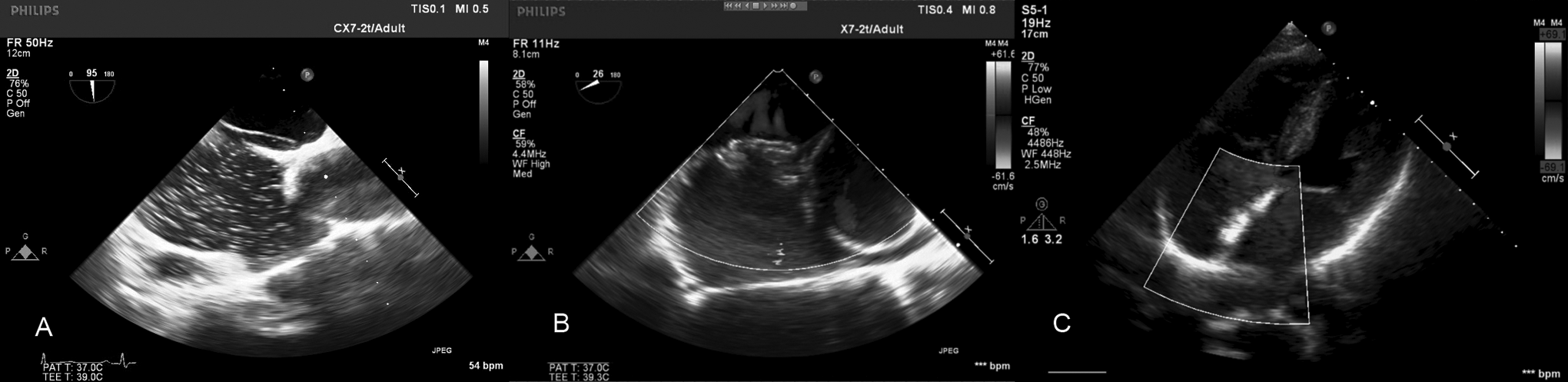
We would like to report the case of a 41-year-old, physically active male who was screened in our clinic before an expedition to climb Broad Peak (8051 m). He had a history of cryptogenic stroke at the age of 25 and had on several occasions surpassed an altitude of more than 6000 m without any neurological events. Before his most recent expedition, a standard transthoracic echocardiogram (TTE) was performed and the procedure revealed a possibility of patent foramen ovale (PFO). The diagnosis was confirmed with transesophageal echocardiography (TEE) with injected agitated saline and a Valsalva maneuver (Fig. 1A). The contrast transcranial Doppler ultrasound (c-TCD) revealed a third degree right to left shunt. It was defined as a large amount of air bubbles of injected agitated saline detected in the middle cerebral artery after the Valsalva maneuver. The alpinist did not consent to a percutaneous closure of the PFO before the expedition and decided to take part in it while being administered a 75 mg dose of aspirin once a day. While climbing just more than 6000 m, the patient suffered from a transient ischemic attack (TIA). His symptoms of headache, blurred vision, and right upper limb paresthesia resolved after rehydration, descent to a lower altitude, and rest. After his return home, he decided to undergo the percutaneous PFO closure procedure with a good periprocedural effect (Fig. 1B). Subsequently 75 mg of clopidogrel and 150 mg of aspirin were prescribed. In the following 6 months, no ischemic events occurred and a TTE revealed complete PFO closure and no device thrombus or device embolization (Fig. 1C). In addition, on c-TCD examination no residual shunt was detected. He was prescribed aspirin at a dosage of 75 mg/day thereafter and clopidogrel was discontinued.
Transesopheageal bubble echocardiography, incomplete fusion of the septum primum and septum secundum in addition to right to left shunting confirming PFO presence (A). Transesophageal echocardiography immediately after percutaneous PFO closure procedure using the Hyperion™ PFO Occlude (Comed B.V., Bolsward, The Netherlands). No residual color flow across the defect with the device in place (B). Transthoracic echocardiography in 3 months follow-up after PFO closure procedure using the Hyperion PFO Occlude (Comed B.V., Bolsward, The Netherlands). No residual color flow across the defect with the device in place (C). PFO, patent foramen ovale.
PFO is estimated to occur in one-third of the general population (Hagen et al., 1984; Allemann et al., 2006). It has been recognized as a potential cause of cerebral vascular events such as stroke or TIA (Webster et al., 1988; Murdoch, 2015). The mild focal neurological events were reported while living at high altitude of 3840 m (Murdoch, 2015). We recommend that individuals mountaineering regularly should be investigated for the presence of a PFO, and if found then a TEE or c-TCD should be applied. However, even if an intracardiac shunt is not demonstrated at low altitude, it must be realized that one may develop it during exercise at high altitudes as a result of increased pulmonary artery pressure, causing a PFO to open (Allemann et al., 2006; Imray et al., 2008). If a concern still persists, then echocardiography performed under hypoxic conditions (e.g., hypobaric chamber or with inhalation of hypoxic gas mixture) could be considered.
In conclusion, to prevent the recurrence of embolic episodes, individuals with a PFO should avoid exposure to high altitudes. Otherwise, to minimize the risk, alpinists who decide to proceed to high altitudes should intake aspirin and take care to maintain adequate hydration during the ascent. In the case of alpinists with confirmed PFO and a history of cryptogenic neurological events, a percutaneous closure in an experienced center may be considered. To evaluate whether this concept is safe and be widely recommended, further research is clearly needed on this important issue.
References
1.
AllemannY, HuttlerD, LippE, SartoriC, DuplainH, EgliM, CookS, ScherrerU, and SeilerC. (2006). Patent foramen ovale and high-altitude pulmonary edema. JAMA, 296:2954–2958.
2.
HagenPT, ScholzDG, and EdwardsWD. (1984). Incidence and size of patent foramen ovale during the first 10 decades of life: an autopsy study of 965 normal hearts. Mayo Clin Proc, 59:17–20.
3.
ImrayCH, PattinsonKT, MyersS, ChanCW, HoarH, BreareyS, CollinsP, and WrightAD. (2008). Intrapulmonary and Intracardiac Shunting With Exercise at Altitude. Wilderness Environ Med, 19:199–204.
4.
MurdochMR. (2015). Revisiting the Cause of Focal Neurological Deficits and Profound Dyspnea at High Altitude—The Potential Role of Patent Foramen Ovale. High Alt Med Biol, 16(4):350–351.
5.
WebsterMW, ChancellorAM, SmithHJ, SwiftDL, SharpeDN, BassNM, and GlasgowGL. (1988). Patent foramen ovale in young stroke patients. Lancet, 2:11–12.