




Abstract

V
During the past decades, the prolonged stay at high altitude has been associated as a risk factor with thrombotic events, a phenomenon explained by the increased erythroid mass, and higher erythropoietin levels (Damodar et al., 2018; Kumar, 2006).
Considering that Ecuador is a country crossed by the Andean mountains, the objective of this study is to compare the mortality rate of pulmonary embolism (PE) in the elderly Ecuadorian population living at the Andean altitude with the group of patients residing in the low altitude.
We performed a cross-sectional study based on the reporting of PE mortality rates in the elderly population residing in the Andean altitude and the low altitude of Ecuador, and analyzed its difference between regions.
Data were extracted from 2014 to 2019 databases “Statistical Records of Live Births, Fetal Deaths, and General Deaths” [Registros Estadísticos de Nacidos Vivos, Defunciones Fetales y Defunciones Generales] created by the Ecuadorian National Statistics and Census Institute [Instituto Nacional de Estadísticas y Censos del Ecuador, INEC] (https://www.ecuadorencifras.gob.ec/defunciones-generales-2019), published and available at the website of the institution. The cases selected were patients ≥60 years, and were classified by its province of residence in the Andean altitude or low altitude groups.
To calculate the mortality rate, we used the following equation:
From 2014 to 2019, 563 deaths by PE were reported in people aged ≥60 years. The groups more affected were women 288 (51.15%) and people age between 76 and 85 years (39.43%). The year with the highest number of deaths was 2019, with 152 (27.00%), and the year with the lowest number of deaths was 2015 with 81 cases (14.29%).
The mortality in the high altitude had a nonsignificant (p > 0.05) increasing trend from 2014 (7.13 deaths/100,000 inhabitants) to 2019 (10.06 deaths/100,000 inhabitants). Regarding the low altitude, the mortality had a reduced variation from 2014 (6.30 deaths/100,000 inhabitants) to 2019 (6.76 deaths/100,000 inhabitants) (Fig. 1).
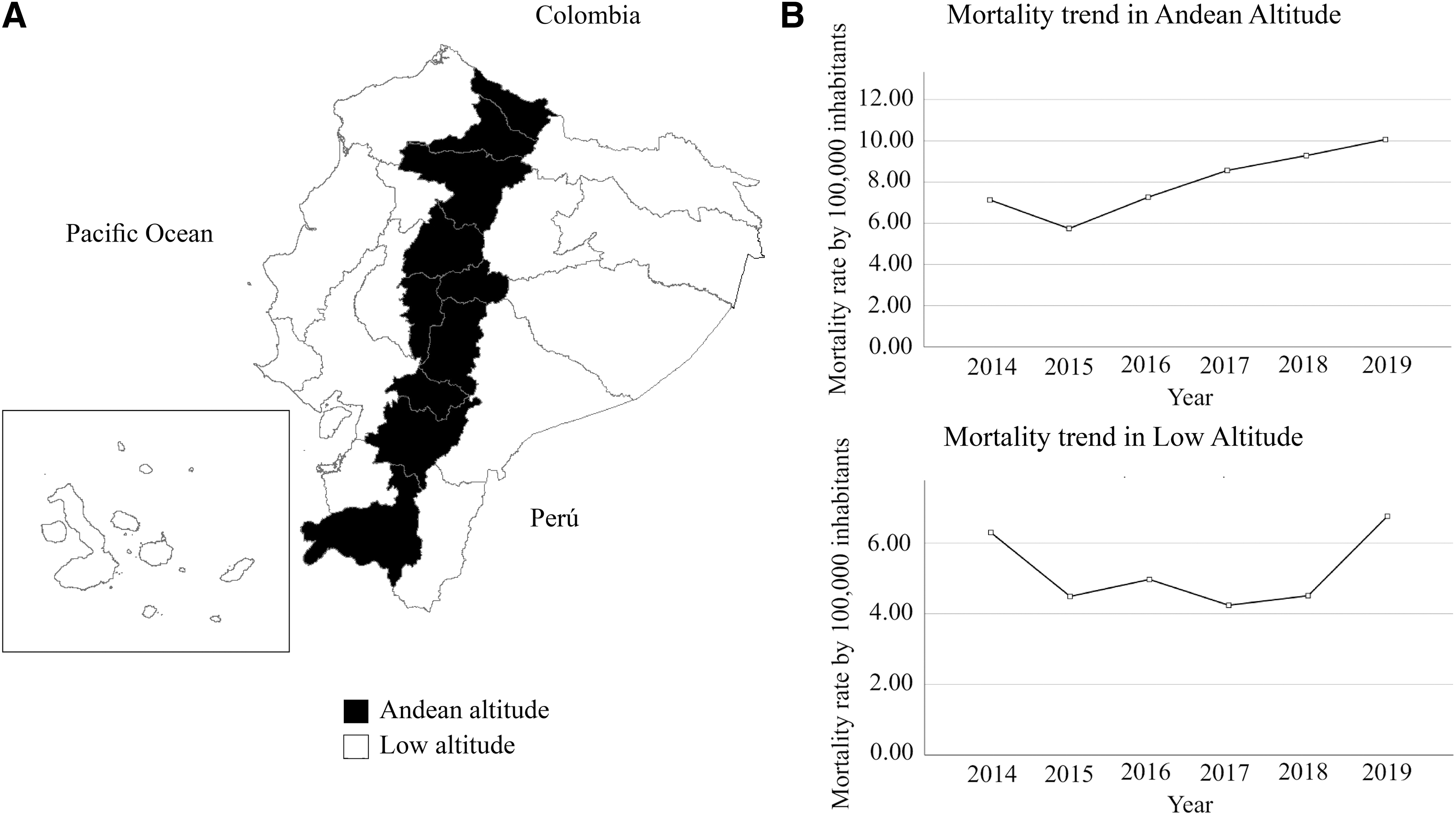
When comparing the mortality rates between Andean altitude and low altitude, the mean difference was 2.79 in favor of Andean altitude (p = 0.01).
Recently, it was observed that patients undergoing orthopedic surgeries performed in high altitudes had a higher risk of thrombosis (Tyson et al., 2016; Cancienne et al., 2017a, 2017b; Donnally et al., 2019). Also, a study including 20,257 hospital admissions found a higher risk of thrombosis-related diseases in people with long-term stay in high and extreme altitudes (odds ratio 30.49; p < 0.001) (Anand et al., 2001).
There are many reports regarding thrombotic events in people with a short or long stay at high altitudes, including pulmonary, splenic, mesenteric, cerebral, or peripheral thrombosis (Singhal et al., 2016). As physiopathological factors linked to this phenomenon have been proposed the erythrocytosis, elevated erythropoietin, a higher number of circulating and activated platelets, and endothelial damage (Moheimani and Jackson, 2011; Singhal et al., 2016).
Secondary polycythemia is frequent in the Andean population. Nevertheless, in 2013, a review concluded that there is no definite evidence of secondary polycythemia per se, increasing the risk of thromboembolism (Bhatt, 2014). However, another study found that patients with platelet counts higher than 398 × 109/L had a multivariable hazard ratio of 1.77 for ischemic stroke. In addition, women and men with hematocrit >45% and >48%, respectively, had a multivariable hazard ratio of 1.46 for myocardial infarction (Warny et al., 2019).
Endothelial damage also has been described in the Andean population. A study conducted in Huancayo, Peru, concluded that the frequency of endothelial damage demonstrated by flow-mediated vasodilation was higher in the Andean population, especially in obese and diabetic patients (Calderón-Gerstein et al., 2017).
We found a higher mortality rate in the elderly Ecuadorian population residing in the Andean altitude compared with its peers residing in the low altitude. We believe that these findings had different possible causes with nitric oxide and a high hematocrit having an important role. Nonetheless, more studies are required in both the epidemiology of VTE in the Ecuadorian population and the physiopathological mechanisms of VTE in the Andean population.
Footnotes
Author Disclosure Statement
No competing financial interests exist.
Funding Information
This research received no specific grant from any funding agency in the public, commercial, or not-for-profit sectors.