




Abstract

U
A total of 352 adults (>15 years old) residing in the Lahaul and Spiti district of Himachal Pradesh were randomly selected for this study. Detail methodologies for accessing health and nutritional status are provided in the Supplementary Data and Supplementary Table S1. Among the 352 participants, 160 (45.5%) were women. Twenty-five percent of the participants were obese (body mass index [BMI] >25 kg/m2). A high prevalence of anemia (94.9%), hypertension (41.5%), gastroesophageal reflux disease (GERD) (51.4%), musculoskeletal pain (58%), and visual refractive errors (RE) (49.1%) were the hallmark findings of this study (Supplementary Table S2).
Interestingly, the occurrence of musculoskeletal pain was statistically significantly higher in patients with high BMI (χ2 = 4.73; df = 1; p = 0.030) (Supplementary Table S3). Furthermore, 13.5% of the populations were found to be prediabetic and 10.5% had hearing loss. Other chronic illnesses, such as cardiovascular disease and hypothyroidism, were also observed, but in negligible frequencies (Fig. 1). Despite a high prevalence of anemia in the community, not a single case of any inherited hemoglobin disorder was found. Similarly, no cases of malaria could be detected.
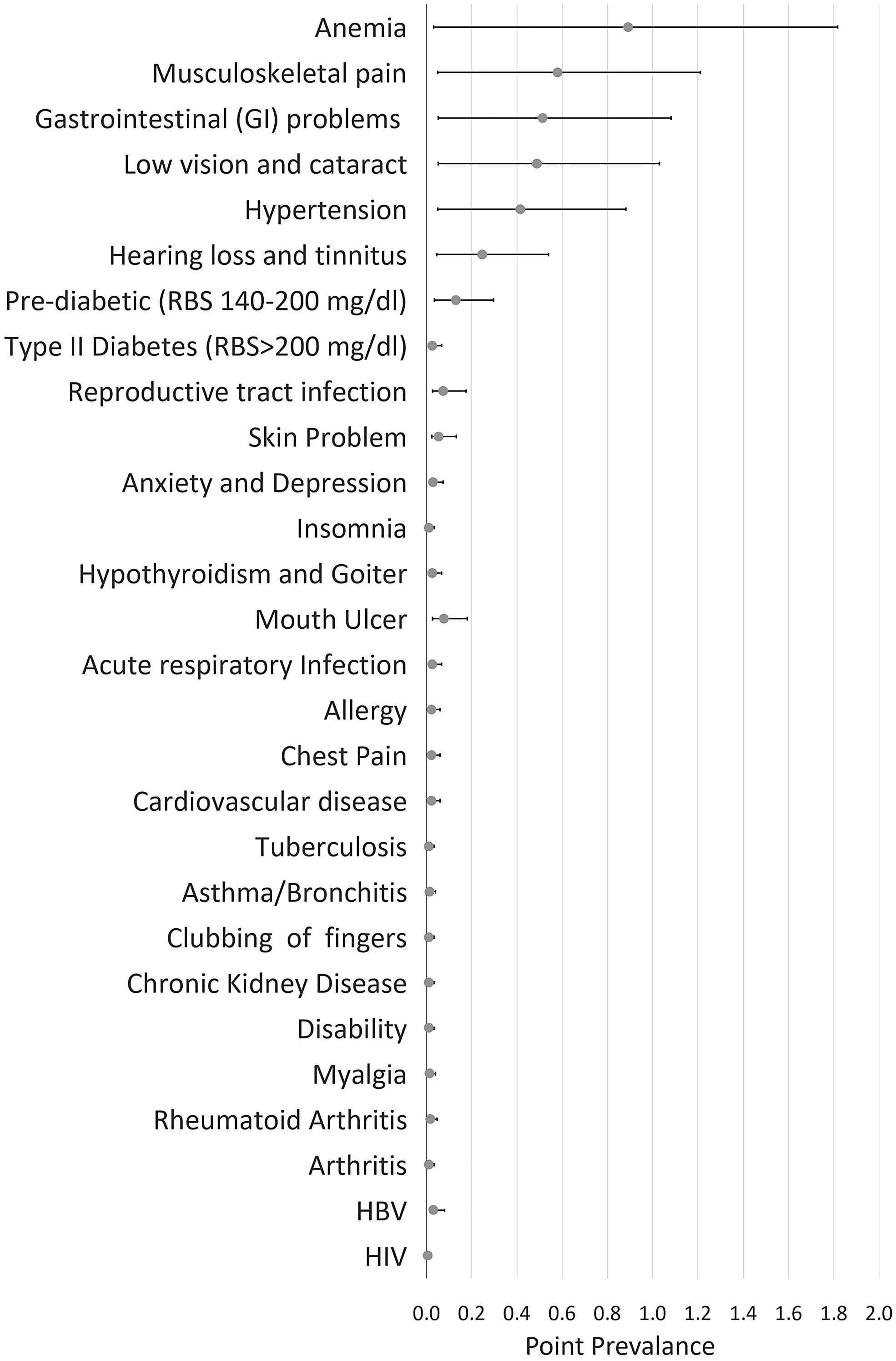
Distribution of different morbidities among study population of Lahaul and Spiti 2019–2020.
These findings, however, differ from populations living at low altitudes. Several aspects of health parameters in these tribal communities living in high altitude (e.g., the high prevalence of anemia, GERD, musculoskeletal pain, and hypertension) differ from peoples living at low altitude. For example, high prevalence (51.4%) of GERD is clearly in contrast to studies conducted in southern Indian populations living at low altitudes, where GERD prevalence was found to be 5%–22.2% (Wang et al., 2016; Chowdhury et al., 2019). Similarly, finding on more than half of the population to have reported musculoskeletal pain was very similar to high altitude Peruvian populations (50.23%) (Vega-Hinojosa et al., 2018). Such parallel results suggest a high prevalence of musculoskeletal pain, possibly as a consequence of physical activity, such as walking in steep terrain.
This finding on high prevalence of hypertension, however, is in contrast to a study conducted a decade earlier, reporting fairly low prevalence of hypertension in the Spiti valley (Negi et al., 2012). It is possible that these particular communities might have recently adapted to a more sedentary lifestyle, which is a known risk factor for obesity (Park et al., 2020). Since obesity is a risk factor for development of hypertension (Natis et al., 2020), current prevalence of a comparatively higher hypertension in comparison with that of the earlier study (Negi et al., 2012) might be attributed to this fact.
In high altitude regions, where the ultraviolet index is higher, a higher prevalence of visual RE could be expected. This finding on high RE is a confirmation of the similar results of 49.1% by earlier workers (Sheeladevi et al., 2019).
In conclusion, this pilot health and nutritional assessment study in two high altitude tribal communities in Himachal Pradesh, India, demonstrated several unique findings in health and nutritional profiles. Similar studies in other tribal communities living in inaccessible and high altitude settings with in-depth laboratory and clinical investigations will contribute in achieving UHC under the SDG in India.
Footnotes
Acknowledgments
The authors are thankful to the Director General, ICMR, and Secretary, Department of Health Research, for encouraging and providing facilities and necessary funds to carry out this research. The authors acknowledge Dr J.P. Narain, former Regional Advisor and Director, WHO for South East Asia Region for guiding and providing local administrative support. The Chief Medical and Health Officer Keylong, Lahaul and Spiti, Himachal Pradesh, Ms Bimla Dhiman, Ms Simmi, and Dr. Tanuja Mishra of the ICMR-Keylong field unit are thankfully acknowledged for their timely help.
Author Disclosure Statement
No competing financial interests exist.
Funding Information
The study was carried out by the intramural research grant of ICMR-NIRTH, Jabalpur.

References
Supplementary Material
Please find the following supplemental material available below.
For Open Access articles published under a Creative Commons License, all supplemental material carries the same license as the article it is associated with.
For non-Open Access articles published, all supplemental material carries a non-exclusive license, and permission requests for re-use of supplemental material or any part of supplemental material shall be sent directly to the copyright owner as specified in the copyright notice associated with the article.
