




Abstract
The Bacillus anthracis virulence plasmids pXO1 and pXO2 have critical implications for biosafety and select agent status. The proper identification and characterization of B. anthracis and its plasmid profile is important to the biodefense research community. Multiplex PCR was used to simultaneously detect a B. anthracis–specific chromosomal mutation, 4 targets distributed across pXO1, 3 targets distributed across pXO2, and highly conserved regions of the 16S gene, allowing an internal positive control for each sample. The multiplex PCR can produce as many as 9 easily separable and distinguishable amplicons, ranging in size from 188 to 555 bp. The PCR results were used to characterize DNA samples extracted from B. anthracis, other Bacillus species, and other bacterial species from many different genera. With the exception of 2 novel putative plasmids discovered, testing against inclusion and extensive exclusion panels showed 100% correlation to previously published and expected results. Upon testing 29 previously unpublished B. anthracis strains, 10 (34.5%) were pXO1+/pXO2+, 9 (31.0%) were pXO1+/pXO2−, 7 (24.1%) were pXO1−/pXO2+, and 3 (10.3%) were pXO1−/pXO2−. The present work presents a novel 9-target multiplex PCR assay capable of species-level identification of B. anthracis via a unique chromosomal marker and the detection of pXO1 and pXO2 via multiply redundant targets on each.
The Bacillus anthracis virulence plasmids pXO1 and pXO2 have critical implications for biosafety and select agent status. The proper identification and characterization of B. anthracis and its plasmid profile is important to the biodefense research community. Multiplex PCR was used to simultaneously detect a B. anthracis–specific chromosomal mutation, 4 targets distributed across pXO1, 3 targets distributed across pXO2, and highly conserved regions of the 16S gene, allowing an internal positive control for each sample. The present work presents a novel 9-target multiplex PCR assay capable of species-level identification of B. anthracis via a unique chromosomal marker and the detection of pXO1 and pXO2 via multiply redundant targets on each.
B
Detection of the B. anthracis plasmids is typically accomplished by amplification of plasmid-specific targets using PCR. To date, numerous PCR-based assays have been published. However, many of the existing methods suffer from lack of adequate target coverage.3-20 Additionally, most of the assays lack an internal control,6-20 which can allow the verification of reaction success in otherwise negative results (eg, plasmidless strains). Both the toxin genes and capsule genes are clustered within the pathogenicity islands (PAIs) of their respective plasmids.1,21 Because these genes are of primary interest with respect to virulence, it is likely that one or more would be intentionally deleted by a researcher wishing to study the effects of such deletions. Such a strain was deposited into the BEI Resources collection (NR-9401).* Initial results indicated that the strain was pXO1− because the assays in place at the time were based on amplification from the 3 genes that had been deleted (lef, pag, and cya). However, these results were incorrect: The remainder of the pXO1 plasmid was present. Thus, it is valuable to have an additional target separate from the virulence genes in order to ensure that the presence of the plasmids can be properly detected. This, in part, was the impetus for the current work.
An additional concern with regard to species identification is the similarity of the Bacillus species closely related to B. anthracis. In particular, the members of the Bacillus cereus group (primarily B. cereus, B. anthracis, and B. thuringiensis) have significant homology in their respective 16S ribosomal RNA (rRNA) nucleotide sequences, making it nearly impossible to reliably differentiate these species using standard 16S sequencing. 22 Prior to the identification of these or homologous plasmids in species other than B. anthracis, the presence of pXO1 and/or pXO2 was considered sufficient information to classify a species as B. anthracis. However, although these plasmids are most typically found in B. anthracis, the nature of interspecies plasmid transfer makes them unreliable for specific differentiation, as evidenced by the isolation of related species harboring these or nearly identical or partially homologous plasmids.2,21,23-36 Thus, in order to identify B. anthracis specifically, a chromosomal marker that is not found in the other members of the B. cereus group must be used. Many of the existing multiplex PCR methods either do not test for B. anthracis–specific chromosomal sequences3,9 or target sequences that have since been found to be inadequately specific to B. anthracis, 37 particularly the Ba813 sequence. 38 Because other species within the B. cereus group have been shown to cause anthrax-like disease when expressing the toxin genes and a capsule,24,27,31,39 the identity of a sample as belonging to the species Bacillus anthracis is mainly of taxonomic interest.
The current work presents a novel multiplex PCR assay capable of simultaneous species-level identification of Bacillus anthracis and the detection of the pXO1 and pXO2 plasmids via multiply redundant targets on each.
Materials and Methods
Multiplex PCR Assay
Table 1 lists the sequences and expected amplicon sizes for the primers used in the current multiplex PCR assay. Two primer pairs (sspE 10 and E517F/E1072R 40 ) were obtained from the literature; all other primers were designed as part of the current study. The ORF53 target on pXO1 and the ORF7 target on pXO2 were selected because they are located distant (≈180°) from the plasmid virulence genes; this should have the effect of insulating these targets from any deletions to the PAIs. Primers were manufactured by Integrated DNA Technologies. PCR reagents (10×Buffer, dNTPs, MgCl2, and Platinum Taq) were obtained from Invitrogen. PCR reagents were combined at the following concentrations to a 50-μL reaction volume: 10×Buffer, 1×; dNTPs, 350 μM; MgCl2, 7.5 mM; primers (Table 1); Platinum Taq, 0.06 U/μL; DNA template, 0.16 μg/μL. PCR conditions were 95°C for 5 min, followed by 35 cycles of 95°C for 30 sec, 62°C for 30 sec, and 72°C for 1 min, and a final extension of 72°C for 2 min. PCR products were run on an Invitrogen 4% agarose E-Gel® with Invitrogen E-Gel® 50 bp Ladder for 45 min and visualized using a Bio-Rad Gel Doc™ XR system.
Primer Sequences, Expected Amplicon Sizes, and PCR Concentrations

Organism Nucleic Acid
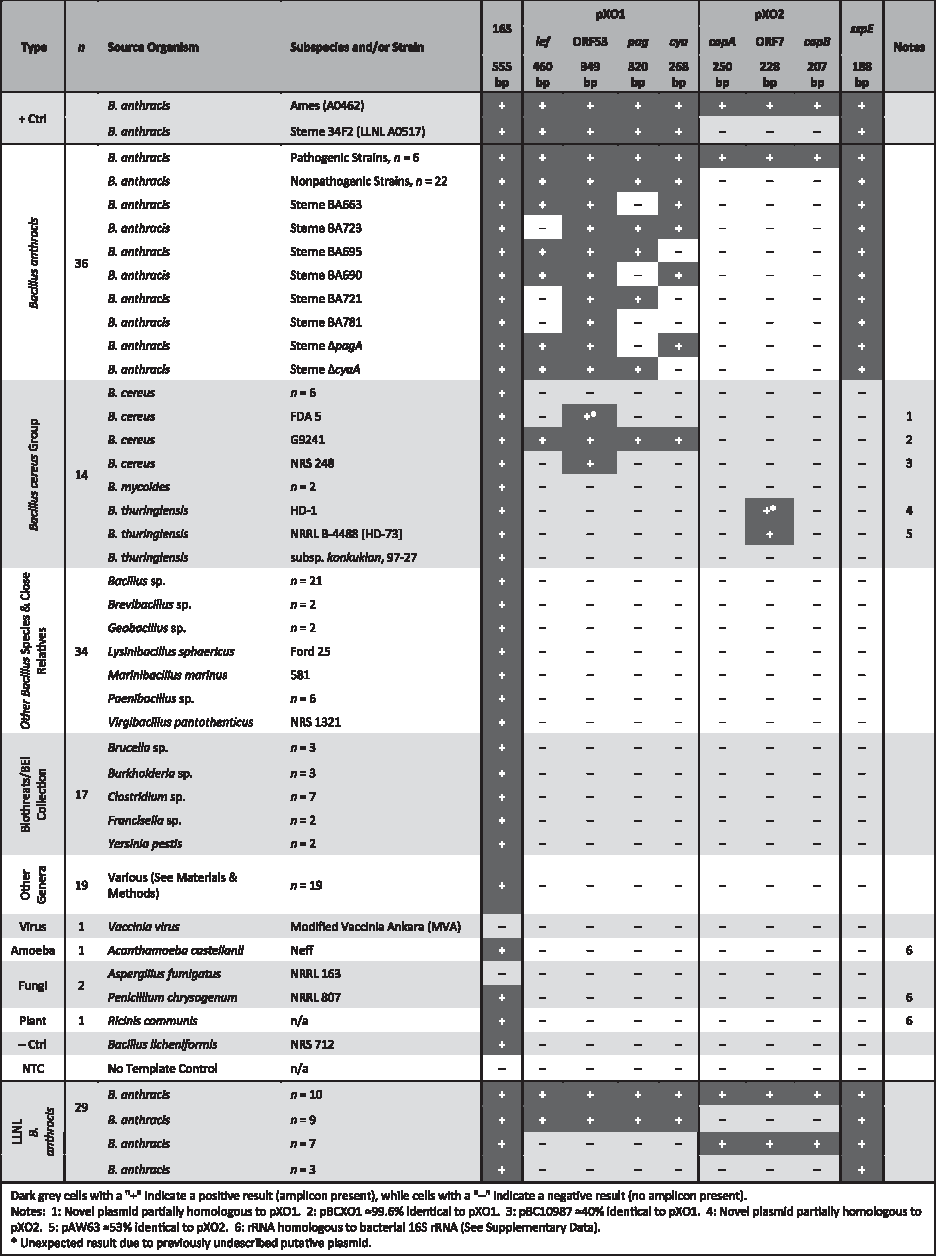
The inclusivity and exclusivity of the multiplex PCR were tested using genomic DNA from the following: 36 B. anthracis samples, 120 bacterial samples from 59 species across 29 different genera, 1 protist, 2 fungi, 1 plant, and 1 DNA virus. Due to the length of this list, a summary of the samples tested is provided in Table 2. In this table, samples in like categories and/or with like results were collated into a single line. Of specific note is the fact that the “Other Genera” category in Table 2 includes species from the genera Acinetobacter, Bacteroides, Burkholderia, Clostridium, Deinococcus, Fusobacterium, Lactobacillus, Legionella, Listeria, Mycobacterium, Pseudomonas, Rhizobium, Rhodobacter, Shewanella, Staphylococcus, Stenotrophomonas, Streptomyces, Synechocystis, and Vibrio. Additionally, Table 2 provides a summarized list of 29 previously unpublished B. anthracis strains that were deposited into the BEI Resources collection by the Lawrence Livermore National Laboratory (LLNL) and that were characterized using the multiplex PCR. (The complete version of Table 2, including collection accession numbers assigned to each strain, is provided as Supplementary Table 1 online at http://online.liebertpub.com/loi/HS). Where available, existing genomic DNA products were obtained from either the BEI Resources or ATCC collections; these products were extracted via BEI Resources or ATCC proprietary methods and are available to the public research community through the respective collections (BEI Resources, http://www.beiresources.org, Manassas, VA; ATCC®, http://www.atcc.org, Manassas, VA). For bacteria without existing genomic DNA products, DNA was extracted from the organism via boil preparations (see Supplementary Methods, http://online.liebertpub.com/loi/HS). DNA from the LLNL strains was extracted via BEI Resources proprietary methods. All work with virulent B. anthracis in this study was performed in BSL-3 conditions using safety precautions as recommended by the BMBL. All other work was performed at BSL-2 conditions.
Summary of the strains used in the inclusion and exclusion testing of the multiplex PCR, and the unknown LLNL samples
Assay Detection Limits
The detection limit of the multiplex PCR was qualitatively determined using genomic DNA at various concentrations. DNA from the B. anthracis, Ames strain was serially diluted from 2 ng/μL to 1 pg/μL, corresponding to a range from 3.06×10 5 genome copies/μL to 153 copies/μL, respectively.
Supplementary Plasmid PCR
To determine the extent of the homology of 2 unexpectedly detected putative plasmids to pXO1, pXO2, and similar plasmids, PCR was performed on the regions upstream and downstream of the intended target. Based on the B. anthracis, Ames strain pXO1 plasmid sequence, primers were designed for a total of 7 overlapping regions around the intended target (see Supplementary Figure 1A, http://online.liebertpub.com/loi/HS); these PCRs were tested against DNA from the Ames strain and strains containing the sequenced plasmids pBCXO1 and pBC10987, known to be homologous to pXO1.24,34 Based on the B. anthracis, Ames strain pXO2 plasmid sequence, primers were designed for a total of 5 overlapping regions around the intended target (see Supplementary Figure 1C, http://online.liebertpub.com/loi/HS); these PCRs were tested against DNA from the Ames strain and strains containing the sequenced plasmids pAW63 and pBT9727, known to be homologous to pXO2. 21 In order to differentiate the pXO2-like plasmid detected in NR-610 from the known plasmid pAW63, primers were designed to 6 targets distributed around pAW63 using the published plasmid DNA sequence (see Supplementary Figure 2, http://online.liebertpub.com/loi/HS). DNA from NR-610 was tested with these primers. Supplementary Table 2 (http://online.liebertpub.com/loi/HS) lists the sequences and expected amplicon sizes for the primers used in these supplementary PCRs.
Results and Discussion
Multiplex PCR Assay
Representative electrophoresis results obtained from this multiplex PCR on B. anthracis, Ames strain (pXO1+/pXO2+) and Sterne strain (pXO1+/pXO2−) are shown in Figure 1. The multiplex assay was tested against a total of 125 samples from the BEI Resources and ATCC collections. The results obtained from the multiplex PCR for the strains tested are shown in Table 2. With the exception of 2 novel partially homologous putative plasmids detected (see “Supplementary Plasmid PCR” below), the correlation of results to the expected results was 100%. 16S PCR products were observed for all bacterial DNA, verifying the proper functioning of the multiplex PCR for all samples tested and indicating the primer binding sites are highly conserved. NR-9401, the Δlef/Δpag/Δcya B. anthracis strain that provided false-negative results via previous characterization methods, shows a positive result for ORF53 using the currently described PCR while maintaining negative results for the 3 deleted toxin genes. Thus, the addition of a PCR target separate from the PAIs provides the ability to properly characterize the presence of the plasmids in the event that the toxin or capsule genes are deleted.
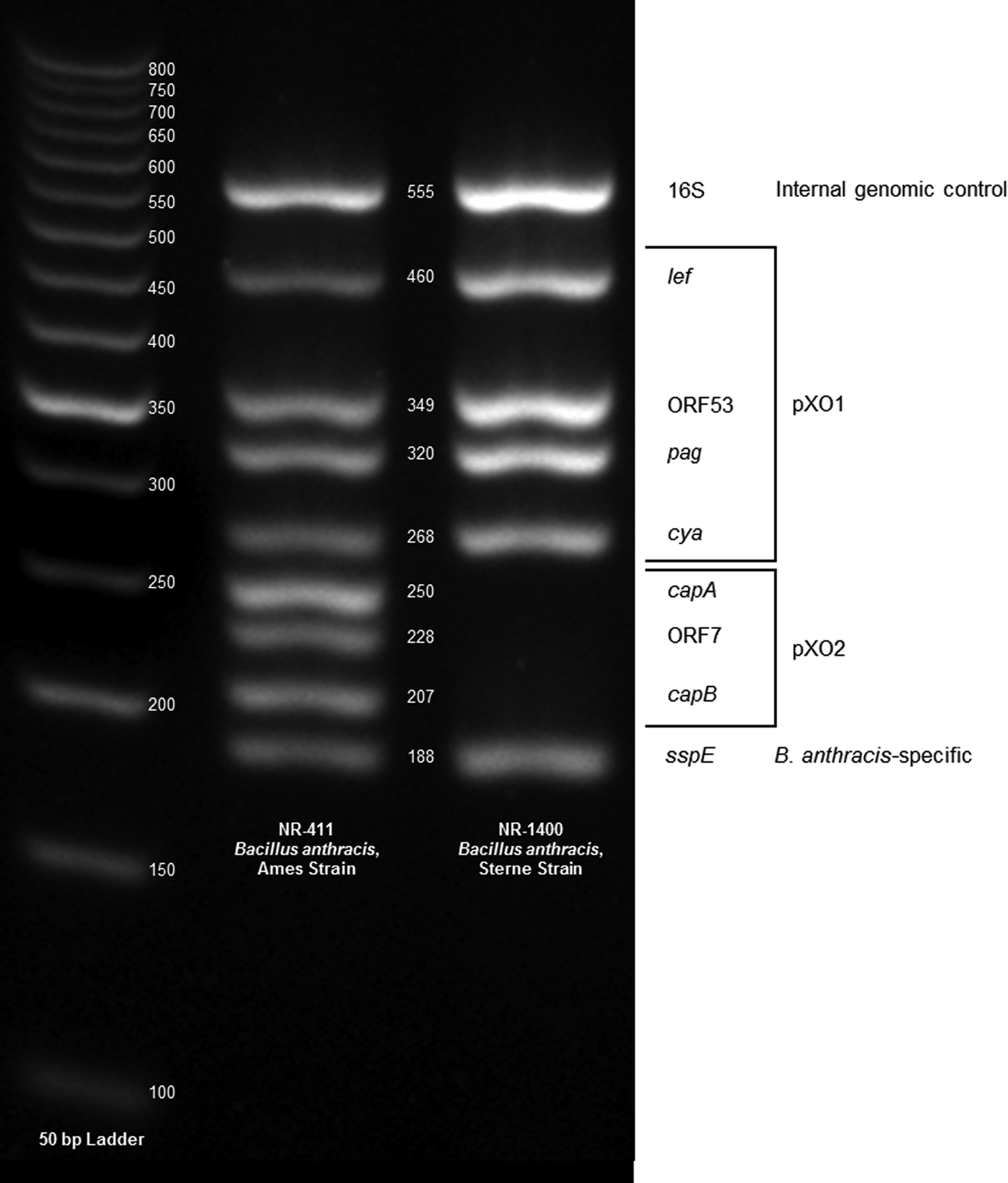
Representative electrophoresis results obtained from the pXO1+/pXO2+ B. anthracis, Ames strain (left), and the pXO1+/pXO2− Sterne strain (right).
Although amplicons corresponding to the approximate expected size for 16S amplicons were observed in Acanthamoeba castellanii (583 bp), Penicillium chrysogenum (556 bp), and Ricinis communis (556 bp), BLAST analysis shows high homology in the respective rRNA sequences corresponding to the primer binding sites for these species, explaining the observed bands (Supplementary Data 1). The assay proved to be highly specific and yields an amplicon profile that is easy to read and interpret.
Assay Detection Limits
Results suggest that the limit of reliable qualitative detection for all 9 of the PCR targets is lower than approximately 1,200 copies of genomic template DNA per 50-μL reaction, corresponding to less than 8 pg/reaction. These results are illustrated in Supplementary Figure 3 (http://online.liebertpub.com/loi/HS). The observed limit of detection (LOD) indicates that even though this assay is likely insufficient for clinical or diagnostic purposes, it is sensitive enough for efficient identification and characterization of laboratory isolates. Preliminary testing suggests that this assay may also be capable of characterizing isolates using bacterial cells, without prior DNA extraction, as template (data not shown).
LLNL B. anthracis Samples
The multiplex PCR was used to test DNA extracted from 29 previously unpublished B. anthracis samples deposited into the BEI Resources collection by LLNL. Of these, 10 (34.5%) were pXO1+/pXO2+, 9 (31.0%) were pXO1+/pXO2−, 7 (24.1%) were pXO1−/pXO2+, and 3 (10.3%) were pXO1−/pXO2− (Table 2 and Supplementary Table 1).
Supplementary Plasmid PCR
The results obtained from the inclusion and exclusion testing of the multiplex PCR assay yielded 2 unexpected findings. The first was an amplicon in NR-608 (B. cereus, FDA 5) corresponding to the pXO1-ORF53 target. Unlike the other two B. cereus strains (G9241 and NRS 248), with amplicons corresponding to the pXO1 targets, no previously published sequence data were found to explain the presence of this amplicon. The second unexpected result was a similar amplicon in NR-610 (B. thuringiensis, HD-1) corresponding to the pXO2-ORF7 target. Both these results are highlighted with an asterisk in Table 2. Again, unlike the other B. thuringiensis strain with an amplicon corresponding to this target, no previously published data are known to exist that would explain the unexpected amplicon. It was hypothesized that these amplicons were due to primer binding to previously unknown plasmids that are partially homologous to pXO1 and pXO2, respectively. To determine the extent of the homologous regions, PCR was conducted across multiple overlapping regions surrounding the intended targets.
For the pXO1-like plasmids, all the targets tested were positive in the samples NR-411 (the Ames strain positive control) and DNA containing the plasmid pBCXO1 (≈99.6% homology 24 ), while 4 of 7 targets were positive in DNA containing the plasmid pBC10987 (≈40% homology 34 ), and 5 of 7 targets were positive in DNA containing the unknown putative plasmid (Supplementary Figure 1B). The amplicons from the unknown putative plasmid were sequenced. The sequencing data indicate that the region from approximately Seq9 to Seq4 is contiguous (Supplementary Figure 1A) and possesses a 99.92% homology to pBc10987 (Supplementary Data 2). The putative plasmid was named pMAR1 due to its apparent homology within the sequenced range to the pXO1-like plasmids.
For the pXO2-like plasmids, all the targets tested were positive in the positive control, while 2 of 5 targets were positive for amplicons of the expected size in samples containing the plasmid pBT9727 (≈89% homology 22 ), 3 of 5 targets were positive in samples harboring the plasmid pAW63 (≈53% homology 21 ), and 3 of 5 targets were positive in those with the unknown putative plasmid (Supplementary Figure 1D). The amplicons from the unknown putative plasmid were sequenced. The sequencing data indicate that the region from approximately Seq5 to Seq13 is contiguous (Supplementary Figure 1C) and possesses a 93.68% homology to pAW63 (Supplementary Data 2). Of the 6 targets designed using the pAW63 plasmid sequence, none was positive in the unknown plasmid in NR-610 (Supplementary Figure 2). The putative plasmid was named pMAR2 due to its apparent homology within the sequenced range to the pXO2-like plasmids.
These results indicate that both the pMAR1 plasmid detected in NR-608 (B. cereus, FDA 5) and the pMAR2 plasmid detected in NR-610 (B. thuringiensis, HD-1) bear some homology to pXO1 and pXO2, respectively, but are distinct from currently known plasmids.
Limitations
The sspE primer pair from Kim et al is designed to produce a 75 bp amplicon in species from the B. cereus group of organisms (B. cereus, B. anthracis, B. thuringiensis, B. mycoides, etc). In B. anthracis, these primers also produce a 188 bp amplicon due to a species-specific repeated region that includes the binding site for the reverse primer. 10 The latter forms the basis of the B. anthracis–specific detection incorporated into this assay. Based on initial experimental results, the use of the 75 bp amplicon specific to the B. cereus group is incompatible with the combination of primers used in this multiplex PCR assay. Amplicons of approximately 75 bp were regularly observed in all reactions; this included no template controls in which no other bands were observed. It is suspected that some combination of the 18 primers used in this assay is susceptible to oligomerization, resulting in DNA molecules of a size larger than typical primer dimers. Because the suspected primer oligomer is approximately the same size as the 75 bp B. cereus group-specific band and occurs whether template is added or is absent, it is not possible to differentiate a positive result from the presence of the oligomer. Thus, the current multiplex PCR is not intended to identify a sample as belonging to the B. cereus group in the same manner as described in Kim et al. As the next smallest band is the 188 bp B. anthracis–specific amplicon, electrophoresis results from this multiplex PCR assay have a wide berth between the valid results and the primer oligomer, thus preventing any potential for confusion. For this reason, the 75 bp sspE amplicon is not considered in the final analysis.
Conclusions
The multiplex PCR presented in the current work has been shown to be highly sensitive and specific for the detection of B. anthracis chromosomal DNA and the pXO1 and pXO2 virulence plasmids. This novel multiplex PCR was also used to characterize 29 previously unpublished B. anthracis samples, confirming their species designation and providing plasmid profiles ranging from pXO1−/pXO2− to pXO1+/pXO2+.
In addition to the expected targets on pXO1 and pXO2, 2 putative plasmids with partial homology to pXO1 and pXO2 were detected during the inclusion and exclusion testing of the assay. NR-608 (B. cereus, FDA 5) contains the plasmid pMAR1, which bears some homology to the pXO1-like plasmids, and NR-610 (B. thuringiensis, HD-1) contains the plasmid pMAR2, which bears some homology to the pXO2-like plasmids. Supplementary PCR was conducted on these samples using the pXO1 and pXO2 sequences to design primers. While these plasmids display some homology to known plasmids, they were shown to be distinct from the known plasmids tested. Thus, these are thought to represent 2 previously undescribed plasmids. Work is currently in progress to further characterize these plasmids.
The multiplex PCR presented in the current work has been shown to be highly specific for the simultaneous detection and characterization of B. anthracis chromosomal DNA and the pXO1 and pXO2 virulence plasmids (and highly homologous plasmids). The PCR has a rapid turnaround time (≈1 hour, 35 min), requires no proprietary instruments or reagents, and produces an amplicon profile that is easy to read and interpret, making this molecular diagnostic assay well-suited for the high-throughput comprehensive identification and characterization of Bacillus anthracis and related Bacillus laboratory samples.
For biodefense purposes, this assay offers a fast and accurate method of characterizing a Bacillus isolate of interest. With further improvements in sensitivity, this assay has potential to be developed as a diagnostic assay.
Footnotes
Acknowledgments
This project has been funded in whole with federal funds from the National Institute of Allergy and Infectious Diseases, National Institutes of Health, Department of Health and Human Services, under Contract No. HHSN272201000027C. This article is subject to the NIH Public Access Policy. The views expressed in this publication imply neither review nor endorsement by HHS, nor does mention of trade names, commercial practices, or organizations imply endorsement by the US government. The authors declare no competing interests.
References
Supplementary Material
Please find the following supplemental material available below.
For Open Access articles published under a Creative Commons License, all supplemental material carries the same license as the article it is associated with.
For non-Open Access articles published, all supplemental material carries a non-exclusive license, and permission requests for re-use of supplemental material or any part of supplemental material shall be sent directly to the copyright owner as specified in the copyright notice associated with the article.
