




Abstract
Current risk assessment and risk communication of biosafety and biosecurity concerns lack a convenient metric and conceptual framework. The absence of such a systematic tool makes communication more difficult and can lead to ambiguous public perception of and response to laboratory biosafety incidents and biosecurity threats. A new 7-category scoring scale is proposed for incidents and situations in laboratories related to the handling of human and animal pathogens. The scale aims to help clarify risk categories, facilitate coordination and communication, and improve public understanding of risk related to biosafety and biosecurity.
Risk assessment and risk communication of biosafety and biosecurity concerns currently lack a convenient metric and conceptual framework. The absence of such a systematic tool makes communication more difficult and can lead to ambiguous public perception of and response to laboratory biosafety incidents and biosecurity threats. The authors propose a 7-category scoring scale for incidents and situations in laboratories related to the handling of human and animal pathogens. The scale aims to help clarify risk categories, facilitate coordination and communication, and improve public understanding of risk related to biosafety and biosecurity.
I
Concepts of Biosafety and Biosecurity
Biosafety “refers to principles, technologies, practices and measures implemented to prevent the accidental release of, or unintentional exposure to, biological agents or toxins, and biosecurity refers to the protection, control and accountability measures implemented to prevent the loss, theft, misuse, diversion or intentional release of biological agents and toxins and related resources as well as unauthorized access to, retention or transfer of such material.”3(pp4-5)
Biocontainment
To ensure the safety of laboratory personnel and the environment, work on human and animal pathogens in laboratory settings is currently classified in biosafety levels 1 to 4 (BSL 1-4 and ABSL 1-4, respectively). 4 The biosafety levels are designated in ascending order, by degree of protection needed for personnel, the environment, and the community.
This classification draws on the concept of biocontainment—that is, the difference between a pathogenic interior and a less pathogenic exterior, such as work/personnel or laboratory/environment, and a stable barrier between them. 5 The physical containment of infectious pathogens or toxins is required to prevent accidental infection of workers or release of pathogens into the environment during scientific research or diagnostics.
Biosafety and Biosecurity Threats
Dangerous human and animal pathogens are handled in laboratories of high and highest biosafety levels. BSL-3 and ABSL-3 laboratories handle pathogens that cause severe diseases in humans and animals but for which there exist therapies and/or vaccines (eg, B. anthracis, rabies virus). BSL-4 and ABSL-4 laboratories handle pathogens for which no treatment or vaccines are available (eg, Ebola virus, Nipah virus). Those laboratories are necessary to diagnose infectious pathogens, guide infection control measures, and conduct research into new vaccines and treatment options. Very strict guidelines regulate BSL-3 and -4 laboratory operations. The mere existence of such high-containment laboratories is often perceived by authorities and the public as threatening. Concerns focus on incidents that could cause pathogens to physically escape the laboratory and contaminate the environment and accidents inside the laboratory that could lead to laboratory-acquired infections.6-9 In the aftermath of the anthrax letters, biosecurity fears also have increased. Concerns have been raised about BSL-4 laboratories, in particular, as a potential source of security threats because their materials and technologies could be used to threaten societies.
Dual-Use Dilemma
Research and development in the field of biomedical sciences can sometimes pose a dual-use dilemma. While scientific discoveries can be used in beneficial ways to cure diseases and improve health, they also can be used for malicious purposes, as biological weapons. Dual use as a concept originated in the Cold War when it was applied to concerns related to nuclear material and its weaponization. Biomedical sciences in the postgenomic era bring a new dimension to the dual-use dilemma: Their dual-use potential is not only material-based (eg, possession of pathogens) but, more importantly, information-based (eg, possession of sequence information). 10 The relevant dual aspects are not only physical possession of pathogens but also knowledge and information about how to modify or manipulate the original structure (eg, sequences of amino acids, mutations). These dual-use concerns were recently broadly discussed when researchers successfully introduced mutations to an avian influenza virus that enhanced its transmissibility (ie, gain-of-function experiments).11,12
Risk Assessment and Risk Communication
Biosafety, biosecurity, and dual-use concepts are complex, lack standardization, and are often understood differently by scientific and security experts, policymakers, and the public. Current risk assessment and communication of laboratory biosafety and biosecurity can add ambiguity because they lack explicit metrics. To address this challenge, we have developed a new scale to help frame risk assessment and facilitate risk communication related to the classification of biosafety and biosecurity incidents and situations in laboratories.
Concept: Marburg Biosafety and Biosecurity Scale
Drawing on the concept of scaling nuclear events using the International Nuclear Event Scale (INES), we developed an explicit metric to assess biosafety incidents and biosecurity levels using a scale from 0 to 7, called the Marburg Biosafety and Biosecurity Scale (MBBS).
For biosafety, we evaluated the impact of laboratory-originated incidents on personnel, integrity of containment (in this context: biocontainment), and the environment. In order to avoid confusion with the BSL classification and to emphasize what we are measuring, we use a biosafety incident scale to classify the kinds of incidents that could occur in laboratories that handle human and animal pathogens and how severe they are in terms of impact on personnel, containment, and environment. Biosafety incidents 0 to 3 describe incidents that could, however unlikely, happen in routine laboratory operations; incident levels 4 to 7 describe accidents or attacks from external actors. From incident level 4 on, biosafety and biosecurity scales merge.
For biosecurity, we use levels to classify situations. Our starting point is the distinction between physical/material–based and intangible/information–based threats. We then further reflect issues related to the impacts on individuals, integrity of containment (in this context, control and effectiveness of response mechanisms), and the public. In contrast to the biosafety incident scale, the biosecurity levels 0 to 3 describe situations and not incidents. Only from biosecurity levels 4 and higher does the scale describe incidents. Botulinum toxin, for instance, is a biosecurity relevant pathogen that is currently in use for medical and cosmetic purposes. This is a biosecurity level 0. If botulinum toxin were to be used to intentionally harm a person (biosecurity level 4) or in synchronized attacks in one country (biosecurity 6) or several countries (biosecurity level 7), the biosecurity level would increase.
The first 4 scores (MBBS 0 to 3) of biosafety- and biosecurity-relevant incidents and situations develop (and would be reported) independently, while from MBBS 4 on, biosafety and biosecurity aspects move closer together, are less discrete, and have a similar common final path (locally contained, regional, national, and international impacts). Literally, the biosafety and biosecurity scale forms a Y-shape, where one arm of the Y is the biosafety branch and the other arm the biosecurity arm, both leading into a common final path (see Figure 1).
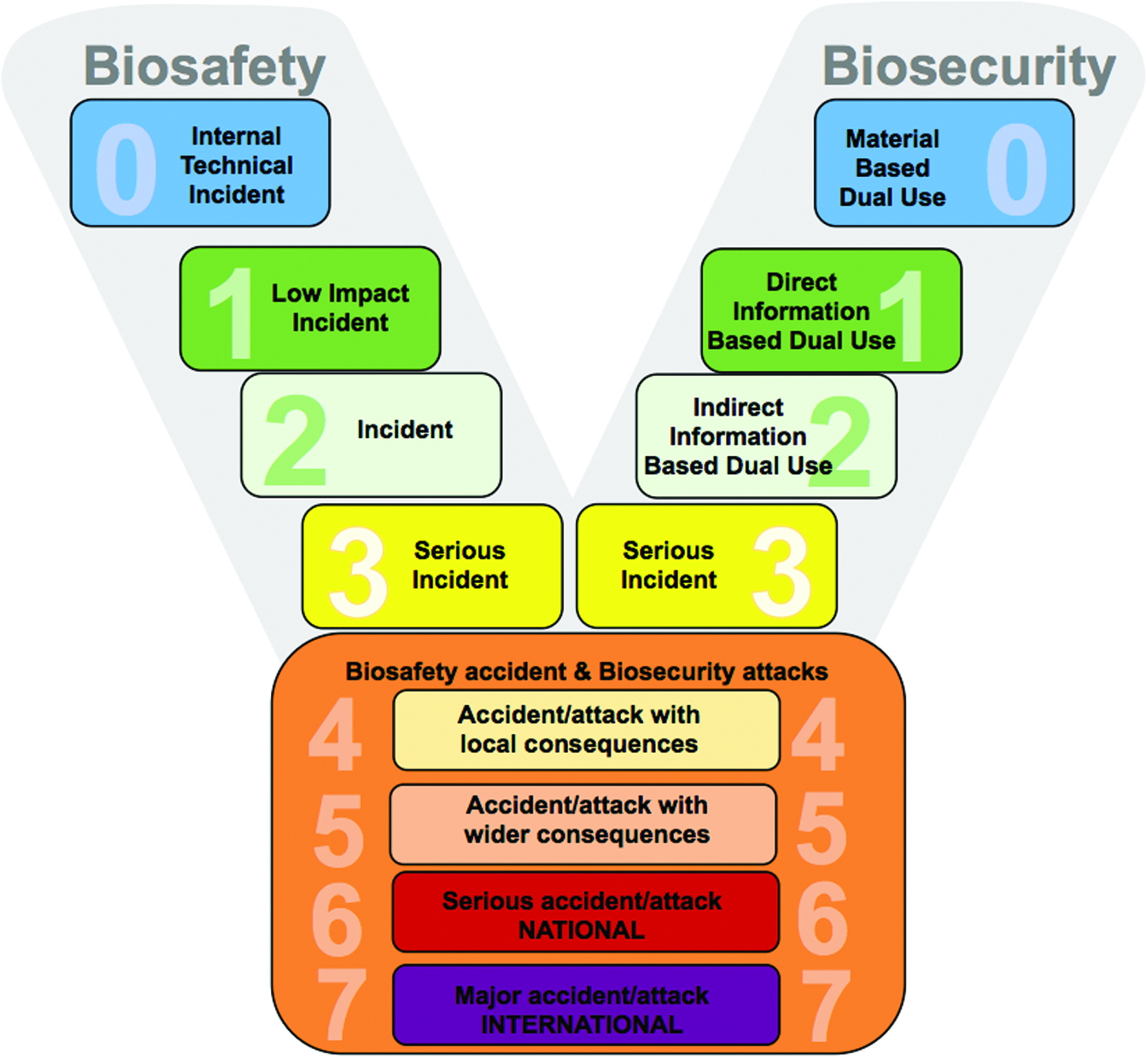
Y-shape of Biosafety and Biosecurity Scale. Color images available online at www.liebertpub.com/hs
MBBS Biosafety Branch
The biosafety branch refers to work on human and animal pathogens in laboratories and provides a metric for evaluating incidents with regard to the impact they have on personnel, the integrity of the containment, and the environment (Table 1). Although this scale applies to all laboratories, only incidents in the high and highest containment laboratories are likely to have a significant impact on people, integrity of containment, and the environment. For this reason, examples presented are mainly drawn from work in BSL-3 and -4 laboratories.
Marburg Biosafety and Biosecurity Scale (MBBS), Biosafety Branch
The leakage of agriculturally relevant pathogens, such as foot-and-mouth-disease virus, from the laboratory into the environment because of a damaged sewage system, with limited infections, would be another example of an incident level 3 situation. Response measures include notification of laboratory and public health authorities, as well as national authorities, to activate containment measures and contact tracing. Information should be provided to personnel, local communities, and the general public.
MBBS Biosecurity Branch
The biosecurity branch of the MBBS includes levels 0 to 7, where the first 4 biosecurity levels, MBBS 0 to 3, describe situations of laboratory development or manipulations, whereas biosecurity levels MBBS 4 to 7 classify incidents with wider implications. The biosecurity scale, however, does not include the wide-ranging long-term social and political ramifications and ripple effects that biosecurity incidents could have on society.
Biosecurity in this context refers to any activity, material, knowledge, or information that could be used for malicious purposes to pose threats or commit crimes or terror attacks.
As an initial distinction we discriminate between tangible, physical dimensions and intangible, information-based dimensions of biological threats. We evaluate biological threats against their effect on individuals, on the integrity of containment (this includes the ability to respond to infectious diseases and contain the pathogen), and on the public (Table 2).
Marburg Biosafety and Biosecurity Scale (MBBS), Biosecurity Branch
Discussion
This proposed scale provides a unique framework for a rational and transparent classification of laboratory biosafety and biosecurity concerns. The scale can be applied both prospectively and retrospectively to contribute to the assessment and communication of biological risks. Applications might usefully include: (1) risk assessment of incidents and situations using the explicit rationale; (2) risk communication of these incidents and situations to relevant stakeholders including the general public; (3) action guidance for laboratory personnel and authorities; (4) system preparedness planning, such as informing other sectors with an interest in biosafety and biosecurity (other than the laboratory community).
Until now, there has been no convenient standardized related rating or scaling system for laboratory-related biological risks. On the input side, risk groups of pathogens have been identified that determine the containment level of work that has to be conducted with these agents. On the outcome side, current systems that classify incidents in laboratories (eg, internal technical incident, low-impact incident, accident) tend to be focused on (and confined to) laboratory experts. Moreover, criteria defining incidents/accidents are not standardized and are often not clear or are not clearly communicated. Current classification systems exclude a broader risk assessment and understanding of biosafety or any classification for biosecurity. The existing color coding to classify terrorism threats (eg, Homeland Security Advisory System or the UK threats) cannot be applied to biosafety or biosecurity, and the criteria for serious or severe, red or orange levels, are too vague.
Regarding response, in the field of biosafety, emergency protocols are in place and are exercised in different settings such as in lab or national exercises that form part of routine quality control procedures. In biosecurity such protocols are more vague, and there are no or few established routines to respond to these threats and test and evaluate the effectiveness of response measures.
Scope
The biosafety incident scale can contribute to a clearer understanding of the nature of incidents in the laboratory (incident levels 0 to 3) and accidents or attacks on laboratories (incident levels 4 to 7), while the biosecurity levels provide an overview of situations (biosecurity levels 0 to 3) and incidents (biosecurity levels 4 to 7). This scale provides an easy to understand, explicit rationale to assess and communicate biosafety and biosecurity concerns. Having clear criteria can contribute to more transparent and concise assessment, communication, and response. Both scales merge from incident level 4, where accidents at laboratories are the result of intentionally malicious purposes, such as an explosion in a BSL-4 laboratory. These represent common external factors, and therefore biosafety and biosecurity move closer together.
Assessment
The MBBS could be used to better understand incidents and consequences and to rethink strategic response measures. Having an explicit framework in place that illustrates where on the scale the situation actually is, how it could develop, and what actions might be necessary is important strategic information that can inform response strategies well ahead of escalating situations. Response mechanisms to biosecurity threats are not well articulated or standardized as yet. For this purpose, we suggest some basic response actions and include a column on possible strategies and consequences. This could be used by relevant institutions and groups to reflect and structure their response.
Reassessment
Working through scenarios, the scale could, for example, show that the former, often intuitive risk assessment that assumes that BSL-4 labs are more dangerous than BSL-3 labs could be misleading. BSL-4 work is highly regulated, and certain threats, such as explosions, should not happen (unless there is an attack), since all explosive materials are prohibited inside BSL-4 facilities. BSL-3 labs are less regulated and more widely distributed; having higher levels on the biosafety and/or biosecurity scale might lead to rethinking about needed security and response capacities and mechanisms among regulators and policymakers.
Quality Control
The notification and reporting that are required on the different levels could also be used to evaluate quality in laboratories. The assessment tool generates new data that can be analyzed and could inform decision making.
Improved Communication
A major feature of this scale is that it allows clearer and more consistent communication. Having the same explicit rationale in place facilitates coordination with institutions and communication with colleagues and the public.
Bioseverity Scale
In order to better understand the health implication of biosafety and biosecurity 4 to 7 and the severity of the epidemiologic situation, a third assessment and communication rationale would be necessary to classify clinical outbreak scenarios and guide public health response. This “bioseverity scale” is currently being developed to assess the clinical and epidemiologic situation for public health responses.
Limitations
The proposed MBBS is a conceptual evaluation framework and metric, and its applicability and benefit need to be demonstrated in further discussions and use. The MBBS does not include a way of measuring the social and political factors that shape both the identification of and responses to incidents, accidents, and attacks. In its current form, it is limited to developing a standardized measuring and communicating tool that could improve understanding and clarify risk assessment and communication related to biosafety and biosecurity. The scale could function in a similar way to the Richter scale for earthquakes: It is not just a strong or heavy or severe earthquake; it is an earthquake of 5.7 on the Richter scale. The MBBS can offer comparability and a better understanding of the impact an event can have. Having an explicit rationale in place could help conceptualize response measures.
An important question for security intelligence is how easily or likely it is that a biosecurity level 0 to 3 situation could develop into biosecurity 4 to 7, or how likely a biosafety incident 4 to 7 is. The MBBS does not provide an intelligence tool to assess how likely or feasible it is that situations may develop. The purpose of this scale at this stage is to provide an explicit rationale for assessment and communication.
Conclusion
Drawing on similar scales that rate and evaluate natural threats and nuclear events, this biosafety and biosecurity scale provides an explicit metric to rate biosafety and biosecurity to improve risk assessment and risk communication. It could also serve to improve quality assessment of laboratory work, inform policy and political decision makers, and help conceptualize and improve appropriate response measures.