




Abstract
The Federal Select Agent Program, which is composed of the Centers for Disease Control and Prevention Division of Select Agents and Toxins and the Animal and Plant Health Inspection Service Agricultural Select Agent Services, regulates entities that possess, use, or transfer biological select agents and toxins in the United States and must preapprove all transfers within or into the US. The requirement to preapprove transfers allows the Federal Select Agent Program to monitor and track shipments to receive alerts of theft, loss, or release during shipment, thereby protecting public health and safety. As part of the program, the Division of Select Agents and Toxins regulates biological select agents and toxins that have been identified by the US government as posing a severe threat to public health and safety. The division analyzed 4,402 transfers that occurred between March 2003 and December 2013 to identify frequently transferred biological select agents and toxins and the types of entities involved in transfers. During the study period, 1 package was lost during shipment and it was determined not to pose a threat to public health. The Federal Bureau of Investigation investigated the loss and concluded that the package was most likely damaged by the commercial carrier and discarded. Further, there were no reports of theft or release associated with biological select agents and toxins shipments. This report represents the first in-depth review of biological select agent and toxin transfers that were approved by the Division of Select Agents and Toxins.
The Federal Select Agent Program regulates entities that possess, use, or transfer biological select agents and toxins in the United States. As part of the program, the Division of Select Agents and Toxins regulates biological select agents and toxins that have been identified by the government as posing a severe threat to public health and safety. The division analyzed 4,402 transfers that occurred between March 2003 and December 2013 to identify frequently transferred biological select agents and toxins and the types of entities involved in transfers. This report represents the first in-depth review of biological select agent and toxin transfers approved by the division.
F
Under the authority of the Bioterrorism Response Act, the US government collectively published 42 CFR §73.3, 4 7 CFR §331.3, and 9 CFR §121.3 5 on December 13, 2002, as the Interim Final Rule to implement provisions of the Bioterrorism Response Act; these 3 regulations went into effect in February 2003 and are hereinafter referred to as the select agent regulations (SARs). HHS delegated authority to regulate biological select agents and toxins of human concern to the CDC Division of Select Agents and Toxins (DSAT), 6 and USDA delegated authority to regulate biological select agents and toxins of plant and animal concern to the Animal and Plant Health Inspection Services (APHIS) Agricultural Select Agent Services (AgSAS). 7 DSAT and AgSAS work together to regulate biological select agents and toxins as the Federal Select Agent Program (FSAP). According to the select agent regulations, entities that possess, use, or transfer an HHS or USDA biological select agent or toxin listed in section 3 of the select agent regulations, or an overlap BSAT (regulated by both DSAT and AgSAS) listed in section 4 of the select agent regulations,8,9 must register with the Federal Select Agent Program, which includes a review of safety and security provisions during an on-site inspection prior to BSAT possession, to ensure entity compliance with the select agent regulations. The select agent regulations changed the paradigm for transferring biological select agents and toxins by requiring entities to receive approval from the CDC and USDA prior to transfer.
The select agent regulations have been modified several times since they went into effect in 2003. In 2005, the regulations were revised to include significant changes to security requirements. 10 Select agent regulation revisions published in 2012 identified as Tier 1 biological select agents and toxins that present the greatest risk of deliberate misuse with the most significant potential for mass casualties or devastating effects to the economy, critical infrastructure, or public confidence. The revisions included substantial enhancements to the security, incident response, and training requirements for entities possessing Tier 1 biological select agents and toxins.8,9 In addition, the list of HHS and overlap biological select agents and toxins was modified from 50 to 44 agents on October 4, 2012, by adding 3 viruses and removing 3 toxins, 2 fungi, 2 viruses, 1 virus subtype, and 1 rickettsia. 8 The lists of HHS, USDA, and overlap biological select agents and toxins are reviewed by the Federal Select Agent Program on a biennial basis. (For the complete current biological select agents and toxins list, please visit http://www.selectagents.gov.)
As described in sections 3(c) and 4(c) of the select agent regulations, the Federal Select Agent Program regulates all biological select agents and toxins as well as nucleic acids that encode for infectious forms of select agent viruses or functional forms of select toxins that can be expressed in vitro or in vivo, or are in a vector or recombinant host genome and can be expressed in vitro or in vivo.8,9 Entities may apply for exclusion from the regulations for biological select agents and toxins that have been attenuated or rendered less toxic or potent, which is decided on a case-by-case basis; however, if virulence or toxicity is restored to an excluded agent or toxin, the biological select agents and toxins will again be subject to the select agent regulations, including transfer preapproval.
According to the transfer requirements outlined in section 16 of the select agent regulations, all transfers of biological select agents and toxins within and into the US must be approved by the Federal Select Agent Program prior to shipment and can only be received by FSAP-registered entities.8,9 The Federal Select Agent Program reviews each BSAT transfer request to ensure that the receiving entity and principal investigator are registered with the FSAP. Entities that initiate transfers that are not registered with the Federal Select Agent Program—including, but not limited to, entities outside the US or local offices of physicians, veterinarians, and third-party diagnostic clinics that identify biological select agents and toxins in clinical and environmental samples—are denoted as nonregistered entities (NREs). The Division of Select Agents and Toxins approves the transfers of HHS BSAT, and AgSAS approves the transfer of USDA BSAT, whereas the transfer of overlap biological select agents and toxins may be approved by either agency.
Each shipment must be packaged, labeled, and shipped in accordance with all federal and international regulations, including, but not limited to, the US Department of Transportation's Hazardous Material Regulations. 11 The entity that is transferring the biological select agents and toxins provides the Federal Select Agent Program with the tracking information so that the FSAP can monitor the shipment. The requesting Responsible Official (RO) must notify the Federal Select Agent Program within 2 business days that the shipment has been received. If the package is damaged during shipment, missing BSAT material, or is not received within 48 hours of the expected delivery time, the requesting RO must notify the Federal Select Agent Program and submit an “APHIS/CDC Form 3, Report of Theft, Loss, or Release of Select Agents and Toxins” to the Program within 7 calendar days as required in section 19 of the select agent regulations.8,9
For this report, we reviewed all HHS and overlap BSAT transfers from March 2003 to December 2013 to characterize trends associated with the transfer of biological select agents and toxins and to identify the most frequently transferred agents and the types of entities involved. This report represents the first in-depth review for Division of Select Agents and Toxins–approved transfers of HHS and overlap biological select agents and toxins between entities registered with the DSAT.
Material and Methods
Data Collection
All information reported for each transfer is maintained in the Federal Select Agent Program National Select Agent Registry database. For this retrospective review, a dataset was extracted from the database that included all DSAT-approved transfers to DSAT-registered entities reported for the period between March 12, 2003 (date when BSAT transfer reporting provisions became effective), and December 31, 2013. The data were compiled into Microsoft Excel for analysis. Data were analyzed by agent, US state of transfer origin (sender location), US state of transfer delivery (recipient location), entity type, and carrier type. The carrier methods used to transfer biological select agents and toxins were categorized into commercial carrier or noncommercial carrier, based on the method reported by the entity initiating the transfer.
Information about entity type was collected from the self-reported “APHIS/CDC Form 1 (Application for Registration for Possession, Use, and Transfer of Select Agents and Toxins)” (Form 1) and categorized as defined below. Transfers that originated outside the US (n=153) and nonregistered entities (n=249) were omitted from the entity type review because these senders could transfer biological select agents and toxins material without reporting the entity type.
• Academic, combining academic (private), academic (state), and academic (not specified) fields in the Form 1;
• Commercial, combining commercial (profit) and commercial (not specified) fields in the Form 1;
• Government (nonfederal), combining government (nonfederal), government (state/local), and government (not specified) fields in the Form 1;
• Government (federal) and private (nonprofit) entity type categories remained unchanged.
Data Analysis
To compare the frequency of transfers between entity types, we standardized the average transfers per entity type by dividing the annual number of transfers initiated per entity type by the number of entities registered with the Division of Select Agents and Toxins for that entity type for that year.
To analyze shipping frequencies by day of the week, the transfers between registered entities were calculated as a percentage of the total number of transfers for the study period for each day of the week in which transfers were shipped and received. The percentage of transfers using each shipping method was determined from the shipping methods reported by the initiating entity for each day that a transfer was shipped. The average calendar days in transit are the average of the number of whole calendar days for all transfers that were initiated on each day of the week, rounded to the nearest tenth. To calculate the percentage of transfers arriving by Friday of the same week, the database was queried for all transfers shipped on each day of the week, and the number of transfers arriving by Friday of the same week was divided by the total number of transfers shipped on that day. All data obtained from the database were compared with archived paper report forms to verify that the information was accurately entered into the databases.
Results
Between March 2003 and December 2013, we approved 4,402 HHS and overlap BSAT transfers between registered entities. Of those, 442 transfers included more than 1 BSAT, resulting in 5,305 biological select agents and toxins transferred during the study period. Of the more than 500 entities across the US that had registered with the Division of Select Agents and Toxins between March 2003 and December 2013, nearly 60% had received at least 1 DSAT-approved BSAT transfer, while 48% had shipped at least 1 BSAT during that time. Eleven entities had received and 8 entities had sent more than 100 transfers during the study period, and these entities accounted for 43.4% and 46.8% of all BSAT transfers, respectively (data not shown). We approved approximately 400 HHS and overlap BSAT transfers requested by DSAT-registered entities per year, ranging from a 12-month low of 395 in 2009 to a high of 522 in 2004 (Figure 1). Since 2004, the number of DSAT-registered entities has remained between 284 and 336, with the total number of entities declining on average 2.4% annually since 2006. After the select agent regulation amendments in 2005 and 2012, the number of annual transfers declined 17.8% from 2006 to 2007 and 20.4% from 2012 to 2013 (Figure 1).

DSAT-Approved Transfers and Number of Registered Entities Per Year, 2003 to 2013. The arrows indicate the enactment of the Bioterrorism Act of 2002 and revisions to the Select Agent Regulations in 2005 and 2012.
Transfers Sent and Received by Day of the Week
The Division of Select Agents and Toxins monitors the length of time that BSAT packages remain in transit to remain alert to potential cases of theft, loss, or release. Approximately 95% of transfers of biological select agents and toxins were initiated between Monday and Thursday, with more than 98% of those shipments arriving by Friday of the same week (Table 1). For shipments initiated between Monday and Friday, the average number of calendar days per BSAT transfer varied from a high of 1.1 on Monday to a low of 0.6 on Friday. Shipments requiring more than 2 days of transit time accounted for 3.1% of all transfers, and nearly 40% of these transfers were shipped on Thursday or Friday (data not shown). BSAT transfers initiated on Thursday and Friday more often used a noncommercial carrier and had the shortest transit times, averaging 0.8 and 0.6 days in transit, respectively (Table 1).
DSAT-Approved Transfers Shipped by Day of Week on Which the BSAT Was Shipped or Received, Type of Carrier, and Transit Time, 2003 to 2013
Note. The percent of shipments transferred and received on each day of the week was calculated from the total number of transfers. The percentage of shipments using a carrier was calculated as a percentage of all the reported shipment methods for each day that a transfer was shipped. The average calendar days in transit are the average of the number of calendar days for all transfers that were initiated on each day of the week.
Transfers by Entity Type
The Division of Select Agents and Toxins–approved transfers between registered entities were analyzed to determine the frequency with which each entity type transfers biological select agents and toxins. We observed that transfers between commercial entities were the highest average number of transfers for all entity-to-entity transfer types during the study period, averaging 1.5 transfers per entity and ranging from 0.8 in 2003 to 2.2 in 2012 (Figure 2A). The transfer of botulinum neurotoxin (BoNT) and BoNT-producing species of Clostridium accounted for over 90% of transfers between commercial entities during the study period (data not shown). Transfers from government (federal) entities to government (federal), academic, private (nonprofit), and government (nonfederal) entities exceeded 1.5 transfers per entity in 2004 (Figure 2B), because of the inclusion of B. anthracis in nearly 60% of all transfers initiating from government (federal) entities that year (data not shown). Transfers per entity from private (nonprofit) to academic and private (nonprofit) entities exceeded 1.0 on multiple occasions from 2008 to 2013 (Figure 2C). Yersinia pestis and B. anthracis accounted for approximately 43% and 39%, respectively, of the transfers between private (nonprofit) entities observed in 2008 and 2010, respectively; however, no BSAT-specific increases in transfers were associated with the increases in transfers from private (nonprofit) to academic entities (data not shown).
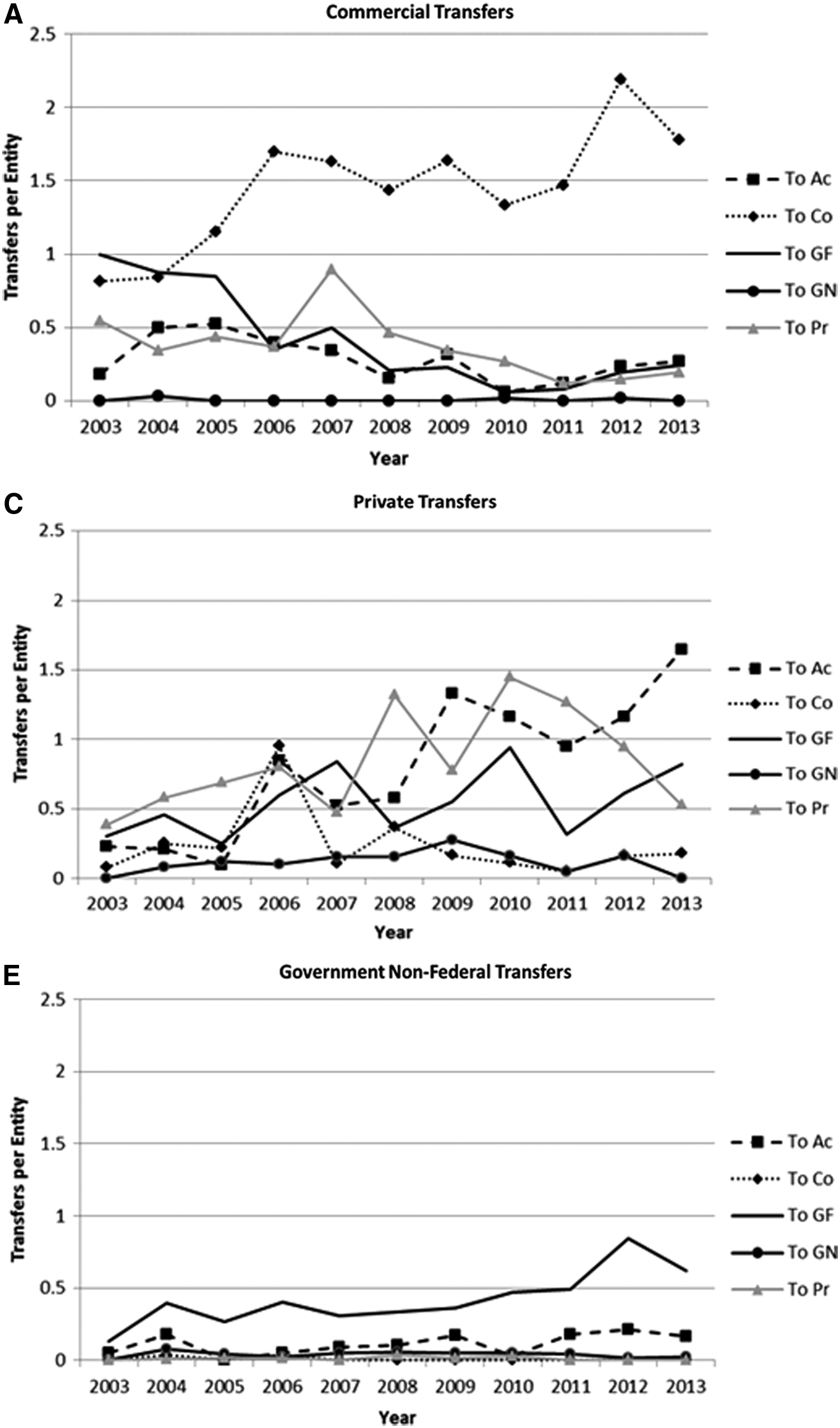
Average Annual BSAT Transfers Per Entity by Entity Type, 2003 to 2013. DSAT-approved annual BSAT transfers per entity type were analyzed by the sending and receiving entity types. The average annual number of transfers per entity was analyzed by the type of entity sending the BSAT for (A) commercial (Co) (n=40); (B) government (federal) (GF) (n=48); (C) private (nonprofit) (Pr) (n=20); (D) academic (Ac) (n=88); and (E) government (nonfederal) (GN) (n=100) entities. The number in parentheses for each entity type is the average annual number of entities for each entity type, rounded to the nearest whole number. The data do not include NRE entity types or transfers originating from outside the US.
Bacteria and Fungi Transfers
Of the 5,305 biological select agents and toxins transferred during the study period, select agent bacteria and fungi were the most commonly transferred organisms and accounted for more than 73% of all transferred biological select agents and toxins (Figure 3A). B. anthracis, F. tularensis, BoNT-producing species of Clostridium, and Y. pestis, all of which are classified as Tier 1, were the most frequently transferred BSAT bacteria and fungi during the study time period (Figure 4) and accounted for nearly 50% of all transferred biological select agents and toxins. B. anthracis accounted for approximately 20% of all bacteria and fungi transfers over the course of the study (Figure 3A), including 217 transfers in 2004 (Figure 4).
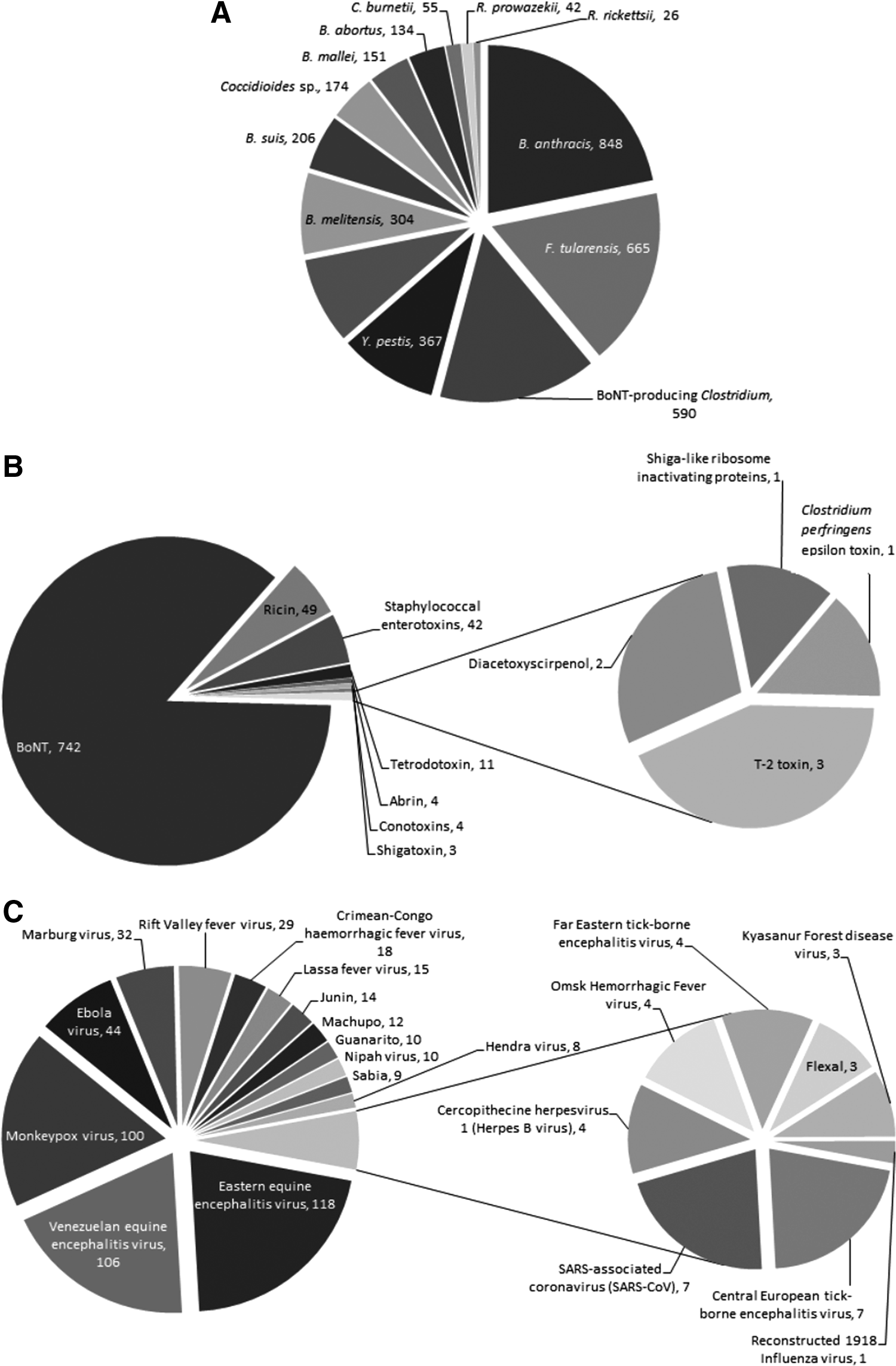
HHS and Overlap BSAT Transfers by Type of Agent or Toxin, 2003 to 2013. The total number of DSAT-approved transfers for each HHS and Overlap (A) bacteria and fungi (n=3,885), (B) toxins (n=862), and (C) viruses (n=558).

Most Frequently Reported BSAT in DSAT-Approved Transfers by Year, 2003 to 2013. The total number of transfers for the study period: B. anthracis (n=848), F. tularensis (n=665), BoNT-producing species of Clostridium (n=590), Y. pestis (n=367), and BoNT (n=742).
Toxin Transfers
From 2003 to 2013, transfers including select toxins accounted for approximately 16% of all biological select agents and toxin transfers (Figure 3B). BoNT is the only toxin classified as a Tier 1 BSAT and was 1 of the 5 most transferred biological select agents and toxins during the study period (Figure 4). BoNT accounted for more than 85% of all select toxin transfers (Figure 3B), and we documented more than 70 approved BoNT transfers per year, observing substantial increases in BoNT transfers from 2005 to 2007 and in 2012-13 (Figure 4). Other than BoNT, we documented fewer than 10 toxin transfers for all select toxins per year except for 2005 and 2013, when there were 11 and 10 ricin transfers, respectively (data not shown). BoNT was the only select toxin that averaged at least 1 transfer each year during the study time period.
Virus Transfers
During the study period, transfers including select agent viruses accounted for approximately 11% of all biological select agents and toxins transfers (Figure 3C). Eastern equine encephalitis virus (EEEV), Venezuelan equine encephalitis virus (VEEV), and monkeypox virus (MPXV) together accounted for nearly 60% of all HHS and overlap BSAT virus transfers during the study period. Increases in transfers were observed for EEEV in 2009 and 2011, MPXV in 2006, and VEEV in 2006 and 2007 (data not shown). The Division of Select Agents and Toxins approved fewer than 10 transfers per year for any select agent virus requiring Biosafety Level-4 (BSL-4) containment facilities.
Compliance
During the study period, 21 shipments involving potential select agent regulation violations were referred to the HHS Office of Inspector General (HHS-OIG) for further investigation and potential enforcement action. Of the 21 transfer incidents referred to HHS-OIG, 8 resulted in civil monetary penalties ranging from $15,000 to $450,000. All but 3 of these incidents involved transfers not approved by DSAT prior to shipment. Of these remaining 3 incidents, 1 involved a package that was lost during transit, 1 involved the failure to comply with applicable laws regarding shipping and packaging, and in 1 incident it could not be confirmed that a violation of the select agent regulations had actually occurred. The package that was lost in transit was reported by DSAT to the Federal Bureau of Investigation (FBI), which conducted an investigation. The FBI concurred with the findings of the shipper that the package was damaged in the automated sort machines at the shipping facility and was disposed of in transit because of the damage to the outer packaging. Because the material was determined to have been appropriately packaged using standard triple packaging, and there was no evidence of the package leaking, it was determined that there was no threat to public health as a result of this incident. Furthermore, the matter was referred to the Department of Transportation, which determined no further action was needed.
Discussion
This report provides the first comprehensive review of Division of Select Agents and Toxins regulatory oversight of biological select agent and toxin transfers for the period between March 2003 and December 2013. In this study, we have identified important types of BSAT and routes of transfer between entity types that will enhance monitoring. We observed that the number of transfers increased prior to and decreased following the implementation of the select agent regulation amendments in 2005 and 2012 (Figure 1). Approximately 1 year prior to each amendment, a Notice of Proposed Rulemaking was published that alerted entities to the potential upcoming changes, and entities may have transferred biological select agents and toxins prior to the publication of the amendment. BSAT transfer requirements, such as DSAT approval prior to shipment and registration of receiving entities with DSAT, did not change in either amendment. However, each amendment contained significant changes to other components of the select agent regulations that may have influenced transfers. The list of regulated biological select agents and toxins was modified in 2005 and 2012 to add or remove BSAT, which may have affected the number of transfers. For example, we approved 174 Coccidoides spp. transfers prior to the 2012 BSAT list modification, and removing this agent may have contributed to the overall reduction in transfers observed in 2013. In addition, the introduction of enhanced security requirements in 2005 and Tier 1 requirements in 2012 may have influenced an entity's decision to possess biological select agents and toxins, and we observed that several entities transferred BSAT prior to the implementation of the amendments. However, not all increases appear to be associated with regulatory changes as some increases in transfers were likely associated with an increase in the transfer of a specific BSAT, such as the increase in B. anthracis transfers in 2004 during the investigations into US Postal Service mailings (Figure 4). 12
In addition to the regulatory oversight provided by the Division of Select Agents and Toxins, registered entities themselves play an important role in ensuring the safety and security of biological select agent and toxin transfers by carefully scheduling and packaging transfers. With only 3.1% of transfers exceeding 2 calendar days in transit, the data indicate that entities schedule transfers to minimize shipping times, thereby reducing the potential for loss of viability as well as the possibility of a BSAT theft, loss, or release. More than 98% of transfers were received by Friday, suggesting that entities likely schedule BSAT transfers to arrive when authorized personnel are available to take possession of the shipment. During the study period, we did not receive any reports of a stolen shipment, which indicates that the security provisions established by DSAT and executed by entities were sufficient to maintain the security of biological select agents and toxins during transfer. In addition, we did not receive any reports of transfer-related releases during the study period, indicating that entities complied with federal regulations to package biological select agents and toxins appropriately for shipment. After analyzing all days of transfers, we observed that the number of transfers that were sent or received on Saturday and Sunday were quite low, and meaningful conclusions could not be drawn.
When the number of entities responsible for transferring biological select agents and toxins was analyzed, 60% of entities registered with the Division of Select Agents and Toxins had received at least 1 DSAT-approved BSAT transfer during the study period, while 48% of the entities had shipped a BSAT. One potential explanation for the number of laboratories that had not frequently shipped or received biological select agents and toxins is that some entities, such as some diagnostic laboratories that only possess unregulated BSAT-positive controls including attenuated strains or genomic fragments, register with DSAT to prepare for the possession of any BSAT specimens that are identified by the entity. Therefore, unregulated positive control BSAT strains can be transferred between diagnostic laboratories without DSAT approval, and those transfers do not need to be reported to the Federal Select Agent Program. Another possible explanation is that diagnostic laboratories often perform presumptive tests on specimens that do not have an identified agent or toxin; the select agent regulations do not apply to specimens that have a presumptive diagnosis, and transfers of diagnostic specimens do not require DSAT approval. In addition, entities such as diagnostic laboratories do not usually perform research and therefore do not transfer biological select agents and toxins to collaborators.
During the study period, only 1 package was lost by a commercial carrier, 13 which suggests that the transfer of biological select agents and toxins between regulated entities in the US is done in an efficient, safe, and secure manner. We were alerted to the lost transfer by the receiving entity when the package did not arrive at the expected time, as required in the select agent regulations. The FBI conducted an investigation and concluded that the package was damaged by the commercial carrier and discarded. As previously noted, it was determined that the lost package did not pose a public health threat. In response to this incident, we initiated a policy in 2010 that requires entities to provide tracking information to the Federal Select Agent Program at the time of shipment. Closely monitoring the shipment of each biological select agent and toxin, including contacting entities if a package has not been received within 48 hours of expected delivery, allows us to rapidly respond to theft, loss, or release of BSAT during shipment.
Entities most frequently transfer biological select agents and toxins to entities of the same type. The Federal Select Agent Program does not limit the amount of transferred material or the number of transfers requested and carried out by any entity; however, the FSAP must approve each transfer. Transfers between commercial and private entities, and between private entities, occurred more frequently than between any other entity type (Figure 2). Government (federal) entities often perform multiple clinical specimen transfers over the course of a year, such as the transfer of specimens in the B. anthracis mailings investigation in 2004, or to share biological select agents and toxins with other laboratories. Commercial and private entity transfer activity may be explained by transfer of environmental and quality control samples of BSAT, including BoNT-producing species of Clostridium. One possible explanation for the observation that entity types frequently transfer biological select agents and toxins among themselves is that many entity types have similar work objectives and use similar BSAT, and established collaborations may exist between entities of the same entity type.
Although the Division of Select Agents and Toxins has regulated only 14 bacteria and fungi during the study period, these organisms were the most frequently transferred material during the 11-year study time period, followed by toxins and viruses. More entities are registered with DSAT for bacteria and fungi than toxins or viruses, in part, because entities do not have to register with DSAT for permissible amounts of toxins and only a few entities maintain a BSL-4 laboratory, which is required to work with most of the HHS and overlap BSAT viruses. The type of select toxin and select agent virus material regulated by the Federal Select Agent Program may provide another possible explanation for the large percentage of bacteria and fungi transfers. FSAP does not regulate transfers that contain permissible amounts of select toxins or transfers that include nucleic acids that are not immediate precursors to infectious viruses, including reverse genetics plasmids or virus genomes that do not use host polymerases (eg, negative strand RNA viruses and some DNA viruses including MPXV). Of the 27 viruses regulated by DSAT since the Bioterrorism Response Act, the regulations apply to the immediate precursors of 9 select agent viruses, while the same material is not regulated for the other 18 viruses. The genetic material of the 2 most frequently transferred viruses, EEEV and VEEV (Figure 3C), is regulated, and we require preapproval to transfer both the live virus and the genomes of these agents.
Over the course of this study, we observed numerous limitations that affected our conclusions and interpretations of the data. For example, we observed that 19 entities accounted for almost half of all BSAT transfers, representing less than 5% of all entities registered during the study period. Therefore, while the focus of this study is to report the regulation of BSAT transfers for all entities registered with DSAT, the entity type trends observed do not apply to all entities. The Division of Select Agents and Toxins is currently identifying individual entities that frequently transfer biological select agents and toxins and will continue to monitor their activity to ensure that BSAT transfers are made in a safe and secure manner. Another limitation of this report is that the data do not include USDA BSAT transfers regulated by AgSAS. Lastly, because of the limitations of the data collected, including a relatively short time period and multiple amendments during that time frame, we were unable to perform statistical analyses to identify statistically significant relationships between the entity types and types of biological select agents and toxins transferred during this time period. Larger sets of data collected over a longer period of time may permit a statistical analysis.
The efficient, safe, and secure transfer of biological select agents and toxins between regulated entities in the US is a fundamental component of an effective preparedness and response program, and the data in this report reflect achievement of that objective. During the study period, the Division of Select Agents and Toxins approved 4,402 transfers of biological select agents and toxins between regulated entities in the US. We did not receive any reports of thefts or releases and only 1 reported loss of BSAT in transit. 13 More than 99% of these transfers were executed in compliance with the select agent regulations, indicating an effective partnership between regulated entities and federal regulators. The vast majority of individuals involved in the packaging and shipping of these materials complied with the regulations and ensured that their packages were appropriately shipped to maximize the probability for a rapid, safe, and secure delivery. We will continue to monitor all BSAT transfers to ensure compliance with the select agent regulations to protect the safety and security of biological select agents and toxins and the public.
Footnotes
Acknowledgments
The authors would like to recognize the contributions of DSAT members that provided assistance in the development of this manuscript: Thomas Fabiny for extracting transfer data from the databases, and Mark Hemphill for proofreading the manuscript. The findings and conclusions in this report are those of the authors and do not necessarily represent the official position of the Centers for Disease Control and Prevention. The authors declare that this research was conducted in the absence of commercial or financial relationships that could be construed as a conflict of interest.