




Abstract
Heat response plans are becoming increasingly more common as US cities prepare for heat waves and other effects of climate change. Standard elements of heat response plans exist, but plans vary depending on geographic location and distribution of vulnerable populations. Because heat events vary over time and affect populations differently based on vulnerability, it is difficult to compare heat response plans and evaluate responses to heat events. This article provides an overview of the Baltimore City heat response plan, the Code Red program, and discusses the city's response to the 2012 Ohio Valley/Mid Atlantic Derecho, a complex heat event. Challenges with and strategies for evaluating the program are reviewed and shared.
This article provides an overview of the Baltimore City heat response plan, the Code Red program, and discusses the city's response to the 2012 Ohio Valley/Mid Atlantic Derecho, a complex heat event. Challenges with and strategies for evaluating the program are reviewed and shared.
H
Many cities across the United States have developed extreme heat programs and heat response plans that seek to protect the public from the effects of extreme heat.9,10 Extreme heat programs usually involve engaging numerous stakeholders, clear criteria that define extreme heat events for the jurisdiction, coordinated outreach and public education tools, and designated cooling centers.8,9 Evaluating heat response plans is challenging because the number and nature of heat events vary from year to year, making it difficult to compare data and activities year to year. 9 The limited studies evaluating heat plans have concluded that heat response plans and programs save lives.11,12
Studies that have looked at projected climate change impacts for the state of Maryland and Baltimore City have identified increased occurrences of extreme heat as a major expected impact. Annual average temperatures in Maryland are expected to increase by 3-8°F by the end of the century. 13 In urban areas in Maryland, the number of days projected to exceed 100°F is between 15 and 35 days, and longer consecutive periods of temperatures between 90°F and 100°F are expected. 13
Baltimore is the largest city in the state of Maryland, and it is the most heavily developed area in the state, with a population of approximately 622,000 people. 14 Like many urban areas, Baltimore experiences an urban heat island effect due to dark roofs and pavement, reduced air flow, building density, decreased vegetation, and waste heat generated from energy usage. 15 Land surface temperatures in Baltimore City can reach temperatures up to 10°F hotter than nearby areas in Baltimore County, especially downtown and in southwest Baltimore. 16
Baltimore has an extreme heat plan in place that establishes a coordinated multi-agency approach to providing cooling relief to vulnerable populations in Baltimore City. It is an emergency preparedness and response program and is not intended to mitigate the urban heat island effect, but rather to respond to extreme heat. Vulnerable populations susceptible to extreme heat in Baltimore, as defined in the city's heat plan, include the elderly, homeless people, substance abusers, and outdoor workers. According to the most recent census data, roughly 12% of Baltimore's population is age 65 and older. 14 Baltimore has a homeless population of approximately 2,600 individuals. 17 The plan leverages existing assets and programs in the city to increase the community's resilience to extreme heat and to provide for response measures during extreme heat and complex heat emergencies.
Baltimore City Code Red Program Overview
Baltimore's Code Red program was first developed in 2006 when the Baltimore City Health Department, the Commission on Aging and Retirement Education, the Baltimore Police Department, and the Baltimore City Fire Department came together to form the Code Red Heat Alert and Energy Assistance Initiative. Initially, the program operated as a special project of the health commissioner to establish cooling centers around the city and to educate the public about the health risks posed by heat. Ten cooling centers were identified in the first year and opened to the public on days when a Code Red heat declaration was issued by the health commissioner. In the initial years of the program, Code Red heat declarations were made when the National Weather Service called for a heat advisory or when the Kent University Synoptic Health Watch-Warning Network called for an excessive heat warning or a heat advisory. The Synoptic Health Watch-Warning Network evaluates the health impact of air masses and expresses the impact in terms of excess mortality. 18
Code Red heat declarations have always been issued by the health commissioner, although overall responsibility for the program moved to the Mayor's Office of Emergency Management for one summer in 2010. The program is unfunded and seeks to leverage existing city resources and to develop a coordinated approach to providing cooling relief to vulnerable residents and public education regarding the risks posed by extreme heat. In 2008, the number of partners participating in the program grew to include the Department of Housing and Community Development, the Baltimore City Recreation and Parks Department, the Mayor's Office of Neighborhoods, the Mayor's Office of Human Services, and the Salvation Army. The Maryland Food Bank became a partner in 2010.
In 2011, the Code Red program was moved into the Baltimore City Health Department's (BCHD) Office of Public Health Preparedness and Response (OPHPR). After a comprehensive review of other city heat plans and extreme heat research was conducted, the Code Red declaration criteria were modified to better match National Weather Service criteria.19,20 Since 2011, the health commissioner has issued Code Red heat declarations when the heat index is forecast to be 105° or greater; however, the Code Red declaration criteria are flexible, and the health commissioner may also issue a Code Red heat declaration for other conditions, such as high temperature or poor air quality. Baltimore's Code Red program is in effect from May 15 to September 15 each summer based on historical climate data, and the greatest period of risk in Baltimore is July through the first 2 weeks of August.
The city provides energy assistance to city residents through its Community Action Programs run by the Mayor's Office of Human Services and the Department of Housing and Community Development's Office of Community Services. These agencies help residents apply for subsidies to help with the cost of heating and cooling bills as part of the Maryland Energy Assistance Program. On Code Red days, the city opens cooling centers at its Community Action Centers and city-run senior centers. Cooling centers are air conditioned, and individuals seeking relief from the heat are also offered bottled water. Bottled water is also provided to homeless individuals by homeless outreach teams and the Salvation Army on Code Red days. The Maryland Food Bank donates water to the city for the Code Red program and delivers water to city cooling centers and the Office of Homeless Services for distribution.
A key component of the program is weather monitoring in order to determine when heat declarations should be made and to identify when extreme heat events are occurring.
Weather Surveillance
During the Code Red season, OPHPR conducts daily weather surveillance that includes looking at forecast temperatures, heat index, and air quality. Because of the urban heat island effect, BCHD uses National Weather Service forecast data from the Maryland Science Center weather station located in downtown Baltimore. The Kent University Synoptic Health Watch/Warning Network is also consulted as an indicator of the burden of illness in the community, and the number of forecast deaths is noted. The daily weather surveillance is used to determine when to issue Code Red heat declarations, and forecast temperatures are sent via email to all city Code Red partners.
Public Information, Outreach, Heat Awareness
The city uses several modes of communication to help increase awareness of the health risks that extreme heat poses to residents. Efforts aim to target the most at-risk populations and to remind support networks to help protect vulnerable residents including seniors, homeless people, and substance abusers. Modes of communication include press releases, mass media, outreach, and social media platforms.
Press Conference and Press Releases
Each year, BCHD organizes a Code Red press conference with its Code Red partners to kick off the summer season, to encourage safe heat practices, and to remind residents to check on neighbors and loved ones. The press conference provides an opportunity for Code Red partners to inform the public about the availability of energy assistance and plans to open cooling centers during periods of extreme heat. BCHD also provides heat safety tip sheets to the public via its Code Red website. 21
BCHD also issues a press release each day during the summer when the health commissioner issues a Code Red declaration. The press releases include heat safety messages, reminders to look out for seniors and other vulnerable individuals, and the locations and operating hours of the city-run cooling centers.
While the Code Red program exists to provide a framework for protecting residents on the hottest days of the year, BCHD has begun to expand its public messaging efforts regarding heat and its effect on health. In recent years, Baltimore has begun issuing heat safety press releases when the city experiences its first heat wave of the summer, even though forecast temperatures do not reach the Code Red declaration threshold. BCHD has also begun to issue press releases on days when the Environmental Protection Agency makes Code Orange declarations due to forecast poor air quality. Public health messages include information related to the effect of poor air quality on sensitive groups, especially those with heart or lung disease or those who suffer from asthma.
Mass Public Communications
On Code Red days, BCHD's Division of Aging and CARE services sends email alerts to city and nonprofit senior centers instructing them to advise older adults to keep cool and safe, and encouraging seniors to seek shelter at cooling centers. The Mayor's Office of Neighborhoods also helps disseminate heat-related information to community associations and community-based organizations.
Residents are encouraged to call the city's 311 center, a nonemergency municipal services call center, to report specific concerns about vulnerable neighbors for referral to the Baltimore Police Department (BPD). Additionally, the city 311 center provides information to the public about cooling center locations, where to go for energy assistance, safety tips, and information about warning signs for heat-related morbidity. During periods of extreme heat or when a series of Code Red days are expected to be declared, the city conducts automated call-outs to all residential landlines using its Reverse 911 system.
Neighborhood Outreach
The city also provides heat awareness and Code Red information through its neighborhood outreach efforts during the summer. The Baltimore City Fire Department distributes heat safety and energy assistance information as part of its normal day-to-day operations and home visits from late spring through summer. The Department of Housing and Community Development (DHCD) increases its outreach efforts related to energy assistance on Code Red days. Outreach personnel across BCHD also distribute Code Red information to the community through their regular outreach and through health fairs in the summer.
Social Media Outreach
Baltimore City uses the Gov Delivery platform to provide email and text alerts to residents who sign up. Gov Delivery is a government-to-citizens communication service that informs subscribers with news and updates. 22 Baltimore residents can sign up to receive email and/or text alerts when Code Red declarations are issued.
The BCHD posts information and answers questions on Twitter to share tips about extreme heat and to inform the public when Code Red declarations are in effect. The BCHD, the Mayor's Office, and the Mayor's Office of Emergency Management (MOEM) also post Code Red declarations and information on their Facebook pages. City agencies also share and retweet information related to Code Red declarations and safety tips and messages in order to increase the reach of heat messaging.
Data Tracking
Enhanced biosurveillance activities and data tracking measures are in place during the Code Red season. BCHD's OPHPR tracks hyperthermia/heat-related emergency department (ED) visits through ESSENCE, a web-based syndromic surveillance system. Data are updated once daily in the ESSENCE system, and ED chief complaint data are queried to identify hyperthermia and heat-related ED visits. Emergency medical services (EMS) patient care reports are queried on a daily basis to identify heat-related EMS calls. The BCHD also receives weekly heat-related death reports from the office of the chief medical examiner during the summer. Heat-related illness and death data are collected and reviewed daily in order to monitor for potential extreme heat events and evaluate the need for additional response measures, especially when extended heat waves are forecast or other complex emergencies arise. Access to and reliability of the data sets have varied over time. Currently, OPHPR has death data from 2005 on, heat-related ED visit data from 2008 on, and EMS heat-related call data from November 2011 on.
A weather surveillance report is produced on weekdays during the summer by OPHPR and distributed to Code Red partners and city partners who receive the BCHD's weekly biosurveillance report to provide situational awareness. The weather report includes the weather forecast for the following day, a tally of the number of Code Red days by month for the year, power outage information, number of heat-related deaths, and graphs depicting the trend in high temperature and heat-related EMS calls and ED visits over the past 2 weeks. The city also tracks attendance and usage at the cooling centers on Code Red days, as well as the number of water bottles distributed to those seeking cooling relief. Senior centers and the community action centers report their data at the end of each Code Red day, and the city 311 center also reports the number of 311 calls received from residents seeking information about Code Red and city services. Code Red partners submit their data to the BCHD via a shared data tracking spreadsheet in Google Drive®.
Complex Heat Emergencies: Summer 2012 and the Derecho Response
The Baltimore City Code Red Heat Plan proposes a set of additional response measures to protect the public when the heat index is forecast to be equal to or greater than 110°F or when an extended heat wave becomes a complex heat emergency. Additional events can compound the emergency so that the definition of a vulnerable population is expanded to include those who would not normally be at risk. The Ohio Valley/Mid Atlantic Derecho of 2012 was this type of event. 23 A derecho is a large thunderstorm cluster that can produce widespread and long-lasting winds. 24
The summer of 2012 was the third warmest summer on record in the United States, and the 8-month period from January to August was the warmest on record. 25 On June 29, 2012, Baltimore experienced a derecho storm followed by a record heat wave and large-scale power outages. Following the storm, the heat index exceeded 105°F for 8 days, and more than 100,000 individuals in Baltimore City were without power.
Heat Event Response Measures
As part of the derecho response, Baltimore opened additional cooling centers at Baltimore City Recreation and Parks recreation centers, for a total of 22 cooling centers across the city. Water and ice distribution sites were set up by DHCD at Mondawmin Mall (on the west side of the city) and the Northwood Shopping Center (on the east side of the city), and more than 5,600 individuals came to the distribution sites to get ice and water. Because of the large number of power outages, Baltimore City also opened 2 emergency shelters to provide community resources and housing for those without power. Shelter locations were air-conditioned and remained open through Sunday, July 8, but only 6 residents sought assistance.
The Mayor's Office of Emergency Management activated the city's Community Emergency Response Teams (CERT). CERT teams went door-to-door in neighborhoods with no power and checked on the welfare of seniors and other isolated residents. Additional outreach was also conducted by neighborhood leaders mobilized by the Mayor's Office of Neighborhoods. The city made calls to residents through its Reverse 911 system to inform them of the heat emergency and the opening of additional cooling centers, and to remind residents to call 311 for more information about resources available during the event. BCHD's Division of Aging and CARE services made live calls to their senior clients to provide additional information regarding emergency services and to check on the welfare of the residents they serve.
The derecho storm caused extensive damage to infrastructure as hundreds of trees were knocked down, obstructing roadways and knocking out power to more than 100,000 residents. The city established a system in the City Emergency Operations Center to prioritize restoration of power to critical infrastructure. The BCHD contacted healthcare facilities and facilities serving vulnerable populations in Baltimore to identify facilities without power. Facilities were instructed to contact the BCHD via the city's 311 system and report power status and health concerns related to the power outage. The BPD assisted in detailing officers to conduct welfare checks at facilities that could not be reached by phone.
Illness and Deaths Following the Derecho
The BCHD put additional biosurveillance measures in place for a week following the storm. In addition to its normal Code Red surveillance measures, the BCHD tracked asthma ED visits, and EMS calls were tracked across a variety of categories, including asthma, cardiac arrest, chronic obstructive pulmonary disease (COPD), respiratory distress, dehydration, dizziness/vertigo, and syncope fainting. The BCHD also collected dead on arrival (nonhomicide) data from the BPD. The city increased on-duty fire and EMS resources during the heat wave to address an anticipated increase in heat-related EMS calls. Overall, EMS heat-related calls during the derecho were flat when compared to other summers; however, EMS had recently changed to a new patient care report system, so direct comparisons were not possible. There was an increase in heat-related ED visits during the heat wave, but the increase was in line with normal Code Red days.
Eight heat-related deaths were reported in Baltimore during the heat wave following the derecho storm. Two additional heat-related deaths were reported just 2 days after the heat wave ended and while the heat index remained above 95°F. Figure 1 depicts the number of heat-related deaths and heat index temperatures following the derecho. Of the 8 deaths reported during the heat wave, at least 4 of the individuals had power in their homes at the time the death was reported. It is not clear from the death reports whether these individuals had access to air conditioning.
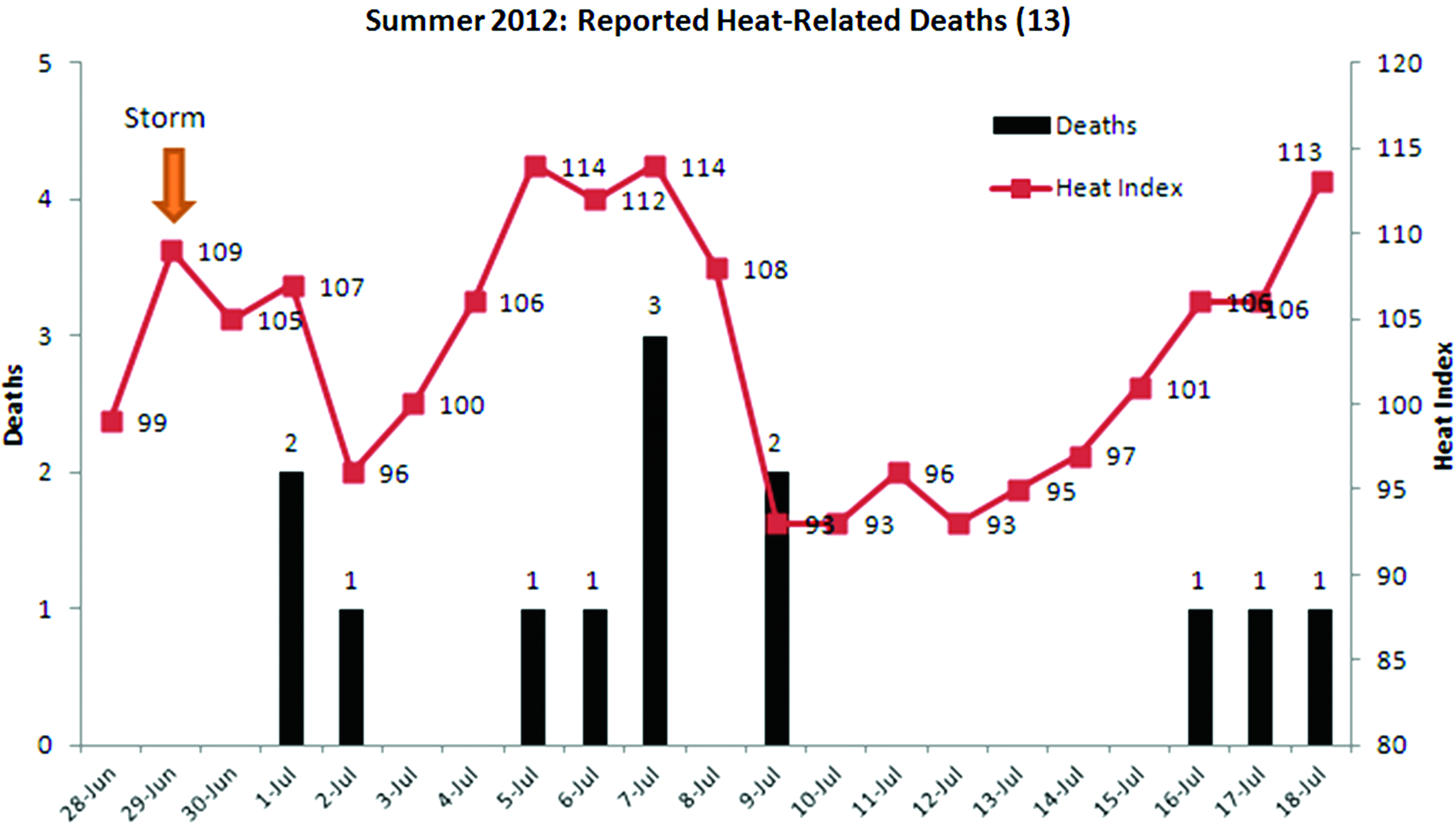
Heat-related deaths and heat index temperatures reported in Baltimore following the derecho storm. Color images available online at www.liebertpub.com/hs
Challenges in Evaluating the Program
At the end of each Code Red season, the BCHD convenes the Code Red partners for an after-action meeting to review the data collected during the summer and to discuss what worked well and areas for improvement in future summers. Feedback from the after-action meetings has led to improved communication pathways among partners and the development of a Google Drive® tool for sharing data. One challenge the program has faced is that the decision to declare Code Red is based on forecast temperatures, but weather forecasts can fall short and actual temperatures sometimes end up being higher than predicted. Several other challenges that affect the comprehensive evaluation of the Code Red program include the short time that the program has been in existence, data limitations, challenges associated with risk communication and behavior change, challenges associated with cooling center standardization and use, and challenges in measuring program effectiveness as discussed below.
Data Limitations
As new data sets become available, the BCHD is better able to ascertain the number of heat-related ED visits and EMS calls in Baltimore City, but access to data sets over the years has varied. Currently, the BCHD does not have enough data to determine statistical norms and baseline data that can be compared to periods of extreme heat in Baltimore. With time, the BCHD will be better able compare Code Red days to baseline data and will be able to better assess how heat-related ED visits and EMS calls vary on Code Red days compared with other days.
Risk Communication and Human Behavior
Public messaging and education for those who are the most vulnerable is a challenge, because the most vulnerable are often individuals who are isolated from the rest of society and do not have strong social networks. The BCHD encourages residents to check on their neighbors whenever Code Red heat alerts are issued. During long periods of extreme heat, the general public and the media can also experience message fatigue. It is necessary for health departments to adapt and find ways to effectively communicate about heat risk, especially as perceived threat diminishes the longer a heatwave lasts. 8
Human behavior and attitudes regarding heat also affect efforts to mitigate heat risks. Residents do not always understand the cumulative effect of heat stress on the body. Additionally, in emergency preparedness outreach settings, many Baltimore residents have indicated that they do not like the idea of going to a cooling center during the day and getting comfortable only to return home, where they do not have air conditioning, and becoming uncomfortable again. It is imperative that public health better communicate about heat risk and about the danger of hyperthermia increasing as duration of exposure increases. 8
Cooling Center Standardization and Use
Baltimore opens cooling centers on Code Red days at city-run facilities because the city has control of the buildings and can standardize hours of operation, which helps facilitate and streamline public information efforts. As part of its messaging regarding heat safety, the BCHD encourages residents to seek out cooling relief wherever they can. Other locations where residents can and do seek out cooling relief include public libraries and faith-based organizations and through other community organizations such as the Department of Social Services. It is unclear how many residents may be seeking cooling relief at locations other than official city cooling centers, and while the BCHD tracks cooling center usage at the city-run cooling centers, it does not currently collect data from other non-city sites where individuals may seek cooling relief. The BCHD is currently engaging with community partners and actively recruiting community cooling centers to become part of the standardized city cooling center program. Efforts to bring on additional cooling centers formally have proved difficult because of a lack of staffing at many faith-based organizations and community groups.
City cooling centers report data regarding center usage to the BCHD via the Google Drive® tool. City cooling centers report the number of individuals who visit the cooling center site and the number of bottles of water handed out. The BCHD sends out reminder emails to partner agencies who report data after each Code Red day. Because of staff limitations, the cooling center sites report all visitors to their site that day, so there are no data regarding how many individuals are visiting the site specifically for cooling versus regular services, including energy assistance.
Measuring “Effectiveness”
A final challenge in evaluating the program is the challenge of defining “effectiveness.” Morbidity and mortality data are one way of measuring the effectiveness of the Code Red program. Other potential metrics for measuring program effectiveness include reported changes in individual behavior and overall population behavior, although measuring whether or not individuals change their behavior is difficult to assess. The Code Red program is unfunded, and part of the planning and qualitative evaluation of the program each year involves examining the available resources and the direct and indirect costs to agencies who participate.
Conclusion
Baltimore City's Code Red program is a comprehensive, multi-agency approach to increasing public awareness about the effects of extreme heat, providing residents with energy assistance for cooling costs, and providing places where residents can seek out cooling relief during periods of extreme heat. The program is flexible and scalable in complex heat emergencies and extended heat waves, as demonstrated by Baltimore's response to the 2012 derecho. The program is still relatively new, and the BCHD continues to strengthen its data collection and risk communication strategies and to expand its network of community cooling center partners.