




Abstract

F
As a society, we have built our lives, behaviors, and activities around historical and current climate conditions. But increasing greenhouse gases in the atmosphere are changing the climate faster than at any time in recent history. 1 As a result, the conditions we are accustomed to and the environments in which we live will change in ways that affect human health. In addition to creating new problems, changes in the climate can exacerbate existing human health threats—for instance, by worsening air pollution and shifting the geographic distribution of certain diseases. 2 Further, many adverse effects of climate change can be compounded by the way in which our society is already changing, including population growth, an aging population, and migration patterns that are concentrating development in coastal and urban areas.
In June 2015, EPA released a report 3 (hereafter referred to as “this report”) estimating the impacts of climate change across 20 sectors in the United States. From health to infrastructure to agriculture, this report estimates the physical and economic risks of inaction on climate change across regions of the country. Based on rigorously peer-reviewed modeling and analysis from experts in government and academia, the report examines 2 potential future worlds: one in which no significant actions are taken to reduce greenhouse gas emissions, and one with global action to limit warming to approximately 2°C above preindustrial levels. This latter scenario represents an important threshold for avoiding dangerous climate effects, as defined by the United Nations Framework Convention on Climate Change. 4 With this goal in mind, international climate negotiations recently culminated in the historic Paris Agreement last December. 5
Importantly, the findings of this report, which are consistent with similar efforts focused both domestically 6 and in other world regions, 7 show that global climate action to reduce greenhouse gases will save lives, protect the environment, and reduce economic damages. The accounting of damages that can be reduced or avoided with greenhouse gas mitigation across a diverse range of sectors and regions provides a compelling basis for urgency in climate action. This conclusion carries forward to impacts that resonate well with specific audiences, from public health advocates to infrastructure planners to freshwater anglers.
Let's consider some of the report's findings relevant to health security.
Air Quality
Worldwide, 2005 to 2014 was the warmest decade on record, and 2015 was the warmest year yet. 8 Left unchecked, rising temperatures and other changes to the climate will likely worsen air pollution, leading to more asthma attacks, respiratory disease, and cardiovascular disease. Figure 1 shows the estimated impacts of climate change on air pollution in futures with and without global action to reduce greenhouse gases. Substantial increases in ozone and fine particulate concentrations are projected for densely populated areas of the country. But with global climate action, Americans can avoid most of these adverse changes to air pollution, preventing an estimated 57,000 premature deaths in the year 2100 alone (∼13,000 per year in 2050). These substantial benefits are amplified when we consider the significant benefits to air quality and health that would stem from the simultaneous reductions in traditional air pollutants along with greenhouse gas emissions mitigation. 9

Projected Impacts on Air Pollution in 2100. Estimated change in annual average ground level hourly ozone (O3, ppb) and fine particulate matter (PM2.5, μg m–3) from 2000 to 2100.
Extreme Temperature
During a 1995 heat wave in Chicago, an estimated 700 people died from the extreme temperatures. Without global action to reduce greenhouse gases, the number of extremely hot days in the contiguous United States could triple between 2050 and 2100, leading to an estimated 13,000 deaths annually by 2100 in the 49 major cities analyzed. Importantly, this large increase in projected deaths accounts for reductions in deaths due to extreme cold temperatures, which are far outweighed by increases in heat-related mortality.
But with global climate action, this mortality could be reduced by over 90%. These benefits of reducing global greenhouse gas emissions can be seen in Figure 2, which shows projected extreme temperature mortality under both scenarios. It is important to note that including the entire US population in the analysis would greatly increase the number of avoided deaths, while advancements in adaptation could moderate the outcome. 10
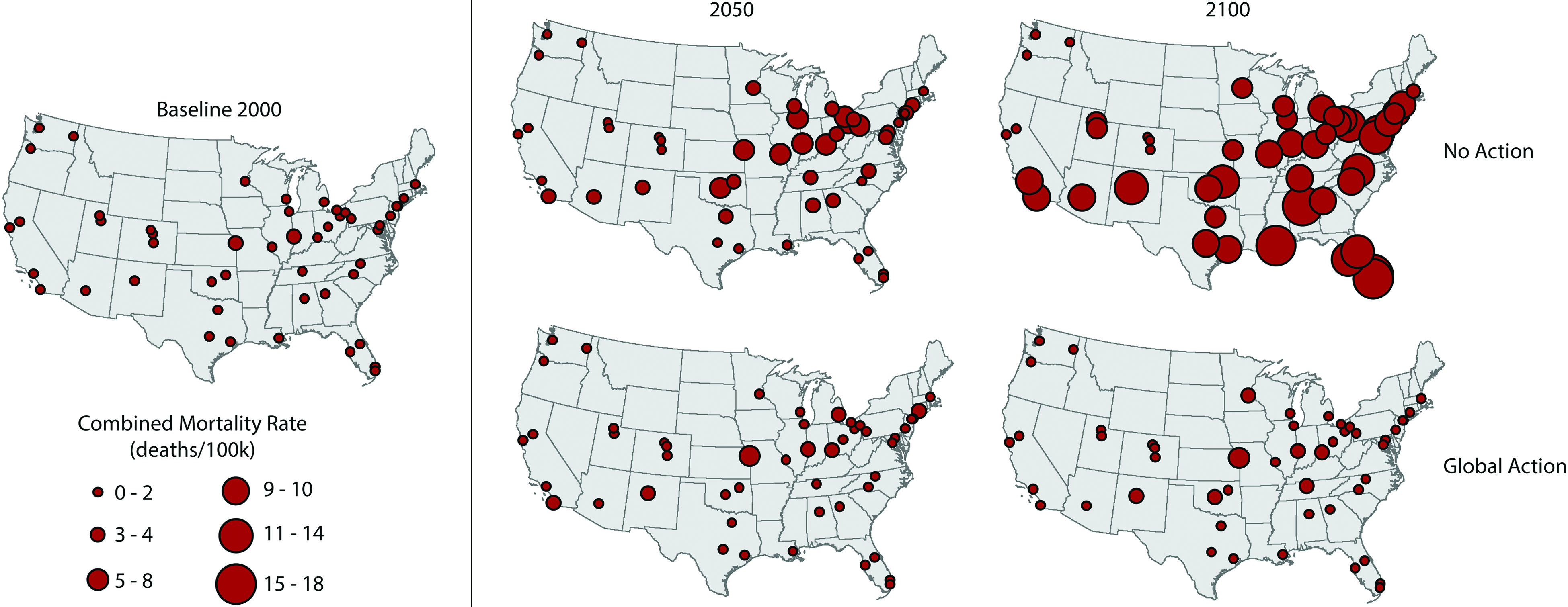
Projected Extreme Temperature Mortality in Selected Cities. Estimated net mortality rate from extremely hot and cold days (number of deaths per 100,000 residents) for 49 cities in 2050 and 2100. Red circles indicate cities included in the analysis; cities without circles should not be interpreted as having no extreme temperature impact.
Labor
Extreme temperatures also affect our productivity, especially for those who work in industries exposed to the elements. When temperatures are too hot to perform the highest-risk outdoor labor (eg, construction, agriculture), workers must reduce their productivity or face potentially life-threatening consequences. Without global action on climate change, over 1.8 billion labor hours are projected to be lost to extreme temperatures each year by the end of the century, which includes both gains from reduced cold weather and losses from extreme heat. But when global greenhouse gases are mitigated, the number of lost labor hours in the US is substantially reduced, saving approximately $110 billion in annual wages by 2100.
Climate change will affect human health in many other ways as well. While not described in detail here, the report investigates many health-related impacts, including drought risk, agricultural productivity, and damages to infrastructure. When infrastructure, the availability of water supplies, and food security are threatened, our health and economic well-being will be jeopardized.
Discussion
The studies underlying this report provide important information in a growing body of research quantifying climate risks. While the results from this study are compelling, only a small portion of the impacts of climate change are estimated; therefore, the report captures just some of the total benefits of reducing greenhouse gases. Future studies can provide more information for quantifying climate risks to public health, analyzing the benefits of climate action, and enhancing adaptive capacity.
For health in particular, we know that the impacts of climate change are likely to be widespread and significant. There is a substantial body of research that shows the wide range of adverse health consequences that may occur worldwide as a result of climate change, including heat impacts on work, human performance, and daily life; morbidity and mortality due to heat waves; respiratory and allergic disorders; vectorborne disease; waterborne and foodborne disease; health impacts related to food and nutrition insecurity; effects of extreme events; mental health impacts; and others. 11 In 2016, the US Global Change Research Program will release a scientific assessment devoted to climate change and human health. This assessment will strengthen and expand our understanding of climate-related health impacts in the United States. Likewise, EPA leads a targeted research program 12 focused on advancing our knowledge of the impacts of climate change—including understanding which populations are most vulnerable—and the measures that can be taken to help us prepare for and adapt to the expected impacts.
The robust and growing body of research points to the urgent need for bold action on climate change. EPA is taking action under the Clean Air Act to reduce harmful pollution from our power plants, cars, trucks, and other greenhouse gas–emitting activities in order to safeguard the health of all Americans, current and future. EPA is also taking action to better understand how vulnerable communities can take steps to become more resilient in the face of climate-related impacts that may occur. It is increasingly clear that the sooner we act, the greater the benefits—for our health, our economy, and our security.