




Abstract
A biosecurity survey was performed to gather information on the biosecurity level and laboratory capacity in Kenya for the purpose of providing information outlining relevant components for biosecurity legislation, biosecurity implementation, and enforcement of biosecurity measures in Kenya. This survey is, to the authors' knowledge, the first to be published from an African country. A total of 86 facilities with laboratories covering relevant categories, such as training laboratories, human diagnostic laboratories, veterinary diagnostic laboratories, and research laboratories, were selected to participate in the survey. Each facility was visited by a survey team and staff were asked to answer 29 groups of questions from a questionnaire. The survey showed that Kenyan laboratory facilities contain biological agents of biosecurity concern. The restrictions for these agents were found to be limited for several of the facilities, in that many laboratory facilities and storage units were open for access by either students or staff who had no need of access to the laboratory. The survey showed a great deal of confusion in the terms biosecurity and biosafety and a generally limited biosecurity awareness among laboratory personnel. The survey showed that the security of biological agents of biosecurity concern in many facilities does not meet the international requirements. The authors recommend developing a legal framework in Kenya for effective controls, including national biosecurity regulations, guidelines, and procedures, thereby reducing the risk that a Kenyan laboratory would be the source of a future biological attack.
A biosecurity survey was taken to gather information on the biosecurity level and laboratory capacity in Kenya. A total of 86 facilities participated; each was visited by a survey team, and staff were asked to answer 29 groups of questions. The survey showed that Kenyan laboratory facilities contain biological agents of biosecurity concern. Many laboratory facilities and storage units were accessible to students or staff who had no need for access. The survey showed confusion in the terms biosecurity and biosafety and a generally limited biosecurity awareness among laboratory personnel. It also showed that the security of biological agents of concern in many facilities does not meet international requirements.
B
The term laboratory biosecurity does not seem to have a standardized meaning across human, animal, and plant health sectors. In veterinary and agricultural fields, the term has come to denote protecting biological resources from foreign or invasive species or genetically modified crops.7,8 The World Health Organization (WHO) defines biosecurity as the protection, control, and accountability of valuable biological materials in laboratories, in order to prevent their unauthorized access, loss, theft, misuse, diversion, or intentional release. 9 The connotations of biosecurity in public health settings relate more closely to the BWC; the concepts are not restricted to public health laboratories but have also been expanded to a variety of other facilities, sites, and areas that work with resources that could be used for purposes prohibited by the BWC. In this context, biosecurity means “institutional and personal security measures and procedures designed to prevent the loss, theft, misuse, diversion or intentional release of pathogens, or parts of them, and toxin-producing organisms, as well as such toxins that are held, transferred and/or exported/imported and including delivery systems and other related materials,” according to OECD (http://www.oecd.org/sti/biotech/38778261.pdf) and UNSCR 1540. 5
Kenya has followed up on its obligation to international laws on prohibition and prevention of the abuse of biological material that pose a threat by drafting a bill and policy: the Kenya National Biosciences Bill and the National Biosciences Policy.2,3,10 As a part of the Kenyan policymaking process, a need was identified for information on the current level of biosecurity measures in laboratory facilities. As part of a collaboration between Denmark and Kenya on biosecurity, this survey was carried out with the engagement of members from the National Commission for Science, Technology and Innovation (NACOSTI), from the National Biosecurity Advisory Committee (NaBAC), and with experts from the Danish Centre for Biosecurity and Biopreparedness. In 2007, a similar survey was carried out in Denmark; it is described in the study by Bork et al 11 and was instrumental in the passing of Danish biosecurity legislation in 2008 and 2009. Experience from this survey was used in Kenya.
The purpose of the biosecurity survey performed in this study was to gather information regarding the general level of biosecurity and laboratory capacity in Kenya in order to provide information outlining relevant components for future legislation and biosecurity implementation in Kenya. Because biosecurity and biosafety in some practical aspects overlap, the survey included questions concerning biosafety, because important information, such as restricted areas and biohazard signs that are relevant to the estimation of established security measures, otherwise could be lost. Finally, the survey served the critical purpose of raising awareness of biosecurity in the laboratories and aiding in acceptance and understanding of the upcoming legislation on biosecurity.
Material and Methods
Definition of the Survey Area
The survey team visited and interviewed personnel in 86 selected facilities in Kenya. Facilities visited were composed of different types of laboratories, which were identified as being capable of handling or storing biological pathogens and toxins (Figure 1). The relevant facility categories were: teaching and training facilities, universities, public health (diagnostic) facilities, veterinary (diagnostic) facilities, foreign-supported research facilities, commercial production facilities, commercial diagnostic facilities, and hospitals. The different types of facilities were represented in the survey to varying extent, prioritizing the labs thought to be most relevant. Three cities in Kenya—Nairobi, Mombasa, and Kisumu—have the most advanced laboratories. An overview of the type and numbers of the facilities participating in the survey can be found in Figure 1.

Types and Numbers of Facilities
Preparation of the Questionnaire
The Danish survey questionnaire used in the study by Bork et al 11 was used as a template and modified to suit the Kenyan conditions. The biological agent list used in this study was based on the Australia Group list for export control, 12 with additions of other relevant and prevalent agents in Kenya suggested by the stakeholders from the National Committee of Science and Technology and the National Biosecurity Advisory Committee and drawn up in October-November 2014. The final questionnaire consisted of 29 questions. The questions are presented in Table 1, including text explaining what we expected to gain from the question. Some of the questions were multiple-choice and others were qualitative questions, to gather as much information as possible from the facilities.
Final Questionnaire
Facility Visits and Interviews
Teams of representatives from NACOSTI, NaBAC, and the Center for Biosecurity and Biopreparedness (CBB) carried out the survey. Each interview was performed at the facility, and the visit was started with a presentation of the background and purpose of the survey and an explanation of the biosecurity term. Physical inspections of the laboratories and storage rooms were conducted subsequent to the interview. The facility could choose to bring in the staff responsible for an area; these people might be either a dedicated biosecurity/biosafety officer and/or the person responsible for the laboratory. A NACOSTI or NaBAC representative explained the questionnaire and clarified individual questions if needed. The answers to the questions were noted throughout the interview, and the final questionnaire was signed and endorsed by the heads of respective facilities at the end of the visit.
The survey was conducted over 3 3-week periods (a total of 9 weeks): the first was carried out in November-December 2014, and the second and third in parallel in January-February 2015. During the first period, facilities in the proximity of Nairobi were visited, and during the last period facilities in Mombasa and Kisumu regions were visited.
All visited institutions were informed that the survey was anonymous to obtain answers that were as true and correct as possible. The participating institutions and employees were informed that their names would not be revealed when data from the questionnaires were published either as government reports or publications.
Results
Biological Pathogens and Toxins
The biological agents reported during the survey consisted of bacteria, viruses, and toxins. In addition, other biological agents were included, as these were considered geographically important for this survey, but these data are not presented in this study.
Question 1 (Table 1) concerned storage and handling of pathogens, as well as the resources and ability to handle these in diagnostic tests, including serological methods, PCR, microscopy, and various detection kits. The laboratory facilities were grouped in 3 categories, depending on the nature of the work carried out in the laboratory (information received as part of the response to question 1): (1) detect specific agents (using only serological tests); (2) detect and handle (perform culture identification) but not store specimens; or (3) detect, handle, and store live specimens (identify, isolate, and store specimens). The 32 laboratories (37%) participating in the survey confirmed having long-term storage of some biological agents (bacteria, viruses, or toxins) listed on the Australia Group list. 12
The survey showed that Kenyan facilities stored 25 different agents consisting of bacteria, viruses, and toxins. The 32 facilities (37%) stored 16 agents consisting of both bacteria and viruses that were of high biosecurity concern and on the Australia Group list (Table 2).
Facilities that Handle and Store Agents on the Australia Group List. Individual answers from 17 questions from the questionnaire were compared to the agents
In the survey, facilities hosting laboratories of biosafety levels (BSL) 1 and 2 were almost equally represented (47 BSL-1 [54%] and 49 BSL-2 [57%]), with only a few facilities also hosting laboratories of BSL-3 (7 facilities, 8%) and none of BSL-4. Even though the majority of the biological pathogens and toxins reported by the laboratory facilities in question 1 require BSL-2 or -3 facilities, 17 BSL-1 laboratories handled or stored these agents, with the majority of these being university laboratories.
Keeping Track of Biological Agents
Forty-eight (56%) facilities with long-term storage of biological agents (including agents not on the Australia Group list) kept their pathogens in freezers and refrigerators according to Questions 8 and 10 (Table 1). Twenty-two (26%) facilities confirmed that they kept inventory lists of their biological materials and that these lists were updated regularly (at least once a month). Seven (8%) facilities kept inventory lists that were updated less than once a month, while 14 (16%) facilities did not keep inventory lists. Ten laboratories (12%) confirmed having the combination of updated inventory lists and anonymous labeling of samples.
Questions 16 and 17 sought to determine biohazard visibility—that is, whether facilities informed nonrelevant personnel and guests of hazards in their facility when working with biological materials, thereby also informing them of where pathogens are kept. The majority (62 of 86 facilities, or 72%) followed the general biosafety regulations and posted relevant biohazard signs at the entrance of the laboratories.
Containment of Biological Pathogens and Toxins
The most commonly used containers for short- or long-term storage of biological agents are freezers, refrigerators, or cupboards. According to answers to question 21, many facilities that routinely store biological pathogens or toxins always kept containment vessels such as freezers, refrigerators, and cupboards locked (29 facilities, 34%). Six (7%) of these facilities had no lock on their storage containers, and 11 facilities often left the storage container unlocked even though it was equipped with a lock. No facilities secured their pathogens in the temporary containment vessels.
Physical Security of Laboratories and Storage Rooms
The majority of facilities participating in the survey kept the doors to the laboratory closed but not locked during working hours (50 facilities, 58%) and always locked the doors after working hours (64 facilities, 74%). Twenty-two (26%) facilities that routinely stored biological pathogens or toxins answered that their storage rooms were “generally” locked after working hours. Three (3%) of these facilities never or rarely locked their storage rooms, while 5 (6%) facilities always kept these rooms locked after working hours. Three facilities (3%) confirmed that they had no locks on their storage containers and that storage rooms were never or generally not locked. Three facilities (3%) always locked their storage containers and the storage room.
Whereas locks are the preferred method of physical security to the storage room among the interviewed facilities (34 facilities, 40%), a minority indicated that electronic devices such as alarms (5) and card readers (3, with and without pin codes) were also represented in question 23. Alarms were applied and activated only after normal working hours in 2 facilities (2%) that routinely store biological pathogens or toxins. In all, 23 facilities (27%) stated that security guards were posted at the laboratories after working hours; 13 facilities (15%) had guards at other locations in the facility—for example, at the gate or entrance to the facility. In addition, laboratories and storage rooms in 21 facilities (24%) were equipped with bars or grills on windows and doors. The quality of the protective measures and the alertness of guards was not included in the questionnaire.
Incidents Regarding Loss of Material
Asked about the number of incidents of lost materials during the past 5 years, 69 (80%) facilities answered that they had had no such incidents. Seven facilities (8%) reported having 1 to 5 incidents. Only 10 facilities (12%) did not know whether they had lost materials. These answers should be considered in light of the lack of inventory lists for biological agents. If theft of biological materials were to happen, 9 (10%) of the 86 facilities had a procedure implemented, clearly specifying the action needed to be taken for the incident.
Biosecurity Awareness Among Personnel
In the majority of facilities, personnel claimed to have heard of biosecurity but were often not able to define it and distinguish it from other measures. In 23 facilities (27%), the biosecurity concept was unknown. Asked about sources of specific guidelines or regulations for biosecurity and biosafety in question 5, 32 (37%) facilities answered that their policies or regulations came from international biosecurity organizations (most of these facilities were foreign collaboration research facilities and veterinary diagnostic facilities). Forty-two facilities (49%) derive their policies on biosafety and biosecurity from national or county government guidance. Twenty-one (24%) facilities participating in this survey did not have access to biosecurity policies or regulations. Thirty-three (33%) of the facilities claimed to have trained 1 or more staff in biosecurity aspects, while 52 (60%) had not; 1 facility did not answer this question.
Appointing a Biosecurity Officer or Committee
Facilities were allowed to answer yes to question 24 only if a person had been specifically appointed as biosecurity officer. In Kenya biosecurity officers and a biosecurity committee are not yet required by law. Biosafety officers without specific training in biosecurity issues were not counted as biosecurity officers. Twenty-three (27%) facilities stated that they had an appointed biosecurity officer. Generally, the facilities claimed to refer biosecurity issues to the biosafety officer (question 13). Facilities with a specifically appointed biosecurity officer (27%) were mainly represented by foreign-supported research facilities and hospitals. Asked whether their facility had generated an institutional biosecurity committee, 9% of facilities said yes: 5 foreign collaboration research facilities and 3 hospitals.
Personnel Accessibility and Identification
Among the facilities participating in this survey, the majority confirmed that a maximum of 100 permanent staff members had daily access to areas where biological pathogens were kept. However, some facilities reported that more than 300 people on the permanent staff had unhindered access to laboratories where pathogens were stored or handled. In the case of teaching institutions, the number of students, interns, postdocs, and others could reach several hundred per month, as could the number of visitors to the facilities.
Transport of Pathogens and Waste Management
Answers to question 13 reflected that several facilities had implemented various security procedures such as personnel screening and preparation of relevant standard operating procedures (SOPs), mainly for biosafety reasons. SOPs for managing biological waste seek to ensure that the waste is destroyed and poses no danger to personnel. The majority of the participating facilities confirmed having SOPs for handling of biological waste (72 facilities, 84%), while 14 (16%) had no such procedures. Regarding SOPs for transportation of infectious materials, more than half of the facilities confirmed that they had such procedures (53, or 62%), while 31 (36%) had no SOPs. Twelve (14%) facilities had no SOPs for waste management or transportation of infectious materials.
Security Levels in Kenyan Laboratories
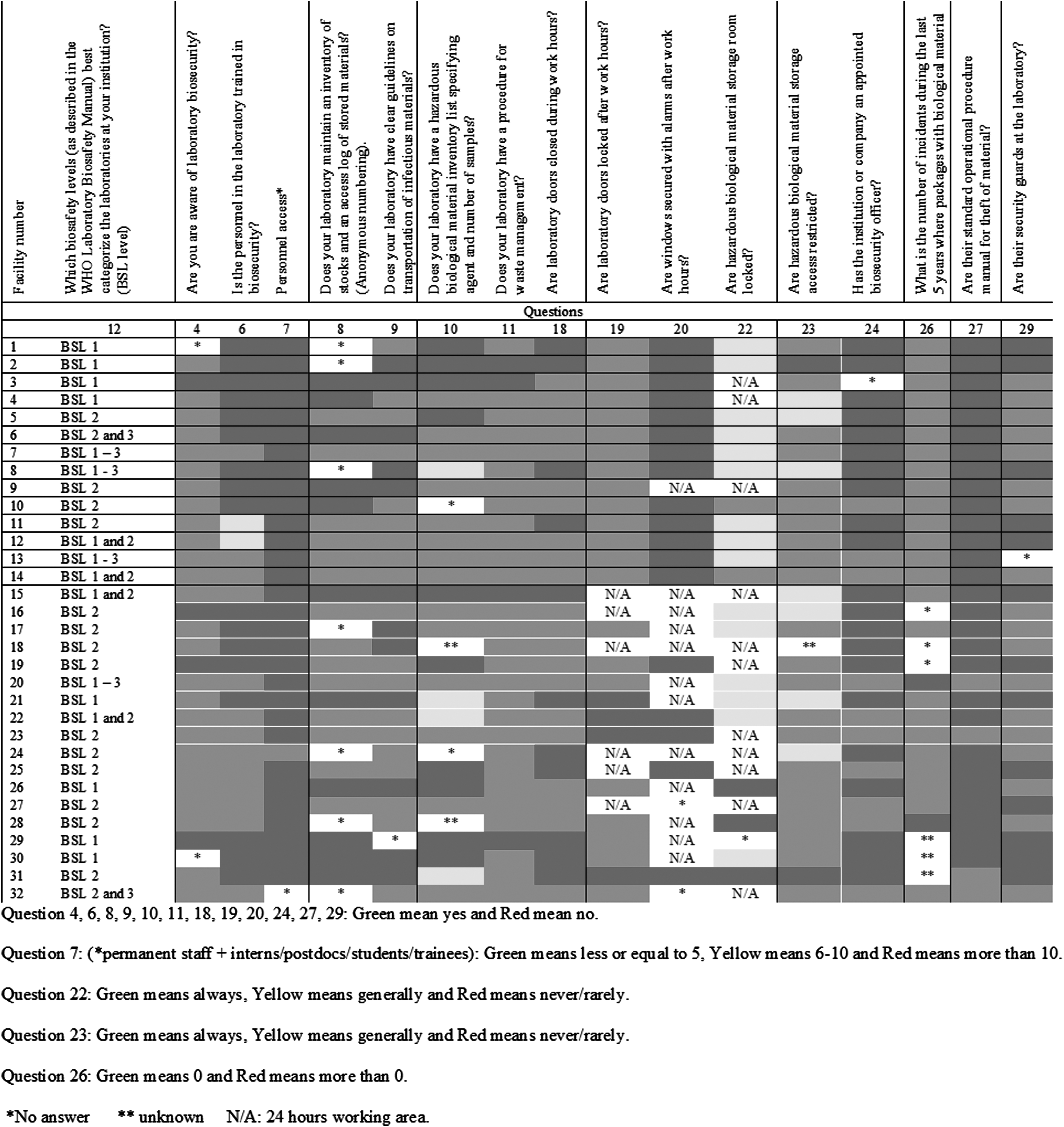
Table 2 presents a list of answers to key biosecurity questions from the 32 laboratories storing biological agents listed on the Australia Group agents list. Combining the answers from those facilities that had a general lack of access restriction to the concerned biological agents (question 7) with the answers from questions 22 and 23 regarding either locked storage room or locked container, it was found that only 1 (1%) facility had no access restriction to biological agents, while 8 (9%) facilities in general, but not always, had access restriction to biological agents. Also, guidelines for transportation (question 9) of pathogens were not present in 12 (14%) facilities. Of general concern is that 2 of the facilities reported that incidents of lost material had occurred within the past 5 years (question 26).
Discussion
With the increasing focus on intentional misuse of biological agents worldwide,1,13,14 there is a need for countries including Kenya to evaluate their biosecurity level and awareness. Kenya signed on to the BWC and UNSCR 1450 in 1976 and 2004, respectively, making the commitment to enforce national implementation measures on categorized biological select agents and related materials that cause harm and can potentially be used as weapons. 5 Kenya has passed legislation on the Cartagena Protocol on Biosafety (CPB) with regards to genetically modified organisms (GMOs) 15 to ensure safety in human use and environmental protection, but biosafety requirements dealing with risks of exposure to biological agents cannot be effected due to framework challenges and ability of authorized institutions implementing occupational health and safety.
Many hospital labs in Kenya are in the process of implementing the WHO Guide for the Stepwise Laboratory Improvement Process Towards Accreditation (SLIPTA) in the African Region, 16 and this is reflected in the implementation of many principles of biosafety at the lab level. Biosecurity regulation is not yet a part of a unified law in Kenya, which is reflected in the uneven biosecurity implementation in the country. However, biosecurity is part of the guidelines in some Kenyan laboratories, and the Ministry of Health has published laboratory policy guidelines for biosafety and biosecurity. 17 Nevertheless, this survey clearly illustrates that guidelines are voluntary for the laboratories and need to be backed up by legislation to be implemented evenly.
A survey on the biosecurity level in a nation's laboratory facilities is a tool that can provide the government with information on the level of biosecurity in the region. In 2007 a biosecurity survey was performed in Denmark, 11 and in Holland a biosecurity toolkit based on a questionnaire has been developed. 18 To the best of our knowledge, Kenya is the first African country to present published survey data on the biosecurity level of its laboratory facilities.
A list of pathogens and toxins with the potential to pose severe threats is important in framing and defining ways to safeguard and secure these agents against theft, loss or release, export, import, transport or transfer, and transit. In this study Kenya chose to use the internationally developed and accepted list from the Australia Group and added agents that may be of particular importance to local Kenyan conditions.
In this survey we found that Kenyan facilities stored 25 different agents consisting of bacteria, viruses, and toxins, of which 16 agents, bacteria and viruses, are of especially high biosecurity concern and on the Australia Group list. Several studies have been published showing the potential bioterror risk for many of the agents found in the Kenyan facilities.1,13,19 At the Australia Group website (http://www.australiagroup.net/en/controllists.html), information on the potential misuse and consequences of a specific agent can be found. Kenyan laboratory facilities contain agents with a potential biosecurity risk, and it is important to bring to the attention of the government the conditions under which some of these agents are stored and what improvements are necessary to secure them against theft and misuse.
The survey showed that fewer than 50% of the facilities with long-term storage had a regularly updated inventory list to keep track of its biological agents, and we believe that this number may actually be an overestimate. The majority of facilities routinely storing biological pathogens or toxins did keep them under lock. In addition, the majority of facilities kept the laboratory closed and locked after working hours. A similar observation regarding inventory lists was also seen in the Danish survey, 11 where only about one third of the facilities had a regularly updated inventory list. Keeping track of biological agents is an important issue, highlighted by recent incidents of, for example, misplaced biological agents. 20 Examples of agents being stolen from laboratories to be used for bioterror has been seen in the past. 18
Handling dangerous pathogens for diagnostic purposes is often not connected with subsequent long-term storage. Most hospital and laboratory facilities dispose of the material after diagnosis. However, these laboratories have a high throughput of samples containing dangerous pathogens, and skilled microbiologists handle these samples on a daily basis. Diagnostic facilities are, therefore, a potential source of biological weapon material. In addition, they could be a source of expertise in isolating and weaponizing such material. Therefore, we recommend that legislation stipulate that facilities with microbiological diagnostic laboratories be licensed. Lost biological material is always of concern because of the risk of misuse, and, as observed in this study, 2 of the facilities storing agents of biosecurity concern reported having an incident of lost material. There might have been more incidents, but they were impossible to spot because of the lack of updated inventory lists.
The transport systems also are vulnerable, and procedures are needed to take into account the risk of theft of biological material. The survey showed lack of security procedures in connection with transport. That good practices regarding handling, storage, and shipment are important can be seen in the reports by Weiss et al, 20 which present a review of recent incidents with biological agents of biosecurity concern from the United States.
Regarding biosecurity awareness among personnel, it is important to know the definition of biosecurity and the differences between biosecurity and biosafety. WHO has described both laboratory biosafety and laboratory biosecurity,9,21 and several papers describe the differences and what is important for biosafety and biosecurity standards.2,18
The survey data showed that few facilities were implementing biosecurity. This was reflected in a lack of internalized biosecurity procedures in general and limited understanding of the difference between biosafety and biosecurity requirements. These results were similar to the observations from the Danish study 11 and to be expected when biosecurity is not mandatory.
Because there is as yet no law or regulation regarding biosecurity in Kenya, appointment of a biosecurity officer and/or a biosecurity committee is not a requirement. However, even without this requirement, 23 facilities reported that they had an appointed biosecurity officer, and 7 facilities reported having a biosecurity committee. A reason that was provided from the institutions for having a biosecurity officer or a biosecurity committee was that this was a request from foreign donors if they were to support the institution.
The data in Table 2 clearly show that improved biosecurity measures are needed at many Kenyan laboratory facilities, because biological agents are stored under easily accessible conditions in locations with high throughput of employees and nonemployed people. The majority of facilities reported monthly access of up to 100 people, while other facilities reported that more than 300 people had access to rooms where dangerous biological pathogens are stored. It is in the interest of both Kenya and the international community to ensure a legal national biosecurity framework, including a national biosecurity authority, to secure Kenya from being a source of biological material or know-how for the next bioterrorism attack anywhere.
In general, the survey showed a similar biosecurity situation in the Kenyan laboratory facilities compared to those in Denmark in 2007. Today, Denmark has achieved a well-functioning biosecurity system, based on a single, dedicated law and a single executive order. A handbook on the Danish biosecurity system, An Efficient and Practical Approach to Biosecurity, from 2015 can be found online at the CBB homepage (https://www.biosikring.dk/biosecuritybook/). 22 Regulations for working with agents of biosecurity interest must take a balanced approach and be flexible in coming up with solutions that will not unnecessarily hinder the important work of the diagnostic laboratories, individuals, or entities including accredited institutions. In order to safeguard and ensure nonproliferation of potential biological agents requires responsible officials or personnel, responsible ownership or control of entities, and regulation of activities involving any categorized biological select agents and toxins, delivery systems, and related materials.
In conclusion, the survey data clearly show that Kenyan facilities contain biological agents of biosecurity concern and that the security of these agents is suboptimal. At this point, no comprehensive law or formal set of rules covers all aspects of biosecurity in Kenya. Legislation is strongly recommended to ensure a mandatory harmonized biosecurity system in Kenya.
Footnotes
The authors acknowledge Dr. Roselida Owuor, Dr. Solomon Gikundi, Dr. Grace A. Murilla, Mr. Willmoth Mukua, Mr. Steen Giese, and Mia Kjems Drægert for their help and support for this study.