




Abstract
The ability to rapidly detect and report infectious diseases of domestic animals and wildlife is paramount to reducing the size and duration of an outbreak. There is currently a need in the United States livestock industry for a centralized animal disease surveillance platform, capable of collecting, integrating, and analyzing multiple data streams with dissemination to end-users. Such a system would be disease agnostic and establish baseline information on animal health and disease prevalence; it would alert health officials to anomalies potentially indicative of emerging and/or transboundary disease outbreaks, changes in the status of endemic disease, or detection of other causative agents (eg, toxins). As a part of its mission to accelerate and develop countermeasures against the introduction of emerging and/or transboundary animal diseases into the United States, the Department of Homeland Security is leading and investing in the development of an enhanced passive surveillance platform capable of establishing animal health baselines over time and alerting health officials to potential infectious disease outbreaks or other health anomalies earlier, allowing for more rapid response, improved animal health, and increased economic security.
The ability to rapidly detect and report infectious diseases of domestic animals and wildlife is paramount to reducing the size and duration of an outbreak. There is currently a need in the US livestock industry for a centralized animal disease surveillance platform, capable of collecting, integrating, and analyzing multiple data streams with dissemination to end-users. The Department of Homeland Security is leading and investing in the development of an enhanced passive surveillance platform capable of establishing animal health baselines over time and alerting health officials to potential infectious disease outbreaks or other health anomalies earlier, allowing for more rapid response, improved animal health, and increased economic security.
A
In 2014, a new strain of highly pathogenic avian influenza (HPAI) appeared in US poultry, causing an outbreak that lasted from December 2014 through July 2015. This HPAI outbreak devastated affected producers and resulted in the deaths of 7.5 million turkeys and 42.1 million egg-layer and pullet chickens. The total cost to taxpayers as a result of this outbreak was nearly $1 billion. 2 If a foot-and-mouth disease outbreak were to occur in the United States, economic models estimate total trade losses and other costs related to disease would range between $2.77 billion and $4.06 billion. 3 In addition to the extreme cost and detrimental effects to the food supply caused by an animal disease outbreak in the agricultural sector, the potential emergence of zoonotic pathogens in domestic animals is cause for concern among human populations. Approximately 75% of emerging pathogens are estimated to be zoonotic. 4
In 2003, the US government designated the food and agriculture sector as a critical part of our nation's security and economy. Homeland Security Presidential Directives 7 5 and 9 6 direct the Secretary of Homeland Security to enhance the protection of our nation's critical infrastructure and key resources from those incidents that could have a negative effect on the economy, cause catastrophic health effects, and impair the ability of federal agencies to perform essential missions and ensure the public's health and safety. The Agricultural Defense Branch in the Science and Technology Directorate of the Department of Homeland Security (DHS) strives to enhance current detection capabilities and develop state-of-the-art countermeasures for high-priority foreign animal diseases. The nation's food and agriculture sector involves a complex array of stakeholders who conduct business that is regulated and protected by both federal and state agencies. When faced with an animal disease outbreak, decision makers must take action in an attempt to mitigate the impact of the outbreak. These actions have both immediate and long-term consequences for the affected industries.
The ability to detect infectious pathogens or other causative agents (eg, toxins) early and take steps to prevent their spread is an essential first step in thwarting an animal disease outbreak. There is currently a need in the US animal agriculture industry for a centralized disease surveillance platform, capable of collecting, integrating, and analyzing multiple data streams with dissemination to end-users and creating an early warning system for disease outbreaks. In an effort to augment the resilience of our food supply against newly emerging, endemic, zoonotic, and transboundary disease threats, DHS is leading and investing in the development of a suite of tools at the Institute for Infectious Animal Diseases (IIAD), a DHS Science and Technology Center of Excellence headquartered at Texas A&M University. This suite of tools, developed under the AgConnect® trademark, addresses multiple aspects of managing animal health and business continuity before, during, and after an outbreak. AgConnect® products are designed to promote day-to-day use during non-outbreak situations, so both the livestock industry and animal health officials are accustomed to the systems and data collection when rapid responses are required during an outbreak.
The AgConnect® suite includes the Enhanced Passive Surveillance (EPS) system, a tool designed to enhance early detection of clinical signs, diagnosis, and reporting of poultry, livestock, and other animal diseases in an effort to shorten detection and response times and augment the resilience of our food supply against endemic and transboundary animal disease threats. The concept of enhanced passive surveillance includes activities such as technology development, which enhance the value of passively collected data by integration, analysis, and dissemination. 7 The coordinated effort of IIAD and partners, including federal government sponsors and stakeholders, supports the development of tools to promote this type of data collection. Prior to the onset of this effort, no single animal health surveillance platform existed with the ability to integrate real-time, veterinarian-submitted syndromic data; laboratory results from specimen submission; and related, external data sources supporting epidemiologic data analysis.
Ideal Animal Health Surveillance System
An ideal animal health surveillance platform offers everyday value (ie, value that users gain through conducting routine, day-to-day tasks during non-outbreak situations) to the agriculture industry while serving as a secure, sustainable system for the collection, integration, monitoring, analysis, and sharing of real-time animal health data. Real-time, multistream syndromic reporting with adequate geographical coverage allows practitioners to view the current health status of animals both in adjacent counties and in other more distant regions of the United States. During an outbreak situation, this aggregation of real-time syndromic reporting data would be critical to rapidly detecting, diagnosing, assessing, and mitigating the threat of disease spread by implementing measures such as increased biosecurity and targeted surveillance for early detection in high-risk areas. Other attributes of a useful and sustainable disease surveillance program include:
▪ Collecting disease-agnostic data to facilitate disease identification; ▪ Targeting by location and risk profile to maximize investigation and sampling of high-risk animals; ▪ Integrating the data collection process with ongoing daily animal production activities for multiple users with minimal training requirements; ▪ Standardizing essential data fields with appropriate access to voluntarily authorized data points to assure confidentiality and appropriate privacy; ▪ Providing automated visual and analytical tools to support timely data monitoring, detection, and alerting to anomalies to all users of the system (eg, veterinarians and producers, state and federal officials); and ▪ Incorporating effective incentives for use, including a system that is user-friendly, provides day-to-day utility, and is readily adapted by end-users.
AgConnect® and Enhanced Passive Surveillance
In 2007, the DHS Science and Technology Directorate's Office of University Programs (OUP) and IIAD began leveraging previous modeling and simulation expertise in support of a research effort to build a rapid prototype information technology solution with the intent of demonstrating how data could be used to support decision making during an animal disease outbreak. Since the initial concept, DHS and IIAD have worked together with animal agriculture commodity groups, state agencies and laboratories, and federal partners to develop a subsequent proof-of-concept data- and information-sharing and management architecture. This architecture allows for business-sensitive data to be integrated from disparate data sources based on established data-sharing protocols, to support shared situational awareness. The resulting prototype system is called AgConnect®; it represents approximately 4 years of collaborative work among DHS, the US Department of Agriculture (USDA), IIAD, state agencies, swine producers and companies and food animal private practitioners, and numerous other public and private sector partners.
One of the first applications of AgConnect® was to support business continuity plans in the swine industry. Continuity of business is a high priority to any animal industry before, during, and after an animal disease outbreak. To that end, AgConnect® houses several software applications that provide a collection of visual and analytical capabilities that bring value to the various business and emergency management functions related to protecting animal health and keeping animals and animal products moving. These applications leverage a common IT architecture, allowing for interoperability and standardization, while maintaining a flexible environment to further customize as needed. This approach enables customers to integrate AgConnect® data collection into their daily business practices, while allowing authorized officials permission to see the animal health status of the nation.
One of the applications under development is the “business continuity” function, which provides data related to managing the safe movement of animals and animal products from noninfected premises during an animal disease outbreak. Surveillance is a key component of daily observation of herds or flocks and aids in documenting that there are no clinical signs of a foreign animal disease present. During an outbreak, this information can be critical and is used to assist business continuity decisions regarding safe movement of animals and animal products, and it can be used to help mitigate the risk of further disease spread. The ability to facilitate continued operations of premises with demonstrated negative status is critical to allowing commerce to flow and enabling incident command to minimize the economic impact of the outbreak. AgConnect® allows the use of one system that provides members of the agricultural enterprise, such as veterinary practitioners and producers and state and federal animal health officials, secure, compartmentalized access to their own data for daily use prior to an animal disease outbreak. During an outbreak response, these disparate data sources can be shared with responsible officials at the state and federal levels based on established data-sharing protocols so that the data are available immediately in the correct format to understand conditions and make informed, risk-based decisions.
The Enhanced Passive Surveillance system is an advanced application also housed in AgConnect® and designed to promote early detection and situational awareness of endemic, zoonotic, transboundary, environmental, and newly emerging animal diseases (Figure 1). In order to develop a method by which health practitioners can establish baseline metrics on animal health and be alerted to potential disease outbreaks, the EPS system uses mobile technologies to allow data providers, such as veterinary practitioners, producers, production managers, wildlife biologists, and other public and private sector partners, to capture healthy and syndromic information on livestock, poultry, and wildlife health in near real-time. The platform is freely available to users via the Biosurveillance Field Entry System (BFES) application in both the Apple App Store® and Google Play® and was designed for mobile devices to be easily deployable in a field setting. Veterinarians and industry animal health officials create an account through the BFES application and participate in a brief training module to learn how to use the application. After registration and training is complete, BFES users are provided access to aggregated animal health information submitted by other users in their state, potentially allowing for better identification and diagnosis of disease as well as increased situational awareness of the status of animal health in their region. All completed syndromic assessment reports are submitted through the BFES application via cellular or wireless connectivity through the internet. Data are submitted and stored in a secure system developed and maintained by the Texas Center for Applied Technology (TCAT), a partner center with IIAD on AgConnect® that leads the technology development effort. Extensive security and user-appropriate authorized data access processes are built into the system to maintain producer confidentiality. Data access can be changed dynamically given the appropriate permissions by the data owner should the critical nature of the situation require an increased level of data sharing.

Overview of AgConnect® and Enhanced Passive Surveillance
The EPS Analyst Workstation (AWS), a web-based platform under development in the AgConnect® suite of data-sharing tools, will be used by authorized users for appropriate role-based aggregated data access and analysis of near-real-time surveillance data. The analyst workstation will aggregate all data streams and provides epidemiologists (or other analysts) with predefined, automated spatial and temporal visualization and analysis tools in a common operating picture for animal health monitoring and baseline determination, trend analysis, and anomaly detection. Aggregate data will also be available for download for use with other statistical and analytical programs.
A Three-State Pilot
In 2008, New Mexico began a syndromic surveillance program 8 as part of their Ag/Livestock Incident Response Team (ALIRT) program, which was coordinated with the USDA Animal and Plant Health Inspection Service (APHIS) and other state and federal partners. Veterinarians in the field would record syndromes of importance using spreadsheets, which would then be manually uploaded to a web portal accessed by USDA APHIS for data analysis. As a result of the ALIRT program, multiple stakeholders and federal agencies recognized the value of an integrated livestock surveillance system that allowed for near real-time reporting, as well as the need to provide end-user value incentives to ensure consistent use of the system to create a continuous flow of data. In order to demonstrate the ability to combine multiple data streams, including veterinarian-submitted syndromic data, and identify potential incentives, DHS funded a pilot test of the Enhanced Passive Surveillance system over a 9-month period beginning in July 2012.
The BFES application was developed with input from stakeholders, end-users, and subject matter experts, including private veterinary practitioners, commodity groups, livestock producers, epidemiologists, and computer scientists and engineers. Tablets pre-loaded with the BFES application were deployed to 44 veterinarians, livestock markets, and diagnostic labs representing New Mexico and Texas. Participants were selected based on their willingness to support this pilot effort, and all were actively practicing livestock medicine at the time of this study. Upon learning of this effort, Arizona also joined the pilot, using their own mobile devices for reporting, with veterinary participation coordinated through their state animal health office, which brought the total number of pilot participants to 58. Three initially selected users dropped out of the program due to selling of the veterinary practice, medical leave, or noninterest in the project. Three additional users were selected to replace these individuals. Users were provided either hands-on or web-based training of the system from identified state industry champions who served as liaisons between the veterinary participants and IIAD. All users also had the option of using a web-based version of the application. Eight syndromic categories were made available for reporting: respiratory, digestive, toxicity, vesicular, central nervous system, musculoskeletal, reproductive/abortion, and sudden death.
BFES users, consisting of private practitioners, veterinary diagnostic laboratories, and livestock markets submitted on average 230 to 260 reports per week on healthy and syndromic animals from July 2012 through May 2013 (Figure 2). Each location was assigned a unique identifier, allowing users to submit multiple reports from a single location over this time period. Over this reporting period, reports were submitted by 192 counties in Arizona, New Mexico, and Texas, representing 676,476 animals (Figure 3). While the vast majority of the reports surveyed bovids (52.3%) and equids (37.2%), small ruminants (7.3%), swine (1.9%), and cervids (1.3%) were also represented. Of the 8,330 total reports submitted, 50.5% were healthy, 21.9% exhibited CNS or musculoskeletal symptoms, 13.4% were found with reproductive symptoms, and the remaining reports consisted of other syndromic clinical sign observations (Table 1).

EPS Reporting of Healthy and Syndromic Animals Over Time from BFES Users in Arizona, New Mexico, and Texas During the 2012-2013 Pilot
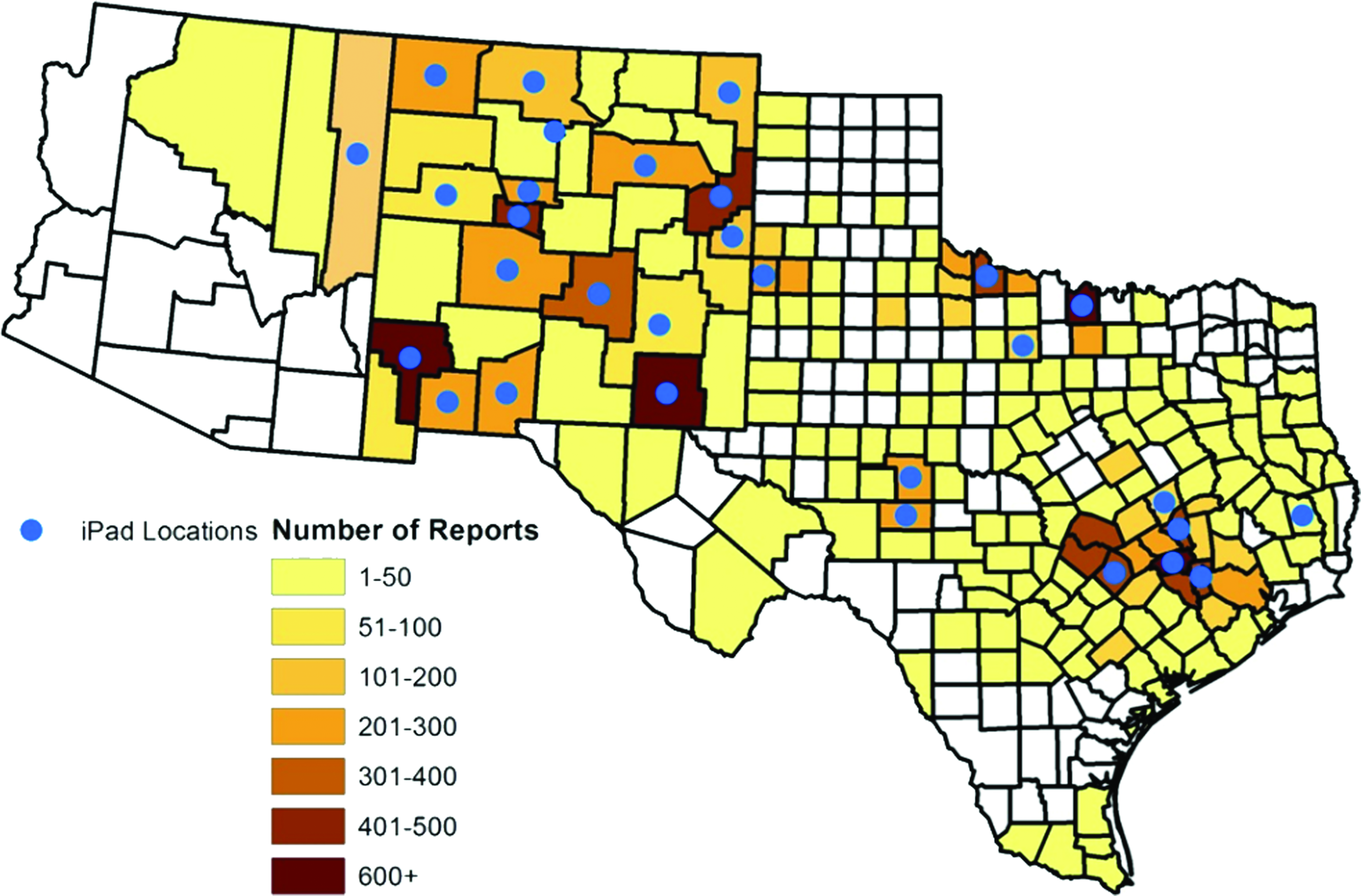
Geographic Distribution of Reporting by BFES Application Users by County, July 2012-May 2013. The blue dots are the county centroid indicating the business location of BFES users; 1 dot may represent more than 1 user within that county.
Summary of Syndromic and Healthy Reports Submitted by BFES Users in Arizona, New Mexico, and Texas During the 2012-2013 Pilot
Three reasons for site visits were available to BFES users for reporting: visits due to an illness or injury, regulatory visits, or routine visits. Of the 4,356 reports submitted on bovids, the majority (64.4%) were a result of routine visits to the location, whereas 21.0% were due to an illness or injury being reported, and 14.6% were due to regulatory visits. Conversely, of 3,102 reports submitted on equines, the majority (71.7%) were due to an illness or injury, whereas the remaining were due to routine (21.7%) and regulatory (6.6%) visits.
The 9-month pilot effort provided valuable information to DHS and interagency partners for determining next steps related to expansion of the effort toward national piloting and adoption. This included recognizing the need to develop and implement data standards and ensure that appropriate data fields are collected in order to meet the objectives of syndromic surveillance. As such, DHS worked with interagency partners to identify and define key minimum data elements that are necessary for conducting syndromic surveillance epidemiologic analyses for inclusion in all BFES applications. Thirteen essential data elements were identified and are now incorporated in all BFES applications for required reporting into the EPS system (Table 2).
Essential Data Elements Required for Conducting Syndromic Surveillance Using the Enhanced Passive Surveillance System
As a result of this pilot effort, DHS gained valuable user feedback on the EPS system, which allowed for further optimization of the BFES application and refining of the EPS system. End-users of this pilot effort identified several key technological and operational features to incentivize participation and reporting through the EPS platform. Technological features identified included incorporation of industry-specific tools to customize the mobile application for business purposes, automation of email of submitted report data, tracking of billing information and case notes, incorporation of electronic Certificates of Veterinary Inspection (eCVI) and other health reporting forms (such as vaccination forms), and installation of manuals and other reference guides.
Operational incentives identified included instant access to submitted reports, access to state data for visibility of other local reports, a blog for communicating with other participating veterinarians, diagnostic lab credit for test panels that meet syndromic case definition criteria, integrated access to test results with automated notifications, and training and continuing education. End-users expressed interest in receiving monthly or quarterly EPS reports that provide epidemiologic analysis of the collected data, with the potential for more frequent reports during seasons of high risk for certain seasonal pathogens, such as West Nile virus. Users also expressed interest in having surveillance and response capabilities integrated into a single system, which is currently under development as part of the AgConnect® suite of data-sharing tools.
Next Steps Toward Adoption
Based on the enthusiastic reception of the 3-state pilot program in the animal health community, the determination that wider adoption with the appropriate incentives was feasible, and the critical need for this type of surveillance data to minimize the impacts of infectious disease outbreaks, DHS funded an expanded pilot of the EPS system that would include all major livestock and poultry industries and wildlife. Funding for this project was initiated in September 2013, and an interagency kickoff meeting was held in November 2013 with representatives from DHS, USDA, the Department of Interior, the Department of Defense, and other relevant federal agencies. State animal health officials, diagnostic laboratories, and livestock industry representatives were also included. As the project progresses, the EPS system continues to mature as a useful tool for animal health practitioners and animal industries in the United States. The BFES Swine and Mixed Animal applications were formally released in June and July of 2015, respectively, to the App Store® (Apple, Inc.) and Google Play® (Google, Inc.). Industry-specific BFES applications for wildlife, poultry, and feedlot and dairy cattle will be released over the next year. The data collected are intended to establish a baseline of syndromic metrics for disease prevalence by species and management system.
Practitioners and producers can use the visualization and analytical tools in the BFES application to assess the animal health situation in their practice area based on the aggregated, anonymous data shared among in-state participants. Subsequently, anomalies in these values can serve as early indicators of a potential outbreak, prompting practitioners to follow up with increased sampling for diagnostic testing. Similarly, when development is finished, it is envisioned that authorized state and federal animal health officials can use the advanced visualization and analytical tools in the analyst workstation for timely animal health monitoring and ultimately allowing for earlier detection, response, and control of a disease outbreak.
A key component to the long-term success of this and any other voluntary surveillance platform is end-user buy-in. DHS and IIAD are taking several steps to ensure that EPS is a valuable option to end-users. First and foremost, development focuses on ensuring the system is customized to meet end-user needs and provides them with useful information to support their daily activities. A major priority for industry during a disease outbreak is continuity of business; by integrating with AgConnect®, the EPS system enhances business continuity efforts by providing early detection of potential disease and outbreaks with spatial and temporal analyses that informs allocation of resources and targeted areas for increased biosecurity. Another critical factor in continued participation is end-user confidence in the security of the system and the data it contains. Data submitted through EPS are aggregated for reporting based on industry-determined requirements, so that locations are anonymous to other end-users of the application. Finally, the last major goal of this platform is successful transition to an external entity for long-term hosting and platform maintenance. This long-term objective may be accomplished either through private funding or a combined public-private partnership.
As the nation faces persistent challenges from emerging diseases and threats of intentional introductions of high-consequence infectious diseases in livestock and poultry, the need for enhanced agricultural animal health awareness and rapid detection tools continues to increase. The HPAI outbreak in 2015 highlights the need for early detection and reporting of infectious diseases in order to mitigate the size and duration of an outbreak. An animal disease surveillance platform that allows real-time reporting of data from multiple streams while ensuring the privacy of end-user data is an important step toward meeting this critical need in protecting animal health and ensures the resilience of both the food supply and the US economy.
Footnotes
Acknowledgments
We would like to thank the veterinary practitioners who participated in the EPS pilots and, especially, Drs. Thomas Hairgrove and John Wenzel, who served as industry champions for the initial DHS-funded pilot and as liaisons between the veterinary practitioners and IIAD. The active participation and feedback from all of these individuals were critical to the success of the EPS system. We would also like to thank Dr. Melissa Hefferin Berquist (IIAD) for her programmatic expertise as well as the rest of the EPS team at IIAD/TCAT who contributed to the development of the Enhanced Passive Surveillance system. Dr. Thompson was supported through the ORAU DHS Research Participation Program, DHS Contract HSHQPM-13-X-00174. IIAD was funded for EPS through DHS contracts HSHQDC-12-J-00154 and HSHQDC-13-J-00329 and for business continuity through DHS cooperative agreement 2010-ST-061-AG0002. Initial prototype development of AgConnect® was funded through DHS grant 2007-ST-061-000002.