




Abstract
We conducted a comprehensive, multiphase laboratory evaluation of the Anthrax BioThreat Alert® test strip, a lateral flow immunoassay (LFA) for the rapid detection of Bacillus anthracis spores. The study, conducted at 2 sites, evaluated this assay for the detection of spores from the Ames and Sterne strains of B. anthracis, as well as those from an additional 22 strains. Phylogenetic near neighbors, environmental background organisms, white powders, and environmental samples were also tested. The Anthrax LFA demonstrated a limit of detection of about 106 spores/mL (ca. 1.5 × 10⁵ spores/assay). In this study, overall sensitivity of the LFA was 99.3%, and the specificity was 98.6%. The results indicated that the specificity, sensitivity, limit of detection, dynamic range, and repeatability of the assay support its use in the field for the purpose of qualitatively evaluating suspicious white powders and environmental samples for the presumptive presence of B. anthracis spores.
The authors conducted a comprehensive, multiphase laboratory evaluation of the Anthrax BioThreat Alert® test strip, a lateral flow immunoassay (LFA) for the rapid detection of Bacillus anthracis spores. The study, conducted at 2 sites, evaluated this assay for the detection of spores from the Ames and Sterne strains of B. anthracis, as well as those from an additional 22 strains. The results indicated that the specificity, sensitivity, limit of detection, dynamic range, and repeatability of the assay support its use in the field for the purpose of qualitatively evaluating suspicious white powders and environmental samples for the presumptive presence of B. anthracis spores.
B
Anthrax, caused by B. anthracis, is primarily a disease of herbivores, although all mammals, including humans, are susceptible.18,19 The majority of human cases are cutaneous and result from occupational exposure.3,14,20 The name is derived from the Greek word anthracites, meaning coal-like, which refers to the discolored, necrotic tissue (ie, eschar) seen in the cutaneous form of the disease. 1 While not generally life-threatening, left untreated, the mortality rate for cutaneous anthrax can approach 20%. 12 In addition to usually painless eschars, patients may also experience fever, edema, and other systemic symptoms.12,21,22 In the 2001 anthrax attacks in the United States, there were 22 total cases, of which 11 were cases of cutaneous anthrax.22,23
Gastrointestinal (GI) anthrax results from the ingestion of spores in vehicles such as contaminated meat. GI anthrax falls into 2 categories: oropharyngeal and intestinal. In both forms, there is a 1- to 6-day incubation period following ingestion. Oropharyngeal anthrax patients present with elevated temperature (above 39°C), sore throat, dysphagia, neck swelling, and lymph node enlargement that can constrict the airway and make breathing difficult. Intestinal anthrax is caused by an infection of the stomach or bowel wall and can lead to ulceration of the ileum and cecum. It should not be mistaken for the nonulcerative hemorrhagic lesions that can occur during anthrax septicemia. Nausea, anorexia, elevated body temperature, severe abdominal pain, and bloody diarrhea are frequently observed symptoms and signs. In both cases, aggressive treatment with antibiotics such as penicillin or tetracycline is recommended. 10 Mortality rates range from 25% to 60% in the absence of prompt intervention. 12
The most severe form is biphasic respiratory or inhalation anthrax, also known as wool sorter's disease, which without treatment can result in death as early as 1 to 7 days postexposure.3,12,14,24-26 The diagnosis of inhalation anthrax presents a challenge because initial symptoms, including fever, malaise, and a dry cough, are nonspecific and resemble influenzalike symptoms, although chest X-rays typically show a widening of the mediastinum caused by hemorrhage and necrosis.3,12,14,21,22,24 A direct Gram stain of patient tissue or fluids can be performed, and suspicious results should immediately be reported to the Centers for Disease Control and Prevention (CDC). 3 Spores, which typically measure between 1 and 2 microns in diameter, are of the ideal size to cause inhalation-associated infections. 27 Following inhalation, spores impinge on the lower respiratory mucosa. In the lungs, alveolar macrophages phagocytize the spores and then carry them to the mediastinal and tracheobronchial lymph nodes. During transport, spores germinate with concomitant synthesis of the toxins and capsule.1,3,12,15,25 Following a 2- to 3-day period, during which patients sometimes experience transient improvement, 14 there is a release of tumor necrosis factor (TNF) and interleukin-1 (IL-1), precipitating a sudden onset of respiratory distress, orthopnea, stridor, tachypnea, high fever, chills, and diaphoresis.3,14,28 Recommended postexposure prophylaxis for inhalation anthrax is 60 days of treatment with ciprofloxacin or doxycycline, although other antibiotics, including levofloxacin, moxifloxacin, amoxicillin, or penicillin VK, may be used as well.3,14,22-24 Mechanical ventilation and other palliative care may also be necessary. In the 2001 US anthrax attacks, there were 11 confirmed cases of inhalation anthrax with 5 deaths and an average incubation period of 4 days.21-23,29,30
Both the United States and the former Soviet Union actively investigated the use of B. anthracis as an offensive biological weapon; Iraq has admitted to such work as well. 27 The Federal Select Agent Program classifies B. anthracis as a Tier 1 agent due, in part, to its ease of dispersal and high mortality rate, although anthrax is not transmissible from person to person. 14 The ID50 for humans is estimated to be between 8,000 and 20,000 spores.3,14 Peters and Hartley 31 calculated that the LD1 could be as low as 1 to 3 spores, which would help explain rare and sporadic cases of anthrax among people who had only minimal contact with known contaminated environments; in a mass exposure event where large numbers of people may be affected, the LD1 is as important as ID50 in determining probability of infection.
A biological attack involving B. anthracis would most likely involve the aerosol dispersal of hydrophobic spores.7,14,20,30 During the 2001 anthrax attack, many public health laboratories and first responders were inundated with suspicious white powder samples for testing because of public fear and panic. The large number of samples overwhelmed the CDC Laboratory Response Network (LRN) laboratories and prevented them from functioning at their optimal level. 32 When first responders encounter unknown white powders in the field, it is important to quickly evaluate them for the presence of biological threat agents to support the appropriate public safety actions, including evacuation, facility closure to prevent additional exposures, decontamination of potentially exposed individuals, sample collection for law enforcement and public health purposes, expedited sample transfer to CDC LRN laboratories for immediate testing, and containment of materials as appropriate to prevent secondary dissemination. In order to provide first responders with the appropriate tools to carry out their mission, there is a critical need to develop, evaluate, and validate rapid screening tools for testing suspicious white powders for the presence of biological threat agents.
The purpose of the present study was to determine the sensitivity, specificity, reproducibility, and limitations of a Lateral Flow Immunoassay (LFA) Anthrax BioThreat Alert® Test Strip (Tetracore®, Inc., Rockville, MD) that can be used in the field to screen for the presence of B. anthracis spores. The goal of this study was to evaluate assay performance, including the likelihood of false-negative results (assay is negative, but the analyte is present at a concentration above the limit of detection [LOD]), false-positive results (assay is positive, but the target analyte is not present in the sample), and robustness and reproducibility of this LFA so that appropriate and effective decisions can be made by first responders to support public safety actions while avoiding unnecessary fear, panic, and costly disruptions to society.
This study was designed and executed through an interagency collaboration with participation from subject matter experts from the Department of Homeland Security (DHS) Science and Technology Directorate (S&T), DHS Chief Readiness Support Officer (CRSO), the Department of Health and Human Services (HHS) Office of the Assistant Secretary for Preparedness and Response/Biomedical Advanced Research and Development Authority (ASPR/BARDA), HHS Centers for Disease Control and Prevention (CDC), Department of Justice (DOJ) Federal Bureau of Investigation (FBI), US Department of Agriculture (USDA), HHS Food and Drug Administration (FDA) Center for Food Safety and Applied Nutrition (CFSAN), FDA Center for Devices and Radiological Health (CDRH), DHS US Secret Service (USSS), and others.
Materials and Methods
Anthrax BioThreat Alert® Test Strips (catalog number TC-8004-025) and Rapid BioThreat Alert Reader MX (catalog number TC-3005-001) were obtained from Tetracore, Inc. (Rockville, MD). All testing with virulent B. anthracis spores was done at the Zoonoses and Select Agent Laboratory, Bacterial Special Pathogens Branch, National Center for Emerging and Zoonotic Infectious Diseases, CDC, Atlanta, GA. Spores of B. anthracis Ames and the inclusivity organisms were prepared and tested at CDC. Five replicates of each sample were tested. All testing using the avirulent Sterne vaccine strain of B. anthracis, near neighbors, environmental background organisms, and white powders were performed at Omni Array Biotechnology, Rockville, MD. Each sample was tested by 5 different operators at Omni Array Biotechnology.
Spores from near neighbors were prepared and stored at 4°C until use, then analyzed by members from DHS S&T and FDA CFSAN according to a standard protocol provided by the manufacturer. Anthrax LFA results were read both visually and with the BioThreat Alert Reader MX according to directions provided by the manufacturer—that is, between 15 and 30 minutes after adding the sample (150 μL) to the lateral flow strip. Samples with readings of <200 were considered negative, while test strips that did not develop a control line were noted, which required repeat testing of the sample. The BioThreat Alert Reader MX measures the ratio of absorbing light intensity and incident light on the surface of the lateral flow strip. As an example, if the incident light intensity was 100 cd/m2 and 0.25 cd/m2 is absorbed on the surface, the resulting ratio (ie, 0.0025), converted into a BioThreat Alert Reader MX value by the instrument, is expressed as the numerical value without units.
The study comprised multiple phases of testing. BioThreat Alert (BTA) buffer, the proprietary assay buffer supplied in the kit, was used as a negative control. Spores of the Sterne strain of B. anthracis at a concentration of 107/mL were used as positive controls at both test sites. Inclusivity strains of B. anthracis were typed using Multiple Locus Variable–number Tandem Repeat Analysis (MLVA) and subjected to strain characterization, plasmid profile analysis, and 16S typing.
Spore Preparation
Strains of B. anthracis were inoculated onto sheep blood agar (SBA) plates and incubated at 37°C for 24 hours. Sporulation media (3 g Tryptone, 6 g Peptone, 3 g Yeast Extract, 0.1% 1.0 M Manganese (II) Chloride [0.1 g Manganese (II) Chloride 4-Hydrate, endotoxin-free (ETF) water to 100 mL], 15 g Agar, ETF water to 1 L) slants were prepared and inoculated with cells from the overnight cultures. Slants were incubated at 30°C for 5 to 7 days; then growth was harvested by washing with 5 mL sterile phosphate buffered saline (PBS) and added to 35 mL sterile PBS in a 50 mL conical tube. The suspensions were heated in a 65°C water bath for 30 minutes to kill any remaining vegetative cells. Tubes were inverted frequently during the 30-minute incubation period. Spore suspensions were then cooled to room temperature and centrifuged at 3,400 RPM for 20 minutes to pellet spores and remove cellular debris. Pellets were resuspended in 30 mL sterile PBS and vortexed for 30 seconds. The spore suspensions were centrifuged at 3,400 RPM at 5°C for 20 minutes. Supernatant was decanted and pellet resuspended in 5 mL sterile PBS and transferred to a 15-mL tube for storage at 4°C. Spore concentrations were determined by serial dilution and plating on SBA plates after incubation for 12 to 18 hours at 37°C. Test dilutions of spore suspensions were based on plate counts. Presence of spores was confirmed by examination of wet mounts using phase contrast microscopy, and the preparation yielded predominantly homogenous spore suspension with little or no clumping.
Environmental Filters
Thirty filters that had been subjected to 24 hours of environmental aerosol collection were extracted by shaking with PBS containing 0.1% Tween-20 (PBST) and the extracts pooled. The protein concentration of the extract was adjusted to 6 μg protein/μL with PBST containing 1% BSA (PBSTB) and then shipped to the testing site.
Phase 1: Limit of Detection and Repeatability Study
The dynamic range of the Anthrax LFA was determined using spores of B. anthracis Ames strain and Sterne strain. Spores were prepared in PBS, then diluted 1:1 with BTA buffer (per manufacturer instructions) to achieve concentrations ranging from 103 cfu/mL to 109 cfu/mL. Following dilution, 150 μL of each spore concentration was added to lateral flow strips. Each concentration was tested 5 times by a single operator. The lowest concentration of Sterne strain spores that yielded positive results in 5 out of 5 lateral flow strips was further tested for repeatability with different operators. Each operator tested 24 replicates, and the 95% confidence level of detection at this concentration was calculated using the total test results from 120 replicate samples tested.
Phase 2: Inclusivity Panel
In order to determine whether this assay could detect spores from diverse strains, spores from 22 (18 fully virulent) B. anthracis strains (Table 1) were prepared as described above and diluted in BTA buffer to a final concentration of 109 to 1010 spores/mL (4 logs above LOD determined with Sterne strain spores) and vortexed. A 150-μL sample volume was added to each test strip. Each strain was tested 5 times by a single operator to understand the sensitivity, reproducibility, and robustness of the assay.
Inclusivity Strains of B. anthracis. Strains lacking a plasmid are not typeable using MLVA-8.
Phase 3: Near Neighbor Panel
Spores were prepared from 34 phylogenetic near neighbors (Table 2) of B. anthracis. The spores were prepared in PBS, then diluted 1:1 in BTA buffer to a concentration of 108 to 109 spores/mL (≥3 logs above Sterne strain LOD) and vortexed, followed by addition of a 150-μL sample volume to each test strip. Each near neighbor was tested once by each of 5 different operators.
B. anthracis Near Neighbor Panel
Phase 4: Environmental Background Panel
Sixty-one diverse environmental background organisms (Table 3) were inoculated onto agar medium optimal for each organism and incubated under appropriate conditions for 24 to 48 hours. A single, isolated colony was selected and inoculated onto a second plate and incubated for 1 to 6 days, depending on the organism and its growth rate. Plates were then sealed with parafilm and stored at 4°C until use. For testing, several colonies were selected and resuspended in 4 mL BTA, and 150 μL was added to each Anthrax LFA. Each organism was tested once by each of 5 different operators to understand the variability of the assay by identifying any potential cross-reactivity or false-positive results.
Environmental Background Panel
Phase 5a: White Powder Panel
The white powder panel shown in Table 4 is identical to the one that was used to evaluate ricin and abrin LFAs33,34 and a modification of one approved by the Stakeholder Panel on Agent Detection Assays (SPADA) in 2010. 35 These materials were evaluated for their ability to affect the performance of the assay. Five milligrams of each of the 26 white powders (Table 4) were suspended (or dissolved) in 500 μL of BTA buffer (final concentration = 10 mg/mL). Each tube was vortexed for 10 seconds. The suspension was allowed to settle for at least 5 minutes, and then 150 μL of the supernatant was removed and added to the Anthrax LFA. Each powder was tested once by each of 5 different operators to understand the variations and robustness of the assay by identifying any inhibition of the internal positive control and potential false-positive reactions.
White Powder Panel
Phase 5b: White Powder Spiked with Spores of B. anthracis Sterne
The white powders tested in Phase 5a were spiked with spores of Sterne strain and further tested to understand the ability of the white powders to inhibit agent detection by the LFA. Five milligrams of each white powder were suspended in 450 μL of BTA buffer and 50 μL of a suspension of Sterne strain spores (final spore concentration = 5 × 10⁷ spores/mL). Each tube was vortexed for 10 seconds. The suspension was allowed to settle for at least 5 minutes; then 150 μL of the supernatant was removed and added to the LFA. Two sets of each powder spiked with B. anthracis Sterne spores were prepared and tested once by each of 5 different operators to understand the degree, if any, to which each white powder inhibited detection of the spores.
Phase 6a: Environmental Filter Extract
Pooled environmental filter extract containing 6 μg extracted protein/μL were shipped to Omni Array Biotechnology, where operators added an equal volume of BTA buffer. After mixing for 10 seconds, 150 μL of supernatant was added to the Anthrax LFA. Each filter extract was tested 5 times to understand the specificity and robustness of the assay by identifying any potential inhibition of the internal control or false-positive reactions.
Phase 6b: Environmental Filter Extract Spiked with Spores of B. anthracis Ames
A 500-μL volume of filter extract was mixed with 400 μL of BTA buffer and 100 μL of B. anthracis Ames spores (final concentration of 5 × 10⁷ spores/mL). After mixing for 10 seconds, a 150-μL volume of supernatant was added to the LFA. The spiked filter extract was tested in 5 replicates to understand whether the presence of filter extract inhibited detection of spores by this assay.
Biosafety Considerations
All of the virulent B. anthracis strains used in this study were handled with appropriate biosafety conditions at the CDC according to Institutional Bio-Safety Guidelines. All other organisms, including low-risk bacterial strains, were handled, processed, and tested under safety protocols in accordance with the 5th edition of Biosafety in Microbiological and Biomedical Laboratories (BMBL). 36 To minimize the risk of aerosols, cultures were handled using BSL-2 practices that also required personal protective equipment and procedures such as gowning, use of gloves and protective eyewear, and working in a certified Class II biosafety cabinet (BSC). All work areas before and after the testing were cleansed with 10% bleach, while disposal of stock cultures or biomedical waste was done in accordance with institutional guidelines.
Statistical Analysis
The performance of the lateral flow assay was assessed by calculating the sensitivity and specificity of the assay using the results from all the testing done in this study. MedCalc Statistical Software version 16.1 (MedCalc Software bvba, Ostend, Belgium; https://www.medcalc.org; 2016) was used for calculation of sensitivity and specificity and also the positive and negative likelihood ratios from the visual results of the lateral flow assay. BioThreat Alert Reader MX values were used for generating the Receiver Operator Characteristic Curves, interactive dot plots of anthrax lateral flow assay and LFA sensitivity and specificity calculations, and assay performance evaluation using MedCalc software. Dot density plot and titration curves of BTA Reader values were made using GraphPad Prism version 6.07 for Windows (GraphPad Software, La Jolla, California, USA, www.graphpad.com). Receiver Operator Characteristic Curve and interactive dot plot of anthrax lateral flow assay were made using MedCalc Software.
Results
A 6-phase study was conducted to evaluate and assess the performance of the Anthrax BioThreat Alert lateral flow assay. A total of 1,246 tests were performed in this study, and the BTA reader values from these tests are shown in Figure 1. The dot density diagram summarizes all of the test results obtained in this validation study. It provides a visual representation of the distribution of BTA reader values in each phase of the study. The number of tests, including the positive and negative controls tested for each phase, is shown at the top. The BTA reader cut-off value of 200 is shown as the solid line. In Phase 1, a total of 320 LFAs were tested for the range finding and repeatability study, and all the tests gave correct results. In Phase 2, 22 B. anthracis strains in the inclusivity panel were evaluated, and all the samples gave correct test results for this phase while performing a total of 120 LFA tests. A total of 175 LFAs were tested in Phase 3 for the evaluation of 33 B. anthracis near neighbors, and 32 of 33 strains gave correct test results. Anthrax LFA testing performed in Phase 4 (n = 315) for the evaluation of 61 environmental background panel yielded 60 of 61 correct results. A total of 316 anthrax LFA cassettes were tested in the evaluation of 26 white powders and environmental aerosol collection filter extract with and without spiking of B. anthracis spores. All of the 26 white powders alone, aerosol filter extract, and 25 of 26 of B. anthracis spores spiked white powders showed correct LFA results.

Dot density diagram that summarizes the testing performed in this validation. It provides a visual representation of the BTA value distribution in each phase. The number of tests, including positive and negative controls, for each phase is displayed at the top of each phase's cluster. The cut-off value of 200 is shown as a solid line. Color images available at www.liebertonline.com/hs
Anthrax LFA results obtained with different concentrations of Sterne and Ames spores are shown as titration curves in Figure 2. The curves were generated using the average of at least 5 tests with each spore concentration, and the error bars are the standard deviations. Titration curves for the Sterne and Ames strains were plotted using nonlinear variable slope (4 parameters) dose-response stimulation equations. The curves show a similar estimated limit of detection (LOD) at ∼106 cfu/mL for both strains since it was the lowest concentration tested that uniformly gave positive results above the cut-off of 200. Nonlinear dose-response curve fitting was performed using GraphPad Prism version 6.07 for Windows.
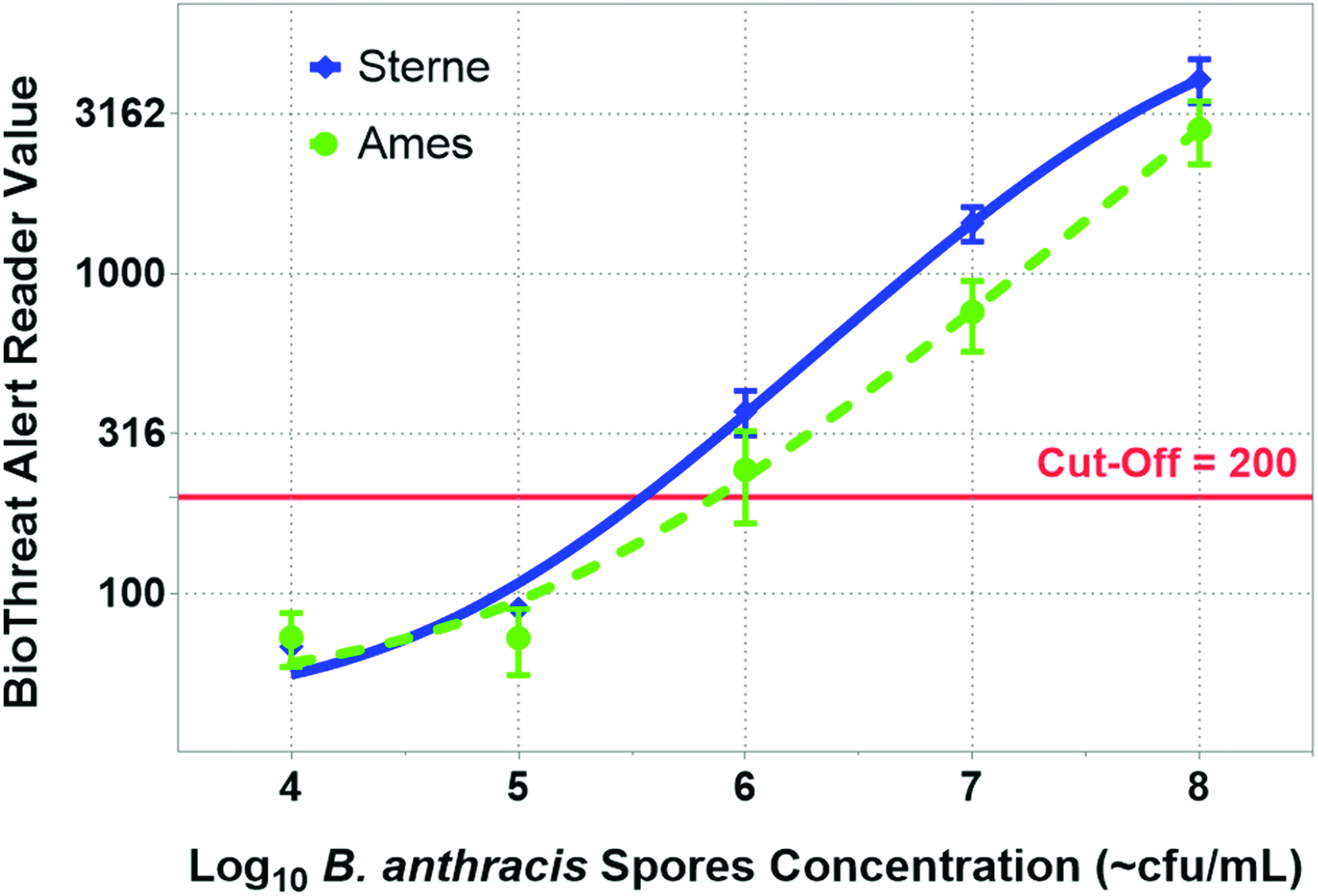
The titration curves depict BTA reader value with respect to the log10 concentration of anthrax spores from the Ames strain as well as the Sterne strain. The curves were generated using the average of at least 5 tests, and the error bars are the standard deviations. The cut-off value of 200 is shown as a solid line. For both strains, the first test concentration that is above the cut-off value is 106 cfu/mL. Color images available at www.liebertonline.com/hs
The results of these tests were used for calculating the probability of detecting Sterne and Ames strain spores. A Probit regression analysis was performed to determine the concentration of Sterne or Ames spores (Figure 3) that would correspond to a probability of 0.95, which is equivalent to the estimated limit of detection within 95% confidence intervals. 37 The calculated LOD based on Probit analysis for Sterne strain spores was 4.3 × 10⁵ cfu/mL (6.45 × 10⁴ cfu/assay) and for Ames strain spores 1.5 × 10⁶ cfu/mL (2.25 × 10⁵ cfu/assay). This is a ∼3-fold difference in LOD between the 2 strains. Area Under the Curve (AUC) by Receiver Operator Characteristic (ROC) Curve analysis was calculated for both Sterne and Ames strains. No statistically significant difference in ROC AUC was found (P = 0.0671) between the detection of Ames and Sterne spores.

Probit regressions for the B. anthracis Sterne and Ames strain spores. The curves are calculated probability of detection as a function of spore concentration. The estimated limit of detection is calculated by finding the spore concentration with a probability of detection at 0.95. For Sterne spores, the LOD is 4.3 × 10⁵ cfu/mL (6.4 × 10⁴ cfu/assay), and for Ames spores the LOD is 1.4 × 10⁶ cfu/mL (2.1 × 10⁵ cfu/assay). Color images available at www.liebertonline.com/hs
The LFA assay was further tested for repeatability by 5 operators, each of whom performed 24 tests with Sterne strain spores at a final concentration of ca. 106/mL (ca. 1.5 × 10⁵ cfu/assay) for a total of 120 assays. All 120 tests yielded positive results both visually and by the BioThreat Alert Reader MX. Anthrax LFA assays for inclusivity testing with spores of 22 different B. anthracis strains were all positive. The results were the same when the LFA cassettes were read visually or using the BioThreat Alert Reader MX. The reader correctly called the cassettes positive or negative in all the cases based on the pre-set cut-off value of 200.
Sensitivity and specificity are basic measures of performance for a diagnostic/detection test. Together, they describe how well the test can determine whether the analyte (eg, B. anthracis spores) is present or absent in the tested sample. Since the visual results were the same as the BTA Reader call, the former were used to calculate the sensitivity and specificity of the LFA (Table 5). The data from the results of the LFA are displayed in a 2 × 2 contingency table. The test result falls in 1 of the 4 categories: true positive (TP, B. anthracis antigen present and test positive); false positive (FP, B. anthracis antigen not present but test positive); false negative (FN, B. anthracis antigen present but test negative), and true negative (B. anthracis antigen absent and test negative). A total of 1,246 tests were performed, of which 558 were positive samples and 688 were negative samples.
2 × 2 Contingency Table to Assess the Accuracy of a LFA for Spores of B. anthracis
Sensitivity and specificity of the LFA was calculated, and the results are shown in Table 6. Sensitivity is defined as the proportion of true positives that are correctly identified by the test and is calculated as 100% × TP/(TP+FN). Specificity is defined as the proportion of true negatives that are correctly identified by the test and is calculated as 100% × TN/(FP+TN). From the results of this evaluation, the estimated sensitivity of the LFA was 99.3% and the estimated specificity was 98.6%. Additional calculations of the Area Under the Curve, positive and negative likelihood ratios, and positive and negative predictive value of this test were also performed, and the results shown in Table 6. In this study, 44.8% of all the samples tested were LFA positive.
Statistical Analysis of the Performance of a LFA for Spores of B. anthracis a
Data used for calculations are presented in Table 5.
The positive reactivity of the assay was also measured using BioThreat Alert Reader MX. Even though the reader values are not quantitative, the values can be used to further evaluate the accuracy of a detection test to discriminate the test positive samples from those that are test negative using Receiver Operating Characteristic (ROC) analysis. The sensitivity and specificity are calculated for every possible cut-off point selected to discriminate between the positive and negative populations. In an ROC curve, the true-positive rate (sensitivity) is plotted as a function of the false-positive rate (100 specificity) for different cut-off points. Each point on the ROC plot represents a sensitivity/specificity pair corresponding to a particular decision threshold. Figure 4 shows the ROC curve of anthrax LFA based on the results obtained in this study. The area under the curve is 0.9987, indicating the test is very accurate and reliable. Sensitivity and specificity can also be calculated from the ROC curve.
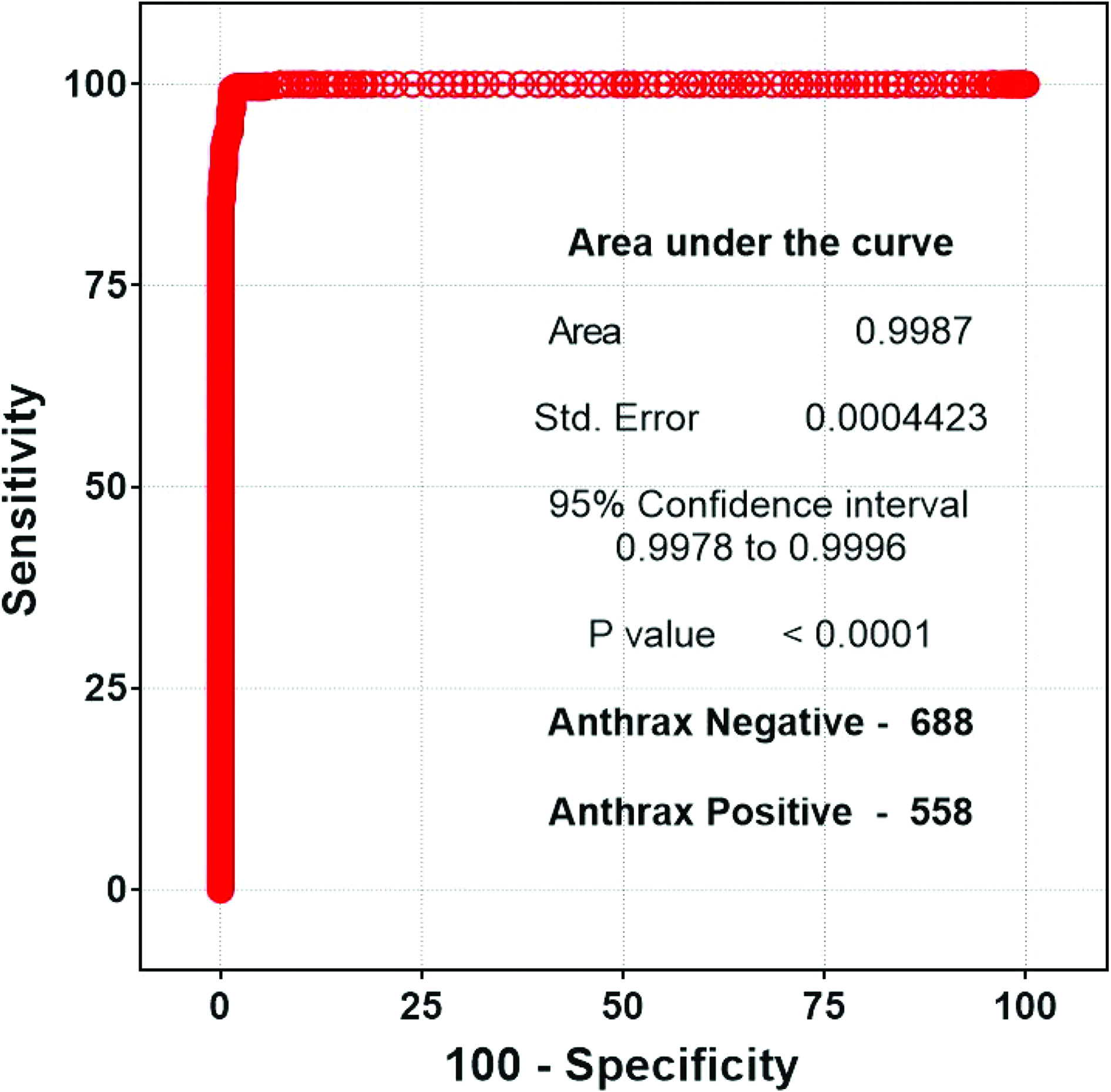
Receiver operator characteristic (ROC) curve provides a visual representation of the sensitivity and specificity of this assay. Each point on the curve is a possible cut-off value, and its place on the curve is determined by its specificity and sensitivity. The calculated assay sensitivity is 99.3%, and the specificity is 98.6%. Color images available at www.liebertonline.com/hs
The data used for ROC analysis can also be depicted as an interactive dot plot (Figure 5). In this plot, the BTA reader values are shown on the Y-axis, and different cut-off values can be used to estimate the sensitivity and specificity at that value. The Youden index J is the maximum vertical distance between the ROC curve and the line of equality. The cutoff value that responds to the Youden index J can give the optimal combination of sensitivity and specificity, if the disease prevalence is 50%. In this analysis, a threshold reader value of 177 gave a sensitivity of 99.5% and specificity of 98.4%. The BTA reader cut-off is set at 200 for a positive call. Hence, at this cut-off the anthrax LFA sensitivity is 98.3% and specificity is 99.6%.
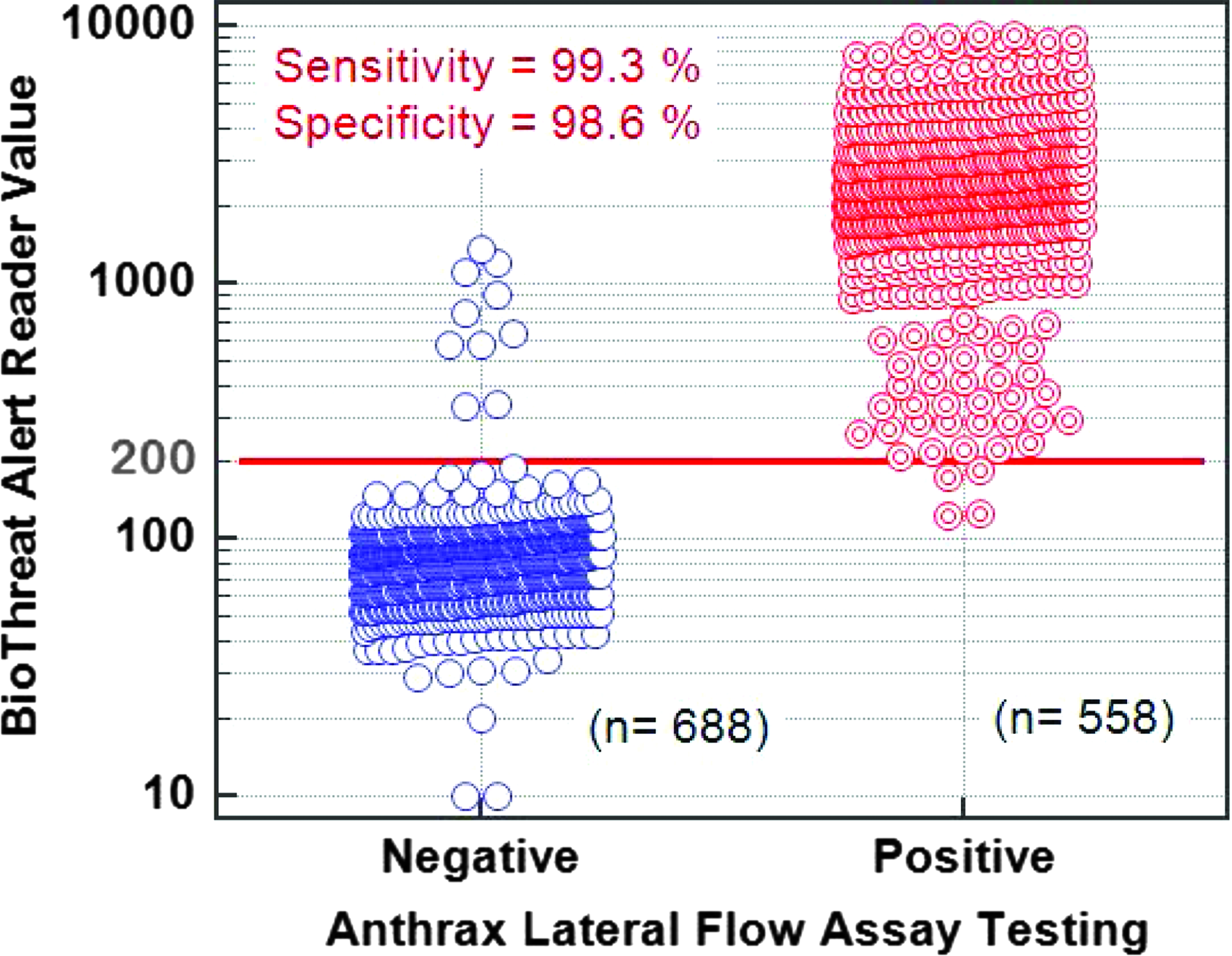
A dot density diagram that shows all 1,246 tests performed, grouped as designated positive and designated negative by the BTA reader. The cut-off value of 200 is shown as a solid line. The number of tests performed in each group is shown in parentheses. Any data points in the designated negative group that were above the cut-off value are false positive, while any data points in the designated positive group that were below the cut-off value are false negative. Color images available at www.liebertonline.com/hs
Discussion
A robust approach to public health preparedness for potential anthrax attacks consists of several facets, including the development of medical countermeasures (vaccines, antibiotics, etc) and diagnostics and surveillance for early identification of disease outbreaks. Defense of a city following a deliberate release of B. anthracis spores requires rapid identification that an attack has occurred so that medical countermeasures can be deployed and used within 48 hours of first exposure. 38 Several technologies have been developed to detect and identify either spores of B. anthracis or one or more of its toxins. Polymerase chain reaction (PCR) was used during the 2001 anthrax attacks, with primer and probe sets targeting each of the plasmids as well as the chromosome. 39 Alam et al 40 improved PCR sensitivity by using 2 signatures for the gene coding for edema factor; Christensen et al 41 determined that real-time PCR could identify 50 fg, or 9 genome equivalents of B. anthracis Ames using either the RAPID or Smart Cycler platforms. However, PCR requires clean samples in a small volume and is not generally suitable for field use.42,43 Other methods of detection have included fluorescence-based sandwich immunoassays on glass slides,44,45 peptide functionalized surface-enhanced Raman spectroscopy (SERS), piezo-electric based detection,43,46 PCR combined with fluorescence resonance energy transfer (FRET), 47 and aptamers and bacteriophage. 43 While each of these methods holds some promise for laboratory-based detection, none is currently appropriate for field use to rapidly screen unknown environmental samples (ie, white powders) for the presence of B. anthracis spores.
Lateral flow immunochromatographic assays were commercially introduced for pregnancy testing in 1988. 48 Simple to use and requiring minimal training, 49 LFAs are ideal for use by first responders and law enforcement officers to test suspicious materials in field settings. BioThreat Alert® Assays have previously been evaluated for the detection of other biothreat agents, including orthopoxviruses, 50 ricin, 33 abrin, 34 and Yersinia pestis. 51 Limited evaluations have also been conducted with LFAs for the detection of Francisella tularensis (unpublished data), botulinum neurotoxins, 52 and staphylococcal enterotoxins. 53 In an earlier study, King et al 54 detected 105 spores/mL of B. anthracis Pasteur strain using the Tetracore BTA LFA.
The Anthrax BioThreat Alert Test Strip is a rapid qualitative test to detect the presence of B. anthracis spores in environmental samples. The test uses a combination of a monoclonal detector antibody and polyclonal capture antibody to selectively capture and detect the presence of B. anthracis spores in aqueous samples. The purpose of the current study was to evaluate the performance of this assay in order to understand its sensitivity, specificity, reproducibility, and limitations for use in the field and also to determine whether this assay could be used for screening samples in a laboratory.
Because of the widespread diversity of B. anthracis, we also determined whether this LFA would detect the presence of spores from 22 strains belonging to different clades. All strains yielded positive results both visually and with the BioThreat Alert Reader. However, one limitation with the present testing of the inclusivity panel organisms was the use of spore concentrations that were greater than the LOD for the Ames strain. In the future, it may be more informative if testing were to be done with spore concentrations closer to the LOD of the strain being tested.
In conclusion, the Anthrax BioThreat Alert Test Strip is a fast, reliable assay that can be used in the field to qualitatively assess an unknown sample for the presence of B. anthracis spores, the results of which may be used to inform public health actions. Samples yielding positive results should be forwarded to a Laboratory Response Network (LRN) laboratory for additional confirmatory testing.
Footnotes
Acknowledgments
The authors wish to acknowledge the important contributions to this manuscript of Dr. Douglas L. Anders, Hazardous Materials Response Unit, Federal Bureau of Investigation Laboratory, Quantico, Virginia, and Dr. Sally Hojvat, Center for Devices and Radiological Health, Food and Drug Administration, Silver Spring, Maryland, for subject matter expert advice and consultation. We express our thanks and appreciation for their assistance in the preparation and execution of this project. This work was funded by Department of Homeland Security (DHS) Science and Technology Directorate (S&T) Homeland Security Research Projects Agency, Contract #HSHQDC-12-C-00071. The views expressed here are those of the authors and do not necessarily represent the position of DHS.