




Abstract
Several recent articles have described risks posed by synthetic biology and spurred vigorous discussion in the scientific, commercial, and government communities about how to best detect, prevent, regulate, and respond to these risks. The Pacific Northwest National Laboratory's (PNNL) deep experience working with dual-use technologies for the nuclear industry has shown that analysis of supply chains can reveal security vulnerabilities and ways to mitigate security risk without hindering beneficial research and commerce. In this article, a team of experts in synthetic biology, data analytics, and national security describe the overall supply chain surrounding synthetic biology to illustrate new insights about the effectiveness of current regulations, the possible need for different screening approaches, and new technical solutions that could help identify or mitigate risks in the synthetic biology supply chain.
A team of experts in synthetic biology, data analytics, and national security describe the overall supply chain surrounding synthetic biology to illustrate new insights about the effectiveness of current regulations, the possible need for different screening approaches, and new technical solutions that could help identify or mitigate risks in the synthetic biology supply chain.
T
In this article, a team of experts in synthetic biology, data analytics, and national security briefly describe the overall supply chain surrounding synthetic biology. Synthetic biology research encompasses many activities and objectives, creating a vast network of goods, services, information exchange, consumers, providers, and other entities. To begin to leverage the supply chain for improved awareness and security, the first step is to identify those key materials and activities that are essential to most or all aspects of potential misuse of synthetic biology. A related step is identifying less widely essential activities and supplies, which may also prove to be important to promoting security along the entire synthetic biology supply chain.
To introduce the discussion, we provide an example to show how an understanding of supply chains has been important in promoting nuclear nonproliferation objectives. The primary entities that make up the nuclear supply chain are identified and the types of interactions among them are characterized, noting critical dependencies. The functional entities that make up the synthetic biology supply chain are also described and the relevant policy and regulatory framework governing biotechnology advancements, including synthetic biology, are discussed. We conclude by recommending responsible research and development among members of the synthetic biology community without hindering associated research or commerce. We focus on the entities supporting synthetic biology–related commerce and research in the United States; extrapolating findings and recommendations to the international context requires additional research and consideration that exceed the scope of this article.
Nuclear Supply Chain
Numerous players are involved in the nuclear supply chain. At the core are buyers and suppliers, but there are also brokers who represent an entity's interest along the supply chain and freight forwarders that ship the goods. Buyers and suppliers engage banks, insurers, and reinsurers for transactions and shipments along the supply chain. Sub-suppliers add another layer of complexity through their role in creating a variety of components, technologies, and services that contribute to the manufacturing of a particular good (Figure 1).
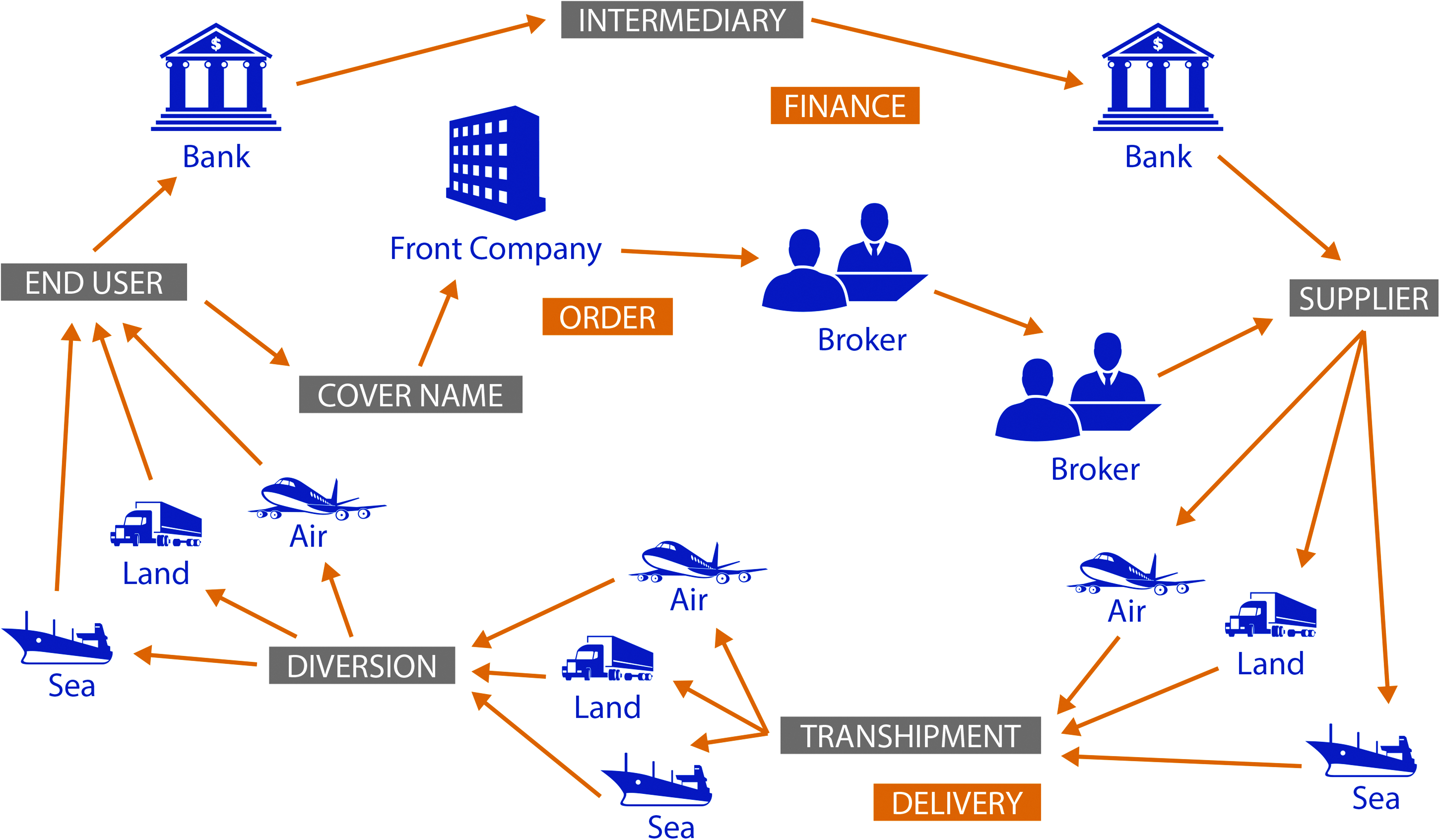
Interactions of Players in the Nuclear Supply Chain. Adapted from Proliferation Financing Report, Financial Action Task Force, Paris, France, 2008.
To add further complexity to the nuclear supply chain, many of the entities involved are small companies that may manufacture dual-use materials like carbon fiber, which can be used in the nose of an airplane or in making a centrifuge to enrich uranium for use in a nuclear weapon. The number of dual-use industries that could potentially support a nuclear weapons program is significant, and the number of companies within each of these industries is also large. PNNL found that there are likely thousands of manufacturers of sensitive dual-use technologies in the United States alone, spanning diverse industry groups ranging from steel production to precision electronics to chemical manufacturing. 1 Often these industries and the companies within each industry do not necessarily see themselves as a possible target for an entity interested in purchasing their goods, services, or technology for illicit reasons. The size of the nuclear supply chain and the complexity of interactions among the players also present a number of opportunities for nefarious actors to acquire and misuse commodities for illicit purposes. To limit these opportunities, regulators enforce export control regulations for selected commodities that could be misused to make a nuclear weapon. Additionally, regulations require that the suppliers know the intended end use and end user before fulfilling a request for a given commodity; however, it is not always easy to obtain that information. For example, brokers often acquire multiple components for a particular customer, which can obscure the intended purpose of the final product. Thus, there remains a growing and urgent need to raise awareness among this broad community about their role in the nuclear supply chain.
As part of this awareness raising effort, for more than a decade, PNNL has been engaging entities along the nuclear supply chain to encourage them to go beyond compliance to ensure that their products, knowledge, and technologies do not end up in the wrong hands. This engagement, which PNNL discusses in the context of supply chain security rather than nonproliferation, aims to raise awareness about best practices that companies can consider to prevent illicit diversions. PNNL defines supply chain security as controlling and securing goods and information, including when in an organization's possession, entering an organization from a supplier, and/or leaving the organization to a customer. 2
This definition for supply chain security also applies to the transaction of goods, services, and information supporting synthetic biology. The next section describes how the existing supply chain could support research intended to cause harm. It explores the players, relationships, and complexities that make risk management in the synthetic biology supply chain challenging.
Supply Chain for Synthetic Biology
There are notable parallels between the supply chains supporting nuclear commerce and synthetic biology research and commerce. Both supply chains involve goods, skill sets, information, and technology that can be used to support either positive or nefarious research or manufacturing, and there are points in both supply chains where controls on access and materials can be addressed. To elaborate, nuclear weapons are greatly constrained by the limited number of bomb designs and a reliance on fissile material, whereas biological weapons may employ a great number of agents (ie, pathogenic cells and viruses) and means of use. Synthetic biological weapons, however, entail agents that have been modified or designed de novo, and thus they rely on sources of genetic material—that is, the signals in the synthetic biology supply chain can be relatively more difficult to differentiate from proper use, but the opportunity to do so may be greater in the early stages of the supply chain.
There are other parallels between the chains to consider as well. Both supply chains involve companies whose reputation could be damaged if they were to become engaged—intentionally or unintentionally—in nefarious activities. In the biology context, the potential consequences of an attack with a synthetically produced bioweapon, combined with the implications of being associated with producing such an agent, should motivate supply chain entities to understand their role in the supply chain and the extent to which the interactions among them might contribute to risk mitigation.
In light of these parallels, we describe the synthetic biology supply chain. Several categories of entities make up the synthetic biology community: entities that curate or publish information; companies involved in the design, development, and refinement of synthetic organisms; companies involved in product testing and scale-up; suppliers of equipment and consumables; † and a variety of end-users. End-users include the individual hobbyist; community laboratories; federal, state, or privately funded researchers; small- to medium-sized public or private companies; and large conglomerates performing research for a variety of purposes (eg, pharmaceutical or agriculture). A small subset of those end-users may be seeking to develop and use a synthetically produced biological agent in an act of terrorism. ‡ In this article, we focus on non-state actors (eg, lone actors, groups such as Aum Shinrikyo 7 and the Rajneeshee cult, 8 or company insiders), who are few and far between, but are the most difficult to detect, deter, or regulate.
A non-state actor's ability to acquire or—depending on capabilities—generate products of concern using synthetic biology is improving because of rapidly maturing biotechnology techniques, technologies, and services. A person with basic knowledge of molecular biology and experience with gene editing techniques has access to a number of options from which to source desired material and design a fully functioning biological system. For example, he or she can isolate starting material from an existing environmental or laboratory source, request material from a peer or repository, § purchase pre-made sequences from a repository or commercial source, purchase custom synthesis, or use his or her own (or his or her own institution's) synthesizer.
To pursue the relatively inexpensive option of requesting or purchasing sequences, the non-state actor need only send a text file to a repository or commercial synthesizer specifying the precise sequence of bases to be assembled, including any positional variability to introduce at the time of synthesis. These sequences may be derived from a design produced by the ordering party or a separate commercial entity translating a set of high-level requirements for a genetic circuit into an actual specification of underlying genes and control features. In the parlance that is commonly used in manufacturing and engineering, this is the design step of the design/build/test/learn cycle to produce novel biological systems with a desired metabolic output or behavior.
In the build step of the design/build/test/learn cycle, prior to the advent of synthetic biology, scientists were mostly limited to working with naturally occurring DNA sequences or short synthetic sequences. A key evolution at the core of synthetic biology is the now-routine ability to cost-effectively synthesize custom DNA sequences up to lengths greater than 20,000 bases. This availability of DNA synthesis capabilities has eliminated the prior need for complex, lengthy, and expensive excision-ligation-cloning steps to build genes, genetic circuits, or vectors. Libraries of component genetic building blocks can be digitally recombined and then synthesized to explore near-infinite variants of possible coding sequences for a desired function. In a matter of days, complex sequences can be constructed with massive parallelization, allowing for the simultaneous analysis of variants and thus drastically shortening the design/build/test/learn cycle. Once synthesized, the same company or a separate company can insert the synthetic DNA into a “chassis” organism to create a (potentially) fully functioning biological system. Cloning is no longer a challenge, nor a necessary skill; the remaining difficulties in weaponization are no different from those posed by use of naturally occurring threat agents. In short, it is becoming increasingly easy for an adversary to not only acquire source material and design a sequence of concern, but also to synthesize that sequence and incorporate it into a living system. These capabilities afford an adversary many opportunities to exploit supply chain interactions while at the same time providing many potential opportunities to deter or defend against exploitation.
For example, a non-state actor could exploit supply chain interactions by subcontracting with companies that specialize in narrow fields of design and then perform the end-stage (in silico) design integration himself prior to moving on to synthesis of the resulting final construct. At present, design-focused synthetic biology companies are not regulated or even under any regulatory guidance in the United States, so it is likely that awareness of security concerns and/or screening of customers is highly variable from company to company. Even if a particular company has built a culture of security awareness and possesses a unique skill set, an adversary could easily contract a third party with less security awareness, or use an unwitting middleman to engage with the security-aware company, thereby hiding the end-user's affiliation with the end-product. Similarly, the path of material transactions (and modifications) from original sources to the end-user may not be apparent to all parties involved. A company that synthesizes DNA for a second company that then creates clonal libraries may not be aware of the final end-user who originally requested the library or the entity who funded the work. Similarly, multiple DNA synthesis companies are unlikely to be aware of the orders being filled by their competitors for the same client unless one or more of those orders triggers existing screening systems. **
In addition, the non-state actor does not need to indicate the species in which the DNA will be expressed, nor the ultimate goal of the final biological system. Thus, he could acquire small fragments of a complete sequence and ligate them together to build a final intact construct, knowing that small fragments of DNA are not screened or further evaluated by synthesis providers. 9 The end-user also could request a small sequence with larger flanking regions of unnecessary DNA that can be removed later. Taking this approach over multiple, small, gene-length orders placed with multiple vendors would again result in access to a final, assembled construct.
Once a prototype organism has been covertly constructed, the scale-up and weaponization of that organism faces the same considerable challenges and complexities that face the weaponization of naturally occurring organisms not produced by synthetic biology–based approaches. The supply chain for these downstream activities is already subject to export control and other regulatory oversight; here we focus only on the supply chain supporting synthetic biology research and commerce and identify key interactions within that network that offer opportunities for risk detection and mitigation. Figure 2 depicts a supply chain consisting of entities performing certain functions. A customer can initially access or exit this supply chain at many points, depending on the extent to which the customer can perform up- or downstream functions himself. For the purpose of this article, Figure 2 depicts the path a customer might take if he were to engage supply chain entities in every stage of the design/build/test/learn cycle.
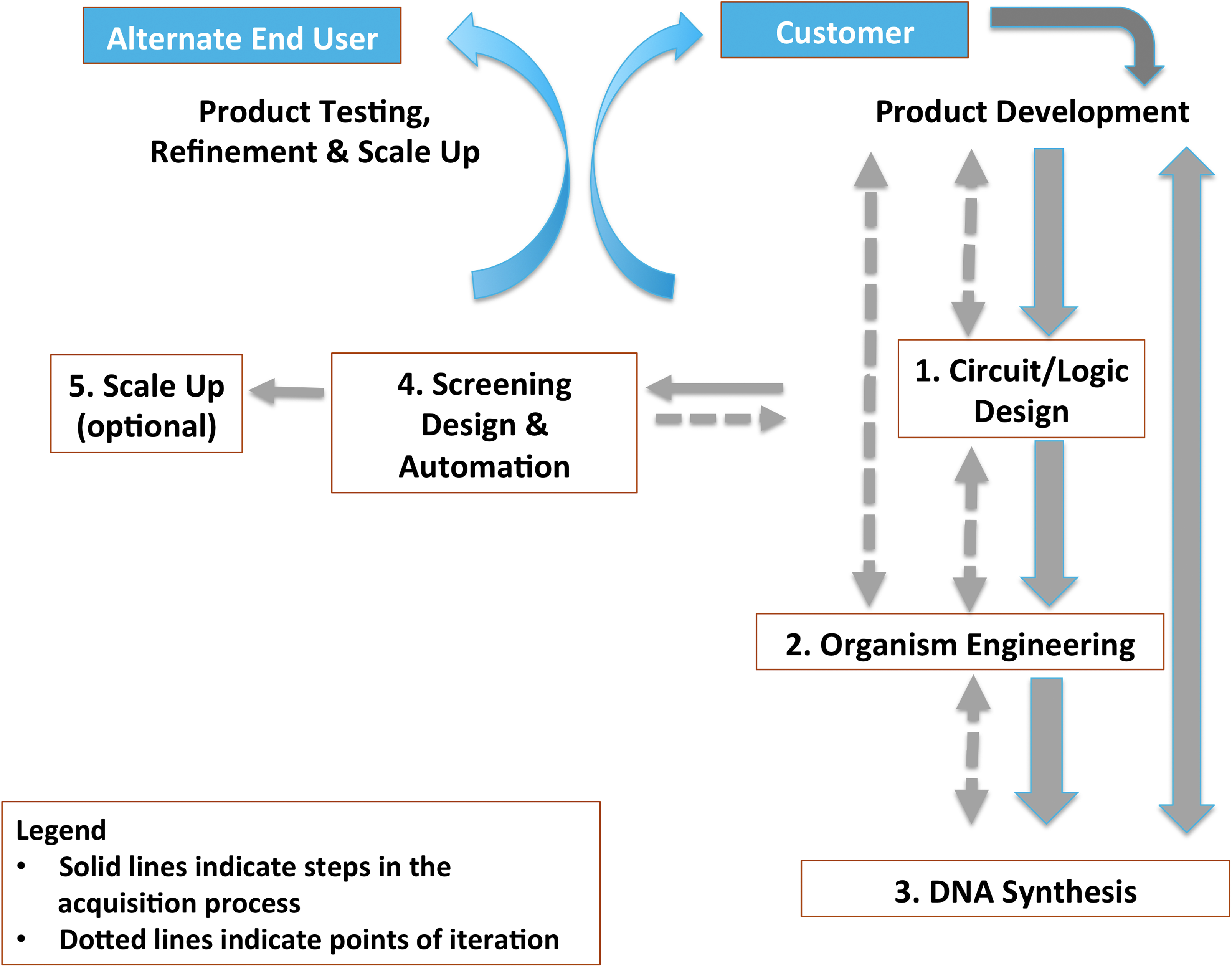
Synthetic Biology Supply Chain
The customer †† can go straight to parties performing DNA synthesis (step 3), or can start by emailing a set of requirements to a genetic circuit/logic design company with a request to design a genetic circuit to produce a desired outcome (step 1). The coded circuit will then be sent to an organism engineering company that will optimize the circuit for a target chassis organism (step 2). The resulting sequence can then be sent to DNA synthesis companies to produce the necessary DNA (step 3) and sent back to the organism engineer. Multiple design iterations may take place before a final collection of strains is ready for screening. At this point, screening design and automation companies test the designed strains to rank those that perform as designed (step 4). This screening and refinement phase may require additional rounds of redesign and optimization by the organism designer until a final prototype strain is developed. Once the final strain performs as desired, it may then be turned over to another party for scale-up to large-scale fermentation for production of industrial quantities (step 5).
A non-state actor may elect not to employ organism engineering, screening, or scale-up services. In fact, he may choose to short-circuit the supply chain altogether by stopping after DNA synthesis or even circuit design and performing offline implementation in a chassis organism to avoid communicating any detail about intent to an organism engineering firm. The opportunity to understand the intent behind this research or take steps to mitigate any risks that may be associated with it is limited. However, for those customers who do engage the supply chain to obtain synthetic organisms, each step represents an opportunity to examine their research. Vendors or regulators could ask questions of the customer, screen sequences, or compare information with other companies that may have received similar requests. The Department of Health and Human Services (HHS) suggests that companies follow up on any concerns with the Federal Bureau of Investigation's Weapons of Mass Destruction coordinator, the Centers for Disease Control and Prevention, or the Department of Commerce. 9
Recognizing that these processes and capabilities could potentially be misused, US officials have already begun to update relevant policy and regulatory frameworks to address existing and emerging risks.
Limitations of Risk Mitigation Approaches
The existing policy and regulatory frameworks that apply to synthetic biology do not effectively address the supply chain vulnerabilities described in this article. Until recently, most biotechnology research in the United States was governed by the Coordinated Framework for Regulation of Biotechnology (1986/1992)10,11 with additional changes anticipated in 2017. In an effort to broaden the scope to promote both risk- and science-based approaches to regulation and oversight of the research and products that involve emerging technologies, including synthetic biology, the US government enacted 2 new policies involving dual-use research of concern (DURC) in 2012 12 and 2014. 13 It also developed the National Strategy for Modernizing the Regulatory System for Biotechnology Products. 14
Despite these efforts to update the regulatory framework covering biotechnology advancements, the US regulatory structure for synthetic biology remains rooted in the fundamental assumption that regulation should focus not on the production process but on the use of products. This assumption reflects the concern that regulation of the process may hamper commerce. Because of this, for a non-state actor interested in executing an attack, such regulations do not adequately prevent access to materials necessary to commit an act of terror, but rather further criminalize the malicious use of the materials. Under the current framework, multiple US agencies, including the Environmental Protection Agency (EPA), the US Department of Agriculture (USDA), and the Food and Drug Administration (FDA), operate under separate statutes in an attempt to cover the landscape of synthetic biology products being produced by DNA synthesis technology (see, for example, reviews by Schmidt 2012; Bar-Yam et al 2012; Bergeson et al 2015).15-17 The result is a regulatory system that is described as one “marked by fragmentation, lack of coordination and different standards for different types of products.” 17
This fragmented regulatory system accentuates several gaps in the supply chain that could be exploited—for example:
•
•
The IGSC Protocol, in addition to screening sequences against a database of regulated pathogens, also calls for the identification of customers and for screening all customers against published lists of individuals and companies with known links to arms and narcotics trafficking, terrorism, or support for designated countries and entities. 18
To further complicate problems with screening, commercial manufacturers do not always have a complete picture of a manufactured product's supply chain, particularly if any information was obscured or otherwise hidden at the time of procurement. 17 A manufacturer may halt a sale because of suspicious information it obtained about the end-user but fail to pass that information to government authorities for further investigation. ‡‡ In both the biology and nuclear contexts, such failures are considered lost opportunities for preventing the next bioweapon or nuclear terrorist attack.
•
As technologies mature and new regulatory gaps emerge, the federal government and the synthetic biology community will grow increasingly unable to maintain adequate situational awareness about the research taking place in both regulated and unregulated space. Sarah Carter and Robert Friedman of the J. Craig Venter Institute acknowledge this challenge in their discussions about the costs and challenges associated with the screening process, and they make a number of useful recommendations in their report. 23 As a result, entities all along the supply chain may need to assume a greater role in promoting responsible science and reporting suspicious activities. In anticipation of this trend, the next section provides several recommendations for a more broadly engaging and adaptive approach that supply chain entities can take to fill these regulatory gaps and strengthen supply chain security.
Findings and Recommendations
With a better understanding of the functions and entities that make up the synthetic biology supply chain, one can begin to consider several recommendations that might promote scientific research while helping decision makers and responsible vendors identify and mitigate risks associated with synthetic biology research.
One set of recommendations draws on PNNL's work for the US National Nuclear Security Administration in promoting nuclear supply chain security. PNNL developed 8 principles of conduct to mitigate the risks facing nuclear suppliers.
24
Of the 8 principles, 5 are particularly relevant to entities involved in the synthetic biology supply chain and are listed below:
• Adopt and communicate a corporate governance statement on supply chain security. • Participate in relevant supply chain security codes of conduct. • Preferentially select business partners that maintain strong supply chain security practices. • Incorporate supply chain security concepts into employee training and education to promote a supply chain security culture. • Develop a corporate policy on reporting anomalous incidents to appropriate parties.
In addition, PNNL has found 2 important leverage points for raising awareness among all of the players in the nuclear supply chain: (1) companies that combine components, technology, and knowledge into products, and (2) financial institutions. Because of the vast number of companies involved in both the nuclear and synthetic biology supply chains, raising awareness among these 2 communities can be a more effective and efficient approach for promoting responsible science and engineering. The first group, also referred to as “integrators,” can preferentially source from sub-suppliers who adhere to the aforementioned principles of conduct. Similarly, most companies have to borrow money or purchase insurance at some point, so banks and insurers can play an influential role by incorporating the principles into their lending practices. 1
To become truly integral, these principles must become part of a corporate culture throughout the entities involved in synthetic biology supply chain. An effective way to do this is to embed the principles into the technologies and workflows of supplier companies, making it easy and cost-effective for suppliers to do the right thing. For example, entities other than DNA synthesis companies supporting the synthetic biology supply chain could use tools to screen and flag suspicious gene-length (>200 base pairs) sequence purchase orders prior to submitting the constructs for synthesis, enhancing the safeguards that International Gene Synthesis Consortium companies currently perform.
Another option for embedding certain principles into organizational workflows pertains to the National Institute of Health (NIH) process for registering rDNA research.
§§
The NIH permit process includes lists of genes, regulatory elements, vectors, host, and target species, but it does not include proprietary information such as specific sequences, arrangements, or spacing. The registration for rDNA could be applied as a prerequisite for DNA synthesis serving all customers in the United States, regardless of funding sources, and—if this information were digitized—synthesis proprietors could use automated software tools provided by the government to cross-check sequence requests against a regularly updated database. A fairly simple 4-step process would include:
1. A software tool such as that recommended above could be used to compare sequence requests against GenBank to find closest matches. 2. To protect proprietary sequence data, the matches would be used to transform the specific sequence request into the more ambiguous information (eg, gene, vector, operon) and source species recorded in rDNA registrations. 3. This information, and the identity of the requesting lab, would be cross-checked against the rDNA registry to greatly reduce the number of sequences that need to be vetted by a human. 4. If a match is found, the sequence would be constructed and a message sent to the principal investigator to make sure he or she is aware of the order—that is, to avoid instances where a staff member uses the principal investigator's credentials to purchase illegitimate sequences.
This is an admittedly imperfect solution, and more work needs to be done to address circumstances when no match is found. Obvious solutions to this problem are controversial and potentially infeasible. Therefore, we recommend that the synthetic biology industry and research community work together to identify options for screening and flagging suspicious sequences that are amenable to all parties.
While such tools are worth exploring, these types of gene-length checks do not address oligo-length (ie, <200 base pairs) purchase orders that have the potential to be assembled into proscribed sequences of concern via simple, widely used laboratory methods (eg, polymerase cycling or Gibson assembly25,26). We recommend that, to be fully effective, techniques should be developed to screen for combinations of smaller sequences ordered from multiple companies.
Another challenge is that high false-positive hit rates associated with shorter sequences would be difficult to disambiguate, and therefore screening across multiple companies is technically more complicated. Adding to the complexity is the need to preserve competitive advantage, as well as maintain the confidentiality of individual orders. While these requirements theoretically could be satisfied by mandating a central clearinghouse for screening, there might be sensitivities about sharing information with government authorities, which suggests that other solutions may be more effective. For example, independent, nongovernmental organizations may be more suitable candidates to serve as third-party validators. This is an approach that PNNL is exploring to help share information about the nuclear supply chain.
Another option PNNL is considering is the use of shared ledger technology (SLT) to help companies share sensitive information for the purpose of monitoring suspicious orders among key stakeholders. SLT links existing state-of-the-art cryptographic techniques with electronic distributed ledgers in specific ways using the blockchain *** to maintain a history of transactions. 27 SLT offers a way for parties that may or may not trust each other to maintain a history of financial and other types of exchanges, including exchanges of physical goods and information. An SLT solution could facilitate a secure way of checking all possible combinations of encrypted sequence purchase orders, which might assure companies that it is safe and secure to share information. In other words, if the analytics running on encrypted data flag an issue, analysts could collect relevant private keys from submitting companies and decrypt the specific data for further analysis. This provides assurance that no one can decrypt commercial records without the knowledge and permission of the submitting company. A representative set of supply chain companies and computer scientists would need to partner to identify the specific technical and operational requirements for such a system.
Homomorphic encryption (HE) is another significant advance in computer science that could contribute to development of privacy-preserving analytics that could help ensure the supply chain is not being used to create lethal pathogens. Homomorphic encryption refers to the ability to draw valid analytic conclusions without first decrypting the data. Although homomorphic encryption is still developing, we believe it could enable the application of advanced analytic algorithms directly to encrypted sequence order data. 28 This opens up several intriguing possibilities. For example, advanced machine learning algorithms are widely used in many areas of science, sifting through enormous quantities of data from high-throughput and data-intensive experiments to find desired “needles in the haystack.” In the case of synthetic biology, it is possible that existing classifiers could be used to go beyond detection of sets of oligo-length orders that could be assembled into a pathogenic sequence. Specifically, development of such classifiers would enable analysis, and risk-rating, of larger overall patterns of ordering behavior. Identifying suspicious ordering patterns, even if they cannot be tied directly to a pathogen, offers opportunities to strengthen supply chain security or help predict the overall behavior of the marketplace. Although the application of these and other advanced technologies to supply chain security requires more research, they remain an important new option that the synthetic biology community can explore to mitigate the risks inherent in its supply chain.
A final consideration is to require that DNA synthesizers be kept in secured access rooms. The computer/software needed to operate the synthesizer should be password-protected and generate a record of each access to a separate server that includes information about the sequences that were synthesized, the names of those who input the data, and dates associated with the creation of a sequence. This would provide a searchable record that may be used by law enforcement to help determine the origin of synthetic sequences used in attacks, accidental releases, or patent infringement cases.
Conclusion
The supply chain entities and interactions described here do not necessarily indicate nefarious activity. In fact, the synthetic biology community consists of responsible scientists and researchers who want to make positive contributions to their field. But as the field evolves, new security concerns emerge, warranting additional consideration and scrutiny from security professionals as well as the synthetic biology research community. As demonstrated by efforts in the field of nuclear nonproliferation, the supply chain interactions described herein offer specific opportunities for companies, financiers, institutions, and regulators to evaluate end-user requests and take a more active role in promoting responsible science among the synthetic biology researcher community without hampering productive research and commerce. Such efforts can help ensure that dual-use products, knowledge, and technology do not end up in the wrong hands. We encourage future research into the costs and spectrum of implications of applying the suggested recommendations. Moreover, further research would be welcome to better understand whether and how these recommendations translate to the international community.