




Abstract
Filoviruses are important etiological agents of emergent diseases with high mortality rates. Traditionally, filovirus fever diseases have primarily been a burden of African countries; however, global interconnectedness has increased the probability of the worldwide spread of filoviruses. Therefore, national healthcare organizations need tools for managing filovirus risk, including diagnostic kits based on real-time reverse transcription PCR (RT-qPCR), as this is the most suitable method for diagnosing filovirus fever diseases. Here we describe a real-time RT-qPCR assay for filovirus detection. This assay is a further development of our previously reported EBOV (Zaire)-Fl kit. Two sets (FiloA-Fl and FiloB-Fl) of real-time RT-qPCR assays for the detection of filoviruses were developed and evaluated using armored RNA phage particles (ARs) as positive controls. The limit of detection of the assay was 5x10² copies/ml of the AR-positive control for the FiloA-Fl set and 5x10³ copies/ml of the AR-positive control for the FiloB-Fl set. Our assay provides a rapid and sensitive tool for detecting filoviruses. The high specificity and sensitivity of the assay make it useful for clinical and epidemiologic investigations in the field of filovirus fever diseases and their etiological agents.
Filoviruses are important etiologic agents of emergent diseases with high mortality rates. Filovirus fever diseases have primarily been a burden of African countries, but global interconnectedness has increased the probability of their worldwide spread. Therefore, national healthcare organizations need tools for managing filovirus risk. This article describes a real-time RT-qPCR assay for filovirus detection.
T
Humanity first faced filovirus fevers in 1967, when an outbreak of MFD occurred in Germany and in the former Yugoslavia. 4 Nine years later, in 1976, 2 simultaneous outbreaks of EFD with a total of 602 cases occurred in Sudan and Zaire. These outbreaks were caused by SUDV and EBOV, respectively.5,6 Subsequently, EFD and MFD outbreaks occurred regularly but did not constitute a great threat to humanity, because they were always limited by the number of cases and usually localized in remote areas of Africa.
However, the situation changed in 2014, when the largest ever recorded epidemic of EFD spread throughout 5 African countries: Guinea, Liberia, Sierra Leone, Nigeria, and Senegal. 7 A total of 28,646 cases and 11,323 deaths had been recorded by March 27, 2016. 8 Despite joint efforts by the world community, elimination of the outbreak took nearly 2 years, and sporadic cases of EFD are still being reported in Guinea and Liberia. 9 Another problem is the large number of convalescents, whose physiological liquids (ie, aqueous humor, sweat, urine, vaginal secretions, conjunctival fluid, feces, and breast milk) contain viable virus for a long time after clinical recovery.10-12 Therefore, these individuals require close surveillance and control.
For this reason, rapid, sensitive, and specific methods for filovirus detection are needed for the diagnosis of EFD and MFD as well as for the surveillance and identification of viral sources in the environment. Here, we describe a real-time reverse transcription PCR (RT-qPCR) assay for the detection of filoviruses. This assay is a further development of our previously reported EBOV (Zaire)-Fl assay. 13
Materials and Methods
Identification of Conserved Sites and Design of the Assay
All sequences of SUDV, MARV, BDBV, RESTV, and TAFV available in GenBank (NCBI) were aligned to identify conserved sites suitable for targeting using real-time RT-qPCR. The alignments were performed using the BioEdit 7.2.5 software package (Ibis Biosciences, USA).
Next, a 135-nucleotide fragment of the NP gene (nt positions 1199-1334 in the reference sequence of MARV, GenBank accession number KR063674) (Figure 1), a 130-nucleotide fragment of the VP30 gene (nt positions 9012-9142 in the reference sequence of SUDV, GenBank accession number KT878488) (Figure 2a), a 97-nucleotide fragment of the VP40 gene (nt positions 4733-4830 in the reference sequence of TAFV, GenBank accession number KU182910) (Figure 2b), an 85-nucleotide fragment of the NP gene (nt positions 87-172 in the reference sequence of BDBV, GenBank accession number KU182911) (Figure 2c), and an 86-nucleotide fragment of the L gene (nt positions 12896-12959 in the reference sequence of RESTV, GenBank accession number JX477166) (Figure 2d) were manually selected as targets for amplification. Additionally, a 113-nucleotide fragment of the L gene, described previously, was used for ZEBOV targeting. 13
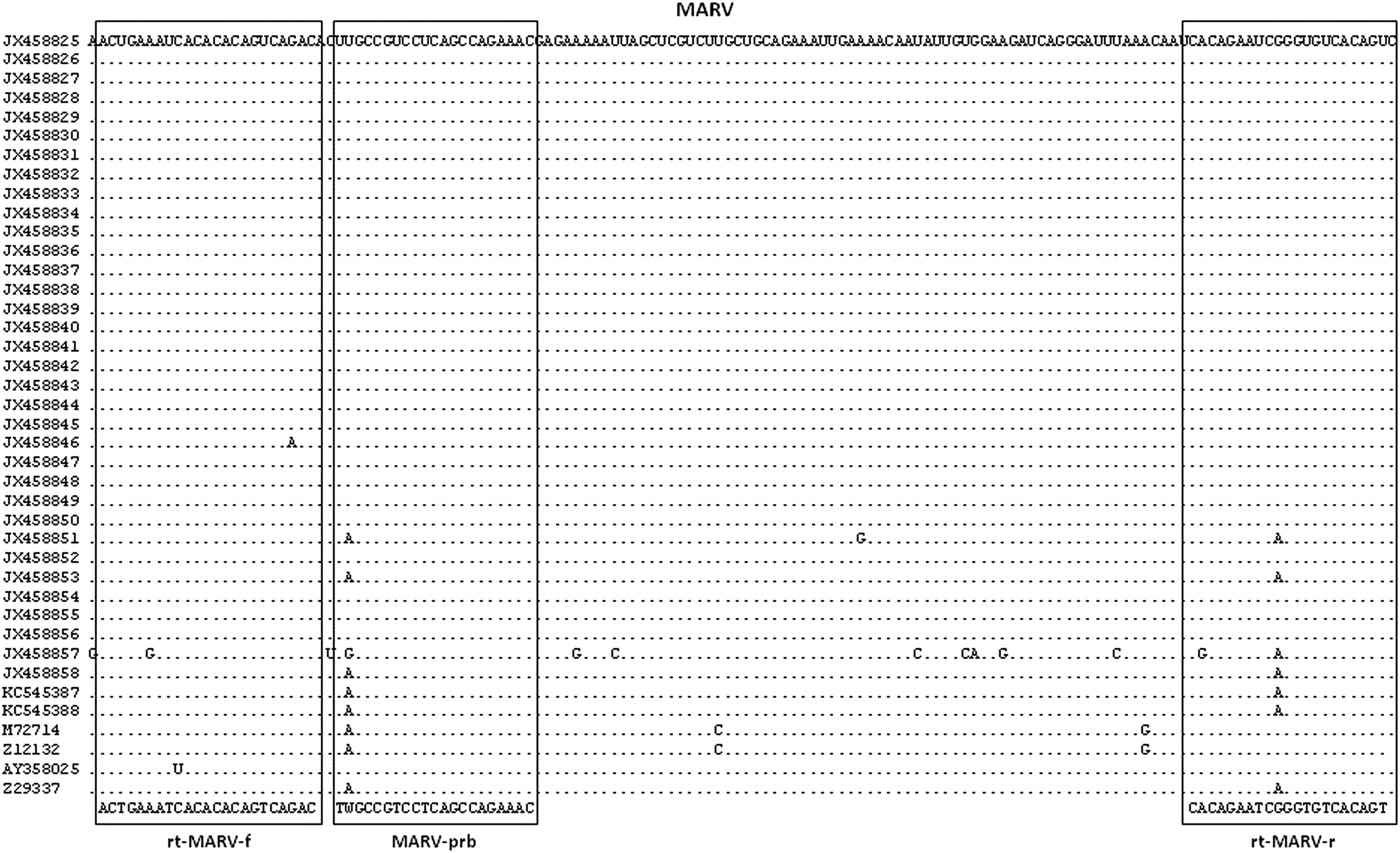
Partial Nucleotide Sequence Alignment of Marburg Virus (L-gen). Partial sequences of Marburg virus (MARV): JX458825-JX458858, Z12132, Z29337, AY358025, KC545387-KC545388, M72714. Sequences of the forward (f) and reverse (r) primers and probe (p) targeting this region are indicated in the frames.
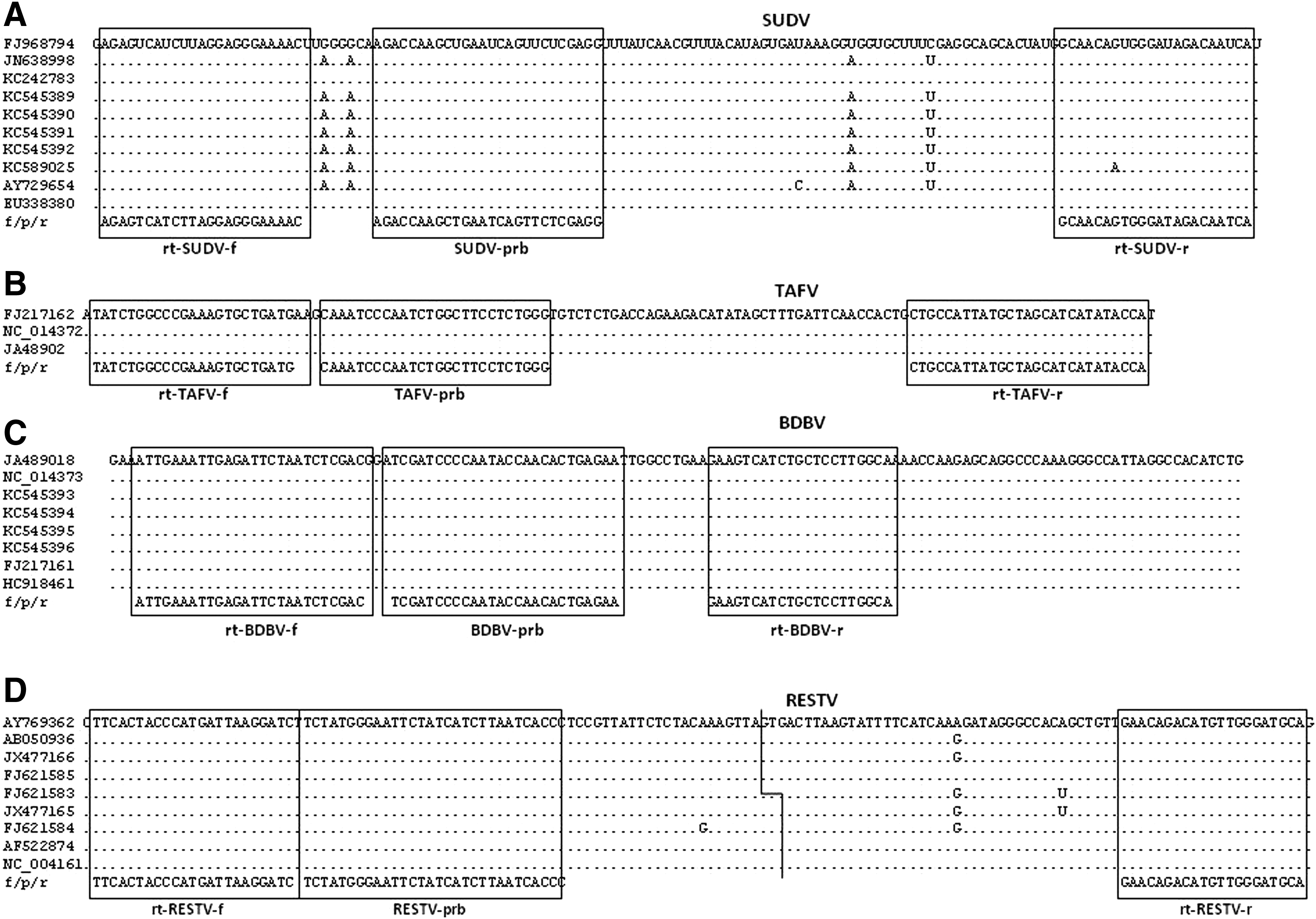
Partial Nucleotide Sequence Alignments of Filoviruses.
The probability of homodimer, heterodimer, or hairpin formation by the primers and probes was optimized using Oligonucleotide Properties Calculator (http://biotools.nubic.northwestern.edu/OligoCalc.html) and UNA Fold Web Server (http://unafold.rna.albany.edu).
We divided our assay into 2 sets due to limitations of the number of fluorescence channels for the real-time PCR instrument. The first FiloA-Fl set was designed to detect the “most frequent” filoviruses: ZEBOV, SUDV, and MARV. The second FiloB-Fl set was designed to detect BDBV, TAIFV, and nonpathogenic to humans RESTV.
Real-time Reverse Transcription qPCR Assay
A real-time RT-qPCR assay was designed for the detection of filoviruses (Tables 1 and 2). The sequences of all primers and specific probes were tested using BLAST. If necessary, nucleotides were added to the 3'-ends of the probes to form a hairpin. A ZEBOV-specific probe and a TAFV-specific probe were covalently attached to the fluorescent reporter dye carboxyfluorescein (FAM) at the 5' ends and to the black hole quencher (BHQ1) at the 3' ends. A SUDV-specific probe and a BDBV-specific probe were covalently attached to the fluorescent reporter dye rhodamine 6G (R6G) at the 5' ends and to the black hole quencher (BHQ1) at the 3' ends. A MARV-specific probe and a RESTV-specific probe were covalently attached to the fluorescent reporter dye rhodamine X (ROX) at the 5' ends and to the black hole quencher (BHQ2) at the 3' ends. The primers and probes were synthesized by the Bioorganic Synthesis Branch in the Central Research Institute for Epidemiology, Moscow.
Design of the FiloA-Fl Set
Design of the FiloB-Fl Set
The targeting fragments were amplified and quantified in 2 25-μl reactions containing 10 μl of the sample (RNA template and RNase-free water), 0.2 μM each of forward and reverse primer, 0.2 μM of each specific probe, 2.5 μl dNTPs (1.76 mM, AmpliSens, Russia), 5 μl 1-step RT-PCR mix2 FEP/FRT (AmpliSens, Russia), 0.25 μl TM-revertase (AmpliSens, Russia), and 0.5 μl TaqF polymerase (AmpliSens, Russia).
The thermal cycling parameters were 50°C for 15 min, followed by 95°C for 15 min, and then 45 cycles of 95°C for 10 s and 60°C for 20 s. Fluorescence was observed at 60°C in a Rotor-Gene Q (Qiagen, Germany).
Positive DNA Controls
A PCR fragment containing the target regions and some flanking nucleotides was generated using step-out amplification, as previously described. 13 The final PCR products were purified using a MinElute Gel Extraction kit (Qiagen, Germany), ligated into the pGEM-T plasmid vector (Promega, USA) and transformed into Escherichia coli (XL1-Blue strain). 14 Recombinant plasmids from individual clones were purified using a Plasmid Miniprep kit (Axygen, USA), and the orientation and absence of mutations in the cloned PCR fragment were evaluated by Sanger sequencing using an ABI-Prism 3500 XL (Applied Biosystems, USA). Plasmids were quantified, diluted in elution buffer (AmpliSens, Russia), mixed in equal amounts, and used as external positive controls (EPC) in the FiloA-Fl and FiloB-Fl sets of the assay.
Plasmid quantification was achieved via droplet digital PCR using the QX100 system (Bio-Rad, USA) with ddPCR Supermix for Probes (Bio-Rad, USA) and species-specific primers and probes.
Armored Positive RNA Controls
Armored RNA phage particles (ARs) were prepared as positive RNA controls for real-time RT-PCR detection of filoviruses, as previously described. 13 After RNA extraction using the RIBO-prep extraction kit (AmpliSens, Russia), the ARs were quantified by RT droplet digital PCR using the QX100 system (Bio-Rad, USA), One-step ddPCR Supermix for Probes (Bio-Rad, USA), and appropriate filovirus-specific primers and probes. The ARs were mixed in equal amounts and used as external positive armored controls (ARCs) in the FiloA-Fl and FiloB-Fl sets of the assay.
Armored Internal Control
To assess the efficiency of RNA extraction, the STI-87rec (AmpliSens, Russia) exogenous internal control (IC) was added to the reagent mixture. STI-87rec is an artificial RNA sequence (150 nt, GC content 50%) surrounded by an MS2-derived protective protein coat. STI-87rec-specific primers and a Cy5-labeled probe were included in the reaction mixture of the FiloA-F1 and the FiloB-Fl sets.
Analytical Sensitivity
Analytical sensitivity was evaluated using a series of 10-fold dilutions of ARs. Briefly, known concentrations of ARs were diluted 10-fold using RNase-free elution buffer (AmpliSens, Russia), added to serum for a final volume of 100 μl, extracted using the RIBO-prep extraction kit (AmpliSens, Russia, in accordance with the manufacturer's instructions), and then tested in the FiloA-Fl and FiloB-Fl sets to establish standard curves and the limit of detection (LOD). The limit of detection was set as the minimal dilution detected in 3 replicates. 15
Analytical Specificity
The ability of the developed assay to detect ZEBOV, SUDV, and MARV was evaluated using high-titer RNA from ZEBOV, SUDV, and MARV, which were kindly provided by State Research Center of Virology and Biotechnology VECTOR. Potential cross-reactivity was assessed using high-titer solutions of viral RNA and DNA from 19 viral species belonging to 9 viral families, which are a part of the collection of Central Research Institute for Epidemiology. The summary of RNA/DNA used in the study is shown in Table 3.
List of viral species used in this study
Diagnostic Sensitivity and Specificity
Diagnostic sensitivity and specificity were assessed using serum samples from ZEBOV-positive (n = 51) and ZEBOV-negative (n = 164) patients with clinical symptoms of fever, as well as from individuals without any clinical symptoms (n = 50). All human samples were collected, previously tested for ZEBOV, and kindly provided by the Virology Laboratory of Hemorrhagic Fevers Research Project, Gamal Abdel Nasser University, Guinea Conakry. A RealStar® Ebolavirus RT-PCR Kit 1.0 (Altona Diagnostics GmbH) was used for ZEBOV detection. Viral RNA was extracted from 140 μl of serum using the QIAmp viral RNA kit (Qiagen, Germany) and examined immediately after extraction.
Results
Two sets (FiloA-Fl and FiloB-Fl) of real-time RT-PCR assays for the detection of filoviruses were developed and evaluated. The melting temperatures and GC contents of all primers and the length of the amplicons were adjusted to be similar for efficient multiplex reactions. The analytical specificity of the assay was studied using a representative sampling of viral and human RNA/DNA. No cross-reactions were observed. The LOD of the assay was 5 × 10² copies/ml of the AR-positive control for the FiloA-Fl set and 5 × 10³ copies/ml of the AR-positive control for the FiloB-Fl set. Standard detection was linear in the range from 105 copies/ml (Ct 28) to 5 × 10² copies/ml (Ct 36) for the EBOV AR (R2 = 0.99), 105 copies/ml (Ct 27) to 5 × 10² copies/ml (Ct 37) for the SUDV AR (R2 = 0.98), 105 copies/ml (Ct 27) to 5 × 10² copies/ml (Ct 37) for the MARV AR (R2 = 0.98), 105 copies/ml (Ct 31) to 103 copies/ml (Ct 39) for the TAIFV AR (R2 = 0.99), 105 copies/ml (Ct 29) to 103 copies/ml (Ct 36) for the BDBV AR (R2 = 0.97), and 105 copies/ml (Ct 31) to 103 copies/ml (Ct 39) for the RESTV AR (R2 = 0.98). Within these ranges, efficiencies were assessed at 94% for EBOV, 87% for SUDV, 97% for MARV, 91% for TAIFV, 99% for BDBV, and 86% for RESTV.
A total of 215 clinical samples and 50 samples from healthy humans assessed by the Virology Laboratory of Hemorrhagic Fevers Research Project, Gamal Abdel Nasser University, Guinea Conakry, were also simultaneously tested using RealStar® Ebolavirus RT-PCR Kit 1.0 (Altona Diagnostics GmbH), with 51 samples testing positive and 214 negative. No discordant samples were observed. Thus, diagnostic sensitivity regarding ZEBOV and diagnostic specificity reached 100%.
Discussion
Filoviruses are important etiologic agents of emergent diseases with high mortality rates. Filovirus fever diseases were traditionally a burden in African countries, but global interconnection has raised the probability of filoviruses spreading worldwide. Therefore, national healthcare organizations need tools for managing filovirus fever disease risks. These tools should include diagnostic kits based on RT-qPCR, because it is the most suitable method compared with enzyme-linked immunosorbent assay (ELISA) or rapid diagnostic tests (RDTs) for filovirus fever disease diagnosis. 16 Many assays and commercial kits for filovirus fever disease diagnosis have been developed in several countries.15,17-19 Some of these kits have been approved by the World Health Organization, 20 but only a few were evaluated during the recent epidemic in West Africa.
The assay described above is mainly intended for use in the mobile laboratory of the Russian special antiepidemic team (SAET) and in the Russian Federation for diagnostic purposes. Unfortunately, we faced some limitations during assay development, namely the lack of RESTV, BDBV, and TAIFV RNAs. Therefore, our assay was evaluated using clinical samples only for ZEBOV and using ARs as well as in silico analysis for the other filoviruses. Nevertheless, the analytical characteristics of the developed assay are comparable with the best of any developed assays for Ebola fever disease and filovirus fever disease diagnostics (see Table 4). 20 Based on our experience of using the EBOV (Zaire)-Fl assay during the Ebola outbreak in Guinea in 2014-2016, we expect this assay to work well.
Comparison of IVD Assays that Have Been Approved for EVD Diagnostics
IVTC = in vitro–transcribed positive control.
Time to results, excluding extraction stage, is shown in brackets.
ARPC = armored positive control.
C+ = positive PCR control.
IC = internal control.
Conclusions
This article reports the development of an RT-PCR assay for filovirus detection. The assay contains all of the necessary components to perform the analysis, including an AR-positive control, positive control for PCR, and an armored internal control. The advantage of this assay is that it allows the verification of all steps of the analysis, including extraction, reverse transcription, and PCR.
Our results revealed that the LOD of the assay is in the range of 5 × 10² to 5 × 10³ copies/ml of ARs. Thus, our real-time RT-PCR assay provides a fast and sensitive tool for filovirus detection. The high specificity and sensitivity of the assay makes it useful for clinical and epidemiologic investigations in the field of filovirus fever diseases.