




Abstract
M
The New York City Department of Health and Mental Hygiene (DOHMH) developed and launched a social media monitoring team (SMMT) in its Incident Command System (ICS) in August 2013. The SMMT is a group of trained agency staff mobilized during ICS activations to monitor social media in support of incident objectives. The mission of the SMMT is to provide relevant, timely, verifiable, and actionable information to ICS leaders. Since its launch, the SMMT has been activated for several emergency responses of varying scales—including hepatitis A exposures, an Ebola case, a Legionnaires' disease outbreak, and the Zika virus threat—and 1 major citywide mass prophylaxis exercise, which was covered by the press. In each instance, the SMMT provided value to the response.
Social Media in the Zika Response
Most recently, the SMMT was activated to coordinate planning and response to the threat of Zika. While the agency began planning for Zika as early as November 2015, the ICS was officially activated on February 1, 2016, and remained in place until October 31, 2016, for a total of 273 days. The activation for Zika was not a typical public health emergency response to a spreading communicable disease, as there was no local transmission of Zika in the United States when the agency decided to activate, nor were there any locally acquired cases in NYC for the duration of the activation. Nevertheless, a tremendous amount of work was needed to handle travel-related cases of the Zika virus and prepare for potential local transmission. For example, the agency planned additional mosquito control activities, conducted human surveillance for travel-related cases, coordinated laboratory testing and communicated instructions for laboratory testing to healthcare facilities, and conducted community outreach. The SMMT was mobilized from the very beginning and quickly established a monitoring plan for Zika-related social media content based on initial incident objectives determined by ICS leaders.
The volume of social media activity fluctuated throughout the Zika response, often depending on news events that drove increased activity. For this reason, the SMMT consisted of primarily 1 or 2 people during any given week. Toward the close of mosquito season (which runs from April to October in NYC) and the end of the response, the SMMT lead actively monitored social media once or twice a week and passively monitored incoming agency messages throughout the day. Active monitoring consisted of staff aggressively looking for relevant Zika content, whereas passive monitoring entailed adjusting notification settings in various tools to alert staff when particular activities occurred, such as agency mentions or keywords being mentioned above a certain threshold. This was different from the Ebola response of 2014, when, in the initial 2 weeks after the Ebola case in New York City was diagnosed, 2 to 3 staff were exclusively devoted to monitoring social media during any given 12-hour operational period.
Monitoring and Risk Communication Strategies
The SMMT lead reported to the public information officer (PIO) and was responsible for sending social media summaries to be included in situation reports. These situation report summaries looked at mentions of Zika virus or the health department's response, sentiment, and messages shared by “influencers”—that is, social media users who have established credibility and, therefore, have the most influence among their social network as measured by number of followers and engagement—in the NYC area (see sidebar for definitions). These social media accounts may not be local to NYC, but they are ranked highly in influence over users geotagged in NYC. Reports were organized by trending top headlines as determined by the most recent social media messages, which were also linked to news stories for further reference. Initially, the reports were organized into 3 categories: NYC-specific messages, national messages, and international messages. Direct links to the Twitter and Instagram content were collected on Storify, an online story curation website, which was also organized by location (local, national, and international) of what was being discussed in the post.
As Zika progressively worsened in South America and the Caribbean, and travel-related cases began to increase throughout the United States and NYC specifically, the SMMT continually modified and added to the search criteria to capture the most relevant data and prioritize reports that honed in on NYC-centric messages. These summaries allowed ICS leaders to get a quick and high-level glimpse of news media and public discourse on Zika.
In the first phase of the Zika educational outreach efforts, public messaging was focused on mosquito control guidance (Figure 1). Given that Zika activation was spread over an extended period of time (9 months), significant repetition of messages was needed. Throughout the 2016 NYC mosquito season, far more messages than in previous years, including those specifically tagging or mentioning DOHMH, were directed at the agency about where standing water or unusual mosquito activity was observed. The SMMT encountered many instances of standing water complaints on social media over the span of the ICS activation. The agency then assisted New Yorkers with following up on complaints that were submitted to 311, New York City's nonemergency call center.
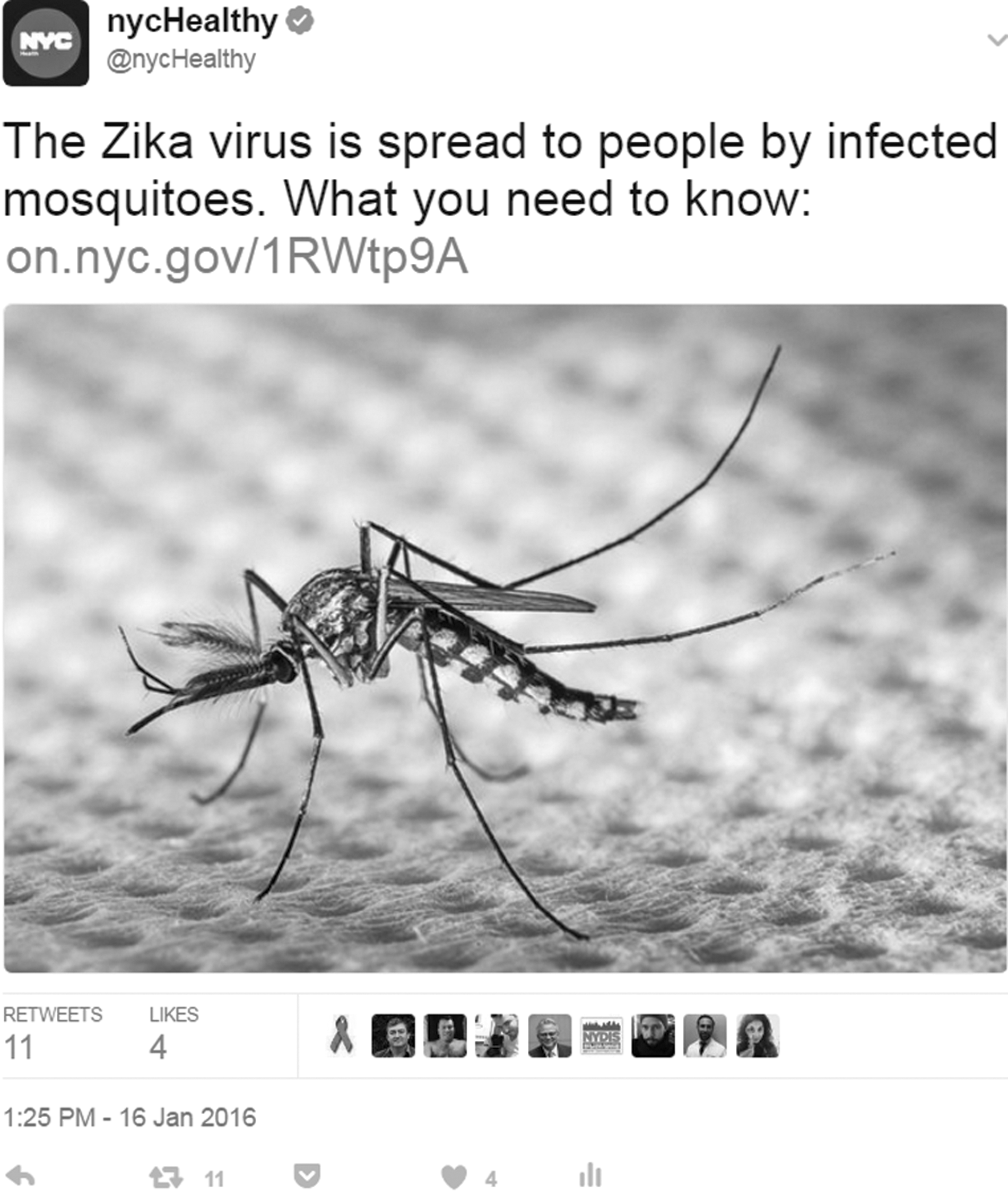
Public messaging on mosquito control guidance.
The focus of monitoring was on Twitter and Instagram rather than Facebook, since the majority of Facebook users keep their profiles private and therefore unsearchable. Lengthy and complex Boolean search queries were created, continually modified and updated, and then saved in social media analytical tools like Hootsuite and Sysomos MAP to monitor and capture relevant messages. Hootsuite, a social media management platform used by digital media managers across all NYC agencies, allowed for monitoring multiple topics of conversation simultaneously on the platform's dashboard. SMMT members could share Boolean strings and observe conversations in real time from their own computers. As a new topic or piece of information emerged, an additional column, or stream, could be added. Hootsuite's listening capabilities were complemented by another listening tool, Sysomos. Unlike Hootsuite, Sysomos has more powerful geographical search capabilities. Using the same Boolean search queries in Sysomos, filtered geographically to the NYC metropolitan region and a particular timeframe, messages could be sorted by authority, popularity, or reach (see sidebar). Sysomos was also the tool used to collect daily tweet volume on a set query, which we used to note upward trends in conversations around certain news stories or events (eg, the 2016 Summer Olympics in Brazil or a US congressional vote for Zika response funding).
As rumors and misinformation about Zika spread, additional queries were added in order to observe conversations. The most prevalent misinformation observed via social media monitoring related to the following general areas:
• Misunderstanding of locally acquired infection versus travel-related cases (the most common misinformation throughout the response); • Incorrectly believing mosquitos in NYC carried Zika or that all mosquito species carry Zika (sporadic throughout response); • Uncertainty around sexual transmission and laboratory testing (heavy activity in July 2016); and • Mosquito spraying conspiracies (particularly active in May and June 2016).
Generally, the agency would not respond to questions or concerns that did not specifically reference the health department. However, if a New Yorker reached out directly by mentioning the agency handle or account name (@nycHealthy), the agency responded directly (see Supplemental Figures S1 through S8 in supplemental material at http://online.liebertpub.com/doi/suppl/10.1089/hs.2017.0031). Also, if a rumor was seen several times and seemed to be gaining momentum or traction, consideration would be made to counter it with an outbound message affirming the facts, but not necessarily replying directly to each individual account. The agency used the Zika hashtag 188 times over the course of the response.
Events Driving Social Media Discussions
The following specific events triggered higher volumes of social media discussion that led to increased observations of misinformation and opportunities for the agency to clarify and reinforce factual information on Zika.
Babies Born with Zika-Related Defects
As the spring and summer of the 2016 mosquito season in NYC progressed, it became clearer that local transmission of Zika virus in the 5 boroughs of the city was increasingly unlikely. However, the threat of acquiring Zika from traveling to areas where the virus was spreading was real. The number of pregnant women living in NYC with lab-confirmed Zika infection was increasing, as was the demand for testing.
One of the aims of the agency's social media content and citywide public awareness campaigns was to warn New Yorkers who were pregnant or potentially pregnant of the threat of traveling to countries where the virus was spreading. However, through monitoring social media, the SMMT observed less concern from New Yorkers about travel-associated Zika transmission and increased concern around the threat of local transmission from local mosquitos. After observing messages from New Yorkers who were pregnant and still traveled to Zika-affected areas, despite the travel warning, the agency knew that its risk communication had to be stronger and more direct (see Supplemental Figure S6). On July 22, 2016, the agency reported that the first baby with congenital Zika virus syndrome had been born in NYC; on December 7, 2016, the agency confirmed that an additional 4 infants had been diagnosed with Zika.2,3 This news generated higher volumes of tweets but did not result in any change to risk communication strategies.
Transmission of Zika Virus in the US
On July 29, 2016, the Florida Department of Health announced the first 2 cases of locally transmitted Zika in the United States, which occurred in the Wynwood neighborhood of Miami. In August and September, additional local transmission was confirmed in Miami Beach and North Miami, respectively. 4 This news was quickly picked up by the SMMT and reported to our public information officer and ICS leaders. Being aware of this report as soon as it became public allowed the agency to immediately work on a messaging strategy and update agency travel guidance to include avoiding travel to the affected area of Florida. A statement, which the agency shared on Twitter, was issued by DOHMH commissioner Dr. Mary Bassett on August 1, 2016, to communicate the updated travel guidance. 5
Sexual Transmission
On February 2, 2016, Dallas County Health and Human Services announced the first sexually transmitted case of Zika in the United States. 6 Subsequently, on July 15, 2016, the NYC DOHMH announced the first-ever female-to-male sexual transmission of Zika. 7 These announcements created new and significant discussion of the disease (ie, sexual partners as a source of transmission), which increased the demand for laboratory testing and further complicated public messaging. Nonetheless, a DOHMH Zika guidance page, which was regularly shared in social media posts, included guidance for using birth control and barrier protection correctly to prevent sexual transmission. 8
Challenges and Lessons Learned
While there are various challenges to developing a social media monitoring capability that is integrated into the emergency response, discussion of them is beyond the scope of this article. 9 The main challenge for the NYC DOHMH in this response was sustaining monitoring operations for 9 months with only 2 staff. Since monitoring activities fluctuated with the news cycle and only required 1 or 2 staff at any given time, it was difficult to transfer other SMMT staff—particularly those who had not participated from the beginning of the activation—to take over monitoring responsibilities in any given week because of the learning curve for new staff on the strategy. Despite having access to upwards of 10 staff members who were previously trained and assigned to the SMMT role, it was more efficient to have the SMMT leads continue to spend a few hours a week than to provide another SMMT with “just-in-time” training on the specific monitoring strategies for Zika in order to transition responsibilities.
Conclusion
By leveraging a combination of online tools and continually refining strategic keywords based on current events and incident objectives, the SMMT was able to contribute valuable information to leaders and help inform future message content. Operating without monitoring social media can be harmful to the agency, particularly from an awareness and public messaging standpoint. If a local health department is leading or supporting any emergency response, there should be staff dedicated to monitoring social media to stay abreast of the latest stories from news outlets, government partners, public health experts, and public discourse. Developing the capacity to perform social media monitoring does require planning and training, but it does not necessarily require costly social media analytical tools to be effective, especially since staffing needs, ICS communication and positioning, team logistics, and technology are flexible and adaptable, based on the needs of the agency and size and scope of the emergency. 10 Without a basic social media monitoring function, at the least, the agency or jurisdiction responsible for the success of the response is placing itself in a vulnerable position by making decisions without real-time situational awareness and understanding of public perception and media reporting of the incident. Using social media for both outgoing risk communication and incoming incident information is a critical capability toward which every health department should dedicate resources.
•
•
•
•
•
•
Footnotes
Acknowledgments
Initial development of the NYC DOHMH social media monitoring team was possible because of funding from the Centers for Disease Control and Prevention Public Health Emergency Preparedness. The authors would like to acknowledge Estella Yu, who assisted with social media monitoring during the Zika response.
References
Supplementary Material
Please find the following supplemental material available below.
For Open Access articles published under a Creative Commons License, all supplemental material carries the same license as the article it is associated with.
For non-Open Access articles published, all supplemental material carries a non-exclusive license, and permission requests for re-use of supplemental material or any part of supplemental material shall be sent directly to the copyright owner as specified in the copyright notice associated with the article.
