




Abstract
This article is the latest in an annual series analyzing federal funding for health security programs. It examines proposed funding in the President's Budget Request for FY2018 and provides updated amounts for FY2017 and actual funding for FY2010 through FY2016. The proposed FY2018 budget for health security–related programs represents a significant decrease in funding from prior years and previous administrations. In total, the President's proposed FY2018 budget includes $12.45 billion for health security–related programs, an estimated decrease in funding of $1.25 billion, or 9%, from the estimated $13.71 billion in FY2017 and an 11% decrease from the FY2016 actual funding level of $13.99 billion. Most FY2018 health security funding ($6.67 billion, 54%) would go to programs with multiple-hazard and preparedness goals and missions, representing a 14% decrease in this funding compared to FY2017. Radiological and nuclear security programs would receive 20% ($2.48 billion) of all health security funding, a slight decrease of 2% from the prior year. Biosecurity programs would be funded at $1.53 billion (12% of health security funding) in FY2018, a decrease of 6% compared to FY2017. Chemical security programs would represent 3% ($389.7 million) of all health security funding in FY2018, a 9% decrease from the prior year. Finally, 11% of health security funding ($1.39 billion) would be dedicated to pandemic influenza and emerging infectious diseases programs, the only category of funding to see an increase (3%) above FY2017.
This article is the latest in an annual series analyzing federal funding for health security programs. It examines proposed funding in the President's Budget Request for FY2018 and provides updated amounts for FY2017 and actual funding for FY2010 through FY2016. The proposed FY2018 budget for health security–related programs represents a significant decrease in funding from prior years and previous administrations.
T
Health security is a “state in which a nation and its people are prepared for, protected from, and resilient in the face of health threats.”15,16 Building health security for the nation is the responsibility of multiple agencies in the US federal government and of state, tribal, territorial, and local governments and the private sector. To better understand and define the federal role in health security, this analysis aims to identify health security–related programs in public health, health care, national security, and defense and to report funding levels for that ongoing work.
To organize this analysis, US federal funding is divided into 5 domains critical to strengthening health security:
• Biosecurity: Federal programs focused on prevention, preparedness, and response to attacks on civilians with biological agents and accidental releases of biological material; • Radiological and Nuclear Security: Federal programs focused on prevention, preparedness, and consequence management of radiological and nuclear terrorism and large-scale radiological accidents; • Chemical Security: Federal programs focused on prevention, preparedness, and response to large-scale acute chemical exposures of civilian populations, both intentional and accidental; • Pandemic Influenza and Emerging Infectious Diseases: Federal programs focused on preparedness and response to large, naturally occurring, and potentially destabilizing epidemics; and • Multiple-Hazard and General Preparedness: Federal programs focused on multiple hazards or on building infrastructure and capacity to respond to large-scale health threats.
General Methods
This analysis of federal health security funding documents funding levels for health security–related programs. It separates funding for health security into categories based on the major focus of the program being included. Choices regarding how an individual program is categorized can be difficult because of limited publicly available information describing the programs or identifying program-level funding amounts.
Efforts are made each year to obtain funding information down to the program level in order to be as accurate as possible. However, in some cases, funding for specific programs cannot be separated from larger line items, and so those line items are either included in their entirety or are included in the “multiple-hazard and preparedness” section of this analysis.
The President's proposed FY2018 budget for health security–related programs represents a significant decrease in funding from prior years and previous administrations. In total, the President's proposed FY2018 budget includes $12.45 billion for health security–related programs, an estimated decrease in funding of $1.25 billion, or 9%, from the estimated $13.71 billion in FY2017 and an 11% decrease from the FY2016 actual funding level of $13.99 billion.
Most FY2018 health security funding ($6.67 billion, 54%) would go to programs with multiple-hazard and preparedness goals and missions, representing a 14% decrease in this funding when compared to FY2017. Radiological and nuclear security programs would receive 20% ($2.48 billion) of all health security funding, a slight decrease of 2% from the prior year. Biosecurity programs would be funded at $1.53 billion (12% of health security funding) in FY2018, a decrease of 6% compared to FY2017. Chemical security programs would represent 3% ($389.7 million) of all health security funding in FY2018, a 9% decrease from the prior year. Finally, 11% of health security funding ($1.39 billion) would be dedicated to pandemic influenza and emerging infectious diseases programs, the only category of funding to see an increase (3%) above FY2017 (see Figures 1 and 2).
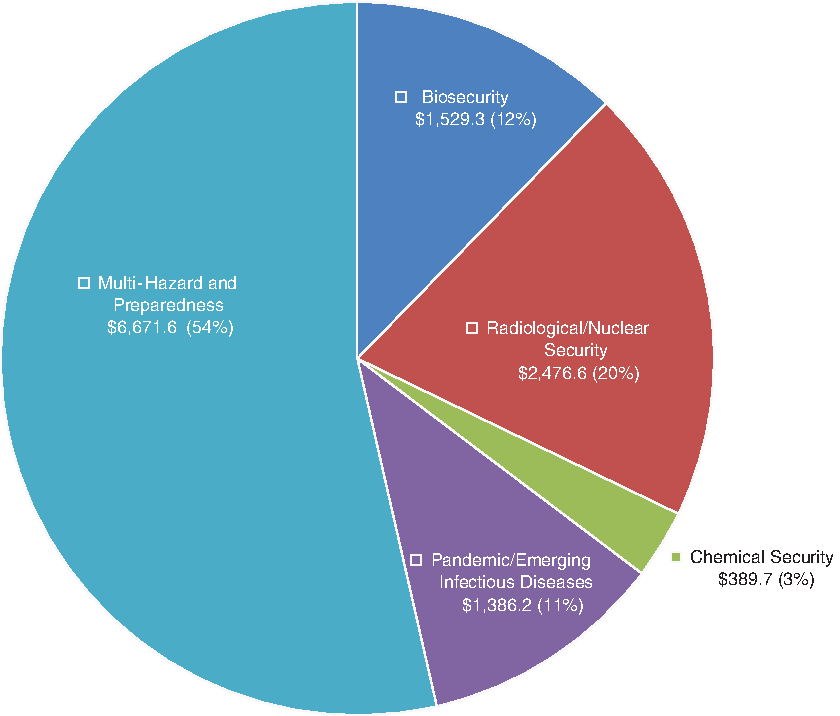
FY2018 Federal Health Security Funding by Program Focus (in $millions)

Percent Change in Health Security Funding Level by Category, FY2017 to FY2018
The authors recognize that this is not a perfect accounting of all of the federal health security work. Analysis of agency budgets and programs included in previous years resulted in a number of program additions and a few changes in the categorization of programs. As a result, funding totals for different areas of health security and agencies included may be difficult to compare with previous years' articles. However, funding comparisons can be made between fiscal years within this article.
Federal funding amounts were analyzed from FY2010 through proposed funding for FY2018, using information from FY2018 federal agency budget materials as well as budget documents from prior years. Sources for this analysis include federal agency “Budgets in Brief,” agency congressional budget justifications, and personal contacts with agency representatives to obtain and track program funding. For the purpose of this analysis, programs have been categorized according to whether they focus on biodefense, chemical hazards, radiological/nuclear hazards, pandemic influenza and emerging infectious diseases, or multiple-hazard and general preparedness. Programs have been categorized based on their major focus, as described in budget documents or on program websites. Summary tables for program funding in each category are provided in this article, with more detailed tables available online (see Supplemental material at www.liebertonline.com/hs/).
This analysis of federal health security budgets prioritizes programs supporting prevention, preparedness, and response, as well as related research efforts. Specifically, research programs that support either medical countermeasure (MCM) research and development (R&D) or threat/risk characterization efforts were included in the analysis. Prevention programs explicitly targeted at preventing large-scale accidents or terrorist attacks with chemical, biological, or radiological agents are also included. Finally, federal emergency preparedness and response programs are included if they focused on protecting the health of US citizens in large-scale health emergencies.
The analysis excluded programs focused on routine provision of health care, occupational health and safety, or warfare between nation states. In addition, the analysis excluded programs focused on protecting the warfighter with no stated or likely civilian applications now or in the future. Specific inclusion and exclusion criteria and methods applied to each domain are detailed in each respective section of this analysis.
Biosecurity Program Funding
This section focuses on funding for federal programs aimed at prevention, preparedness, response, recovery, and mitigation of deliberate biological threats against the US civilian population, and of accidental releases of biological threat agents from a laboratory. In total, the President's proposed budget includes $1.53 billion in FY2018 for programs solely devoted to civilian biodefense. The FY2018 proposed budget would represent a decrease of $91.8 million from estimated biodefense appropriations in FY2017 (see Table 1).
Federal Civilian Biosecurity Program Funding (in $millions)
Funds for CBP ATPL for agriculture inspection are provided by USDA from fees collected by APHIS.
Funding amounts for NBAF and PIADC for FY2016-FY2018 are approximate. Detail was lacking in the budget, so amounts were estimated based on the previous year's budget.
Amount for NBACC in FY2015 is approximate. Detail was lacking in the budget, so the amounts were calculated based on other totals.
The NSF Homeland Security Programs have been removed from the budget in FY2018. It is unclear what was spent on these programs in FY2016 and FY2017.
Methods
Programs included in this section are solely or primarily focused on civilian biodefense as described in budget documents or on program websites. There are many programs in the federal government that address biodefense as a portion of their mission, but they do not focus specifically on biodefense. These programs are excluded from this section and are instead included in this analysis under the heading of “multiple-hazard and preparedness” programs.
Funding by Federal Agency
Department of Defense (DoD)
The FY2018 DoD budget for biodefense programs with civilian applications totals $700.2 million. This total represents a slight reduction in funding of $3.3 million. The DoD budget includes funding for programs with civilian biodefense applications under the Defense Threat Reduction Agency (DTRA), the Defense Advanced Research Projects Agency (DARPA), the defense-wide Chemical and Biological Defense Program (CBDP), and the Defense Health Program at the Uniformed Services University of the Health Sciences (USUHS).
In FY2018, $172.8 million is budgeted for DTRA's Cooperative Biological Engagement Program (CBEP), a proposed decrease of $41.2 million in funding for this program from the FY2017 estimated level. The CBEP aims to prevent proliferation of biological weapons material and expertise, improve laboratory safety, and build public health capacity internationally in order to lower the threat of a biological weapons attack in the United States. 17
DARPA Biodefense Research, Development, Testing and Evaluation (RDT&E) programs with civilian applications total $124.0 million for FY2018, a proposed decrease of $26.5 million from FY2017 estimated funding. 18 DARPA programs focus on developing and applying cutting-edge science and technology to protect the warfighter and civilians from biological threats.
The CBDP budget for civilian-applicable programs includes a number of research initiatives, ranging from applied research to technology transition. In total, $400.4 million in funding has been proposed for CBDP biodefense programs with civilian applications, a proposed increase of $63.5 million from FY2017 levels. 19 Of note, investment in developing novel diagnostic technologies appears to be on a downward trajectory, year over year, whereas investments in biosurveillance platforms and systems appear to be increasing. Another notable feature of this year's budget is an increase of $30 million in the CBDP's Medical Biological Defense line item. A majority of that comes from an increase in funding for development of a recombinant botulinum toxin vaccine and nonclinical Ebola MCM efficiency studies.
Finally, the Biological Defense Directorate at the Naval Medical Research Center under the Defense Health Program RDT&E would receive $3 million, a proposed increase of $0.9 million from estimated FY2017 funding. 20 This organization develops and deploys rapid diagnostic technologies for the identification and characterization of threat agents such as anthrax and Ebola.
Department of Homeland Security (DHS)
The FY2018 DHS budget includes $562.3 million in proposed civilian biodefense program funding, which is a decrease of $73.5 million from FY2017 estimates. This year's analysis includes programs in the Office of Health Affairs (OHA), Customs and Border Protection (CBP), and the Science and Technology Directorate (S&T). Of note, the President's budget request eliminates funding for the National Biodefense Analysis and Countermeasures Center (NBACC), a unique federal laboratory located in Frederick, MD, that conducts biodefense research. NBACC houses both the National Biological Threat Characterization Center and the National Bioforensic Analysis Center. Funding for the National Biosurveillance Integration Center (NBIC) is also eliminated. 21
Department of Health and Human Services (HHS)
In FY2018, the proposed HHS budget specific to civilian biodefense programs would remain flat at $266.8 million. All biodefense programs included in this year's analysis are located in the FDA's Bioterrorism portfolio, including Food Defense ($217.5 million), the Advancing Medical Countermeasures Initiative (MCMi) ($24.6 million), Physical Security ($7.0 million), and operationalizing the Life Sciences and Biodefense Lab ($17.7 million). Other programs at HHS that have biodefense as a goal, including those at the Centers for Disease Control and Prevention (CDC), the National Institutes of Health (NIH), and the office of the Assistant Secretary for Preparedness and Response (ASPR), are included in the “multiple-hazard and general preparedness” section of this analysis because they do not focus solely and specifically on biodefense.22-24
National Science Foundation (NSF)
The National Science Foundation's FY2018 budget request does not include its Homeland Security Activities: Research to Combat Bioterrorism line item, which indicates it may have been cut. 25
Radiological/Nuclear Security Program Funding
Programs included in this section of the analysis focus on prevention, preparedness, and consequence management of terrorist and accidental radiological and nuclear incidents. Proposed federal funding for radiological and nuclear programs totals $2.48 billion for FY2018. This level of proposed funding is slightly reduced from the previous 2 years (see Table 2).
Federal Civilian Radiological/Nuclear Security Program Funding (in $millions)
The Nuclear Counterterrorism Incident Response Program and the Counterterrorism and Counterproliferation Programs were transferred from the Weapons
Activities appropriation to the NNSA Defense Nuclear Nonproliferation appropriation starting in FY2016.
Has offsetting collection authority.
Methods
Budget documents and program websites were reviewed to determine if programs were solely or primarily focused on radiological/nuclear hazards. Focus areas included domestic preparedness and response, international threat reduction, non-state nonproliferation, and counterterrorism activities. US nuclear stockpile stewardship, state level nonproliferation, and missile defense programs were not included in the analysis.
Funding by Federal Agency
Department of Energy (DOE)
The National Nuclear Security Administration's (NNSA) mission includes response to nuclear and radiological emergencies, and NNSA houses all of the programs from DOE that are included in this analysis. For FY2018, the total proposed budget in DOE for included radiological and nuclear programs is $1.8 billion, which is slightly lower than FY2017 and FY2016 funding levels. This total includes an 8% increase for Defense Nuclear Nonproliferation ($446.1 million funding level), a 6% increase for Material Management and Minimization ($332.1 million), and a 20% increase for Nuclear Counterterrorism and Incident Response ($277.4 million). Two programs would see large decreases in funding: Global Material Security (−20%; $337.1 million) and Nonproliferation Construction (−17%; $279 million). Both of these programs have applications in reducing global nuclear security threats, such as restricting access to radiological material that could be used in an attack on the United States. Funding for Nonproliferation and Arms Control would remain essentially flat ($129.7 million). 26
Department of Homeland Security
In the FY2018 budget, there are 2 programs in DHS that are solely or primarily focused on radiological and nuclear security: the Domestic Nuclear Detection Office (DNDO) and FEMA's Radiological Emergency Preparedness Program (REPP). Together, funding for these programs would be reduced by $19.8 million; they would be funded for a total of $338.6 million. DNDO would see a 5% reduction and would be funded at $303.5 million, and REPP would remain flat at $35.1 million. Funding for DHS S&T's Radiological/Nuclear Response and Recovery Program, which supported planning, training, and exercises for responding to and recovering from the detonation of a radiological dispersal device or improvised nuclear device, would be eliminated. 21
Department of Defense
Proposed funding in DoD for civilian-applicable radiological and nuclear programs would remain essentially flat at $194.5 million. There are many programs in DoD that have radiological and nuclear defense missions, many of which are primarily focused on the warfighter or are broadly focused on the joint CBRNE defense mission. Programs focused solely on the warfighter without stated or likely applications for civilian defense are excluded from this section's analysis. Programs with a CBRNE focus, which include radiological and nuclear (RN) components, are represented in the “multiple-hazard and preparedness” programs section when RN components could not be parsed out. Included programs are housed in a range of agencies such as DARPA, 18 DTRA,17,27 CBDP, 19 and the Defense Health Program. 20 Funding for these programs remains relatively steady.
Department of State
FY2018 funding for the 2 included radiological and nuclear programs at the Department of State would see a slight increase of $3.7 million to $97.9 million in the FY2018 budget. The International Atomic Energy Agency (IAEA) Voluntary Contribution would total $91.9 million, a $3.9 million increase. The Weapons of Mass Destruction Terrorism Program, which focuses specifically on countering nuclear smuggling and nuclear terrorism, would see a slight reduction from $6.2 million in FY2017 to $6 million in FY2018. A number of additional programs at the Department of State, which include radiological and nuclear defense missions, were included in the “multiple-hazard and general preparedness” section of this analysis. Other programs related to radiological and nuclear defense focused on nonproliferation at the nation-state level and were therefore excluded from this analysis. 28
Environmental Protection Agency (EPA)
Of the 2 existing programs focusing on radiological and nuclear security at the EPA, one would see a significant cut and the other would be eliminated entirely in the FY2018 budget, reducing funding levels by 70% to $5.6 million. Funding for Radiation Response Preparedness, which supports planning and training for radiation emergency response activities, would be reduced by 11% to $5.6 million. Funding for Radiation Protection, which is responsible for developing and determining methods to measure radioactive releases and exposures, would be eliminated. 29
Nuclear Regulatory Commission (NRC)
Radiological and nuclear defense programs in the NRC would be increased under the proposed FY2018 budget. The Homeland Security program would receive a 31% increase in funding to $22.4 million, and Event Response would be increased by 13% to $16.2 million. 30
Department of Health and Human Services
Radiological and nuclear defense related programs in HHS were difficult to separate from large line items and, as a result, are accounted for in the “multiple-hazards and general preparedness” section of this analysis.
Chemical Security Program Funding
The federal government supports a range of programs intended to prevent, prepare for, and respond to acute, potentially harmful chemical exposures, resulting either from a deliberate release of a chemical weapon (CW) or a deliberate or accidental release of a toxic industrial chemical (TIC). In FY2018, the President's budget includes $389.7 million for chemical defense programs, which is a $37.8 million (9%) reduction from FY2017 funding levels (see Table 3).
Federal Civilian Chemical Security Program Funding (in $millions)
This program was combined with Chemical Risk Review and Reduction as of FY2015.
OPCW and other United Nations–related contributions were under review at the time this article was written. No funding amount had yet been proposed in the FY2018 budget.
Funding for this program was subtracted from the CDC State and Local Preparedness and Response Capability in the Multi-Hazard and Preparedness Section. FY2018 is an estimate only because funding amounts were not available in the FY2018 budget.
Methods
Federal chemical defense programs were included in this section if they explicitly support basic research, prevention, and response capabilities for large-scale civilian exposures to either chemical weapons or toxic industrial chemicals. Research and development activities undertaken by the DoD were included because of their potential application to future civilian chemical defense capabilities, but advanced development of detection technologies was excluded unless there was a stated civilian/interagency application. Programs were also excluded if they focused primarily on environmental health or did not focus on preventing or responding to large-scale chemical releases.
Funding by Federal Agency
Department of Defense
The DoD has the highest proposed chemical defense budget in FY2018 at $202.1 million. This budget represents a slight increase of $7 million from the FY2017 estimate of $195.4 million. The agencies/offices primarily responsible for executing the civilian-applicable chemical defense mission in the DoD are DTRA for chemical weapons destruction; 27 CBDP for RDT&E of diagnostics, detection, therapeutics, and pretreatments; 19 and the Department of the Army for the Chemical Stockpile Emergency Preparedness Project. 31 Overall, the DoD chemical defense budget is largely dedicated to research, development, and acquisition of anti-chemical medical countermeasures and personal protective equipment.
Environmental Protection Agency
The EPA's budget for chemical defense programs in FY2018 is $102.8 million, which is a decrease of $11.3 million from the FY2017 estimate of $114.1 million. EPA's chemical defense portfolio includes the chemical risk review and reduction program, which works to manage the potential risks from toxic industrial chemicals; the Human Health Risk Assessment program, which conducts research on the potential health risks of chemical exposures; and the State and Local Prevention and Preparedness program, which is responsible for implementing the Improving Chemical Facility Safety and Security Executive Order. 29
Department of Homeland Security
Chemical defense programs at DHS are budgeted at $73.2 million in FY2018, down by $14 million from the FY2017 estimated total of $87.2 million. The majority of chemical program funding ($72.4 million) is being requested for the Infrastructure Security Compliance program in NPPD, which is intended to improve security at industrial facilities. 21 The President's budget request eliminates funding for all chemical defense programs at DHS S&T, including Chemical Threat Assessment, R&D for multifunction detectors, and the Chemical Forensics program.
Department of State
At the time of writing, the US contribution to the Organisation for the Prohibition of Chemical Weapons (OPCW), which is the implementing agency for the Chemical Weapons Convention, was under review at the State Department. No funding amount had yet been proposed in the FY2018 budget. The United States has historically contributed in the range of $20 million per year to supporting the OPCW. 28
Department of Health and Human Services
In FY2018, $11.6 million is budgeted for the Chemical Laboratories program, which is intended to enhance laboratory preparedness for chemical threats. Funding has been steady for this program for the past several years. 33 Not included in this year's analysis of chemical security programs is the NIH's CounterACT program, which supports basic research into the pathology and treatment of toxic chemical exposures. The CounterACT program is instead included under the “multiple-hazard and general preparedness section,” because the NIH budget combines research funding for radiological, nuclear, and chemical countermeasures into 1 budget line item.34,35
Pandemic Influenza and Emerging Infectious Diseases Program Funding
Programs included in this section of the analysis are aimed at prevention, preparedness, response, recovery, and mitigation of pandemic influenza and emerging infectious diseases (EID) with destabilizing potential. In FY2018, proposed funding for pandemic and emerging infectious disease programs is $1.39 billion, which represents an increase of $42.1 million (see Table 4).
Federal Civilian Pandemic Influenza and Emerging Infectious Diseases Program Funding (in $millions)
Starting in FY2014, the Global Disease Detection and Emergency Response program and the GHSA are now located under Global Public Health Protection.
Funding for Global Health Security at USAID would not be new money in FY2018, but reprogrammed money from previously appropriated Ebola emergency funds.
Methods
Programs included in this section of the analysis were limited to those with a focus on pandemic influenza preparedness and response, newly emerging or re-emerging infectious diseases with potentially destabilizing effects (such as dengue), and antimicrobial resistance. Emerging infectious disease was defined, following NIH convention, as including “infectious diseases that have newly appeared in a population or have existed but are rapidly increasing in incidence or geographic range, or that are caused by one of the [HHS] Category A, B, or C priority pathogens.” 36 This analysis excluded programs focused on established infectious diseases that have their own funding streams, such as HIV, TB, and malaria, and chronic diseases. This section does not reflect the emergency funding for Ebola response in 2014 and 2015, which can be found in previous analyses. 13
Funding by Federal Agency
Department of Health and Human Services
The majority of federal programs dedicated to pandemic influenza and emerging infectious diseases are located in HHS. Proposed FY2018 funding for these programs totals $1.24 billion, an increase of $20.7 million from estimated FY2017 funding.
In the CDC, Emerging and Zoonotic Infectious Disease programs are budgeted to receive $514 million, a decrease of 11% from FY2018. The CDC Global Public Health Protection program, which includes Global Disease Detection, monitors outbreaks, and maintains response teams, would be reduced by 9% to $50 million. Influenza Planning and Response, which supports influenza prevention, detection, and monitoring activities, as well as pandemic planning and response, would see a 5% increase in funding and is budgeted to receive $180 million. 35
Pandemic Influenza at ASPR is budgeted to receive a large increase in funding, rising from $67.9 million in FY2017 to a proposed $202.9 million in FY2018. This increase would support “the sustainment of critical domestic influenza vaccine manufacturing facility infrastructure; ensure pandemic influenza vaccine production requirements; and maintain overall domestic pandemic readiness.” 37 At the NIH, funding for influenza research is proposed at $215.0 million, an 18% reduction from the FY2017 funding level. 38 Included programs at the FDA would both see reductions, with $34.1 million in funding budgeted for Pandemic Influenza, and $42.4 million budgeted for Antimicrobial Resistance. 23 Finally, funding for International Pandemic Influenza Activities in the Office of Global Affairs, which supports “global health diplomacy in international pandemic preparedness and response,” would remain flat at $4.0 million for FY2018. 37
US Agency for International Development (USAID)
FY2018 funding for the Global Health Security program (formerly the Pandemic Influenza and Other Emerging Threats [PIOET] program) at USAID would remain flat at $72.5 million. This program works to reduce threats to human health by improving early identification of and responses to dangerous infectious disease outbreaks in humans and animals before they emerge as major infectious disease events. 28
Department of Defense
Proposed FY2018 funding for DoD programs that focus on pandemic influenza and emerging infectious diseases totals $71.3 million, a 43% increase from FY2017 levels. The Combating Antibiotic Resistant Bacteria program in the Defense Health Program would be funded at $2.9 million in FY2018, a slight reduction from the FY2017 level. 20 DARPA includes several programs that help combat pandemic influenza and emerging infectious diseases, including Analysis and Adaptation of Human Resilience ($16.9 million), Outpacing Infectious Disease ($16.5 million), and Enhanced Monitoring of Health and Disease ($11.3 million). Two programs would be added: Predicting Disease Transmission from Animal Carriers ($9.8 million) and Pandemic Prevention ($13.9 million). One DARPA program, Harnessing Biological Systems, would be eliminated. 18
Multiple-Hazard and Preparedness Program Funding
This section is focused on federal programs aimed at prevention, preparedness, response, recovery, and mitigation of multiple types of hazards and programs that aim to build preparedness and response systems for large-scale health events generally. Total proposed funding for multiple-hazard and preparedness programs in FY2018 is $6.67 billion. Compared with estimated funding for FY2017, this year's budget represents a 14% decrease in funding (–$1.11 billion). This proposed decrease is largely due to funding reductions at HHS, DHS, State, EPA, and NSF (see Table 5).
Federal Civilian Multiple-Hazard and Preparedness Program Funding (in $millions)
Funding amounts for LRN-C for FY2013-FY2018 have been subtracted from the total for State and Local Preparedness and Response. These annual amounts are represented in the chemical program section.
The funding level for the Office of Chemical and Biological Weapons Affairs was not included in the FY2018 budget. However, in personal communication, the Office's representatives presume flat funding.
The funding levels for the Directorate of Operational Medicine are estimates only for years prior to FY2018.
Methods
Programs included in this section have a focus on multiple-hazards, have general preparedness and response goals, and/or are targeted at building infrastructure and capacity to respond to large-scale domestic health threats of many types and causes. Examples of programs that are included in this section are those aimed at a combination of chemical, biological, radiological, and nuclear threats (CBRN) or weapons of mass destruction (WMD) preparedness and response; programs aimed at building public health, medical, or emergency management capacity to respond to large-scale health emergencies; and basic infectious disease research programs, the results of which may have implications for a multitude of emerging infectious diseases.
Funding by Federal Agency
Department of Health and Human Services
Total FY2018 HHS funding for multiple-hazard and preparedness programs is proposed at $4.12 billion. This represents a reduction in funding of $591.1 million (−13%) compared to the FY2017 estimate. The largest proportion of multiple-hazard and preparedness funding in HHS is provided for Biodefense and Emerging Infectious Disease Research ($1.37 billion) in the NIH. 38 This funding level is 10% below the FY2017 estimate. Nuclear/Radiological/Chemical Countermeasures Research at NIH would also be reduced by $74.4 million, 20% lower than the FY2017 estimate. 35
CDC program funding under this heading would be reduced overall by 10%. The State and Local Preparedness and Response Capability ($539.4 million, including the Public Health Emergency Preparedness (PHEP) cooperative agreements) would be reduced by 18% compared to FY2017. If funded at this level, the State and Local Preparedness and Response Capability program will have been reduced by 43% since its funding high in FY2002.1,33 The CDC Preparedness and Response Capability ($140 million), which includes funding for CDC's emergency operations center and the BioSense surveillance program, would receive a 13% reduction. Finally, the Strategic National Stockpile program ($575 million) would remain flat compared to FY2017. 33
Multiple-hazard and preparedness funding in ASPR would see a 2% decrease under the proposed FY2018 budget due to a reduction in funding by $26.9 million (−11%) to the Hospital Preparedness Grant Program (HPP). Similar to the CDC PHEP program, this proposed FY2018 HPP funding level would represent a large cumulative reduction to the program of 56% since HPP's funding high in FY2003.1,37 Funding for other programs in ASPR, including Project BioShield (which supports the procurement of medical countermeasures against chemical, biological, radiological, and nuclear threats) and the Biomedical Advanced Research and Development Authority (BARDA), would remain steady. 37
Department of Homeland Security
The DHS budget for FY2018 includes approximately $1.34 billion in funding for programs focused on multiple-hazards and preparedness related to health security. This represents a significant proposed decrease in funding of $405.6 million (−23%) compared with the FY2017 estimated level of $1.75 billion. In DHS, the largest proportion of funding in this category falls under FEMA, totaling $1.28 billion proposed for FY2018. This FEMA budget represents a $434 million reduction from FY2017, coming largely from preparedness and protection grant programs. These proposed grant program cuts include a $116.7 million reduction to the State Homeland Security Grant Program, a $150 million reduction to the Urban Area Security Initiative (UASI), $52.2 million in reductions to both the Transit Security and Port Security Grant Programs, and proposed elimination of the Countering Violent Extremism program (–$49.5 million). 21
The Integrated Terrorism Risk Assessment (ITRA) program would receive level funding at $2 million, but would take on the responsibility of the Chemical Terrorism Risk Assessment (CTRA) program, which would be zeroed out in FY2018. Exercises, Training, Ops Plans and Policy; Intelligence, Information Sharing, and Situation Awareness funding; and Medical Countermeasures programs would also remain level. OHA would add a new program on Medical Readiness with funding starting in FY2016. Finally, the Container Security Initiative in Customs and Border Protection would receive an increase in funding to $51.4 million from $18.9 million in FY2017, but would be approximately level when compared to FY2016. 21
Department of Defense
Multiple-hazard and preparedness programs in the DoD include those that support WMD and CBRN threat prevention, preparedness, and response. The Army National Guard CBRNE Enterprise, which includes WMD civil support teams that support first responders with identification, assessment, and advice in the event of a domestic CBRNE incident, and CBRNE capabilities to support the teams, would receive $173.5 million under the proposed FY2018 budget. 39
DTRA's multiple-hazard and preparedness programs include the Cooperative Threat Reduction (CTR) Program, which works to reduce WMD proliferation from the former Soviet Union and other regions; 17 international nonproliferation programs; and WMD-focused research and development. 27 In total, these programs would receive $266.0 million under the proposed FY2018 budget, an increase of $43.1 million mostly due to additional funding for Proliferation Prevention, but somewhat offset by a funding decrease for the USSTRATCOM Center for Combating WMD group, which would be transferred in part to the US Special Operations Command (USSOCOM) and is zeroed out in this year's budget. DARPA's Biological Warfare Defense Program, which focuses on a range of threats including CBRN, would receive $0, a decrease in funding of $7.1 million from estimated FY2017 amounts. 18 Multiple-hazard research in CBDP would receive an increase of $20 million for a total of $164.9 million in the proposed FY2018 budget. 19
Department of State
Proposed funding for multiple-hazard and preparedness programs in the Department of State would be reduced by $26.1 million in FY2018 for a total of $189.0 million. The Office of Chemical and Biological Weapons Affairs in Arms Control, Verification, and Compliance would likely receive steady funding ($2 million) in FY2018 (however, this could not be confirmed), as would the International Security and Nonproliferation office (ISN) ($42.2 million). 24 However, 2 of the 3 programs in State's Nonproliferation, Anti-Terrorism, Demining and Related Programs (NADRP) would receive funding reductions in this year's proposed budget: The Nonproliferation and Disarmament Fund would decrease by 83% ($25 million) for a total of $5 million; Export Control and Related Border Security Assistance funding would decrease by $15.3 million to $59.7 million; and the Global Threat Reduction program under NADRP would receive a slight increase of $4.9 million in FY2018. 28
Environmental Protection Agency
Proposed funding in the EPA for multiple-hazard and preparedness programs totals $209.2 million for FY2018, a decrease of 25% from the FY2017 estimated level. Funding reductions to EPA's Homeland Security programs include a $22.1 million cut to Preparedness, Response, and Recovery, and complete elimination of the Critical Infrastructure Protection program. In addition, Emergency Response and Removal, under the Superfund program, would also receive a significant cut of $33.8 million. These programs all play a role in EPA's CBR preparedness and response to environmental contamination emergencies with impacts on human health. 32
Department of Justice (DoJ)
This multiple-hazard and preparedness analysis includes the National Security Division of DoJ. Under the proposed FY2018 budget, funding for this program would receive a small increase of $6.2 million for a total of $101.0 million. 40
National Science Foundation (NSF)
Two programs in NSF Homeland Security activities have been included in this section of the analysis in past years: Counterterrorism and Emergency Planning and Response. However, neither of these programs was included in the FY2018 budget, nor were any other programs under the NSF Homeland Security Heading. Thus, funding amounts for these programs could not be verified or included this year. 25
Department of Commerce (DoC)
Multiple-hazard and preparedness programs in the Department of Commerce are located in the Bureau of Industry and Security (BIS) Export Administration. Proposed funding for these programs in FY2018 would total $56.9 million, a small decrease of $1.7 million below FY2017. 41
US Department of Agriculture (USDA)
Funding for USDA programs related to multiple-hazards and preparedness would remain relatively steady at $52.4 million in FY2018. USDA programs include the Food Safety and Inspection Service's (FSIS) Public Health Data Communication Infrastructure System, the Office of Homeland Security and Emergency Coordination, and the Animal and Plant Health Inspection Service (APHIS) program for Emergency Management. 42
Department of Veterans Affairs (VA)
The Emerging Pathogens/Bioterrorism program in the VA would receive $1 million in the proposed FY2018 budget, representing flat funding from FY2016 and FY2017. 43
Conclusions
Federal funding for health security programs dedicated to civilian biological, radiological and nuclear, and chemical defense; pandemic influenza and emerging infectious diseases; and multiple-hazard and preparedness is budgeted at $12.45 billion for FY2018. This proposed funding level represents a significant budget decrease for health security programs of $1.25 billion (−9%) compared to FY2017, and a proposed decrease of 11% compared to FY2016 actual funding. Of the total proposed health security funding for FY2018, a majority of funding (54% or $6.67 billion) would go to multiple-hazard and preparedness programs dedicated to building systems that can protect the country from a variety of threats to health. While this multiple-hazard and preparedness funding is the largest proportion of health security program funding, it also is scheduled to receive the biggest funding cut ($1.11 billion or 14%) in FY2017. Radiological/nuclear security programs would receive about 20% ($2.48 billion) of health security program funds in FY2018, which would represent a decrease in funding of 2%. Biosecurity programs comprise around 12% ($1.53 billion) of the overall health security budget in FY2018, again a decrease in funding of $91.8 million (6%) from FY2017. Programs dedicated to chemical incident prevention, preparedness, and response would receive 3% ($389.7 million) of the health security funding total this year, a decrease in funding of $37.9 million (−9%) from FY2017. Finally, the only category to receive a funding increase in FY2018 would be pandemic influenza and emerging infectious diseases programs, which contribute about 11% ($1.39 billion) to the health security budget, an increase of $42.1 million (3%) above FY2017.
References
Supplementary Material
Please find the following supplemental material available below.
For Open Access articles published under a Creative Commons License, all supplemental material carries the same license as the article it is associated with.
For non-Open Access articles published, all supplemental material carries a non-exclusive license, and permission requests for re-use of supplemental material or any part of supplemental material shall be sent directly to the copyright owner as specified in the copyright notice associated with the article.
